
Quick answer
Tradition lists favourable times for starting treatment, but surgeons, anaesthetists and obstetricians decide when an operation or caesarean happens, and medical care is never delayed for a muhurat. A caesarean should not be timed to produce a chosen birth chart. Families add prayer, a sankalpa or a Mahamrityunjaya jaap alongside the medical plan.
Is there such a thing as a surgery muhurat?
A surgery muhurat is a traditional idea that an operation or a course of treatment should begin at a favourable time, chosen from the panchang the way a wedding or a house entry is. The classical texts do discuss auspicious times for starting medicine, and many Indian families still ask about it when a parent or child needs an operation. This page explains what the tradition says, and then why, in every real decision, the doctors decide.
That second part is not a reluctant disclaimer. It is the position Master Vijay Ram takes in every consultation: medical care is never delayed, rearranged or second-guessed for astrology, and a muhurat consultation for anything health-related works only inside the dates the medical team has already given.
Why must doctors decide the date and time?
Because the timing of an operation is itself a clinical decision, which is why operation date astrology has so little room to work. Surgeons and anaesthetists weigh how urgent the condition is, the results of tests, whether medicines need to be stopped beforehand, the availability of a theatre, a specialist and an intensive-care bed, and the patient's own fitness for an anaesthetic. A date that looks arbitrary from outside usually has reasons behind it that the family cannot see.
Public hospitals also schedule elective surgery by urgency category, and asking to move a booked date can mean waiting much longer for the next one. For an urgent or emergency operation there is no choice at all, and the only right response is to let the team do its work; the Rahu kaal and other avoided periods simply do not apply to it.
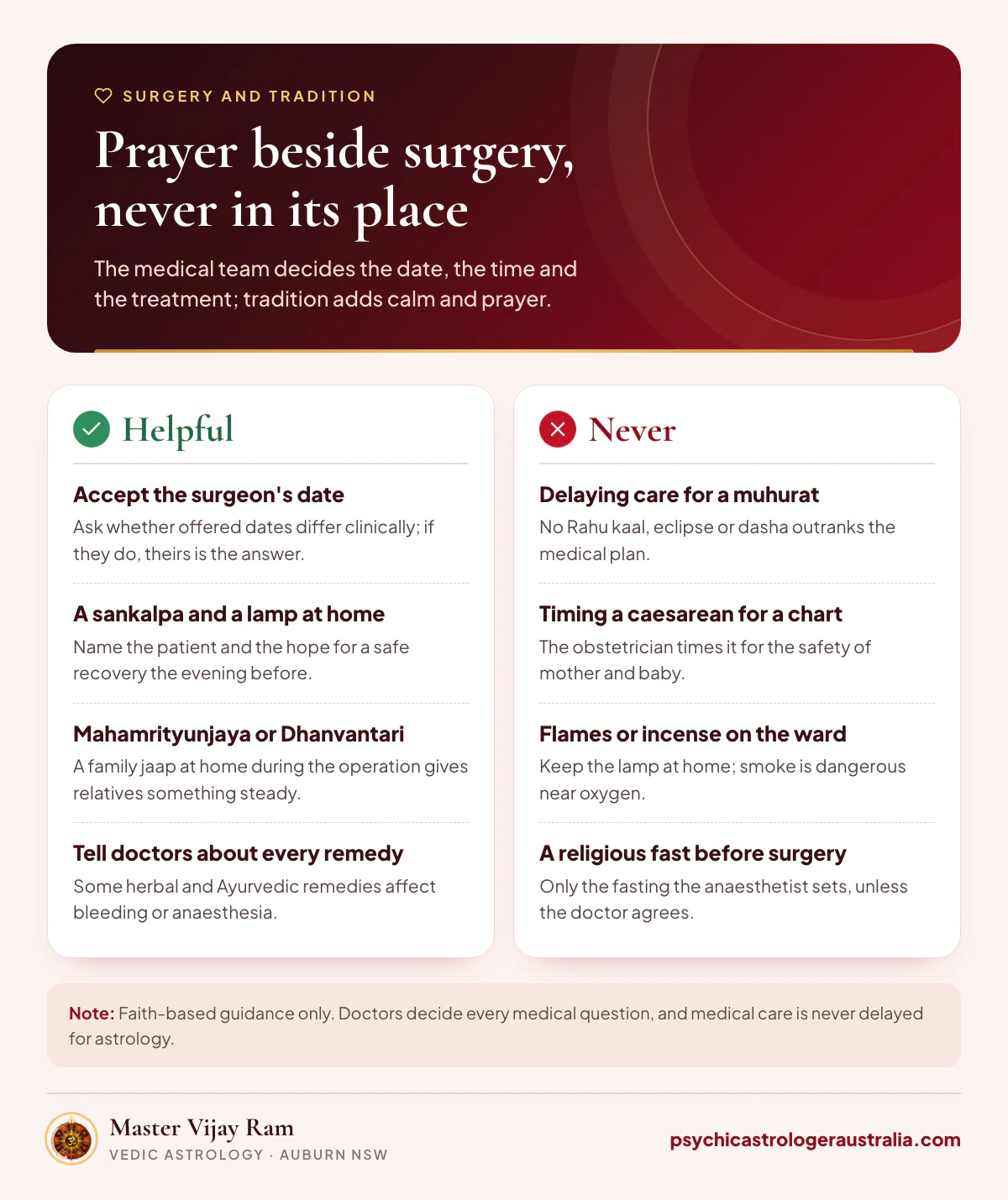
So the rule is simple. Never delay, refuse or reschedule medical care for a muhurat, a Rahu kaal, an eclipse, a retrograde or a difficult dasha. If you feel strongly about a date, ask the surgeon whether there is any clinical difference between the options offered; if there is, theirs is the answer.
Should a caesarean be timed for a good birth chart?
No, and this is the question that matters most on this page. Some families ask an astrologer to choose the minute of a planned caesarean so that the baby is born with a particular lagna or nakshatra, and some even ask the obstetrician to bring the operation forward. Medical guidance discourages scheduling a birth for non-medical reasons, and a planned caesarean is timed by the obstetrician for the safety of the mother and the baby, including how mature the baby's lungs are likely to be.
The tradition does not support it either. Vedic astrology reads the moment a child arrives as part of that child's own karma, not as a setting for parents to choose, and a chart engineered by appointment is not the chart the tradition is describing. Master Vijay Ram declines every request for a caesarean muhurat of that kind, and recommends that families accept the date and time their obstetrician gives.
If the birth happens by emergency caesarean, or labour begins before the booked day, nothing has gone wrong in astrological terms. The child's chart is simply the moment the child came, and naming and the newborn kundli proceed from that.
What does the tradition actually say about timing treatment?
Classical muhurta texts list nakshatras considered favourable for beginning medicine and treatment, among them Ashwini, ruled by the twin physicians of the gods, along with Pushya, Hasta and some others; lists vary between texts. They also advise avoiding the rikta tithis and the Rahu kaal for starting a course of medicine where there is genuine freedom to choose.
Those rules were written for a world in which treatment meant herbs and diet started at home on a day the family chose. They translate sensibly only to the small decisions still in a family's hands today, and never to the scheduling of surgery, chemotherapy or a hospital admission.
| Situation | Who decides | What tradition can add |
|---|---|---|
| Emergency surgery or emergency caesarean | The medical team, immediately | Prayer by the family while the team works |
| Booked elective surgery | Surgeon, anaesthetist and hospital | A sankalpa and a lamp at home the evening before |
| Planned caesarean | The obstetrician, on medical grounds | Prayer for mother and baby; no choosing of the minute |
| Two clinically equal dates offered | The patient, after the surgeon confirms they are equal | A consultation may suggest one of the two |
| Recovery at home | GP and treating team | Mantra, a gentle daily routine, a donation of thanks |
When can a family genuinely choose between dates?
Occasionally a surgeon offers two or three dates for a non-urgent procedure and says there is no clinical difference between them. In that narrow case, and only after the surgeon has confirmed it, a family that cares about the panchang can ask which of those dates is better, and a consultation answers within that list. It never adds a fourth date or asks for a postponement.
The same goes for small things in your control: the day you begin a physiotherapy routine, the day you start a diet the dietitian has set, the morning you leave home for the hospital. Those can be placed in a good window if it brings peace of mind, and none of them changes anything the doctors have decided.
How can prayer sit alongside medical care?
Quietly, and in ways that make the patient calmer rather than more frightened. Many families make a sankalpa the evening before, naming the patient, the operation and the hope for a safe recovery; light a lamp at home; and recite the Mahamrityunjaya mantra, from Rigveda 7.59.12, addressed to the three-eyed Shiva, or prayers to Dhanvantari, the physician of the gods. Others read the Hanuman Chalisa while they wait.
A family can keep a jaap going at home during the hours of the operation, which gives anxious relatives something steady to do. Where a family wants a formal puja or jaap performed, Master Vijay Ram does it personally at his place of practice in Auburn on a chosen muhurat, the family joining by video if they wish; a puja or jaap for recovery starts from $250, agreed before it is performed.
What hospital practicalities should families know?
- No flames, incense or camphor on the ward: hospitals do not allow them, and smoke is dangerous near oxygen. Keep the lamp at home.
- Threads, rings, bangles and other jewellery may have to come off before theatre for safety and hygiene; ask the nurses, and a family member can keep them.
- Fasting before surgery is set by the anaesthetist. Do not add a religious fast around an operation without the doctor's agreement.
- Tell the doctors about every herbal, Ayurvedic or home remedy the patient takes, because some affect bleeding or anaesthesia.
- Many hospitals have pastoral care or multifaith chaplaincy and a quiet room for prayer; ask the ward.
After discharge, coming home after a hospital stay covers a gentle household routine for the recovery weeks.
What does the chart say about surgery and health?
Traditionally the sixth house is read for illness and its treatment, the eighth for operations and sudden events, and Mars for cuts, surgery and surgeons. A reading can describe periods that call for extra care and can help a family think about timing in a broad sense, such as which months suit a non-urgent recovery away from work. Health and wellbeing readings explain how he approaches those questions without alarm.
A chart cannot diagnose anything, predict the result of an operation or say whether a treatment will work. Anyone who claims it can, or who says an operation must be moved to avoid disaster, is overreaching, and families should walk away from that advice.
What about pregnancy and birth more generally?
Pregnancy brings its own wave of family advice, from what to eat to which day to deliver. Everything medical belongs with the midwife, the GP and the obstetrician; Pregnancy, Birth and Baby and PANDA support parents through the worries that come with it. The household customs of protection, such as those in nazar and pregnancy, sit beside that care and never instead of it.
When the baby arrives, by whatever route and at whatever minute, the family can turn to the naming and the newborn chart with nothing to regret about the timing.
What should a frightened family do first?
Ask the medical team every question you have, write the answers down and bring a second person to appointments. Fear makes people look for certainty, and astrology cannot give certainty about an operation; the surgeon's explanation of risks and recovery is the most reliable information there is. Lifeline on 13 11 14 and Beyond Blue are there for relatives who are struggling while they wait, and when to see a doctor first explains where a reading fits when worry takes over.
Families in the regions, in Townsville, Cairns, Darwin or Geelong, often face travel to a bigger hospital as well. The Townsville astrology page explains how phone and video consultations work from North Queensland.
How does Master Vijay Ram help, and what can he not do?
He offers a $50 consultation by phone, video or WhatsApp, in English, Hindi or Punjabi, to talk through the family's worries, suggest prayers and, where the surgeon has offered clinically equal dates, say which suits the patient's chart. He will not choose a caesarean minute, advise anyone to move an operation, or comment on a diagnosis or treatment.
Prayer, mantra and a calm household are what the tradition offers alongside medicine. The doctors decide the date, the time and the treatment, and that is exactly as it should be.
Read next
- Holi 2027 in Australia: Date and Holika Dahan TimingHolika Dahan is Monday 22 March 2027 in every Australian city and Rangwali Holi is Tuesday 23 March; India is a day e…
- Ganesh Chaturthi 2027 in Australia: Date and Sthapana TimingGanesh Chaturthi 2027 is Saturday 4 September in Australia and India. Midday sthapana windows for Sydney, Melbourne, …
- Love Spell Cost, Timeline and What a Genuine Practitioner Says No ToWhat a love spell should and should not cost, why no honest practitioner fixes a date, and the requests a genuine one…
Frequently asked questions
Should I choose an auspicious date for my operation?
Only in the narrow case where your surgeon offers several dates and confirms there is no clinical difference between them. Otherwise accept the date the hospital gives. Never delay, refuse or reschedule surgery for astrology; the timing of an operation is a medical decision based on urgency, tests and the availability of the team.
Can astrology choose the time of a caesarean?
It should not. Medical guidance discourages scheduling a birth for non-medical reasons, and the obstetrician times a planned caesarean for the safety of mother and baby. The tradition itself reads the moment of birth as the child’s own karma, not a setting for parents to choose. Master Vijay Ram declines such requests and recommends accepting the obstetrician’s date.
What prayer is said before surgery?
Many families recite the Mahamrityunjaya mantra, from Rigveda 7.59.12, or pray to Dhanvantari, the physician of the gods, or read the Hanuman Chalisa. A sankalpa the evening before names the patient and the hope for a safe recovery. Prayer is kept at home or in the hospital’s quiet room, never with flames or incense on the ward.
Is it bad to have surgery during Rahu kaal or an eclipse?
No. Medical care goes ahead whatever the panchang says, and the tradition’s concern with Rahu kaal is for beginnings you choose freely. An operation set by a surgeon is not one of those. Pray if it helps you, and let the medical team do its work at the time they have chosen.
Can I wear a sacred thread during an operation?
Often it has to come off, along with rings, bangles and other jewellery, for safety and hygiene in theatre. Ask the nurses; a family member can keep the thread and it can be retied afterwards. The protection families associate with a thread does not depend on wearing it through surgery.
Should the patient fast for religious reasons before surgery?
Only the fasting the anaesthetist instructs. Adding a religious fast before or after an operation can affect blood sugar, fluids and recovery, so it needs the doctor’s agreement. A family member can keep a fast or a vow on the patient’s behalf instead, which many traditions accept.
Can a birth chart predict whether surgery will go well?
No. A chart is read for tendencies and periods needing care, through the sixth and eighth houses and Mars, but it cannot diagnose an illness or predict the result of an operation. The surgeon’s explanation of risks and recovery is the reliable information. Walk away from anyone who says an operation must be moved to avoid disaster.
Does Master Vijay Ram perform a puja for someone having surgery?
Yes, where a family asks. He performs the puja or a Mahamrityunjaya jaap personally at his place of practice in Auburn on a chosen muhurat, with the family joining by video if they wish, from $250 agreed before it is performed. It is prayer alongside medical care and never a substitute for it.
People also ask
Is there an auspicious time for surgery in Hindu astrology?
Classical texts list nakshatras such as Ashwini, Pushya and Hasta as favourable for beginning treatment and advise avoiding the Rahu kaal where there is free choice. Today that applies only to small decisions in a family’s hands; surgeons decide when operations happen, and medical care is never delayed for a muhurat.
Is it right to fix a C-section date by astrology?
No. The obstetrician times a planned caesarean on medical grounds, and scheduling birth for non-medical reasons is discouraged. Vedic tradition also treats the moment of birth as the child’s own, not something to engineer. Accept the medical date and pray for mother and baby.
Which mantra is chanted for a successful operation?
The Mahamrityunjaya mantra, addressed to Shiva as the three-eyed one, is the prayer most families choose for health and recovery, along with prayers to Dhanvantari and the Hanuman Chalisa. They are said for strength and calm, alongside the medical team’s work, not as a promise of any outcome.
What should be avoided before surgery in Hindu tradition?
Tradition-minded families avoid frightening talk around the patient and add prayer at home. The real things to avoid are medical: fasting the anaesthetist has not set, herbal or Ayurvedic remedies the doctors have not been told about, and any delay to the operation. Flames, camphor and incense are never taken onto a hospital ward.
References & further reading
Serving clients across Australia
Confidential consultations by phone, video & WhatsApp — including: