
Quick answer
Your Sun sign is where the Sun was at birth, your Moon sign where the Moon was, and your rising sign, the lagna, the sign rising in the east that minute. Western astrology leads with the Sun; Vedic astrology frames the chart from the lagna, reads the mind from the Moon, and its sidereal zodiac puts most signs one earlier than the Western ones.
What are the Sun sign, the Moon sign and the rising sign?
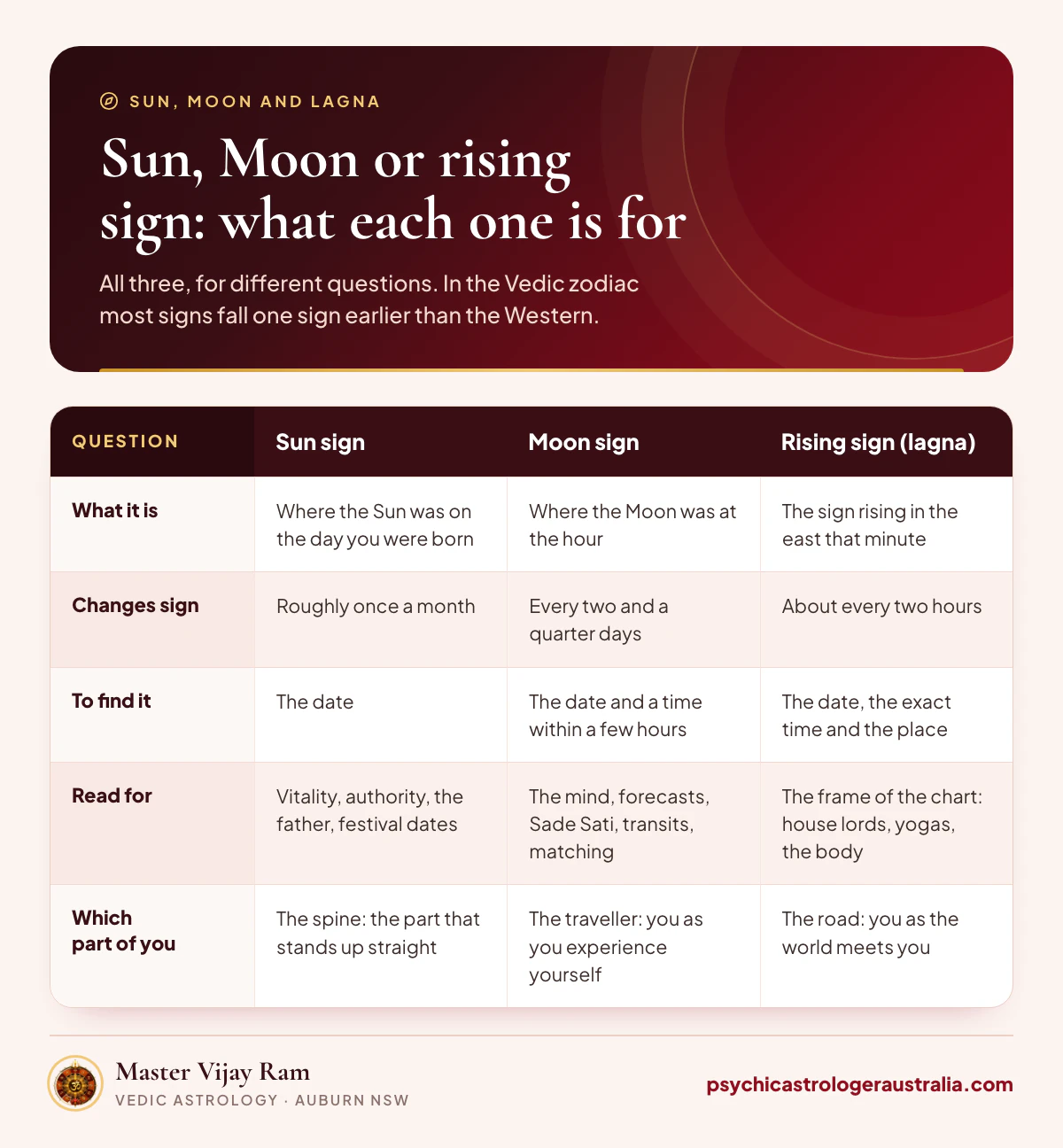
The Sun sign, Moon sign and rising sign are the three signs every birth chart is built on: the Sun sign is the zodiac sign the Sun occupied on the day you were born, the Moon sign is the sign the Moon occupied at the hour, and the rising sign, called the lagna in Vedic astrology, is the sign that was coming up over the eastern horizon at the minute and place of your birth. The Sun changes sign roughly once a month, the Moon every two and a quarter days, and the rising sign about every two hours, which is why the three ask for different amounts of information.
Western astrology, the astrology of newspaper columns and most apps, leads with the Sun sign and treats the other two as refinements. Vedic astrology does the reverse: it reads the chart from the lagna, names the person by the Moon sign and keeps the Sun for what the Sun governs. A kundli reading with Master Vijay Ram uses all three, each for its own purpose.
Why does Western astrology lead with the Sun and Vedic with the Moon and lagna?
The Sun sign became the headline in the twentieth century because it is the only one of the three a newspaper can print from a birthday alone, and the Western tradition had long read the Sun as the core of the self. Jyotish grew up as a timing system, and timing runs from the Moon: the Moon's nakshatra fixes the dasha, the Moon sign is where Saturn's Sade Sati and the yearly transits are counted from, and the Moon is the mind that experiences all of it. The lagna, meanwhile, is the frame of the whole chart, because every house is counted from it.
So a Vedic astrologer who asks for your sign means your Moon sign, and one who asks for your birth time wants your lagna. The big three are the same three signs in both traditions; the weight given to each is what differs.
Why your Vedic sign may be one sign earlier: the ayanamsa
Western astrology uses the tropical zodiac, which starts Aries at the March equinox; Vedic astrology uses the sidereal zodiac, which keeps Aries against the fixed stars. The two have drifted apart by about 24 degrees since they coincided, and the difference, the ayanamsa, stood at 24°14′ on 1 Jan 2027 by the Lahiri measure Master Vijay Ram uses. Subtract that from any Western position and you have the Vedic one, which is why about four people in five find their Vedic Sun sign is the sign before their Western one.
The table shows the 2027 dates for both zodiacs. A person born on 1 August is a Leo by the Western calendar, which begins Leo on 23 July 2027 in Sydney, and a Karka, Cancer, by the Vedic one, which does not begin Simha until 17 August 2027.
| Sign | Western (tropical) | Vedic (sidereal) |
|---|---|---|
| Aries / Mesha | 21 Mar – 19 Apr | 14 Apr – 14 May |
| Taurus / Vrishabha | 20 Apr – 20 May | 15 May – 14 Jun |
| Gemini / Mithuna | 21 May – 21 Jun | 15 Jun – 16 Jul |
| Cancer / Karka | 22 Jun – 22 Jul | 17 Jul – 16 Aug |
| Leo / Simha | 23 Jul – 22 Aug | 17 Aug – 16 Sep |
| Virgo / Kanya | 23 Aug – 22 Sep | 17 Sep – 17 Oct |
| Libra / Tula | 23 Sep – 23 Oct | 18 Oct – 16 Nov |
| Scorpio / Vrishchika | 24 Oct – 22 Nov | 17 Nov – 15 Dec |
| Sagittarius / Dhanu | 23 Nov – 21 Dec | 16 Dec – 14 Jan |
| Capricorn / Makara | 22 Dec – 19 Jan | 15 Jan – 12 Feb |
| Aquarius / Kumbha | 20 Jan – 18 Feb | 13 Feb – 14 Mar |
| Pisces / Meena | 19 Feb – 20 Mar | 15 Mar – 13 Apr |
Capricorn and Sagittarius run across the new year, so their ranges start in December 2026 or end in January 2028. Computed with the Swiss Ephemeris (Lahiri ayanamsa for Vedic positions) and checked against US Naval Observatory data. Times are rounded to the minute.
The same shift applies to the Moon and the rising sign, and it is the most common reason a person's app and their family astrologer disagree. Neither is wrong; they are measuring from different starting lines.
The rising sign: the one that needs a birth time
The lagna changes sign roughly every two hours, so it is the sign most sensitive to the recorded time and the one that cannot be found from a date alone. It governs the body, the temperament as others see it, the direction of the life and the frame from which every house, and therefore every lord, is counted. Two people born on the same day with different lagnas have different house lords, different yogas and different dashas in meaning, which is why a Vedic reading without a birth time is a reading from the Moon with the lagna missing.
Lagna explained goes through the twelve rising signs; the rising sign vs Moon sign question usually resolves into the lagna for the path and the Moon for the person walking it.
The Moon sign: the one a Vedic reading is named for
The Moon sign, the rashi, is the sign most Vedic astrology is organised around. Yearly forecasts, Sade Sati, Dhaiya, the monthly transits, marriage matching by gun milan and the nakshatra that starts the dasha are all counted from it. It describes the mind, the emotional nature, the mother and what a person needs in order to feel settled, and the Moon in the twelve houses shows how the house it falls in shapes that. Finding your Moon sign is a page of its own.
The Sun sign: what it means in Jyotish
The Sun in Jyotish is the soul, the father, authority, vitality, the bones and the eyes, and the Sun's sign and house describe how a person carries dignity and deals with those in charge. A strong Sun in Aries, Leo or the tenth house gives confidence and a straight back; a Sun in Libra, its sign of debilitation, or in the twelfth, gives a person who leads quietly or avoids the front of the room. It matters a great deal for health and for the relationship with the father; it simply is not the headline.
Hindu festivals, too, run from the Sun's sidereal signs: Makar Sankranti is the Sun's entry into Makara, which falls on 15 January 2027 in Sydney time and 14 January 2027 in India.
Which one is you?
All three, for different questions, and the table is the short answer. The lagna is you as the world meets you and the road you walk; the Moon is you as you experience yourself; the Sun is the part of you that stands up straight when it has to. A person with a Scorpio lagna, a Cancer Moon and a Leo Sun is reserved on first meeting, soft at home and formidable when a parent or a job is threatened, and all three are true.
| Question | Sign used | Why |
|---|---|---|
| The frame of the chart, house lords, yogas | Rising sign (lagna) | Every house is counted from it |
| Temperament, mind, emotional needs | Moon sign | The Moon is the mind in Jyotish |
| Yearly forecast, Sade Sati, transits | Moon sign | Transits are counted from the Moon |
| Dasha, the timing of the life | Moon's nakshatra | The birth nakshatra starts the cycle |
| Marriage matching (gun milan) | Moon sign and nakshatra | The eight kootas are Moon-based |
| Vitality, authority, the father, the bones | Sun sign and house | The Sun is the soul and the father |
| Festival dates, Sankranti | Sun's sidereal sign | Solar months run from the Sun |
| Health timing, body | Lagna with the Moon | The first house is the body |
How do you find each of the three?
The Sun sign needs only the date, though a birth within a day of the Sun's change of sign needs the time as well. The Moon sign needs the date and a time to within a few hours, and on the one day in two and a quarter when the Moon changes sign it needs the exact time. The rising sign needs the date, the exact time and the place, because the horizon is local and the lagna turns a full sign every two hours.
Any app will calculate them, and the setting to check is the zodiac: tropical gives the Western signs, sidereal with the Lahiri ayanamsa gives the ones a Vedic astrologer uses. Why apps and a human reading differ covers the settings that silently change a chart.
When the signs disagree with how you see yourself
People read a Sun-sign profile and recognise nothing, and the reason is usually that the profile was for the Western sign and the Vedic sign is the one before, or that the Moon and the lagna are doing most of the work in that chart. A sign is also only a sign: the nakshatra, the planet's degree, its dignity, its house and the planets with it change its expression completely, and a Leo Sun in the twelfth house with Saturn is not the Leo of the magazines. Sun, Moon and rising in Vedic astrology are a starting point, and a reading that stops there is a horoscope column with a longer word count.
What honesty asks of sign astrology
Sun-sign profiles are vague enough to fit most people, and a famous double-blind study in 1985 found that astrologers matching full birth charts to personality profiles did no better than chance. Master Vijay Ram does not argue with that result; he says that a chart is read for timing, tendency and counsel within a faith, not as a laboratory instrument, and that anyone who claims otherwise is overselling. The signs are a language, and a language is judged by what is said in it.
A worked example: a FIFO worker in Darwin
A fly-in fly-out worker based in Darwin, born in late August, had always called himself a Virgo, read the Virgo columns and found them wrong. His Vedic chart had the Sun in Simha, Leo, because the ayanamsa moved it back a sign, a Cancer Moon in the fourth house, and a Taurus lagna: a proud, warm man who missed home badly on swing and was steadier than he looked. The Leo Sun explained the back he put up at work; the Cancer Moon explained the homesickness; the Taurus lagna explained why he had stayed in the job for nine years.
None of it needed a remedy, and the reading was mostly a translation of a chart he had been reading in the wrong zodiac. Darwin clients read in Central Standard Time, half an hour behind Sydney in winter and an hour and a half in summer, and he booked a WhatsApp call from the mine camp.
Which sign do you read for 2027?
The Moon sign. Forecasts for the year, Saturn's move from sidereal Pisces into Aries on 3 June 2027 and back on 20 October 2027, Jupiter's passage from Cancer through Leo into Virgo, and the Sade Sati list are all counted from the rashi, and a forecast read from the Western Sun sign is being read from the wrong sign in the wrong zodiac. The yearly forecast reading starts from your Moon sign and your own chart, and the 2027 forecast for all twelve Moon signs gives the general shape of the year.
Remedies for a weak Sun or Moon
The tradition's remedies for a weak Sun are water offered to the Sun at sunrise, the Surya mantra and respect shown to the father; for a weak Moon, water on Mondays, white food and time with the mother. Where either is seriously afflicted, a Surya or Chandra shanti is performed personally by Master Vijay Ram at his own place of practice from $250, agreed before it is performed, and online puja and havan explains what is included. A consultation is $50 and most readings of the three signs end with understanding rather than a rite.
What the three signs cannot tell you
They cannot predict an event, describe a whole personality or decide a decision; they are three placements out of a chart with nine planets, twelve houses and twenty-seven nakshatras. They cannot replace a doctor for the body or a counsellor for the mind, and they are faith-based guidance, not medical, legal or financial advice.
How Master Vijay Ram uses all three in a reading
He needs your date, time and place of birth, and the time is what turns a Sun-and-Moon reading into a chart. He casts the lagna with the Lahiri ayanamsa, reads the Moon's sign, house and nakshatra for the mind and the dasha, places the Sun for vitality and authority, and only then reads the rest. You come away knowing all three of your signs in the Vedic zodiac, what each is used for, and why the column you have been reading since school was never about you.
The consultation is $50, by phone, video or WhatsApp anywhere in Australia, in English, Hindi or Punjabi, or in person at Auburn by appointment; the online reading page explains how a phone or video consultation runs. The question of which sign is you has a Vedic answer: the lagna is the road, the Moon is the traveller and the Sun is the spine.
Does being born in Hobart or on the Gold Coast change your rising sign?
The rising sign is the one of the three that changes with place, because the horizon it is read from is your own. Two things about Australian skies make the birth time matter even more for the rising sign than the usual two-hour rule suggests.
The first is latitude. South of the equator the signs that rise quickly over India rise slowly here, and the reverse; in Hobart, far to the south, some signs clear the horizon in little more than an hour and others take well over two, while nearer the tropics, in Darwin or Cairns, each takes closer to an even two hours. A half-hour doubt about a Hobart birth can therefore move the lagna for one sign and leave it untouched for another.
The second is the border clock on the Gold Coast. Coolangatta in Queensland and Tweed Heads in New South Wales are twin towns an hour apart in the daylight-saving months, so two babies both recorded at 3 pm on a January afternoon, one on each side of the border, were born an hour apart, enough to move the lagna by about half a sign.
So enter the town where the birth actually happened, not the nearest big city, with the time zone that town keeps. In Robina or Coolangatta the reading itself happens by video or WhatsApp through Gold Coast astrology readings, and Tasmanians in Sandy Bay or Kingston book an astrologer for Hobart and Tasmania by phone just as easily. If the time is a family memory rather than a hospital record, say so, because it widens the margins on the lagna far more than on the Moon or the Sun.
Read next
- Moon Sign (Rashi) Explained: How to Find Yours and Why It MattersYour Moon sign (rashi): what it is, why Vedic astrology reads from it rather than the Sun sign, the 12 rashis and the…
- Lagna Explained: Your Rising Sign the Vedic WayLagna, the Vedic rising sign: why it outranks the sun sign, how fast it changes, the twelve lagnas and their lords, a…
- Kundli Reading Explained: What Your Birth Chart RevealsWhat a Kundli reading reveals about your life, personality, career and destiny. Master Vijay Ram explains Vedic astro…
Frequently asked questions
What is the difference between Sun sign, Moon sign and rising sign?
The Sun sign is the sign the Sun was in on your birthday, the Moon sign the sign the Moon was in at the hour, and the rising sign, or lagna, the sign on the eastern horizon at the minute and place you were born. The Sun changes sign monthly, the Moon every two and a quarter days and the lagna every two hours, so each needs more precise birth data than the last. Vedic astrology uses all three for different purposes.
Which sign is more important in Vedic astrology?
The lagna frames the chart, because every house and house lord is counted from it, and the Moon sign carries the mind, the dasha and the transits, so a Vedic astrologer weighs those two above the Sun. The Sun still matters for vitality, authority, the father and the bones. When someone asks a Vedic astrologer for their sign, the answer expected is the Moon sign.
Why is my Vedic Sun sign different from my Western one?
Western astrology uses the tropical zodiac, anchored to the March equinox, and Vedic astrology the sidereal zodiac, anchored to the stars; the two have drifted about 24 degrees apart, 24°14′ by the Lahiri ayanamsa on 1 Jan 2027. Subtracting that moves most people's Sun back one sign, so a Western Leo born on 1 August is a Vedic Karka. The same shift applies to the Moon and the rising sign.
Can I find my rising sign without a birth time?
Not reliably. The lagna changes sign roughly every two hours, so a birth time rounded to the hour can still be wrong near a sign boundary and an unknown time leaves twelve possibilities. A birth certificate, hospital record or a parent's memory of the hour is usually enough. Without a time, Master Vijay Ram reads from the Moon sign with the lagna missing and says plainly what that leaves out.
Which sign should I read my horoscope for?
The Moon sign, in the sidereal zodiac. Yearly forecasts, Sade Sati, Dhaiya and the monthly transits are all counted from the rashi, so a forecast read from the Western Sun sign is being read from the wrong sign in the wrong zodiac. A personal reading goes further and reads the transits against your own houses, which a sign-level forecast cannot do.
What does the Sun sign mean in Jyotish?
The soul, vitality, authority, the father, the bones and the eyes. The Sun's sign and house show how a person carries dignity and deals with those in charge: strong in Aries, Leo or the tenth house, quieter in Libra, its debilitation, or in the twelfth. It matters for health and for the relationship with the father, and festival dates such as Makar Sankranti run from the Sun's sidereal sign.
What if I was born on a cusp?
There is no cusp in the technical sense: the Sun is in one sign or the other at the minute of birth, and the exact time decides which. A birth within a day of the Sun's change of sign needs the time as well as the date, and the same is true of the Moon on the days it changes sign. A Vedic astrologer calculates the position rather than averaging two profiles.
Do Western and Vedic astrology use the same signs?
The same twelve names and the same order, but measured from different starting lines, tropical and sidereal, so the dates differ by about three weeks. Vedic astrology also adds the twenty-seven nakshatras, reads from the Moon and the lagna rather than the Sun, uses whole-sign houses and the dasha system, and does not use the outer planets. The signs overlap; the method does not.
Is sign astrology scientifically proven?
No, and Master Vijay Ram does not claim it is. A double-blind study published in 1985 found that astrologers matching birth charts to personality profiles did no better than chance, and sun-sign profiles are vague enough to fit most readers. He offers a chart as timing, tendency and counsel within a faith tradition, says so plainly, and leaves medical, legal and financial questions to the professions that own them.
People also ask
What is the big three in astrology?
The Sun sign, the Moon sign and the rising sign, the three placements every chart is built on. Western astrology leads with the Sun and uses the other two as refinements; Vedic astrology frames the chart from the rising sign, the lagna, and reads the mind, the dasha and the transits from the Moon sign.
How do I know my Moon sign?
You need your date of birth and a time to within a few hours, because the Moon changes sign every two and a quarter days; on a day it changes sign the exact time matters. Any chart app will calculate it, with the zodiac set to sidereal and the Lahiri ayanamsa for the sign a Vedic astrologer uses.
Is the rising sign the real you?
It is the you the world meets and the road the life walks, since every house in the chart is counted from it, but the Moon is the you that does the feeling and the Sun the you that stands up straight. A Vedic reading treats all three as true at once and uses each for its own question.
Why do I not relate to my Sun sign?
Usually because the profile was written for the Western sign and your Vedic Sun sign is the sign before, or because the Moon and the lagna carry more of your chart than the Sun does. A Sun in a quiet house, or with Saturn, also reads very differently from the magazine version of the sign.
Which sign is used for marriage matching?
The Moon sign and the Moon's nakshatra. Gun milan, the eight-point matching used across India, is built on the two Moons, and the deeper layers of matching compare the seventh houses, the dashas and the nodes from each lagna. The Sun sign plays no part in traditional matching.
References & further reading
Serving clients across Australia
Confidential consultations by phone, video & WhatsApp — including: