
Quick answer
Rahu and Ketu are the Moon's nodes, always opposite each other: Rahu is the hunger for what you have not had, Ketu the release of what you have. On the first and seventh houses, on Venus or the Moon, or on a partner's planets, they create the pull people call karmic. The bond carries a lesson, not a sentence.
What are Rahu and Ketu, and why do they matter in relationships?
Rahu and Ketu in relationships are the hunger and the release in a chart. Rahu is a shadow planet that marks the north node, the point where the Moon's path crosses the Sun's, and Ketu is the south node that sits exactly opposite it; neither has a body and both carry a great deal of influence in Vedic astrology.
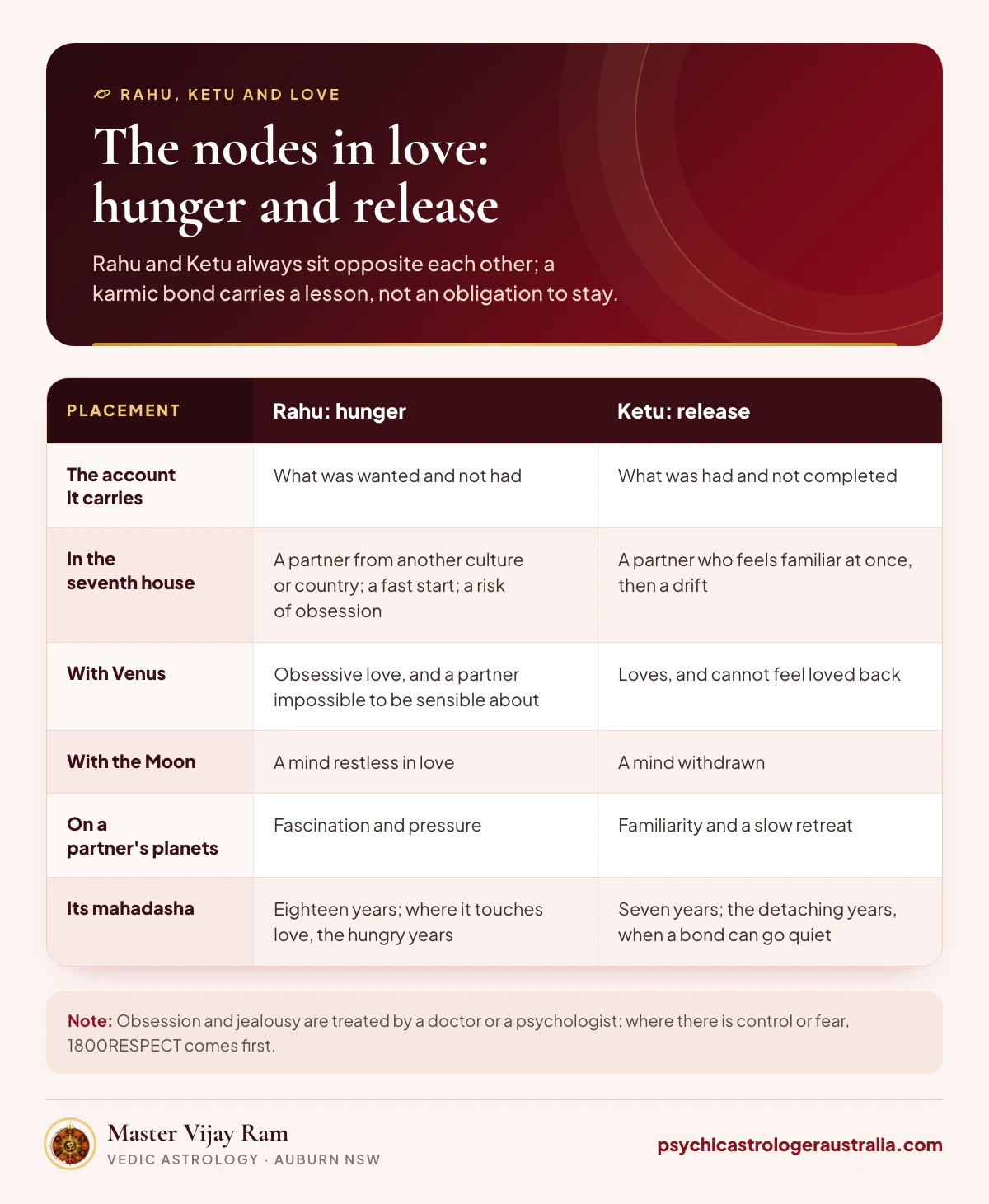
Rahu is hunger: the pull toward what you have not had, the foreign, the forbidden, the more. Ketu is release: the pull away from what you have already lived, toward detachment, familiarity and the past. They always sit opposite each other, so wherever Rahu wants, Ketu lets go.
In a relationship chart that pairing is everything. One axis of the chart describes what a person reaches for in a partner and what they cannot quite hold, and when the nodes fall on the houses of love and marriage, or on the other person's planets, the relationship carries a charge that people reach for the word karmic to describe. A love and marriage prediction reading reads that axis first when a relationship feels fated; this page explains what it looks for.
The Rahu and Ketu axis: always a pair
Because the nodes are 180 degrees apart, Rahu in the seventh house means Ketu in the first, Rahu in the fifth means Ketu in the eleventh, and so on. The reading is never of one node but of the axis, the line drawn across the chart between the hunger and the release. The house pairs that touch love are the first and seventh, self and partner; the fifth and eleventh, romance and friendship; the second and eighth, family and intimacy; and the twelfth and sixth, the bed and the daily grind.
The sign on each end colours the appetite. Rahu in Taurus is hungry for comfort and a beautiful partner; in Scorpio for intensity and secrets; in Sagittarius for a partner from another faith or country; in Capricorn, where it sits through 2027, for status and a partner who has arrived in the world. Ketu opposite carries the matching renunciation.
Rahu in the seventh house
Rahu in the 7th house gives a person who reaches hard for partnership and reaches past the obvious. The partner is often from a different culture, religion, caste, country or generation; the relationship may begin fast, online, abroad or against family advice; and the longing for the other can shade into obsession, which is the Rahu signature the tradition warns about. With Ketu in the first house the person themselves can feel oddly absent from their own life, defined by whoever they are with.
It is a placement with a famous reputation and a better record than the reputation suggests. Many inter-cultural marriages that have lasted thirty years in Australia belong to people with Rahu in the seventh who married exactly who Rahu wanted. The work of the placement is to want the person rather than the novelty, and the dasha, as explained below, usually makes that clear in time.
Ketu in the seventh house
Ketu in the 7th house gives the opposite texture: a partner who feels familiar from the first meeting, as if already known, and then a drift, a sense that the relationship is happening at a distance or that the other person is never fully there. Rahu in the first makes the person self-focused, ambitious, hungry for their own becoming, and marriage can feel like an interruption to it. The partner Ketu describes is often spiritual, quiet, older in spirit, or from the person's own past in some way.
The tradition reads this as a relationship debt being paid rather than a relationship being built, and it is the placement most often described with the words 'I feel like we were together in another life'. The honest reading is that Ketu asks the person to love without needing to possess, and that marriages under it are peaceful when both people accept the distance and difficult when one keeps trying to close it.
The nodes in the other houses of love
Rahu in the fifth house brings intense romances, unconventional lovers and sometimes a child who changes the course of a relationship, with Ketu in the eleventh detaching the person from friends and social approval. Rahu in the eighth brings a marriage with a secret in it, a partner's family that is hard to know, and intimacy that is either everything or nothing, with Ketu in the second loosening the hold on one's own family and speech. Rahu in the twelfth brings foreign partners and a love lived abroad or in private.
The nodes on the Moon or Venus are read the same way as the houses. Rahu with Venus is the classic signature of obsessive love and a partner who is impossible to be sensible about; Ketu with Venus loves and cannot feel loved back; Rahu with the Moon makes the mind restless in love, and Ketu with the Moon makes it withdrawn. Venus in your birth chart covers that pairing in detail.
What does a karmic relationship mean in the Vedic frame?
The word is used loosely online, and in the tradition it has a plain meaning. Rinanubandhan, the bond of debt, is the idea that some connections exist to settle an account carried from before, and the nodes are the planets that describe such accounts, because Rahu is what was wanted and not had and Ketu is what was had and not completed. A karmic relationship in astrology is therefore one where the nodes fall on the houses or planets of love in one chart, or on the other person's Moon, Venus, lagna or seventh house.
What it does not mean is fate. A karmic relationship is not one you are obliged to stay in, and it is not one that is certain to last; the tradition says only that it carries a lesson and that the lesson is the point. Some of these bonds become long marriages once the lesson is learnt; others end, and the ending is the lesson. He says this plainly because the word karmic is too often used to keep people in relationships that are hurting them.
Nodal contacts in synastry: when your Rahu meets their Moon
Nodal contacts in synastry are the places where one person's Rahu or Ketu falls on the other person's planets or angles, and they are the single most common signature in couples who describe their meeting as instant and inexplicable. The table sets out the main contacts and what they tend to feel like from each side.
| Contact | How it feels to the node person | How it feels to the planet person | The lesson |
|---|---|---|---|
| A's Rahu on B's Moon | A is fascinated, wants to know B completely | B feels seen, then crowded; moods are amplified | Closeness without consuming |
| A's Ketu on B's Moon | A feels B is familiar, like family | B feels safe, then unheld; a slow emotional retreat | Staying present without a hook |
| A's Rahu on B's Venus | A desires B intensely, sometimes obsessively | B feels adored and under pressure | Desire that respects the other's pace |
| A's Ketu on B's Venus | A loves B but keeps a distance | B feels loved and quietly unsure of it | Showing love that is felt, not assumed |
| A's Rahu on B's lagna or in B's seventh | A is drawn into B's life and wants to shape it | B feels chosen, then directed | Partnership as equals |
| A's Ketu on B's lagna or in B's seventh | A recognises B and expects little | B feels accepted and sometimes invisible | Effort where ease has made it lazy |
| Nodes on the same axis in both charts | Born within months of each other, or about nine or eighteen years apart | A shared hunger and a shared blind spot | Noticing what neither of you sees |
Nodal synastry is read with the rest of the comparison, and a strong Rahu contact with a weak Venus and Moon connection is the pattern behind the relationship that begins like lightning and ends in eighteen months. A relationship compatibility reading looks at the nodes alongside gun milan and the dasha, which compatibility beyond gun milan explains.
The Rahu and Ketu axis in 2027
By transit the nodes change signs every eighteen months or so, and they moved into Capricorn and Cancer on 6 December 2026 in Sydney time, 5 December in India, using the mean node, and they stay there through all of 2027. That puts transit Rahu in the seventh house and Ketu in the first for anyone with a Cancer Moon or a Cancer lagna, and transit Rahu in the first and Ketu in the seventh for a Capricorn Moon or lagna. For those people 2027 is a year in which the relationship axis is lit from outside: new attractions that feel like destiny, old partnerships that feel suddenly distant.
The table below places the slow movers of the year, Rahu and Ketu among them. The transit does not create a relationship; it brings the themes of the natal axis forward for a season.
| Planet | Moves | Date (Sydney) | Date in India |
|---|---|---|---|
| Jupiter | Gemini → Cancer (Karka) | Tue 2 Jun 2026 | 2 Jun 2026 |
| Jupiter | Cancer → Leo (Simha) | Sat 31 Oct 2026 | 31 Oct 2026 |
| Jupiter | Leo → Cancer (Karka) retrograde | Mon 25 Jan 2027 | 25 Jan 2027 |
| Jupiter | Cancer → Leo (Simha) | Sat 26 Jun 2027 | 26 Jun 2027 |
| Jupiter | Leo → Virgo (Kanya) | Sat 27 Nov 2027 | 26 Nov 2027 |
| Jupiter | Virgo → Leo (Simha) retrograde | Tue 29 Feb 2028 | 28 Feb 2028 |
| Jupiter | Leo → Virgo (Kanya) | Mon 24 Jul 2028 | 24 Jul 2028 |
| Jupiter | Virgo → Libra (Tula) | Tue 26 Dec 2028 | 26 Dec 2028 |
| Saturn | Pisces → Aries (Mesha) | Thu 3 Jun 2027 | 3 Jun 2027 |
| Saturn | Aries → Pisces (Meena) retrograde | Wed 20 Oct 2027 | 20 Oct 2027 |
| Saturn | Pisces → Aries (Mesha) | Thu 24 Feb 2028 | 23 Feb 2028 |
| Rahu | Aquarius → Capricorn (Makara) retrograde | Sun 6 Dec 2026 | 5 Dec 2026 |
| Rahu | Capricorn → Sagittarius (Dhanu) retrograde | Sat 24 Jun 2028 | 24 Jun 2028 |
| Ketu | Leo → Cancer (Karka) retrograde | Sun 6 Dec 2026 | 5 Dec 2026 |
| Ketu | Cancer → Gemini (Mithuna) retrograde | Sat 24 Jun 2028 | 24 Jun 2028 |
Rahu and Ketu use the mean node, the usual Vedic default. Computed with the Swiss Ephemeris (Lahiri ayanamsa for Vedic positions) and checked against US Naval Observatory data. Times are rounded to the minute.
Rahu and Ketu dashas: the long seasons of the axis
Rahu's mahadasha runs eighteen years and Ketu's seven, and either can arrive in the middle of a marriage. A Rahu period in a chart where Rahu touches the houses of love tends to bring the hungry years: a new attraction, a move abroad, a partner from outside the circle, or a restlessness inside a settled marriage that the person cannot explain. A Ketu period brings the detaching years, in which a relationship can go quiet without anyone having done anything wrong.
Knowing which period is running changes what a couple does about it, which is why he reads the dasha before he reads the complaint. The Rahu mahadasha and the Ketu mahadasha are each described on their own page.
When Rahu's hunger is a health matter
Obsession, jealousy, the inability to stop checking a phone or driving past a house, are described by Rahu in the chart and treated by a doctor or a psychologist in life. A nodal reading can name the tendency; it cannot treat it, and it should never be used to excuse behaviour that frightens a partner. When a relationship involves control, fear or harm, the first call is 1800RESPECT, listed below, and faith-based guidance comes after safety, not before it. Nothing on this page is medical, legal or financial advice.
Remedies the tradition offers for the nodes
Rahu and Ketu are pacified rather than strengthened. The tradition offers Durga and Ganesha worship, the Rahu and Ketu beej mantras, service to people on the margins for Rahu and to spiritual teachers and to dogs for Ketu, and, where a chart genuinely warrants it, a Rahu or Ketu shanti performed as part of a planetary puja. Master Vijay Ram performs that work personally at his own place of practice in Auburn on a muhurat chosen for it; a consultation is $50, and spell or prayer work starts from $250, agreed before anything is performed.
Graha shanti and navagraha puja describes the planetary work, and online puja and havan how clients join by video from anywhere in Australia. A remedy does not change who a person loves; it steadies the person doing the loving, which is usually what was needed.
What the nodes cannot tell you
They cannot tell you whether a relationship is meant to be, because the tradition does not hold that any relationship is. They cannot name a person, confirm a betrayal or predict a decision. They describe the shape of a hunger and the shape of a release, the houses those fall in, and the seasons in which they are strongest, and they are read beside Venus, the Moon, the seventh house and the dasha, never alone.
How Master Vijay Ram reads Rahu and Ketu for a couple
He places the axis in each chart, reads its signs and houses and the planets it touches, then lays the two charts over each other for the nodal contacts, then reads the running dashas of both people and the transit of the year. What you receive is a description of the pull between you, the lesson in it, and the seasons in which it will be loudest, in plain words. The consultation is $50, by phone, video or WhatsApp anywhere in Australia, in English, Hindi or Punjabi, or in person at Auburn by appointment.
Clients in Adelaide ring half an hour behind Sydney; couples in different cities join the same call from two phones. The Rahu and Ketu axis in marriage is one of the readings people find most freeing, because a pull that has a name is easier to live with than one that feels like a spell.
When Rahu brings a partner from another culture: couples in Hobart and Townsville
Rahu in the seventh house reaches past the familiar, and in Australia the unfamiliar is often in the next seat at university or on the next shift. In Hobart that might be a Nepali-speaking student at the University of Tasmania in Sandy Bay and a classmate from the mainland; in Townsville, two colleagues on the wards at Douglas whose families pray in different languages.
The chart reads these pairings without alarm. Rahu in the seventh house describes the appetite for difference, and whether it becomes a long marriage depends on Venus, the Moon and the dasha, not on whose passport is whose. What usually needs care is the family on each side, and guidance on love and intercaste marriage takes that conversation on directly.
Those families often live on three clocks. Townsville stays on Queensland time all year, Hobart moves with Sydney, and the grandparents may be in Nepal or Kerala, so a call with both sets of parents is set around the elders' day rather than the couple's.
The Hobart astrology readings and Townsville astrology readings pages show how calls run from each city. Couples in either place consult by phone, video or WhatsApp at a time that suits both families; meeting Master Vijay Ram in person means booking a time at his practice in Auburn.
Read next
- Ketu in the Seventh House: Distance, Detachment and a Spiritual PartnerKetu in the 7th house: the distance it brings to marriage, the spouse it describes, how it delays, the 2027 transit, …
- Rahu in the Seventh House: Unusual Partners and Restless MarriagesRahu in the 7th house: the unusual partner it describes, why marriages feel restless, intercaste and overseas matches…
- Black Magic on Marriage: Signs Your Relationship Is TargetedSigns that black magic may be affecting a marriage, how the drift unfolds week by week, and the ordinary causes to ru…
Frequently asked questions
What does Rahu in the 7th house mean for marriage?
A strong reach for partnership and a reach past the obvious: a partner from another culture, faith, caste, country or generation, a relationship that begins fast or against advice, and a longing that can tip into obsession. With Ketu in the first house the person can feel defined by whoever they are with. Many long inter-cultural marriages belong to this placement; its work is to want the person rather than the novelty, and the dasha usually makes that clear in time.
Will I get married with Ketu in the 7th house?
Yes, as often as anyone else. Ketu in the seventh describes the quality of the partnership rather than its existence: a partner who feels familiar from the start, then a sense of distance or of the other person never being fully there. Marriages under it are peaceful when both people accept a little space and difficult when one keeps trying to close it. The seventh lord, Venus and the dasha decide the timing, as for any chart.
Is a karmic relationship meant to be?
The tradition does not say so. A karmic relationship, rinanubandhan, is a bond that settles an account carried from before, marked by the nodes on the houses or planets of love or on the partner's chart, and what it carries is a lesson. Some become long marriages once the lesson is learnt; others end, and the ending is the lesson. Master Vijay Ram says this plainly because the word is too often used to keep people in relationships that hurt them.
What are nodal contacts in synastry?
Places where one person's Rahu or Ketu falls on the other's Moon, Venus, lagna or seventh house when the two charts are laid together. A Rahu contact brings fascination and pressure, a Ketu contact familiarity and a slow retreat, and they are the most common signature in couples who describe their meeting as instant. They are read with the rest of the comparison, gun milan and the dasha, because a strong Rahu contact with a weak Venus and Moon link rarely lasts.
Is Rahu in the 7th house good for a love marriage?
It leans that way. Rahu in the seventh, especially with Venus or the fifth lord involved, often brings a partner the family did not choose and a relationship that moves faster than anyone planned, which is the shape of most love marriages. Whether the marriage is good depends on Rahu's sign, its dispositor, the seventh lord and the navamsa, and on the couple wanting each other rather than the thrill of the unconventional.
What happens to a marriage in a Rahu mahadasha?
When Rahu touches the houses of love in the chart, its eighteen-year period brings the hungry years: a new attraction, a move abroad, a partner from outside the circle, or a restlessness inside a settled marriage that the person cannot explain. When Rahu sits elsewhere the period is about career or status and the marriage simply carries the strain of it. Knowing the period is running changes what a couple does about it, which is why the dasha is read before the complaint.
Do Rahu and Ketu show a foreign spouse?
Rahu in the seventh, the twelfth or the ninth house, or Rahu with Venus or the seventh lord, is the classic signature of a partner from another country, culture or faith, and in Indian-Australian charts it describes a great many marriages exactly. Ketu in those places points instead to a partner who feels like family or who comes from the person's own past. Neither is a rule; the seventh lord's sign and the navamsa are read with them.
What are the remedies for Rahu in the 7th house?
The nodes are pacified rather than strengthened: Durga and Ganesha worship, the Rahu beej mantra, service to people on the margins, and a steady home routine that gives Rahu's hunger somewhere ordinary to go. Where the chart warrants it, a Rahu shanti is performed personally by Master Vijay Ram at Auburn as part of a planetary puja, from $250, agreed before it is done, after a $50 consultation. A remedy steadies the person; it does not change who they love.
Can the nodes be read for a couple by phone?
Yes. With both sets of birth details the two charts are drawn before the call, the axis is placed in each, the nodal contacts are found, and the running dashas and the year's transit are read, by phone, video or WhatsApp from anywhere in Australia, in English, Hindi or Punjabi. Couples in different cities join from two phones. In-person appointments are at Auburn in Sydney only, and the consultation is $50.
People also ask
What is a karmic relationship in astrology?
In the Vedic frame, a bond of debt, rinanubandhan, that exists to settle an account carried from before. It is marked by Rahu or Ketu on the houses or planets of love in one chart, or on the other person's Moon, Venus, lagna or seventh house. It carries a lesson, not an obligation; some become long marriages and others end, and the ending is the lesson.
Is Rahu in the 7th house good or bad for marriage?
Both, depending on what the person does with it. It reaches for a partner outside the circle and can bring a lasting inter-cultural marriage, or it can chase novelty and obsession. Rahu's sign, its dispositor, the seventh lord and the navamsa decide which, and the Rahu dasha is when the question is usually settled.
What does Ketu in the 7th house mean?
A partner who feels familiar from the first meeting and then a drift, a relationship lived at a slight distance, and a self, with Rahu in the first house, that is busy with its own becoming. The tradition reads it as a debt being paid; it is peaceful when both people accept the space and difficult when one keeps trying to close it.
Which houses do Rahu and Ketu transit in 2027?
Rahu is in Capricorn and Ketu in Cancer through all of 2027, having entered them in early December 2026 by the mean node. That puts Rahu in the seventh house and Ketu in the first for a Cancer Moon or lagna, and the reverse for Capricorn; every other Moon sign counts its own houses from those two signs.
Can Rahu and Ketu cause a divorce?
No planet causes a decision. The nodes on the seventh house, on Venus or on the Moon, and the Rahu or Ketu dasha arriving in a marriage, can bring the hungry or the detaching seasons in which a marriage is tested. Many marriages pass through those seasons intact once the pattern is named; the decision to stay or leave belongs to the two people.
References & further reading
Serving clients across Australia
Confidential consultations by phone, video & WhatsApp — including: