

Quick answer
Living with in-laws works best when costs, private space, the kitchen and the couple's own decisions are agreed openly, and each partner handles their own parents. The chart reads the mother-in-law from your 10th house and the father-in-law from your 3rd or 4th, as tendencies, never blame. If anyone is afraid, call 1800RESPECT, or 000 in danger.
What is it really like living with in-laws after marriage?
Living with in-laws is a household arrangement in which a married couple shares a home with one partner's parents, most often the husband's, in the pattern of the traditional joint family. In Australia it happens for many reasons, and it can be warm, practical and deeply supportive, or a daily strain on a young marriage, often depending less on the people than on the rules of the house.
Many couples who ring about in-laws are not looking for someone to blame. They want to know whether the friction is normal, what is fair, and whether a chart says anything about the relationships under one roof.
This post covers where friction usually starts, how boundaries work without disrespect, what the tradition reads in the chart for each parent-in-law, and the point at which safety, not harmony, is the question. Where the strain has reached the marriage itself, help with marriage problems sets out the longer support.
Why do so many Indian-Australian couples share a home with parents?
Partly tradition and partly arithmetic. Housing in Sydney, Melbourne and Perth is expensive, and pooling incomes with parents can make a home possible. Grandparents provide childcare that would otherwise cost a large share of a salary, and ageing parents need care that a son or daughter wants to give.
Some arrangements are temporary: parents visiting from India for several months, or a couple saving for a deposit in the parents' house in Blacktown or Point Cook. Others are permanent by choice, the joint family after marriage continuing as it did in Punjab or Gujarat.
Each kind has its own pressures, and long visits in particular are covered in long stays by parents visiting from India.
Where does the friction usually begin?
In small, daily territory, and the classic mother in law conflict starts in the kitchen: whose recipes, whose rules about onion and garlic on fasting days, who cleans up. Then come money, privacy, how the grandchildren are raised, the daughter-in-law's job and hours, and visitors who arrive unannounced.
Underneath, two different ideas of a household are meeting. The parents may expect the old order, in which the eldest woman runs the house; the couple may expect the Australian norm of two adults running their own life. Neither expectation is wrong, but both cannot be fully met in one kitchen.
The son, or sometimes the daughter whose parents live with the couple, is usually caught in the middle, wanting to keep both sides happy and often pleasing neither.
What is fair in a shared house?
Fairness is easier to agree in advance than to argue about afterwards. Families who share a home well tend to have settled a few things openly:
- How household costs are shared, and who pays for what.
- Some space that belongs to the couple alone, and time when they are not disturbed.
- Kitchen arrangements that give each adult some say, such as alternating days or separate meals now and then.
- That decisions about the couple's work, money and children are made by the couple, with parents consulted, not deciding.
- How visitors and family functions are handled.
Written down, these can feel too formal for a family. Spoken aloud at a calm moment, with both generations present, they prevent a great many quarrels.
How do you set boundaries without being disrespectful?
By having each partner handle their own parents. A husband speaks to his mother about the kitchen; a wife speaks to her father about the grandchildren's screen time. A request from a son or daughter lands as family business, while the same request from a daughter-in-law or son-in-law can land as an attack.
Respectful language helps, and Indian families have plenty of it. "Mummy ji, we would like to cook for ourselves on weekends so you can rest" is a boundary; so is "Papa, we will decide about the school, and we would value your thoughts first." Neither is rude, and both are clear.
Avoid triangles. Complaining to one parent about the other, or asking a sibling to pass on a message, nearly always makes things worse.
What does a birth chart show about in-laws?
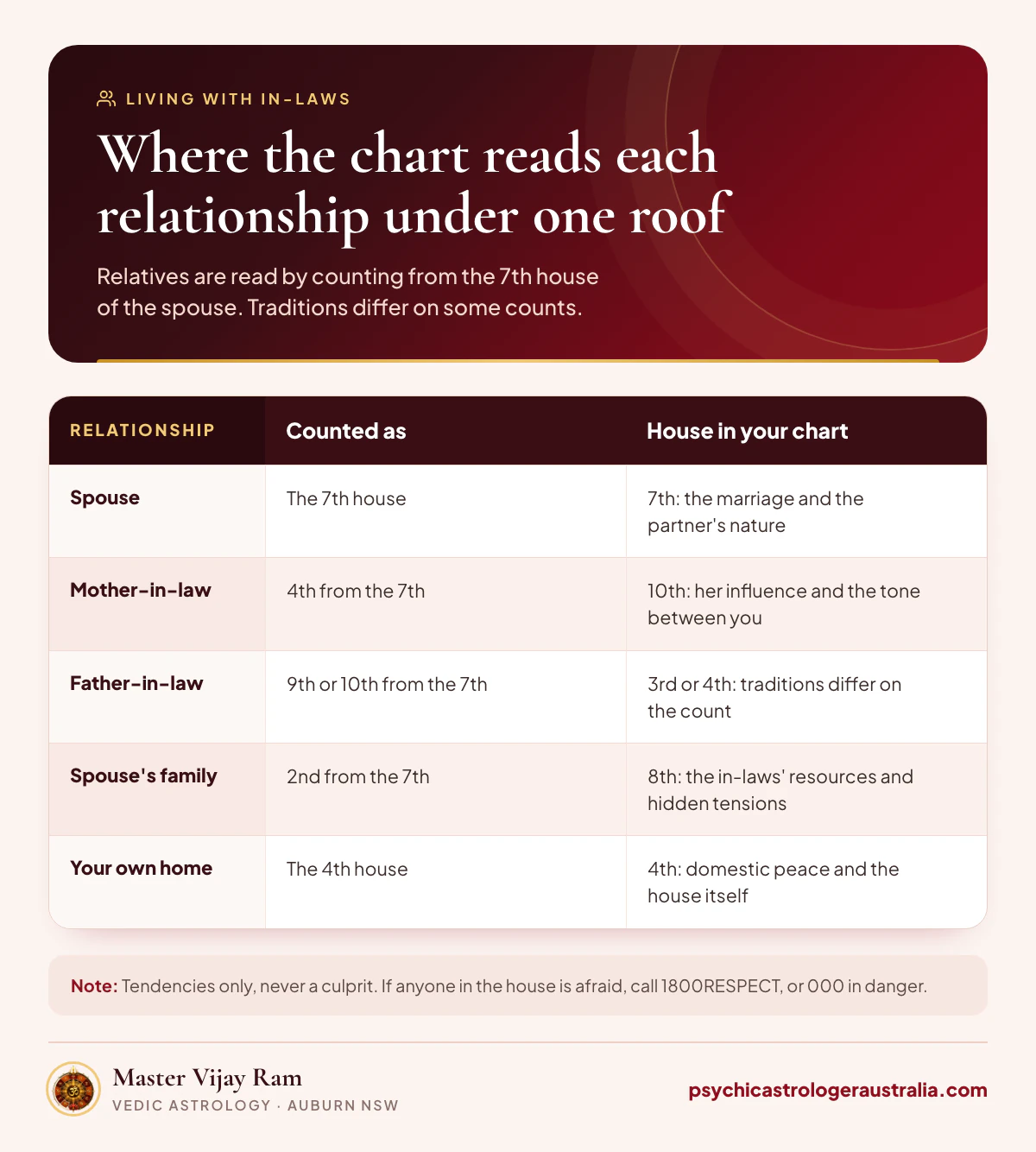
In in laws problems astrology, relatives are read by counting houses from the house that represents a person. Since the 7th house is the spouse, the spouse's mother is the 4th from the 7th, which is your 10th house, and the spouse's father is the 9th from the 7th, your 3rd house, though some traditions use the 10th from the 7th, your 4th, for him. Traditions differ, and they are presented here as such.
| Relationship | Counted as | House in your chart | What is traditionally read |
|---|---|---|---|
| Spouse | The 7th house | 7th | The marriage and the partner's nature |
| Mother-in-law | 4th from the 7th | 10th | Her influence and the tone between you |
| Father-in-law | 9th or 10th from the 7th | 3rd or 4th | His role; traditions differ on the count |
| Spouse's family as a whole | 2nd from the 7th | 8th | The in-laws' resources and hidden tensions |
| Your own home | The 4th house | 4th | Domestic peace and the house itself |
Notice that the 4th house appears twice in some traditions, as your domestic peace and as the father-in-law's house, which is one reason a joint household is read with such care. The 10th, the mother-in-law's house, is also the house of your career and public standing, and tension there can spill into how you feel at work.
All of this describes tendencies, coloured by the planets in those houses, their lords and the dasha running. It never makes a parent-in-law a villain.
Does the reading involve the in-laws' own charts?
Only with their agreement. Master Vijay Ram reads the couple's charts for the relationship with the wider family, and if parents wish to join and share their own charts, he can look at how the household fits together. He does not read anyone's chart behind their back to build a case against them.
He also never names a relative as the source of a family's troubles, and he does not treat a mother-in-law's temper as a curse. Families who suspect that kind of thing are better served by protection without a family rift, which keeps the focus on the household rather than on accusing anyone.
What is the husband's part in all this?
Larger than most husbands realise. In the common arrangement of a wife moving into her husband's parents' home, he is the only person who belongs fully to both sides, and how he handles disagreements largely decides whether the house is calm.
The useful habits are simple: back your wife in private and in public, raise concerns with your parents yourself, keep some time that is only for your marriage, and never repeat to your mother what your wife told you in confidence. None of this is disloyalty to parents; it is what makes living together possible.
When is it time to live separately?
When the arrangement is costing the marriage more than it gives the family. Signs include constant arguments that never resolve, a partner who dreads coming home, children who are confused about whose rules apply, or health suffering on either side. Moving out, even nearby, is often what saves the relationship with the parents as well as the marriage.
It is a practical decision as much as an emotional one: money, care for the parents, school zones and the lease all come into it. A reading can help with timing, and help with family problems describes the longer work some households need while they decide.
Which remedies are traditionally used for harmony?
Conduct first, then shared prayer. Many households find that a short family aarti in the evening, everyone present, softens the day's frictions; others keep a Monday prayer to Shiva and Parvati for the marriage, or a Thursday observance for Jupiter as the planet of elders and good counsel.
Where the charts show a hard period for the household, a family havan or a graha shanti may be suggested. Master Vijay Ram performs it personally at his place of practice in Auburn, from $250 agreed before anything is performed, and the family can join by video, as puja and havan on request explains.
What he will not do is work aimed at bending a parent-in-law's will. What is ethical when in-laws are the problem explains where that line sits and why.
When is it no longer about harmony but about safety?
When anyone in the house is afraid. Family violence includes abuse by in-laws, not only by a partner: controlling money or documents, isolating someone from friends or their own family, threats, demands for dowry, humiliation, confinement, or physical harm. Threats about a visa are also a form of control.
If this is happening, call 1800RESPECT, and in danger call 000. Questions about how leaving would affect a visa belong with Legal Aid or a registered migration agent, and nobody should stay in danger because of a threat about their residency. No chart, puja or patience is the right answer to abuse.
What can a reading not do in a joint household?
It cannot change another adult's personality, decide who is right in a quarrel, or replace a counsellor, a lawyer or the police. It cannot tell you that your mother-in-law has cursed you, because that is not something a responsible reading claims.
It can describe the tendencies in each relationship, show which periods may be tense and which easier, and help a couple choose a good time for a difficult conversation or a move. Relationships Australia also offers family counselling that includes more than one generation.
How does a consultation about in-laws work?
Usually with the couple, sometimes with the husband or wife alone. Master Vijay Ram reads the 7th, 10th, 4th and 3rd houses with their lords, the running dashas and the current transits, and talks about practical steps alongside the chart. Couples who are newly married may also find the first year of marriage and its adjustments helpful.
A consultation is $50 by phone, video or WhatsApp, in English, Hindi or Punjabi. Families in Melbourne and Victoria, Darwin or Brisbane usually consult by video, and the Central Coast is close enough to come in person; he sees people in person only at Auburn, by appointment.
Read next
- The First Year of Marriage: Adjustment, In-Laws and the ChartThe first year of marriage: what normal adjustment looks like, the pressures on Indian couples in Australia, what a c…
- Remarriage After Losing a Spouse: Family Feelings and the ChartRemarriage after losing a spouse: grief and guilt, children and in-laws, practical matters for a lawyer, and what the…
- Vashikaran for Marriage Approval: Softening Family ResistanceHow family resistance to a marriage really softens: what vashikaran addresses, a stage-by-stage timeline, the honest …
Frequently asked questions
Which house shows the mother-in-law in astrology?
Counting from the 7th house, which represents the spouse, the spouse's mother is the 4th from the 7th, your 10th house. The tradition reads her influence and the tone between you from that house, its lord and the planets there. It describes tendencies coloured by the dasha running and never makes her responsible for your troubles.
Which house shows the father-in-law?
Traditions differ. Many count the 9th from the 7th, which is your 3rd house, since the 9th represents the father; others count the 10th from the 7th, your 4th house. Master Vijay Ram says which method he uses and reads it together with the planets and dashas involved.
How do I set boundaries with my in-laws respectfully?
Let each partner speak to their own parents, choose calm moments, and use respectful language that is still clear, for example asking to cook for yourselves on weekends so a parent can rest. Agree household costs, private space and who makes decisions about the couple's work and children. Avoid complaining to one parent about the other.
Are there remedies for problems with in-laws?
Conduct and shared prayer come first: a short family aarti in the evening, a Monday prayer to Shiva and Parvati, or a Thursday observance for Jupiter. Where the charts show a hard period, a family havan or graha shanti may be suggested, performed at Auburn from $250, agreed before anything is performed. Work to bend a relative's will is refused.
Should we move out of my in-laws' house?
Consider it when arguments never resolve, a partner dreads coming home, children are confused about whose rules apply or anyone's health is suffering. Moving out, even nearby, often protects the marriage and the relationship with parents. It is also a practical decision about money, care for the parents and housing, which a reading can help time but not decide.
Can my mother-in-law have put negative energy on me?
Master Vijay Ram does not name relatives as the source of a family's troubles and does not treat a difficult temper as a curse. Tension in a shared home has ordinary explanations first. If a household feels heavy, protection is done for your own home and conduct, without accusing anyone, and practical help such as counselling comes first.
What if my in-laws control my money or my passport?
That is a form of family violence, as are isolation, threats, dowry demands and threats about your visa. Contact 1800RESPECT for confidential support, and call 000 if you are in danger. Visa questions go to Legal Aid or a registered migration agent; no one should stay in danger because of a threat about their residency.
How can my husband help with problems with his parents?
By backing his wife in private and in public, raising concerns with his parents himself, keeping time that belongs only to the marriage, and never repeating what his wife told him in confidence. He is the person who belongs fully to both sides, and how he handles disagreements largely sets the tone of the house.
People also ask
Is it normal to have problems living with in-laws?
Yes. Two generations with different ideas of how a household runs are sharing one kitchen, one budget and one set of children, and friction is common in the first years. It usually eases when costs, space and decisions are agreed openly and each partner handles their own parents. Fear or control is not normal and needs outside help.
How do you deal with a controlling mother-in-law?
Let your spouse raise concerns with their mother, agree clear arrangements for the kitchen, money and children, keep some private space and time, and stay respectful in language while being firm. If the control extends to money, documents, isolation or threats, it is family violence, and 1800RESPECT can help.
What does the 10th house say about in-laws?
Counted from the 7th house of the spouse, the 10th house is the 4th from the 7th, the spouse's mother. Its sign, lord and planets are traditionally read for the mother-in-law's influence and the tone between you. The 10th is also your career house, so tension there is sometimes felt at work too.
Are joint families still common in Australia?
Many Indian-Australian households share a home across generations, for reasons of tradition, housing costs, childcare or caring for ageing parents. Some arrangements are permanent and some temporary, such as long visits from India or a couple saving for a deposit. Each works best with openly agreed arrangements.
References & further reading
Serving clients across Australia
Confidential consultations by phone, video & WhatsApp — including: