
Quick answer
Remarriage after losing a spouse is a decision about grief, family and the future, not a betrayal of the person who died. There is no fixed waiting time; many families wait at least until the first annual rites. Children, in-laws and wills deserve care and advice. A chart can describe periods of readiness, never tell you whom or whether to marry.
Is it right to think about remarriage after a spouse dies?
Remarriage after the death of a spouse is a new marriage entered by a widow or widower, and it is one of the most tender questions a family faces. Remarriage after a spouse’s death does not cancel the first marriage or the love in it. Many people find that a good first marriage is exactly what makes them want companionship again.
Master Vijay Ram hears this question from a widower in Wollongong with two school-age children, and from a woman in Adelaide who lost her husband in her forties and whose in-laws still visit every Sunday. The chart side of a second marriage is covered in what the chart says about a second marriage. This post is about the grief, the family and the feelings around the decision, and a love and marriage prediction reading can add the timing when you are ready.
How long should someone wait?
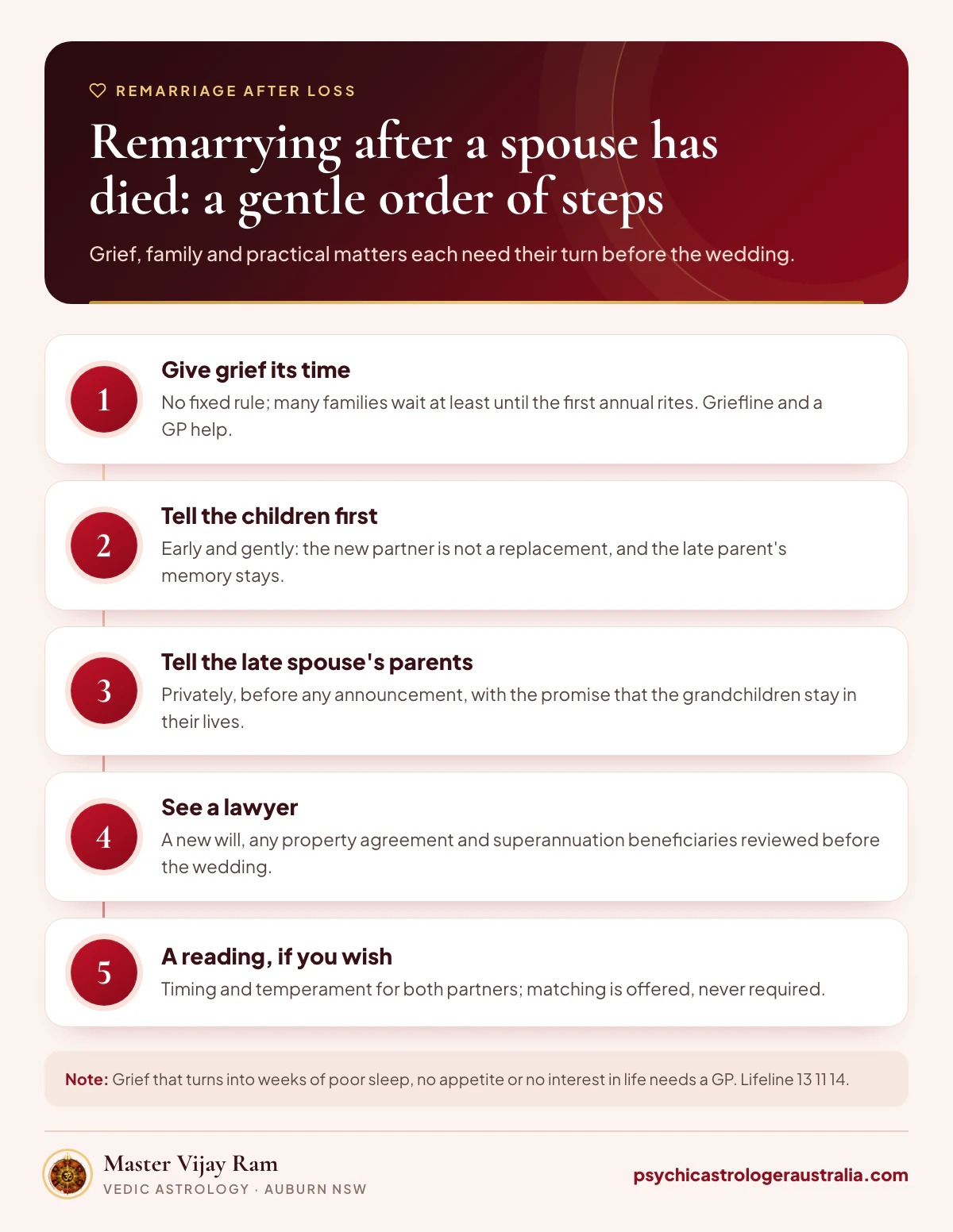
There is no rule that fits everyone. Many Hindu families feel that nothing should be planned until after the first annual rites, the barsi or varshik shraddha, and some prefer longer; others accept an earlier marriage when young children need a settled home. Customs differ between regions and families, and none of them is a law of the chart.
A more useful question than “how long” is “how ready”. Signs of readiness include being able to speak of the late spouse with warmth rather than only pain, wanting a partner for themselves rather than to fill a gap, and the children having had time to grieve too.
What does grief have to do with it?
Everything. Grief does not follow a timetable, and it often returns at anniversaries, festivals and family weddings long after the funeral. A new relationship begun to escape grief usually carries it in with it.
Griefline offers support to people grieving any loss, and a GP can help when grief has become depression: sleep collapsing, eating stopped, no interest in anything for weeks. Lifeline is on 13 11 14 at any hour. Getting support for grief is not a sign of being unready for love; it is often what makes love possible again.
Why does guilt come up so often?
Many widows and widowers feel that wanting someone new is disloyal; widower remarriage is judged less harshly in most families, yet men feel the guilt just as sharply.
Many also worry what the late spouse’s family will think. In Indian communities, older relatives sometimes still carry the old discomfort with widow remarriage, especially for women, and say so. That pressure can make a natural wish feel shameful.
The tradition’s deepest teaching about the dead is to honour them and let them go in peace, not to stop living. Many people find it helps to keep the remembrance practices, such as the annual shraddha and a lamp on the anniversary, alongside a new life. Pitru Paksha and shraddha in Australia describes how families keep those rites here.
How do children feel about a parent remarrying?
With children and remarriage, everything depends greatly on their age. Young children may fear forgetting their late parent or being replaced; teenagers may feel loyal to the parent who died and angry at the new person; adult children may worry about inheritance, the family home or their own parent’s vulnerability. All of these are understandable.
Tell children early, gently and before others do. Make clear the new partner is not a replacement and that the late parent’s photographs, rituals and memory will stay. A new partner who does not rush the children usually earns more trust than one who tries hard to be liked.
| Who | What they often feel | What tends to help |
|---|---|---|
| Young children | Fear of forgetting the parent who died, or of being replaced | Keeping photos and rituals; the new partner taking it slowly |
| Teenagers | Loyalty to the late parent; anger or embarrassment | Honesty, no forced closeness, time with the surviving parent alone |
| Adult children | Worry about inheritance, the home, or a parent being taken advantage of | Open talk about wills and property, with a lawyer involved |
| The late spouse’s parents | Grief again; fear of losing contact with the grandchildren | Reassurance they remain family; visits continuing |
| Your own parents | Relief, or worry about the community’s view | Letting them meet the new partner early |
| The new partner | Fear of living in a shadow | Making room for them without erasing the past |
What about the late spouse’s family?
In many Indian families the in-laws of a widow or widower remain close, especially when there are grandchildren. They may support a remarriage warmly, or feel it as a second loss. Telling them yourself, privately and before any public announcement, honours the bond.
Reassure them that the grandchildren will stay in their lives and that the late spouse will be remembered. Where relations have become tense, a family problem reading can sometimes show when a difficult conversation is likely to go better.
How does a new partner fit into a home that holds a memory?
A new partner moving into the home the late spouse shared may find photographs, a puja corner with their picture, and rooms full of their things. Talk about what stays, what moves and what is given away, and do it together rather than suddenly. A loved one’s belongings after death offers a gentle way through.
Where children from both sides are involved, the household becomes a blended family, with its own pace and difficulties. Blended families and step-parents looks at that in detail.
What practical matters need attention?
A remarriage changes wills, property, superannuation beneficiaries and, sometimes, what children from the first marriage will inherit. Before the wedding, see a lawyer about a new will and any agreement about property, and check who is named on superannuation. These conversations feel unromantic, but they protect both the children and the new marriage.
Some couples also talk to a financial adviser about combining or keeping finances separate. A reading has no part in these decisions; they belong with professionals.
What can the chart say about remarriage after loss?
A reading looks at the seventh house, Venus and the dashas running for timing. For a widow or widower the chart is read exactly as for anyone else; there is no planetary rule against remarriage. Periods that support partnership are traditionally read through the seventh lord, Venus and Jupiter, while Saturn periods often coincide with a long time of mourning and duty.
The Moon describes how grief is carried. A Moon under heavy pressure in a hard period can mean grief sits longer, and the tradition advises patience then. These are tendencies; they describe seasons, not whether a particular person is right for you.
Should the wedding be small or large?
Most second weddings after a loss are quieter than first ones, and many couples prefer a temple ceremony with close family, a registry office or a small gathering at home. That is a matter of taste, not of rule. Some families want a full celebration because the new marriage is a genuine joy, and that is just as valid.
Think about who might find the day hard: the late spouse’s parents, a teenage child, a close friend. A quiet word beforehand, a place for them at the ceremony and perhaps a moment of remembrance can turn a painful day into one they are glad to share.
Should the new partner’s chart be matched?
Many families like to, and it can be useful. For a second marriage the emphasis usually moves from guna points to temperament, how each person grieves and copes, and whether the dashas support a settled period. If the new partner has also lost a spouse or been divorced, both histories are taken into account with care.
Matching is offered, never required. Two adults who have lived through loss often know far more about what they need than any chart.
Is there a puja before remarriage?
Some families hold a prayer for the late spouse before the new marriage, as a way of honouring them and asking blessings for the next chapter; others simply keep the annual shraddha. Where a family wants this, Master Vijay Ram performs it personally at his place of practice in Auburn, with the family joining by video if they wish. A puja or havan on request starts from $250, agreed before it is performed.
It is optional, and the decision to remarry does not depend on it.
What if remarriage comes later in life?
Many widows and widowers meet someone in their fifties, sixties or later, when the questions shift toward companionship, adult children and property. Love after 50 and companionship looks at that stage, including the scams that target lonely people online.
What can a reading not do, and what does it cost?
A reading cannot tell you whether you have grieved enough, decide whom to marry, or replace grief counselling, a lawyer or a GP. It is faith-based guidance. A consultation with Master Vijay Ram is $50 by phone, video or WhatsApp, in English, Hindi or Punjabi, and families on the Illawarra coast can see how calls are arranged on the astrologer in Wollongong page.
Read next
- Second Marriage: What Your Birth Chart Says About RemarriageSecond marriage astrology: the houses and planets that show remarriage, what a second marriage yoga means, marriage a…
- Living With In-Laws After Marriage: Friction and the ChartLiving with in-laws after marriage: where friction starts, fair boundaries, what the chart reads for each parent-in-l…
- Signs Someone Is Doing Vashikaran to Break Your MarriageWorried someone is doing vashikaran to break your marriage? The signs people report, the ordinary causes to rule out …
Frequently asked questions
How long should a widow or widower wait before remarrying?
There is no fixed rule. Many Hindu families feel nothing should be planned until after the first annual rites, and some prefer longer, while others accept an earlier marriage when young children need a settled home. Customs differ. Readiness matters more than the calendar: being able to speak of the late spouse with warmth and wanting a partner for yourself.
Is it disrespectful to the late spouse to remarry?
No. The tradition asks families to honour the dead and let them go in peace, not to stop living. Many people keep the annual shraddha and an anniversary lamp alongside a new marriage. A good first marriage is often what makes someone want companionship again, and remarrying does not erase the love that came before.
How do I tell my children I want to remarry?
Tell them early, gently and before they hear it from others. Make clear the new partner is not a replacement and that their late parent’s photographs, rituals and memory will stay. Give teenagers and adult children room to react honestly. A new partner who takes things slowly usually earns more trust than one who tries too hard.
What about my late husband’s or wife’s parents?
Tell them yourself, privately and before any public announcement. Many in-laws remain close, especially where there are grandchildren, and may feel the news as a second loss. Reassure them that the grandchildren will stay in their lives and the late spouse will be remembered. Some become strong supporters of the new marriage once they feel included.
Does the birth chart show remarriage after the death of a spouse?
The chart is read for a widow or widower as for anyone else, with no planetary rule against remarriage. The seventh house, Venus, Jupiter and the dashas running show periods that support partnership, while Saturn periods often coincide with mourning and duty. These describe seasons and tendencies, not whether a particular person is right for you.
What legal matters should be sorted before remarrying?
A remarriage can affect wills, property, superannuation beneficiaries and what children from the first marriage inherit. See a lawyer before the wedding about a new will and any agreement on property, and check who is named for your superannuation. This protects both the children and the new marriage. A reading has no part in these decisions.
Where can I get help with grief?
Griefline supports people grieving any loss, and a GP can help when grief becomes depression, for example when sleep, eating or interest in life collapse for weeks. Lifeline is on 13 11 14 at any hour. Many people find that getting support for grief is part of becoming ready for a new relationship, not a sign they are unready.
Is there a puja to perform before remarrying?
Some families hold a prayer for the late spouse before a new marriage to honour them and ask blessings for the next chapter, while others simply keep the annual shraddha. Master Vijay Ram performs such a puja personally in Auburn from $250, agreed before it is performed. It is optional, and the decision to remarry does not depend on it.
People also ask
Is widow remarriage allowed in Hinduism?
Yes. Widow remarriage is accepted in Hindu practice today, though some older relatives still carry discomfort with it, especially for women. Families differ in how long they prefer to wait, often at least until the first annual rites. The birth chart carries no rule against remarriage and is read for a widow as for anyone else.
How do you know you are ready to love again after losing a spouse?
Signs include speaking of your late spouse with warmth rather than only pain, wanting a partner for your own sake rather than to fill an empty space, and having given children time to grieve too. Grief still returns at anniversaries, and that is normal. Talking with a grief counsellor can help you test your readiness.
How do children react when a widowed parent remarries?
Young children may fear being replaced or forgetting their late parent, teenagers may feel loyal and angry, and adult children often worry about inheritance or the family home. Telling them early, keeping their late parent’s memory present and letting the new partner build trust slowly help most families through.
Does a second marriage need kundli matching?
It is offered rather than required. Many families like to match the charts, and for a second marriage the focus usually moves from guna points to temperament, coping with loss and whether the dashas support a settled period. Two adults who have lived through loss often know clearly what they need.
References & further reading
Serving clients across Australia
Confidential consultations by phone, video & WhatsApp — including: