

Quick answer
The first year of marriage is a normal period of adjustment in which two people fit their habits, families and expectations into one household, and most arguments in it are about money, chores, in-laws and time. A chart shows tendencies through the 7th, 2nd and 4th houses and the running dasha, but habits and early counselling do most of the work.
Why is the first year of marriage harder than anyone said?
The first year of marriage is a period of adjustment that almost every couple goes through, in which two separate sets of habits, families and expectations are fitted into one household. The wedding album shows none of it, and many couples who ring in their first year are surprised mainly by how ordinary their problems turn out to be.
First year of marriage problems tend to be small and constant: who cooks, whose parents get the Sunday call, how much is spent on a sister's wedding gift, why one of you needs the television on to sleep. Each is minor; together they can feel like proof that something is wrong.
Usually nothing is. This post separates the normal friction from the patterns that need help, explains what a Vedic chart can add, and offers habits that make the year easier, with or without astrology.
What counts as normal adjustment?
Most of it, and newly married adjustment is supposed to be untidy. Couples in their first year commonly argue about money, chores, time with each other's families, friends, sex and affection, and the pace of decisions such as a house or children. Those arguments are how two people find out where the other's lines are, and they usually get shorter as the year goes on.
A useful test is direction. If the same fight comes back but ends a little sooner each time, with a little more understanding, the marriage is adjusting. If it comes back louder, or one partner has started to feel afraid rather than annoyed, it is not adjustment any more and needs outside help.
What makes the first year different for Indian couples in Australia?
Distance, mainly. A couple in Townsville or Geelong often has no aunt down the road to take one of them aside, no family dinner to cool a quarrel, and both partners working full time, sometimes on opposite shifts. The support system that softened the first year for their parents simply is not there.
There are other pressures particular to the diaspora. One partner may have just arrived from India and be facing a new job market, new weather and loneliness at the same time. Parents in Jalandhar or Hyderabad may be on video every evening, and a mother-in-law may arrive for six months just as the couple has found a routine.
- One partner earning and the other waiting for work rights or a first job.
- Arranged couples getting to know each other properly for the first time under one roof.
- Love-marriage couples carrying a family's disapproval into the new home.
- Different regional cuisines, festival calendars and ideas of what a wife or husband does.
Naming these as circumstances rather than character flaws takes much of the heat out of them.
What does a birth chart show about the first year?
In marriage adjustment astrology, a Vedic chart describes tendencies and timing, never a verdict on a marriage. For a newly married couple, Master Vijay Ram looks first at the 7th house of each partner, its lord and the planets in or aspecting it, and at the natural karakas of marriage, traditionally Venus in a man's chart and Jupiter in a woman's.
The 2nd house matters more than people expect in the first year, because it governs the family one lives with, speech and food, all of which change at marriage. The 4th house shows domestic peace and the home itself, and the Moon in each chart says a great deal about how each partner handles stress and needs reassurance.
The navamsa, the D9, is read for the marriage itself, and its reading needs accurate birth times; the navamsa chart and marriage explains how. A love and marriage reading draws these together for one couple.
Does the dasha at the time of the wedding matter?
It colours the first year. A couple who married while one partner was running a Saturn period may find that partner more serious, tired or duty-bound than during courtship, while a Rahu period can bring restlessness, ambition or a pull towards a career move that unsettles the new home.
None of this makes the wedding date wrong. Dashas change, and the antardasha running in the first year is often a shorter, gentler period inside the larger one. Knowing what is being run helps a couple stop taking a partner's mood personally, which is often the most useful thing a reading gives.
Which first-year frictions are common, and what helps?
| Friction | Usual ordinary cause | What a chart may add | A practical habit |
|---|---|---|---|
| Arguments about money | Different upbringing about saving, sending money home | 2nd and 11th houses, the 7th lord's link to them | A fixed weekly money talk with the numbers on the table |
| Feeling unheard | Fatigue, different ways of showing affection | The Moon and Mercury in each chart | Ten minutes daily without phones, one talks, one listens |
| Chores and cooking | Unspoken expectations from each family | Usually nothing; this is habit | Write the list and split it, then revisit it monthly |
| Family on video every night | Homesickness, parents' worry | The 4th house and the Moon's attachment | Agree which evenings are family calls and which are yours |
| One partner withdrawn | New country, job search, loneliness | The running dasha, especially Saturn or Ketu | A GP visit if low mood lasts; a community group |
| Intimacy mismatched | Shyness, stress, different expectations | Venus and the 7th and 12th houses | An honest talk; a GP or counsellor without embarrassment |
Notice how often the right-hand column does the work. The chart explains why a friction may run deep for one partner; the habit is what changes the evening.
How do in-laws affect the first year?
Strongly, and not always badly. In-laws can be the couple's best support or the most common subject of arguments, and often both in the same week. The new spouse is learning a family's rules while the other partner is caught between loyalty to parents and loyalty to the marriage.
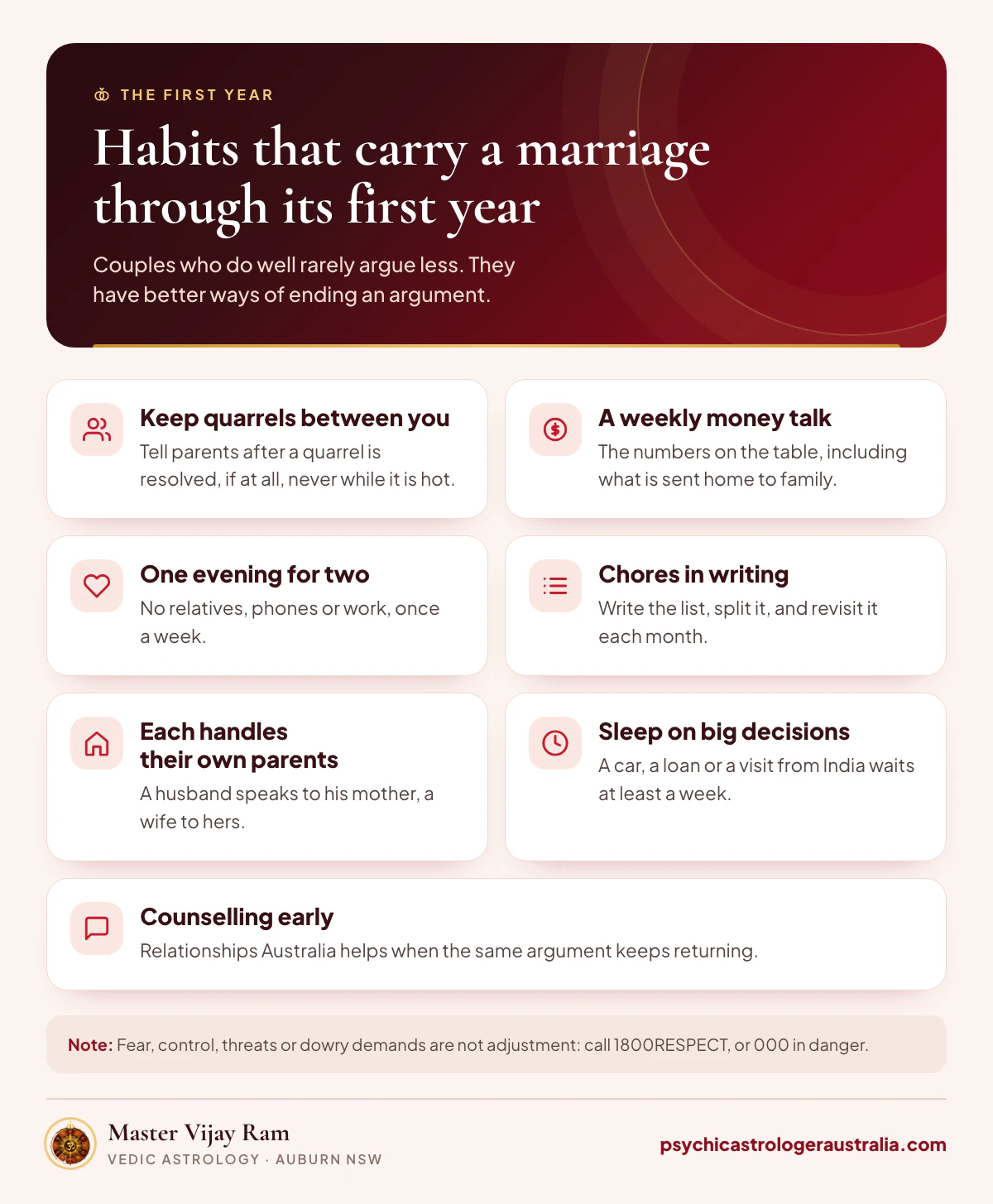
The habit that matters most is that each partner deals with their own parents. A husband speaks to his mother; a wife speaks to hers. Living with in-laws after marriage goes into this in detail, including what the chart traditionally reads for each parent-in-law.
What habits make the first year easier?
Small, repeated ones; the best first year marriage tips are dull and they work. Couples who come through the first year well rarely have fewer arguments; they have better ways of ending them. A few that work across cultures:
- Never report a quarrel to your parents while it is still hot; tell them after it is resolved, if at all.
- Keep one evening a week for the two of you, with no relatives, phones or work.
- Agree how much each partner may send home to family without asking, and keep to it.
- Sleep on big decisions, such as a car, a loan or a visit from India, for at least a week.
- Pray or sit quietly together if that is part of your life; even five minutes at the altar is shared time.
Money is the friction that most often outlasts the first year, and money fights in marriage and the chart looks at it on its own.
When should a couple see a counsellor?
Earlier than most do. Relationships Australia offers counselling and short courses for couples at every stage, including the first year, and seeing a counsellor is not an admission that the marriage is failing. Many Indian couples find a few sessions in the first year save years of resentment later.
Some things are not adjustment at all. If a partner controls your money, phone or movements, threatens you, hits you, demands dowry or gifts from your family, or makes you afraid to come home, call 1800RESPECT, and in danger call 000. No chart and no puja is the right first response to fear.
Are there remedies for the first year?
Conduct comes first in the Vedic tradition, and it is the remedy that asks only for effort: kind speech, keeping promises, respecting each other's parents. Many couples keep a simple shared practice, such as lighting a lamp together on Fridays for Venus or reciting a Shiva-Parvati prayer on Mondays.
Where both charts show a difficult period for the marriage, a Gauri-Shankar or Uma-Maheshwara puja is sometimes suggested. Master Vijay Ram performs it personally at his place of practice in Auburn, from $250 agreed before anything is performed, and the couple can join by video; puja and havan on request explains how that works. It is a prayer for a marriage, not a replacement for the work two people do.
What can a reading not do for a new marriage?
It cannot make a partner kind, change a family's attitude or decide whether to stay. It cannot replace counselling, a GP for low mood or a lawyer for a legal question. And a reading of one partner's chart without the other's knowledge tells only half the story.
What it can do is describe the season the couple is in, show which frictions are likely to ease as a period changes, and give both partners a shared, neutral language for what they are feeling. For many couples that alone lowers the temperature.
How does Master Vijay Ram read a newly married couple?
Ideally with both partners and both charts, and with both of them agreeing to the reading. He looks at the 7th house and navamsa of each, the dashas each is running, how the two Moons sit together, and the transits of Saturn and Jupiter over the coming year, then speaks plainly about tendencies rather than predictions.
If the reading points to a deeper conflict, help with marriage problems describes the longer work. A consultation is $50 by phone, video or WhatsApp, in English, Hindi or Punjabi; couples on the Sunshine Coast, in Cairns or in Townsville and North Queensland usually consult by video, and in person he sees people only at Auburn, by appointment.
What should a newly married couple remember?
That nearly everyone finds the first year hard, and that the difficulty is usually a sign of two people learning each other rather than a sign of a wrong match. Patience, a few good habits and help sought early carry most couples through.
The chart is a map of the weather, not a judgment on the marriage. The walking is still done together.
Read next
- Living With In-Laws After Marriage: Friction and the ChartLiving with in-laws after marriage: where friction starts, fair boundaries, what the chart reads for each parent-in-l…
- Money Fights in Marriage: Finances and the ChartMoney fights in marriage: practical steps first, how to recognise financial abuse, and what the second, eighth and el…
- Get Ex Love Back in Australia: An Honest Vedic GuideGet your ex love back in Australia with Master Vijay Ram: honest Vedic astrology and ethical prayer work, by phone, v…
Frequently asked questions
Is it normal to fight a lot in the first year of marriage?
Yes, within limits. Most couples argue in their first year about money, chores, families, time and intimacy, because they are learning each other's habits under one roof. The useful sign is whether arguments get shorter and end with more understanding over time. Fear, threats, control or violence are never normal adjustment and need 1800RESPECT or 000, not patience.
What does astrology say about the first year of marriage?
A Vedic chart reads the first year through the 7th house and its lord, Venus and Jupiter as marriage karakas, the 2nd house of family life, the 4th house of domestic peace, both partners' Moons and the navamsa. The dasha running at the wedding colours the mood of the year. These are tendencies, not a verdict on whether the marriage will last.
How do I adjust to my husband's family after marriage?
Slowly, and with your husband handling his own parents. Learn the family's routines without giving up all of yours, agree with your husband how often relatives visit or call, and raise problems with him privately rather than in front of others. If friction is constant, a Relationships Australia counsellor can help both of you work out fair boundaries.
Can the wedding date cause problems in the first year?
A muhurat is chosen to start a marriage under favourable conditions, but it does not decide the whole marriage. The partners' own charts and the dashas they are running matter far more. If the first year is hard, the useful questions are about habits, families and the current period, not whether the date was wrong.
When should newlyweds see a counsellor?
Whenever the same argument keeps returning without resolution, when one partner feels lonely or unheard for weeks, or when families are pulling the couple apart. Relationships Australia offers counselling and courses for couples at every stage. Seeing someone early, in the first year, usually makes problems smaller rather than proving the marriage has failed.
Are there remedies for a difficult first year of marriage?
Conduct comes first: kind speech, kept promises and respect for each other's parents. Many couples light a lamp together on Fridays for Venus or pray to Shiva and Parvati on Mondays. Where both charts show a hard period, a Gauri-Shankar puja may be suggested, performed by Master Vijay Ram at Auburn from $250, agreed before it begins.
My wife just arrived from India and seems unhappy. Is it the chart?
First look at the circumstances: a new country, no family nearby, no job yet, different weather and food, and a husband at work all day. Those alone can cause loneliness and low mood. A community group, English classes or a job search can help, and a GP should see anyone whose low mood lasts. A chart can show a heavy period but is not the first explanation.
Should both partners be present for a marriage reading?
Ideally yes. Master Vijay Ram prefers to read both charts with both partners agreeing, because one chart shows only half the marriage and a reading done behind a partner's back can damage trust. A consultation is $50 by phone, video or WhatsApp, in English, Hindi or Punjabi, or in person at Auburn by appointment.
People also ask
What is the hardest part of the first year of marriage?
For most couples it is the accumulation of small differences: money habits, chores, sleep, time with each family and how affection is shown. For Indian couples in Australia, distance from family support, work pressure and a newly arrived spouse's loneliness add to it. None of these means a wrong match; they are the usual work of building one household.
Which house in astrology shows married life?
The 7th house is the house of marriage and the spouse, read with its lord and the planets in or aspecting it. The 2nd house adds family life and speech, the 4th domestic peace, the 12th the bed and private life, and the navamsa chart is read for the marriage itself. Venus and Jupiter are the traditional karakas.
How can newly married couples avoid fights?
They cannot avoid every fight, but they can end them better. Keep quarrels between the two of you rather than reporting them to parents, hold a weekly money talk, keep one evening a week free of relatives and phones, split chores in writing, and sleep on big decisions. Early counselling with Relationships Australia helps if the same argument keeps returning.
Does Saturn affect the first year of marriage?
A Saturn period or a Saturn transit over the 7th house or the Moon is often read as making a partner more serious, tired or duty-bound, and can make the first year feel heavy. It is a tendency that eases as the period changes, and its weight depends on Saturn's sign, aspects and house. It is not a sign the marriage is doomed.
References & further reading
Serving clients across Australia
Confidential consultations by phone, video & WhatsApp — including: