

Quick answer
Negative energy from jealous relatives is usually ordinary family envy meeting a tiring gathering, and the tradition itself says nazar can fall from a loving eye, so nobody needs to be blamed. The Vedic answer is quieter than a confrontation: share news late, keep visits warm but short, light your lamp, wear a kalava from a puja, and keep the relative in your prayers.
What does negative energy from jealous relatives really mean?
Negative energy from jealous relatives is a name families give to a heaviness that follows contact with one particular cousin, sister-in-law or in-law: a pounding head after the visit, a baby who cries all evening after being passed around, a quarrel between husband and wife on the drive home. The feeling is real. The cause is usually plainer than the name suggests, and only sometimes is it what the tradition calls nazar.
Families rarely ring Master Vijay Ram about strangers. They ring about the bhabhi who asks what the house cost, the cousin whose children always seem a step ahead, the mother-in-law who praised the baby the night before the fever. His work on evil eye and nazar removal starts from one rule that matters more inside a family than anywhere else: nobody is named, tested or blamed.
Why does jealousy run so close to home?
Because relatives are the people we are measured against. Two brothers who arrived in the same year are compared on houses, jobs and children’s marks for the rest of their lives, by their parents, by the family back in India and by each other. Comparison is the soil envy grows in, and a family supplies it at every birthday.
Migration adds a layer. The relative in Australia is often imagined to be rich, and every holiday photo is read that way in Jalandhar or Hyderabad, while the cousins here measure one another at each griha pravesh and naming day. None of this needs anyone to be wicked; it needs only people who love each other and still keep score.
What should you rule out before calling it nazar?
Gatherings are exhausting. A wedding weekend means late nights, rich food, long drives, a hall of guests and the work of being pleasant to all of them, and the headache that follows is often just that. A toddler handed from lap to lap at a party meets twenty pairs of hands and whatever cold the cousins brought.
Then there is what the visit stirs up. One remark about weight, money or a child’s results can reopen an old hurt and sour a household for a week, and hosting in-laws for a month is tiring in ways that have nothing to do with the unseen. A GP for a feverish child, a quiet day after a big weekend and an honest look at what was actually said explain most of what families bring.
Can a relative cast nazar without meaning any harm?
In the tradition, yes, and it is the most useful thing the tradition teaches about family. Nazar from relatives is said to fall through admiration as readily as through envy, which is why a grandmother murmurs nazar na lage while praising a grandson and why a black dot goes behind a baby’s ear before a big function. The eye that lands may belong to someone who adores you.
That takes away the need for a culprit. If love itself can carry nazar, then a baby unsettled after a family party says nothing about who wished him harm, and a simple nazar utarna at home is the same whoever was looking. Negative energy from a neighbour deals with envy from over the fence; inside a family the rule is gentler still.
What about bitter words spoken in anger?
Words are a different matter from a look. A parent’s outburst at a wedding, an aunt’s sentence in a property quarrel, a sister-in-law’s “you will see” across a kitchen bench: the tradition gives spoken bitterness its own name and its own remedy, and that remedy starts with repair rather than ritual. Shrap, the spoken curse explains what the epics say and why an elder’s words weigh so much.
For this page the order is what matters. A harsh sentence from a relative is answered first by not repeating it, not returning it and not building a family legend around it. Most such words are spoken in a bad hour and regretted within the week.
Which family situations come up most, and what helps?
The table sets out the situations that come up most often when relatives are involved. The third column is a boundary and the fourth is a quiet practice to go with it; neither involves telling anyone what you suspect.
| Situation | What is usually going on | A boundary that keeps the peace | A quiet practice |
|---|---|---|---|
| A baby unsettled after a family function | Tiredness, too much noise, a cold caught from the other children | Shorter visits, fewer hands, a quiet room for naps | A gentle nazar utarna at home that evening |
| A cousin who compares marks, jobs and houses | Their own worry about their children, voiced as comparison | Share results once they are final, not while you are hoping | A lamp for both families’ children at the evening prayer |
| A sister-in-law who asks what everything cost | Curiosity, money worries of her own, or plain envy | A smiling non-answer, given the same way every time | A short mantra said before family visits |
| In-laws staying for months | Crowding, different routines, a couple with no privacy | An hour each day that belongs to the couple alone | Keeping your own prayer time even with a full house |
| Bitter words at a wedding or over property | Hurt, grief, or a dispute that needs a lawyer or a mediator | No reply on the day; the matter raised calmly later, or not at all | Repair first; a havan only if the chart agrees something remains |
| A family WhatsApp group full of digs | Old rivalries with a new microphone | Mute the group; answer news, never remarks | Leaving the remarks out of your prayers |
How do you share less without seeming cold?
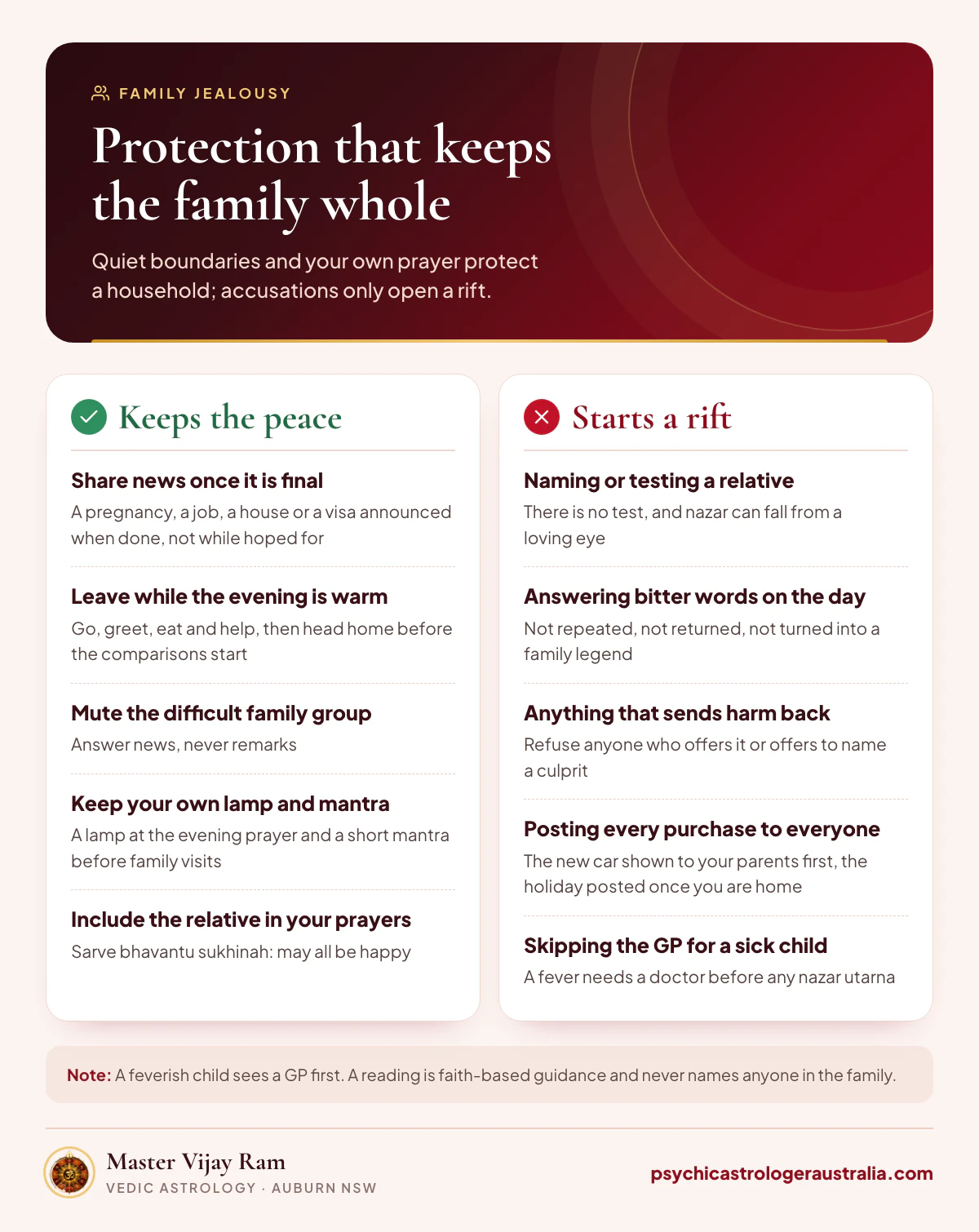
The oldest advice in Indian families is also the most practical: do not announce a thing until it is done. A pregnancy past its early months, a job once the contract is signed, a house once settlement has gone through, a visa once it is granted. That is not secrecy but timing, and it spares you explaining a disappointment to the whole clan if something falls over.
Online the same rule applies with more force. A close-friends list for the baby’s photos, the new car shown to your parents before the extended group, the holiday posted after you are home. Dealing with jealous relatives is far easier when they hear good news calmly and late, with less in it to compare.
How should you handle festival gatherings and weddings?
Go, greet everyone, eat, help in the kitchen and leave while the evening is still warm. The long hours after dinner, when the comparisons and the old grievances come out, are where most family wounds are opened, and a household that leaves at a sensible hour misses them without anyone remarking on it. Diwali, Lohri, a cousin’s mehndi or a Karva Chauth evening: the rule is the same.
If you host, host in a way that lets you set the clock: a lunch rather than an open-ended dinner, a community hall rather than your own lounge room if the house itself invites comparison. Seat the two people who always clash at opposite ends of the table. None of this is unkind, and families have kept the peace this way for generations.
What if the in-laws live under the same roof?
Parents visiting from India for six months, a mother-in-law who has moved in for good, a brother’s family staying until they find a rental: the strain of a shared house is often called negative energy by a daughter-in-law who has nowhere else to put the word. Crowding, clashing routines and a couple with no time alone produce exactly the irritability and tiredness families describe.
The practical remedies come first: an hour each day that belongs to the couple, a fair division of the kitchen, and a conversation between husband and wife before it becomes one with the parents. Help with family problems describes what a reading can add when a household is stuck, and Relationships Australia offers counselling for couples and families who need a neutral room to talk in. A relative who leaves you depleted rather than envied is a different pattern, covered in energy vampires and the Vedic view of giving.
Which protective practices does the tradition keep at home?
The quiet ones. A ghee lamp at the evening prayer, a short mantra before you leave for a family function, a kalava tied at a puja and worn until it frays, and a black dot for a small child before a crowded day. Kalava, mauli and black thread explains what the protection threads mean and when they are changed.
The most traditional practice is also the hardest: including the envious relative in your prayers. Many families close the evening prayer with sarve bhavantu sukhinah, may all be happy, and saying it while thinking of the cousin who stung you is the oldest protection from jealous family members the tradition has, because it ends the exchange instead of feeding it. Where something more is needed, a kavach prepared after a consultation is described under taweez and kavach protection.
Why should you never accuse a relative?
Because an accusation cannot be taken back, and a family outlasts a bad year. Saying that a mother-in-law or a cousin has done something to you ends invitations, splits siblings and leaves children growing up without their cousins, all over a suspicion nobody could ever prove. There is no test for it, and Master Vijay Ram will not offer one.
The cost can be far worse than estrangement. Witch accusations in India killed more than 2,500 people between 2000 and 2016 by National Crime Records Bureau figures, overwhelmingly women, and a household that starts whispering about a female relative has taken the first step on that road. The tradition gives no permission for it.
When does it make sense to ask for a reading?
When the pattern sits in your own household and has outlasted the ordinary fixes: a child unsettled for weeks since one particular gathering, a run of setbacks you can trace to one particular week, a home that has felt heavy since a quarrel. Master Vijay Ram compares your chart with those dates over the phone, on video or by WhatsApp, in English, Hindi or Punjabi, and tells you whether the timing shows anything.
He does not ask for the relative’s name, birth details or photograph, and a reading never ends with a suspect. If a nazar shanti is warranted, it is done for your family alone, by him, at his place of practice in Auburn.
What does help with family jealousy cost?
The consultation is $50, and many calls about relatives end there, with advice on boundaries, a home practice and sometimes a suggestion that the couple see a counsellor together. Where a shanti puja or havan is warranted it starts from $250, a figure settled with you before any work begins, and the family is welcome to watch by video. How a performed puja or havan works sets out what is included.
Anyone who offers to identify the relative responsible, or to send something back, should be refused at once.
Close-knit communities: Darwin, Cairns and Townsville
In a smaller community the jealous cousin is not a phone call away but at every festival. Families in Darwin meet at the temple in Malak, Townsville families at IndiaFest and community pujas, Cairns families in the halls and parks where the Hindu Samaj holds its celebrations, and the same faces appear each time. Distance, the easiest boundary in a big city, is not on offer.
That makes the habits above more useful, not less: arrive, greet, leave early, share late. Families there, and in Geelong or on the Central Coast, talk to him by phone or video, and Vedic readings for Darwin families sets out how consultations work from the Top End; face-to-face appointments happen only in Auburn.
What no reading can do for a family
It cannot make a relative less envious, reveal who looked at your child, settle a will or ease a marriage strained by a crowded house. Those belong to time, to a lawyer and to a counsellor. A reading is faith-based guidance, not legal, medical or psychological advice, and no outcome can be promised.
What it can do is tell you whether the trouble at home is ordinary or carries a pattern, give your household a protection that harms nobody, and leave the family whole for the next wedding. Underneath the question, that is usually what people wanted.
Read next
- Negative Energy From a Neighbour: What to Do Without Starting a WarNegative energy from a neighbour: what the fear usually is, what to rule out, the protection that stays on your side …
- Visiting India: Nazar, Gifts and Protection When You Travel HomeVisiting India and nazar: small protections before you fly, taking praise without fear, gifts and biosecurity, jet la…
- Signs of Negative Energy in Your Home & How to Clear ItSigns of negative energy in a home, the ordinary causes to rule out first, and how nazar, heavier interference and me…
Frequently asked questions
How do I protect my family from jealous relatives without causing a rift?
Share news once it is final rather than while you are hoping, keep gatherings warm but short, mute the family group rather than arguing in it, and keep your own evening lamp and mantra. Do a simple nazar utarna for a small child after a crowded function. Never accuse anyone, never answer a bitter remark on the day, and include the relative in your prayers; protection that harms nobody keeps the family whole.
Can relatives give nazar to a baby?
In the tradition, yes, and often without meaning to. Nazar is said to fall through admiration as well as envy, which is why grandparents say nazar na lage while praising and why a black dot goes behind a baby’s ear before a function. A baby unsettled after a party is more often tired, overstimulated or catching a cousin’s cold, so a GP or child health nurse comes first for any fever.
My sister-in-law is jealous of me. Could she be doing black magic?
Jealousy is common, black magic is rare, and the two are not the same thing. Most sisters-in-law who ask what things cost or compare the children are worried about their own lives. Nobody can test a relative for black magic and Master Vijay Ram will not try; he looks at your own chart for the period when the trouble started and tells you plainly whether anything beyond ordinary tension shows.
A relative said something terrible in anger. What should we do?
Do not repeat the words, do not answer them, and do not build a family story around them. In the tradition spoken bitterness is met first by repair: an apology where one is owed, a visit, an elder’s blessing asked for plainly. A havan is considered only if the chart agrees something remains after that, and it is performed for your family, never aimed at the person who spoke.
Is it negative energy or just tension with my in-laws?
Usually tension, and tension is real enough. A shared house, clashing routines and a couple with no time alone produce the irritability, tiredness and heaviness that families describe as negative energy. Start with the practical fixes: an hour each day for the couple, a fair division of the kitchen, an honest talk between husband and wife, and counselling if you are stuck. A reading is for a pattern that outlasts those.
Should I stop going to family functions?
Rarely. Staying away altogether tends to start the very rift you are trying to avoid, and it gives the relatives something new to discuss. Go, greet everyone, eat, help and leave while the evening is still pleasant; seat people who clash far apart if you are hosting; keep a short mantra and the evening lamp at home. Where a relative is abusive rather than envious, safety comes before any custom.
Can Master Vijay Ram tell me which relative is causing the problem?
No. He does not read a relative’s chart or study a photograph to find a source, and he never names anyone. The tradition itself holds that nazar can come from a loving eye, so a name would prove nothing and cost the family a great deal. His reading covers your own household’s charts and the weeks when things changed, and any remedy is for your family alone.
What does a nazar shanti for family jealousy cost?
The consultation costs $50 and can be held over the phone, on video or by WhatsApp; many calls about relatives end there with practical advice and a home practice. Where a shanti puja or havan is warranted, the cost begins at $250 and is agreed with you beforehand; he carries it out in person in Auburn, and relatives can follow on a video call.
Does a kalava or black thread protect against nazar from relatives?
In the tradition they are protective signs: the kalava is tied at a puja with a short mantra and worn until it frays, and a black thread is kept for nazar, especially on small children. They are reminders of a prayer rather than shields, and they work alongside the ordinary boundaries, not instead of them. Sharing news late and leaving gatherings early still do most of the protecting.
People also ask
How do you deal with jealous relatives in Hinduism?
The tradition’s answer is quiet: share good news late, keep your own prayer and lamp, refuse to return bitterness, and pray for the relative’s wellbeing. Nazar is said to come even from a loving eye, so nobody has to be blamed, and words spoken in anger are met with repair rather than ritual. A reading is for a pattern in your own household that outlasts the ordinary explanations.
What are the signs of nazar from family members?
Families describe a baby who cries all evening after a function, a sudden headache after lavish praise, or a run of small mishaps after a visit. Each has an ordinary explanation first: tiredness, a virus, too much noise, a hard conversation. In the tradition the sign that counts is timing, trouble that follows praise within a day, and even then the response is a simple nazar utarna at home.
How do you protect yourself from jealous in-laws spiritually?
Keep your own practice steady even with a full house: a lamp at the evening prayer, a mantra before difficult conversations, a kalava from a puja. Pair it with practical boundaries, such as an hour a day for the couple and an honest talk between husband and wife. Never accuse in-laws of anything spiritual; the tradition offers protection for your household, never a weapon against theirs.
Is it wrong to keep your distance from jealous family?
Polite distance is an old and respectable answer. Arriving, greeting, eating and leaving early, sharing news once it is final and muting a difficult group chat are boundaries, not insults. What the tradition discourages is the cold war: accusations, exclusion, and children kept from their cousins over a suspicion. Where a relative is abusive rather than envious, safety comes first and custom second.
Can family jealousy cause negative energy at home?
Families feel it that way, and the tradition takes nazar seriously. Most of the heaviness after a visit, though, comes from what was said, what was compared and how tired everyone is. If a household stays heavy for weeks after one particular gathering and the ordinary explanations do not fit, a look at the household’s charts for that period shows whether anything more is there.
References & further reading
Serving clients across Australia
Confidential consultations by phone, video & WhatsApp — including: