
Quick answer
Feng shui and vastu agree on clutter, light and a clear entrance, and clash on directions: fire, water and sleep sit in different places. Use either for small fixes, but pick one system for structural choices. Practitioners disagree on whether the southern hemisphere flips the solar logic; Master Vijay Ram keeps the classical directions. A consultation is $50.
What are feng shui and vastu, in a sentence each?
Feng shui is a Chinese practice that arranges buildings, rooms and furniture so that qi, the vital energy it describes, can move through them gently. Vastu shastra is the Indian tradition of building and placement that sets a home inside a sacred grid oriented to the eight directions, each with its own guardian and element.
Australian homes meet both. A family in Brisbane may have a Chinese-Australian neighbour with a mirror over the front door and a grandmother on the phone from Pune asking which way the stove faces, and the comparison of feng shui vs vastu begins the day someone hangs a wind chime in the north-east.
Master Vijay Ram reads homes in the Vedic tradition only, and his vastu consultation is described on its own page; this guide sets the two systems side by side as fairly as an outsider to one of them can.
Where does each system come from?
Feng shui, literally wind and water, grew from Chinese ideas about landscape, burial sites and the flow of qi. Its main approaches are the form school, which reads shapes, hills and water around a site, and the compass school, which reads directions with a special compass and, in some lineages, the occupants' personal numbers.
Vastu comes from the Indian building tradition alongside temple architecture. Its map is the vastu purusha mandala, a square grid with the cosmic being lying across it, head toward the north-east, and Brahma at the centre, which is why the middle of a house, the brahmasthan, is kept open.
How do the two read a home differently?
Feng shui maps a home with the bagua, an eight-sided arrangement of trigrams in which each area stands for a part of life: wealth, fame, relationships, family, children, knowledge, career, and helpful people, with health at the centre. Some schools lay it on the compass; a popular Western approach lays it from the front door, whatever direction the door faces.
Vastu always uses the compass. North belongs to Kubera and wealth, the north-east to Ishana and prayer, the east to Indra and the rising sun, the south-east to Agni and fire, the south to Yama, the south-west to Nirriti and stability, the west to Varuna and water, and the north-west to Vayu and air.
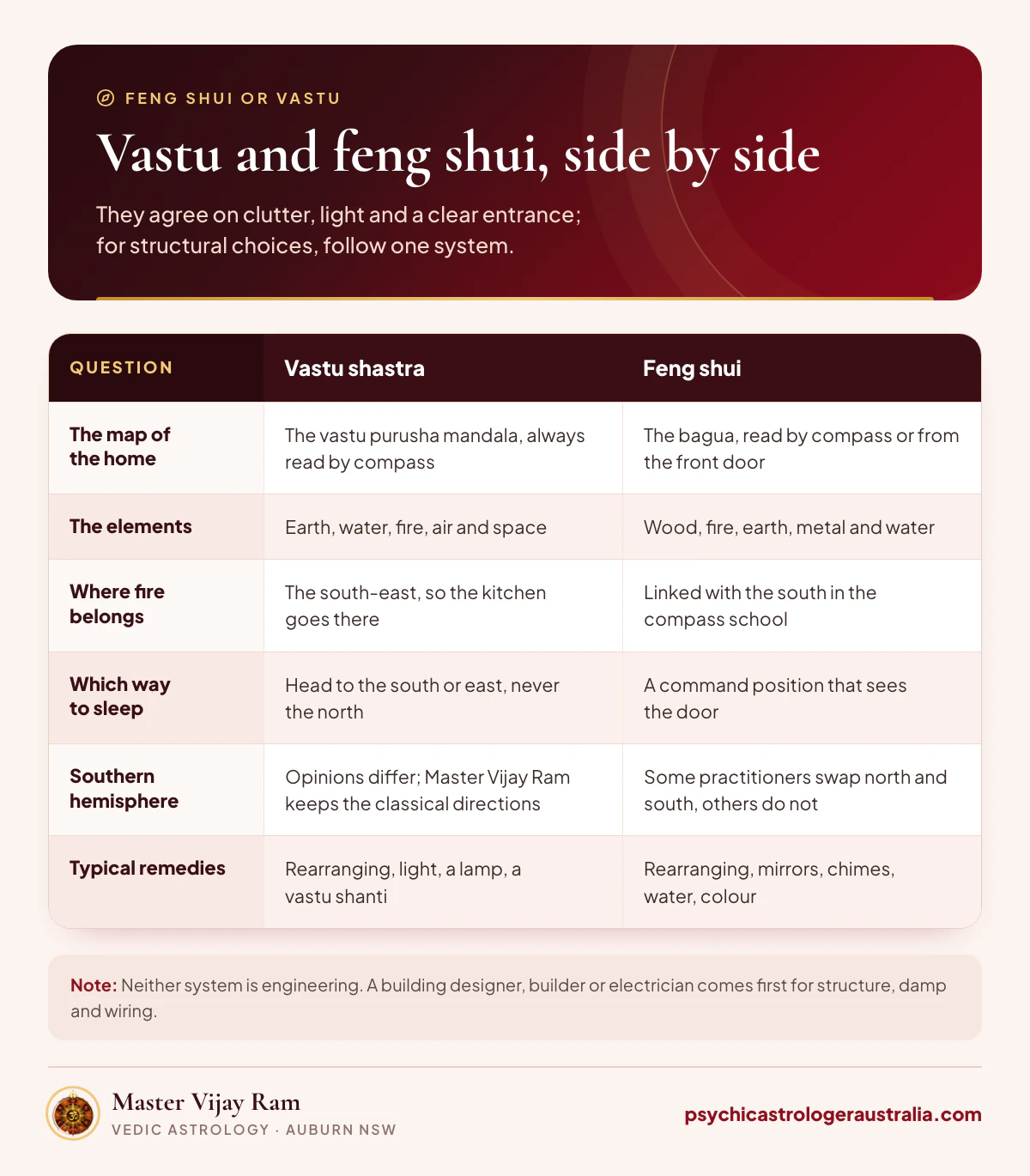
| Question | Vastu shastra | Feng shui |
|---|---|---|
| Where it comes from | The Indian building and temple tradition | Chinese thought about landscape, qi and dwellings |
| The map of the home | The vastu purusha mandala, always read by compass | The bagua, read by compass or from the front door, by school |
| The elements | Earth, water, fire, air and space | Wood, fire, earth, metal and water, in productive and controlling cycles |
| Where fire belongs | The south-east, Agni's corner, so the kitchen goes there | Associated with the south in the compass school |
| Where water belongs | The north and north-east | Varies by school and purpose; often the north, or a wealth area |
| Which way to sleep | Head to the south or east, never the north | A command position seeing the door; some schools add personal directions |
| Typical remedies | Rearranging, light, plants, a lamp, and a vastu shanti for what cannot move | Rearranging, mirrors, plants, chimes, water features, colour by element |
Where do they agree?
On more than people expect. Both dislike clutter, and both treat the entrance as the mouth of the house that should be clear, lit and welcoming, with no mirror throwing the arrival straight back out of the door.
Both dislike a beam over the bed, a mirror facing the bed, a toilet at the heart of the house and a road aimed at the front door; houses at a T-junction are a worry in both traditions. And both want light, air and a home that is cared for, which is most of what makes any house pleasant to live in.
Where do they clash?
The clashes are about direction and element, and they are real. A water feature placed in the south-east to activate wealth, as some feng shui schools suggest, sits in the very corner vastu reserves for fire, and vastu would call it a fault.
Sleep is the second clash: vastu never puts the head to the north, while a compass-school feng shui reading built on personal numbers may recommend exactly that for some people. Fire is the third, since vastu's kitchen belongs in the south-east and compass feng shui links fire with the south.
Mirrors are the quietest disagreement. Feng shui uses them actively, to deflect, double or brighten, while vastu uses them sparingly and mostly on the north and east walls.
Can you mix vastu and feng shui?
For the small things, yes, because the small things are where they agree: clear the clutter, light the entrance, open the windows, move the mirror off the bedroom wall. Mixing vastu and feng shui at that level is harmless, because nothing in it contradicts either tradition.
For structural choices, pick one system and follow it consistently. A kitchen, a main entrance, a bedroom and a water tank are expensive to place, and taking the fire rule from one tradition and the water rule from the other produces a house that satisfies neither.
The sensible test is the household's own faith and history. A Hindu family that will hold a griha pravesh and keep a puja shelf in the north-east has already chosen vastu's frame, and a Chinese-Australian family with a feng shui master they trust has chosen the other; both are reasonable.
Does the southern hemisphere change the rules?
This is the honest disagreement, and practitioners of both systems are divided. In India and China the midday sun stands in the south; in Australia it stands in the north, and the hot afternoon sun comes from the north-west rather than the south-west.
One view says the reasoning should follow the sun. If vastu kept the south-west heavy partly to shield the house from harsh afternoon heat, and if feng shui links fire with the south because the sun is there, then Australian homes should flip the solar logic, and some feng shui practitioners here do swap north and south.
The other view says the directions carry meanings that do not depend on the sun's arc: the guardians of the quarters, the sunrise in the east, the compass itself. On that view the classical directions stand unchanged, and vastu in the southern hemisphere reads exactly as it does in Delhi.
What does Master Vijay Ram do about it?
He keeps the classical compass directions, because the sun still rises in the east and the tradition's guardians are tied to the quarters, and he says plainly that this is a judgement other sincere practitioners make differently. A family that has been told the opposite by another reader has not been misled, only given another school's answer.
In practice the disagreement matters less than it sounds. He treats the north-facing living area that Australian builders favour for winter sun as the practical gift it is, and the fixes that settle most homes, set out in vastu remedies without demolition, work the same in either reading.
What about an apartment?
Apartments narrow the argument. The building faces where it faces and the kitchen sits where the architect drew it, so both systems end up working with furniture, light and use, and they agree on most of that.
Vastu for apartments and units covers the removable fixes in detail. A tenant can follow it without touching a wall or risking the bond.
Is either system engineering?
No. Neither replaces a building designer, an energy assessment, insulation, ventilation or a builder who knows the block, and neither should override advice about bushfire, flooding or structure.
A house that feels heavy is also not necessarily badly placed. Damp, poor airflow and an old gas heater are the commoner causes, and the practical checks for mould, damp and gas should come before any reading in either tradition.
What should you be wary of in either tradition?
Both have been commercialised, and both attract people selling objects. A crystal, a chime, a brass pyramid or a yantra sold as a cure for a layout is a product, not a reading, and a consultant who cannot explain in plain words what it is for is selling the object.
Be wary too of anyone who mixes fear into the advice: a house that will "bring illness", a corner that will "destroy your marriage". Neither tradition, read honestly, talks that way, and feng shui for an Australian home or vastu should leave a family calmer, not poorer.
What does a vastu reading cost?
A reading costs $50 and needs only a floor plan, a compass bearing and some photographs, shared by phone, video or WhatsApp; it ends with a short list of changes in order of importance. A vastu shanti for a fault that cannot be moved costs from $250, a sum agreed with the family first, and Master Vijay Ram conducts it in Auburn; the online puja and havan page explains the arrangements.
He does not visit homes, and he does not read feng shui. A family in Hobart, reading by phone or video, where every hour of winter sun counts, or in Perth or Adelaide, books in the same way.
What can neither system promise?
Neither can guarantee wealth, health or harmony, and neither can fix a leaking roof. A layout shapes daily habits, light and mood, which matter, but it does not decide a family's fortunes on its own.
Vastu as Vijay Ram ji offers it is a matter of faith and tradition, never a substitute for engineering, legal, financial or medical advice. If a home has gone wrong after an event rather than being laid out badly, that is a different question, and negative energy removal is the page for it.
Read next
- Vastu for Apartments and Units: Practical Fixes for Sydney and Melbourne FlatsVastu for apartments and units: what you can change in a Sydney or Melbourne flat when walls cannot move: entrance, b…
- Vastu for Wealth: The Money Corners of Your HomeVastu for wealth: the north, north-east and south-west corners, where the safe and the cash go, leaks and clutter, an…
- Signs of Jinn Disturbance at Home and How Ruqyah HelpsJinn disturbance at home: which signs matter, which have ordinary causes, what ruqyah really is, and how a settled ho…
Frequently asked questions
Is vastu or feng shui better for an Australian home?
Neither is better in the abstract. They agree on the everyday things, clutter, light, air and a clear entrance, and differ on directions and elements. The sensible choice follows the household’s own faith and history: a Hindu family keeping a puja shelf and planning a griha pravesh has already chosen vastu’s frame, while a family with a trusted feng shui consultant may follow that.
Can I use vastu and feng shui together?
For small things, yes, because that is where they agree: decluttering, lighting the entrance, opening windows, moving a mirror off the bedroom wall. For structural choices, choose one system. Taking the fire rule from one and the water rule from the other produces a kitchen, entrance or bedroom that satisfies neither tradition and costs real money to place.
Do vastu directions change in the southern hemisphere?
Practitioners disagree. One view says the reasoning follows the sun, which stands in the north at midday in Australia, so the solar logic should be flipped. The other says the directions carry meanings independent of the sun’s arc, so they stay as they are. Master Vijay Ram keeps the classical compass directions and says plainly that others judge it differently.
Where should a water feature go?
In vastu, in the north or north-east, and never in the south-east, which is the fire corner. Some feng shui schools place water in a wealth area that can fall in the south-east, which is exactly where the two systems collide. If your home follows vastu, keep water north or north-east; if it follows feng shui, follow your consultant’s school consistently.
Are wind chimes, crystals or a laughing Buddha part of vastu?
No. They belong to feng shui and to the wider trade in decorative remedies, not to the vastu tradition. Vastu works with placement, light, plants, a lamp and, where a fault cannot move, a vastu shanti. Keeping a chime or a figure you like is fine; buying one as a cure for a layout is buying a product, not a reading.
Which way should my bed face?
Vastu says sleep with your head to the south or the east, never to the north. Feng shui places the bed in a command position where you can see the door without lying in line with it, and some schools add personal directions. Choose one system for the bedroom; most homes can satisfy vastu’s rule and still see the door.
Does Master Vijay Ram read feng shui?
No. He reads homes in the Vedic tradition only, through vastu, and does not offer feng shui. If a family already has feng shui advice, he will point out plainly where it conflicts with vastu on the kitchen, water or bed, and leave the choice of system to the family. He does not criticise another tradition’s practitioners.
What does a vastu consultation cost?
It is $50, by phone, video or WhatsApp, worked from your floor plan, a compass reading taken at the front door and some photographs, and it ends with a prioritised list of changes. A vastu shanti, offered only for a fault that cannot be moved, begins at $250, with the amount settled before the puja is held in Auburn.
People also ask
What is the main difference between vastu shastra and feng shui?
Vastu is the Indian tradition that sets a home in a compass-based grid of eight guarded directions and five elements: earth, water, fire, air and space. Feng shui is the Chinese practice of arranging space for qi, mapped with the bagua and its own five elements: wood, fire, earth, metal and water. They agree on clutter and light but differ on directions.
Can you mix vastu and feng shui in one home?
At the level of tidiness, light and a welcoming entrance, yes, because both say the same thing. For the kitchen, the main entrance, the bedroom and any water feature, pick one system, because their rules on fire, water and sleeping direction conflict. A consistent house in either tradition beats a mixture that follows neither.
Should vastu be reversed in Australia?
Opinions differ honestly. Some practitioners reverse the solar reasoning because the midday sun is in the north here; others keep the classical directions because the sunrise is still in the east and the directions carry meanings beyond the sun. Master Vijay Ram keeps the classical directions and welcomes the north light Australian homes are built for.
Where is the wealth corner in feng shui and in vastu?
In feng shui it depends on the school: the south-east in the compass method, or the far left corner from the front door in a popular Western method. In vastu wealth belongs to the north, the direction of Kubera, and the south-east is kept for fire. That difference is a good example of why one system should guide structural choices.
References & further reading
Serving clients across Australia
Confidential consultations by phone, video & WhatsApp — including: