
Quick answer
In the Hindu view a peaceful death at home leaves no curse on a house; a new owner’s custom is a thorough clean, a lamp and prayer for the departed’s peace, and a griha pravesh. In NSW an agent selling must disclose a murder or manslaughter there within the last 5 years; tenancies and other states differ, so a conveyancer or solicitor checks.
Is a house where someone died unlucky?
A stigmatised property is a home that buyers avoid for reasons unrelated to its condition, such as a death or a crime. Indian families meet the question at an open inspection, when a neighbour leans over the fence and says the old man who lived here passed away in the front bedroom last winter, and the room suddenly looks different.
The Hindu view is calmer than the moment feels. Death is part of the round of life the tradition has always described, and for generations many Hindus hoped to die at home among their family rather than anywhere else; a peaceful death in a house leaves no curse on it.
What the tradition asks of a new owner is what it asks in any home that has been lived in: a thorough clean, a prayer, and a proper entry, which griha pravesh and home blessing covers for families across Australia.
What does the tradition actually say about death and a house?
The rites that follow a death belong to the family of the person who died. Their period of ritual impurity, their offerings and their closing ceremonies support the departed's onward journey, and sutak and the shuddhi after a death describes what a household keeps after its own loss.
Folk belief does tell of spirits that linger, especially after a sudden or untimely death. The classical answer to that worry runs through the departed's own family and their rites, and a later owner's part is small and kind: a lamp and a prayer for the peace of whoever lived there.
Nothing in vastu marks a room because of who died in it. Vastu reads directions, light, fire and water; the history of the occupants is a separate question, and it is answered with prayer, not with a compass.
What does NSW law require an agent to tell you?
New South Wales sets one specific rule for sales, and it is worth reading exactly as it stands:
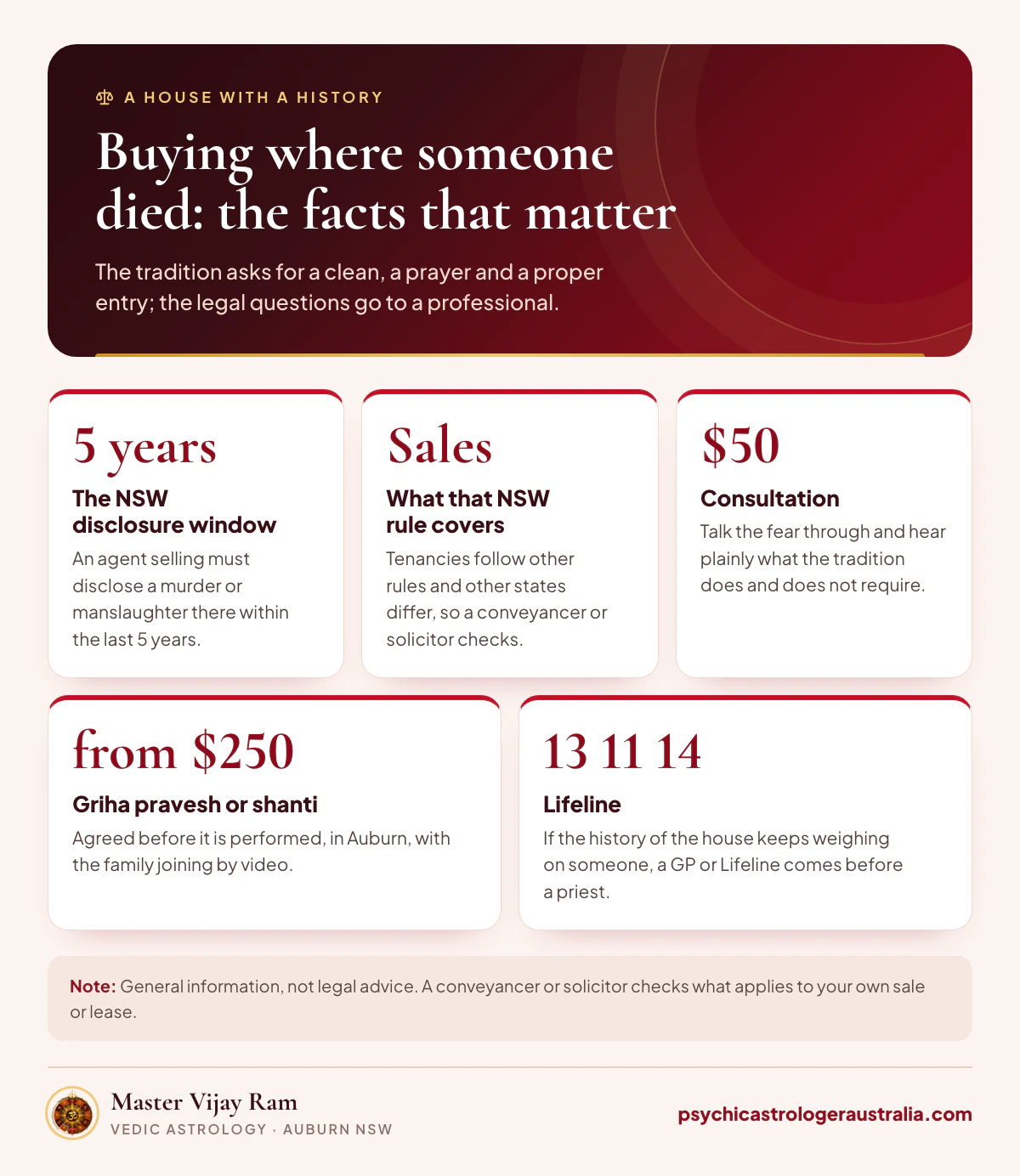
An agent selling residential property must disclose if, within the last 5 years, the property was the scene of a murder or manslaughter (a prescribed material fact).
That rule names those two crimes and that five-year window, and it is the heart of what people mean by material facts in NSW property sales where a death is concerned; it is not a register of every death, and a peaceful death in old age is not what it describes. If the history of the house matters to your family, ask the agent directly and in writing, and have your conveyancer or solicitor check what applies to the sale in front of you.
What about rentals and the other states?
Tenancies follow other rules, and other states differ. A family renting in Newcastle, buying in Hobart or Canberra, or settling on a house in Geelong or on the Sunshine Coast should not assume the NSW sales rule covers them, and a conveyancer or solicitor checks.
The practical habit is the same everywhere. Put the question in writing before you sign, keep the answer with your contract or lease, and let a professional, not a forum thread, tell you what the law requires where you are buying or renting.
Fear or fact: what are families really worried about?
Most of the worry about buying a house where someone died falls into a few familiar shapes. The table sets each against what is actually known and what helps.
| The fear | What is known | What helps |
|---|---|---|
| The person's spirit stays in the house | Folk belief says so after sudden deaths; the classical rites address it through the departed's own family | A lamp and a prayer for their peace on the first evening |
| A death makes the house inauspicious | The tradition does not curse a house for a death; it asks for a clean and a proper entry | A shuddhi clean and a griha pravesh on a chosen muhurat |
| The agent hid something | In NSW the prescribed material fact covers murder or manslaughter within 5 years; other deaths and other states differ | Ask in writing; your conveyancer or solicitor checks |
| We will never be able to sell it | Some buyers avoid stigmatised property and others do not mind | Ask your conveyancer and a local agent before you commit |
| The children will be frightened | Children take their cue from the adults around them | A simple, honest sentence; no ghost stories |
| Something still lingers in one room | Smells, stains or old carpet are physical and treatable | Specialist cleaning, new flooring, fresh air |
None of the rows needs a remedy before the physical and legal ones have been done. Most need nothing more than a family deciding, together, that the house is theirs now.
Do you need to know the details?
Some families want to know everything, and some would rather not know at all; both are reasonable, and the decision is best made before the auction rather than after. The agent's written answer and your conveyancer's advice tell you what you need for the purchase.
Beyond that, leave the previous family their privacy. Their grief may still be raw and may live a few streets away, so nobody should be asked how it happened, and neighbourhood stories, which grow with every telling, are not evidence of anything.
Should we still buy it?
That is a decision about comfort, budget and resale, and the tradition does not make it for you. A family that would lie awake every night in a particular house has found a real cost, and walking away is a sensible choice; a family that feels for the old owner and loves the garden has found a home.
A $50 consultation can help a family talk the fear through and hear plainly what the tradition does and does not require. What it will never do is frighten you out of a purchase or into a ritual.
What should we do after settlement?
Practical things first: change the locks, test the smoke alarms, open every window and look honestly at the carpets, curtains and fittings. If the house has been closed up for months, damp and stale air will do more to unsettle a family than its history, and checking for mould, damp and gas comes before anything spiritual.
Then the clean the tradition calls shuddhi: floors washed, cupboards wiped, the whole house aired, and the room where the death happened given exactly the same care as the others and no more. Cleansing a house after the previous owner died needs nothing exotic, only thoroughness.
On the first evening, light a lamp and say a prayer for the peace of the person who lived there, by name if you know it. Then hold the griha pravesh on a good muhurat; for an established house it is the sapoorva form of entry, and nothing about a previous death changes it.
Buying a deceased estate: what about the things left behind?
Many such houses are sold by executors, and sometimes furniture, a shed full of tools or a cupboard of crockery comes with the keys. Keeping them is a practical and sentimental choice, and the folk idea that objects hold impressions, with the simple cleansing many families give them, is covered in second-hand furniture and whether objects carry energy.
Anything personal, such as photographs, letters, medals or religious images, belongs with the family. Ask the agent to pass it back to the executor rather than throwing it out; it is a small courtesy that a grieving family remembers.
Should the room be treated differently?
No. Setting a room apart, keeping its door shut or leaving it empty teaches the household to fear it, which is the opposite of what the shuddhi is for.
If one person is uneasy, let the room be a study or a guest room for the first months and let the family settle into it naturally. A child should never be given the room as a dare or told stories about it.
What if the death was violent or unexplained?
The practical response comes first again. Specialist cleaners deal with any physical trace properly, flooring and plaster can be replaced, and if the history keeps returning to someone's mind, a GP or Lifeline on 13 11 14 is the right first call, not a priest.
The tradition's response stays the same in kind: the departed's family keeps their own rites, and the new household prays for peace and enters properly. Where the family wants more for its own peace of mind, a shanti is performed for the household; it is never presented as removing something known to be present.
When is a reading worth having?
When the household has done the clean, the lamp and the griha pravesh, has lived in the house for a month, and still cannot settle in a way that began with the move. Then the charts of the household are read against the date of the move, as why a new home can feel wrong explains, and most such calls end with reassurance and an ordinary cause named.
Where the reading does find something, negative energy removal for the household is the next step, performed for the family that lives there now. Nobody, living or dead, is blamed.
What does it cost?
A consultation costs $50, held by phone, video or WhatsApp in English, Hindi or Punjabi. A griha pravesh or a shanti for the house begins at $250, a figure settled with you beforehand, and Master Vijay Ram conducts it himself in Auburn with the family welcome to join on screen; online puja and havan explains how that works.
He does not visit houses. A couple in Wollongong, reading by phone or video who bought a deceased estate is helped the same way as a family in Canberra or Hobart.
What a puja cannot tell you
It cannot tell you what happened in the house, whether a disclosure rule was followed or what the property will be worth when you sell. Those are questions for the agent in writing, your conveyancer or solicitor, and the market.
Vijay Ram ji's guidance is faith-based, not legal, financial, medical or psychological advice, and no particular result from a puja can be promised. What the tradition offers is a way to honour whoever lived there before and then begin, properly, as the family who lives there now.
Read next
- Cleansing the Home After a Death: Sutak, the Thirteen Days and ShuddhiSutak after a death, gently explained: what a Hindu home pauses for ten to thirteen days, the lamp, the terahvi, the …
- Bringing a Newborn Home: Sutak After Birth, the Naming Day and a Calm HouseSutak after birth, jatakarma and the naming day in Australia: what the house keeps, how it is cleansed, and why no sm…
- Signs of Negative Energy in Your Home & How to Clear ItSigns of negative energy in a home, the ordinary causes to rule out first, and how nazar, heavier interference and me…
Frequently asked questions
Does an agent have to tell me if someone died in the house?
In NSW an agent selling residential property must disclose if, within the last 5 years, the property was the scene of a murder or manslaughter, which is a prescribed material fact. That rule is not a register of every death. Tenancies follow other rules and other states differ, so ask the agent directly in writing and have a conveyancer or solicitor check what applies.
Is it bad luck in Hinduism to buy a house where someone died?
No. Death is part of the round of life the tradition describes, and for generations many Hindus hoped to die at home among their family. A peaceful death leaves no curse on a building. The custom for a new owner is the same as for any lived-in home: a thorough clean, a lamp and prayer for the departed’s peace, and a griha pravesh.
What should we do before moving into a house where the owner died?
Change the locks, test the smoke alarms, air the house and deal with any damp, stale carpet or closed-up smell. Then clean everything thoroughly, treating the room where the death happened like every other room. Light a lamp on the first evening with a prayer for the person who lived there, and hold the griha pravesh on a good muhurat.
Can we hold a griha pravesh in a house where someone died recently?
Yes. The ritual impurity after a death belongs to the departed’s own family, not to the next owner, so a buyer does not keep their sutak. For an established house the entry is the sapoorva form of griha pravesh, held on a muhurat chosen for your family after the shuddhi clean. A prayer for the person who died can open it.
Does a death in the house affect its vastu?
No. Vastu reads the layout of a home: its directions, entrance, fire, water and centre. It does not mark a room because of who died in it. If the house has a layout fault, that is a separate matter for a vastu reading, and the history of the occupants is answered with a clean, a prayer and a proper entry, not with a compass.
What if the death in the house was violent or a suicide?
Deal with the practical side first: specialist cleaners for any physical trace, and new flooring or paint where needed. If the history weighs on anyone, speak to a GP, or call Lifeline on 13 11 14. The departed’s family keeps their own rites. Your household prays for peace and enters properly, and a shanti can be held for your own peace of mind.
We are renting. Does the landlord have to tell us?
The NSW rule quoted for sales applies to agents selling residential property; tenancies follow other rules, and other states differ. Ask the agent or landlord in writing before you sign the lease and keep the answer. Your state’s fair trading or tenancy body, or a solicitor, can tell you what disclosure the law requires for a rental where you live.
Will Master Vijay Ram come and cleanse the house?
No. House calls are not part of his work anywhere; he practises only in Auburn. The family does the clean and the lamp at home, and any griha pravesh or shanti is performed by him in Auburn on the chosen muhurat, with the family watching on video if they like. Families in Canberra, Hobart or Geelong are helped in exactly the same way.
How do we explain it to the children?
Simply and honestly, at their level: someone lived here for a long time, they died, and we will say a prayer for them and make the house ours. Children take their cue from the adults, so a calm voice matters more than the words. Never give a child the room as a dare or tell ghost stories about it.
People also ask
What is a stigmatised property?
A stigmatised property is a home that buyers avoid for reasons unrelated to its condition, such as a death or a crime that happened there. The building may be perfectly sound. Some buyers will not consider such a house and others do not mind, so a buyer weighing one should ask a conveyancer and a local agent how it might affect them.
Is it okay to live in a house where someone died?
Yes. People have died at home for as long as there have been homes, and in the Hindu view a peaceful death leaves no curse on a house. What matters is that your family can live in it calmly. A thorough clean, a lamp and prayer for the person who died, and a proper house-warming help a household make it its own.
Do you have to disclose a death in a house in Australia?
It depends on the state and on whether it is a sale or a tenancy. In NSW an agent selling residential property must disclose if, within the last 5 years, the property was the scene of a murder or manslaughter. Tenancies follow other rules and other states differ, so ask in writing and have a conveyancer or solicitor check.
How is a house cleansed after a previous owner died there?
If it is your own family’s loss, the sutak and shuddhi customs of your family apply. If you bought the house, air it, deal with any damp or stale carpet, clean every room thoroughly, light a lamp with a prayer for the person who died, and hold a griha pravesh on a chosen muhurat.
Does a house where someone died have negative energy?
Not because of the death itself. A house that has been closed up after an owner died often has damp, stale air and dust, which make it feel heavy, and those are fixed with fresh air and cleaning. A household that still cannot settle a month after a proper entry can have its charts read against the date of the move.
References & further reading
Serving clients across Australia
Confidential consultations by phone, video & WhatsApp — including: