
Quick answer
Chhaya daan is a Saturday offering to Shani in which you look at your reflection in mustard oil in an iron or steel bowl and then give the oil away. It is named after Chhaya, Shani’s mother, and is kept during Sade Sati, Dhaiya or a hard Saturn period. The oil is never eaten afterwards, and it shortens nothing.
What is chhaya daan?
Chhaya daan is a Saturday offering to Shani, the planet Saturn, in which a person looks at their own reflection in a bowl of mustard oil and then gives the oil away. Chhaya means shadow or reflection and daan means a gift, so the name says exactly what happens: you give away your shadow. Families keep it through Sade Sati, Dhaiya or a hard Saturn period, usually for a run of Saturdays.
It is one of the gentlest of the Saturn practices, and one of the most misunderstood. Sade Sati and Shani remedies sets out how Master Vijay Ram reads Saturn’s pressure in a chart; this page is about the custom itself, what it means, and how to keep it properly in an Australian city.
Who was Chhaya, and why is the offering named after her?
In the story told in the Puranas, Sanjna, the wife of Surya the Sun, could not bear her husband’s brilliance. She made a shadow of herself, Chhaya, to stay in her place and slipped away, and Chhaya bore Surya children of her own, among them Shani. Versions differ in their details, but they agree that Shani is the son of the shadow.
That is the logic of Shani chhaya daan. Saturn is the child of a reflection, so the offering made to ease his weight is a reflection too: your face in the dark oil, given away. It also explains the old enmity the tradition reads between the Sun and Saturn, a father and son who never quite reconciled.
How is chhaya daan done on a Saturday?
Traditions differ, but the common form is short. After bathing on a Saturday, pour mustard oil into an iron or steel bowl, enough to see your face, and some families drop in a coin. Look at your reflection for a few moments while saying a Shani mantra, then give the oil away the same day without bringing it back into the house.
The mantra most families use is the Saturn beej mantra, Om Praam Preem Praum Sah Shanaye Namah, and a family’s own version is just as good. Many keep the practice for a set number of Saturdays, often seven or eleven; others keep it on every Saturday of a difficult phase, and some only on a Shani Amavasya, an Amavasya that falls on a Saturday by the local panchang.
The attitude matters more than the method. The custom is an act of humility, not a transaction, and it is done quietly, without telling the neighbourhood or photographing the bowl.
Why mustard oil and an iron bowl?
Iron is Saturn’s metal in the tradition, and dark oils are his, which is why black sesame, black urad, iron, a dark blanket and mustard or sesame oil are the classic Saturday gifts. Steel is iron at heart and is what most Australian kitchens own, so a steel katori is accepted almost everywhere; some families buy a small iron bowl just for the purpose and give it away with the oil.
Sesame oil is the alternative some families prefer, particularly in the south, and nothing is lost by using it. A mustard oil donation on a Saturday is the north Indian habit, and in many Indian markets men still walk from shop to shop with a bucket of oil and a small Shani image, collecting exactly this offering.
Who is usually advised to do it in 2027?
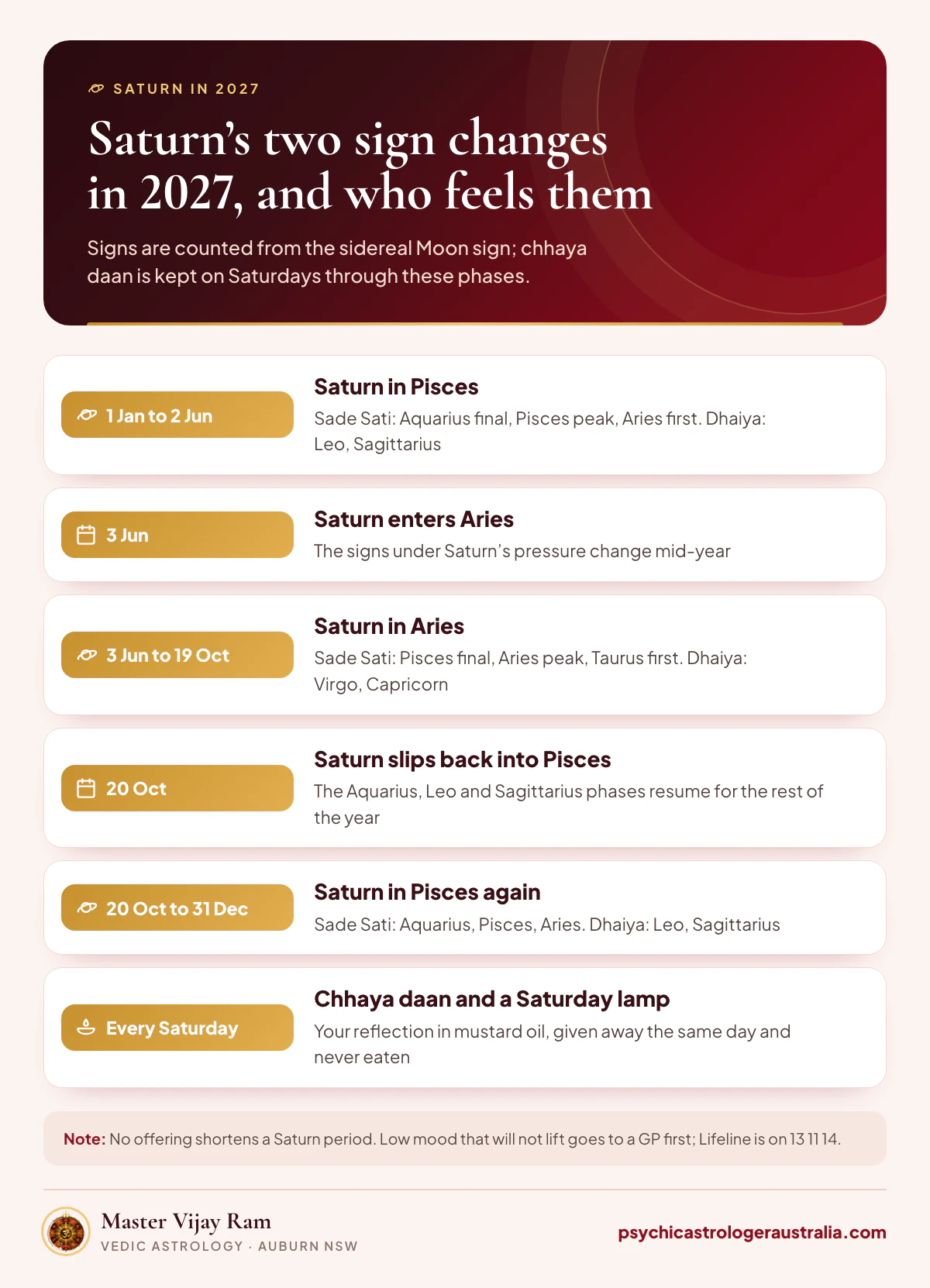
Chhaya daan is traditionally suggested to people under Saturn’s pressure: those in Sade Sati, in Dhaiya, in a Shani mahadasha or antardasha, or with an afflicted Saturn in the birth chart. Saturn crosses from Pisces into Aries on 3 June 2027 and retreats into Pisces on 20 October 2027, so the signs affected change mid-year, as the table shows.
| Moon sign | 1 Jan – 2 Jun | 3 Jun – 19 Oct | 20 Oct – 31 Dec |
|---|---|---|---|
| Aries (Mesha) | Sade Sati — first phase | Sade Sati — peak | Sade Sati — first phase |
| Taurus (Vrishabha) | — | Sade Sati — first phase | — |
| Gemini (Mithuna) | — | — | — |
| Cancer (Karka) | — | — | — |
| Leo (Simha) | Ashtama Shani (8th) | — | Ashtama Shani (8th) |
| Virgo (Kanya) | — | Ashtama Shani (8th) | — |
| Libra (Tula) | — | — | — |
| Scorpio (Vrishchika) | — | — | — |
| Sagittarius (Dhanu) | Kantaka Shani (4th) | — | Kantaka Shani (4th) |
| Capricorn (Makara) | — | Kantaka Shani (4th) | — |
| Aquarius (Kumbha) | Sade Sati — final phase | — | Sade Sati — final phase |
| Pisces (Meena) | Sade Sati — peak | Sade Sati — final phase | Sade Sati — peak |
Saturn enters Vedic Aries on 3 June 2027 (9:58 am AEST), slips back into Pisces on 20 October 2027 (12:42 pm AEDT) and re-enters Aries on 24 February 2028 (Sydney time). Computed with the Swiss Ephemeris (Lahiri ayanamsa for Vedic positions) and checked against US Naval Observatory data. Times are rounded to the minute.
Two points the table makes plain: Pisces and Aries Moons are in Sade Sati all year, and four Dhaiya signs share the year between them, Leo and Sagittarius while Saturn is in Pisces, Virgo and Capricorn while it is in Aries. The signs are counted from the sidereal Moon sign, not the Western sun sign, and Sade Sati in 2027, sign by sign reads each phase in detail.
Where does the oil go in Australia?
In India the oil goes to a Shani temple, a collector at the market or the foot of a peepal tree. Here the choices are different, and none of them involves pouring oil onto a tree, into a garden or down a drain.
| Option | How it works | Practical note |
|---|---|---|
| The temple’s Shani, Navagraha or Hanuman shrine | The oil is offered to light the shrine’s lamps on a Saturday | Ask first: some temples welcome oil, some want sealed bottles, some take none |
| A gift of food or money instead | The oil is set aside and a meal, groceries or a donation goes to someone in need | Keeps the daan, the giving, which is the heart of the rite |
| Respectful disposal | A small amount is soaked into newspaper and bagged with the household rubbish | Never down the sink, where it clogs pipes; ask your council about larger amounts |
| A collector in India | Relatives give it there on your behalf | The offering is yours in intention, wherever the oil goes |
Can the oil be eaten or cooked with afterwards?
No. Oil that has received your reflection in a chhaya daan is treated as carrying the weight you wanted to put down, so it is never used for cooking, never given to anyone to eat, and never poured back into the bottle. In India it is given to people who burn it in temple lamps, not to people who cook with it.
That is why the most practical Australian answer is often a substitution. Light the shrine’s lamp if the temple accepts the oil, and if it does not, give fresh food or money to a food bank, a langar, a shelter or a neighbour who is struggling, which honours the giving while the used oil is disposed of properly.
What about a mustard-oil lamp on Saturdays?
Many families light a lamp of mustard or sesame oil at dusk on Saturdays as part of the same observance, at home, at a temple’s Shani or Hanuman shrine, or both. It is the other half of the Saturday practice: the chhaya daan gives something away, and the lamp keeps a steady light through the evening.
Set it on a metal tray well clear of curtains, where small hands and paws cannot reach it, and do not walk away from it while it burns or cover a smoke alarm for it. Ghee or oil for a protective diya covers wicks, direction and timing.
How does chhaya daan sit beside Hanuman worship and the other Saturn remedies?
Comfortably, because they come from the same Saturday. In the story many families tell, Hanuman once freed Shani from Ravana’s captivity, and Shani promised in return not to trouble Hanuman’s devotees, which is why Saturday is a Hanuman day as well as a Shani one. The Hanuman Chalisa on Saturdays is the companion practice most families keep.
Every Shani remedy the tradition trusts looks like Saturn himself: routine, restraint, honest work, help for elderly people and those with little, and giving that expects nothing back. Chhaya daan fits that pattern, and a person who keeps it while ignoring the rest has missed its point. The nineteen-year Shani mahadasha explains why Saturn rewards conduct over ceremony.
When is a Shani shanti puja considered instead?
When the birth chart itself, not only the transit, shows Saturn bearing down on the Moon or on the lord of the ascendant, and Saturn’s own dasha or a period it spoils is running. Then a Shani graha shanti with mantra japa and a havan may be advised, usually on a Saturday chosen from the chart; most people in Sade Sati need nothing of the kind.
Master Vijay Ram’s consultation, $50 and held in English, Hindi or Punjabi on the phone, by video or over WhatsApp, places your Moon and your Saturn before any remedy is named. A shanti, havan or jaap starts from $250, the figure is fixed with you before anything is done, and pujas and havans performed in Auburn explains how families join the rite by video.
Saturday observances in Newcastle, Wollongong or Cairns
A steelworker in Wollongong on rotating shifts might keep the chhaya daan before an early Saturday start; a family in Geelong might take the oil to the Saturday lamp at a Melbourne temple once a month; a retiree in Cairns might give groceries to a food bank instead, because the nearest shrine is a long drive away. All three are keeping the same custom.
Those living in Wollongong, Geelong, the Sunshine Coast, Cairns or Townsville consult in the same way as readings for Newcastle clients, over the phone or on video and WhatsApp. North Queensland keeps one clock all year, so give your local time when you book, and in-person visits are at Auburn by appointment only.
What chhaya daan cannot do
It cannot shorten a Sade Sati, cancel a Dhaiya, clear a debt or lift low mood that has lasted for weeks. Saturn’s years are long, and the tradition is clear that they are met with steadiness rather than bargained away; a run of Saturday offerings is a discipline, not a payment.
If the heaviness is sadness that will not lift, a GP comes first, and Beyond Blue on 1300 22 4636 or Lifeline on 13 11 14 are there at any hour. This is faith-based guidance offered with no guarantee, not medical, legal or financial advice.
Read next
- Daan by Planet: What to Give and WhenDaan by planet: the traditional gifts and days for each graha, how to give them through Australian food banks, shelte…
- Peepal Tree Worship on Saturdays, and ShaniPeepal tree worship on Saturdays and Shani: what families do, where Ficus religiosa grows in Australia, root and fire…
- How to Remove Negative Energy From Yourself: Vedic MethodsVedic ways to clear negative energy from yourself: what to rule out first, safe home practices, the four-gate reset, …
Frequently asked questions
What is chhaya daan?
Chhaya daan is a Saturday offering to Shani in which you look at your reflection in mustard oil, poured into an iron or steel bowl, and then give the oil away. Chhaya means shadow or reflection and daan means gift. Families keep it during Sade Sati, Dhaiya or a difficult Saturn period, usually for a set number of Saturdays, as an act of humility rather than a bargain.
How do you do chhaya daan at home?
On a Saturday, after bathing, pour enough mustard oil into an iron or steel bowl to see your face, add a coin if your family does, and look at your reflection while saying a Shani mantra such as Om Praam Preem Praum Sah Shanaye Namah. Then give the oil away that day without bringing it back inside. Traditions differ on the details, and a family’s own version is fine.
Who should do chhaya daan in 2027?
It is traditionally suggested to people under Saturn’s pressure. In 2027 Pisces and Aries Moons are in Sade Sati all year, Aquarius Moons except between 3 June and 19 October, and Taurus Moons only during those months. Dhaiya falls on Leo and Sagittarius while Saturn is in Pisces and on Virgo and Capricorn while it is in Aries.
Who was Chhaya in Hindu mythology?
In the Puranic story, Sanjna, the wife of Surya the Sun, could not bear his brilliance, so she created a shadow of herself named Chhaya to take her place and left. Chhaya bore Surya children, including Shani, the planet Saturn. Versions of the story differ in detail, but all make Shani the son of the shadow, which is why the offering to him is a reflection.
Where do I give chhaya daan oil in Australia?
Ask your temple whether its Shani, Navagraha or Hanuman shrine accepts oil for its Saturday lamps; some do, some want sealed bottles and some take none. If it cannot go to a temple, give fresh food or money to someone in need instead and dispose of the oil properly, soaked into newspaper and placed in the rubbish. Never pour it on a tree, into a garden or down the sink.
Can I cook with the oil after chhaya daan?
No. Oil that has received your reflection is treated as carrying what you wanted to put down, so it is never cooked with, never given to anyone to eat and never poured back into the bottle. In India it goes to people who burn it in temple lamps. If no temple can take it, give fresh food or money to someone in need and dispose of the oil.
Should I use mustard oil or sesame oil?
Either is traditional. Mustard oil is the north Indian habit for Saturday offerings, and sesame oil is preferred in many South Indian families and for Shani lamps generally. Both are dark oils associated with Saturn, and the custom does not depend on the choice. What matters is the bowl of iron or steel, the quiet moment with your reflection and giving the oil away the same day.
Does chhaya daan reduce Sade Sati?
No offering shortens Sade Sati or changes the dates Saturn moves. The tradition treats chhaya daan as a discipline that steadies a person through Saturn’s years, alongside routine, honest work, care for elderly people and anyone doing it hard, and patience. If a hard Saturn period is bringing low mood, debt or ill health, a GP, a financial counsellor or a lawyer comes first, with the practice beside them.
Does Master Vijay Ram perform chhaya daan for clients?
No; chhaya daan is the person’s own offering and only makes sense done by them. What he offers is a $50 consultation that places your Moon and your Saturn and says whether the practice suits you. Where a chart shows a deeper Saturn affliction, a Shani shanti, havan or jaap may be advised, from $250 with the price settled beforehand, and he performs it personally at Auburn.
People also ask
What is Shani chhaya daan?
Shani chhaya daan is the Saturday custom of looking at your reflection in mustard oil in an iron or steel bowl, saying a Saturn mantra and giving the oil away. It is named after Chhaya, Shani’s mother in the Puranic story. People in Sade Sati, Dhaiya or a Saturn dasha often keep it for seven or eleven Saturdays, or for every Saturday of a hard phase.
Why is mustard oil donated on Saturday?
Saturday is Shani’s day, and dark oils such as mustard and sesame are traditionally his, along with iron, black sesame and black urad. Giving them away on a Saturday is an old way of honouring Saturn through humility and generosity. In India the oil goes to Shani temples and lamps; in Australia ask your temple first, and give food or money if it cannot take oil.
What should I not do in chhaya daan?
Do not cook with the oil afterwards, give it to anyone to eat, pour it back into the bottle, or pour it onto a tree, into a garden or down the sink. Do not bring it back into the house once given, and do not turn the rite into a bargain or a public display. Keep any Saturday lamp on a metal plate and never leave it burning alone.
Can chhaya daan be done on any day?
It is a Saturday practice, because Saturday belongs to Shani, and many families also keep it on a Shani Amavasya, an Amavasya that falls on a Saturday by the local panchang. Some do it in the morning after bathing and some at dusk. Take the Saturday dates you need from your temple’s panchang rather than an Indian calendar, because the local day can differ.
References & further reading
Serving clients across Australia
Confidential consultations by phone, video & WhatsApp — including: