
Quick answer
Dosha cancellation is the set of rules by which a chart defect is neutralised: a planet in its own or exalted sign, a Jupiter aspect, a strong house lord, or the same dosha in both charts of a match. Most kundlis an app flags carry one of these. Master Vijay Ram checks the cancellations first and recommends a remedy only for what survives them.
What is dosha cancellation?
Dosha cancellation is the part of Jyotish that apps leave out: the set of conditions under which a defect in the chart is neutralised, softened or turned to use. A dosha is a weight on one side of the scale, and every classical text that lists one also lists the placements that lift it. The Sanskrit words are bhanga, which means breaking, and parihar, which means setting aside; in North India people say the dosha is cut.
Master Vijay Ram's experience is that most people who arrive frightened by a bad kundli are carrying a chart whose doshas are already cancelled. The reading that tells them so takes an hour of care and $50, and it usually ends with no remedy at all. A dosha reading with him begins with the cancellations, not the fear.
Why do apps and websites find doshas everywhere?
Because a dosha is easy to test for and a cancellation is not. Software can see Mars in the seventh house in a second; weighing whether that Mars is in its own sign, aspected by Jupiter, or matched by the same Mars in the partner's chart takes judgement, and judgement is not what an app sells. The result is a generation of Indian-Australians who have been told they are manglik, or have Kaal Sarp Dosh, by a screen that never looked at the rest of the chart.
There is also a commercial reason. A defect sells a remedy; a cancellation sells nothing. Vijay Ram ji has heard of families quoted thousands of dollars for pujas against doshas that a first-year student of Jyotish would have cancelled on sight.
The general rules that cancel almost any dosha
A few principles run through every specific rule, and knowing them lets you read a dosha report with some scepticism. A planet in its own sign, its exaltation sign or its moolatrikona is rarely a source of dosha, whatever house it sits in. Jupiter's aspect on the afflicted planet or house is the single most common cancellation in the texts. A strong lord of the afflicted house, and a strong ascendant lord, carry the chart through most of what any single placement can do.
The fourth principle is the dasha. A cancelled dosha stays cancelled, but even an uncancelled one is felt only in the periods of the planets involved. The Vimshottari dasha is the clock that decides whether a defect is live or sleeping.
Manglik dosha: the most cancelled dosha of all
Mars in the first, second, fourth, seventh, eighth or twelfth house from the ascendant, the Moon or Venus is called Manglik, and by that count close to half of all charts qualify, which should tell you something. The cancellations are as classical as the dosha: Mars in Aries, Scorpio or Capricorn, Mars in the first house in Aries, in the fourth in Scorpio, in the seventh in Cancer or Capricorn, in the eighth in Sagittarius or Pisces, in the twelfth in Taurus or Libra; Mars conjunct or aspected by Jupiter; and the dosha present in both partners' charts, where it is understood to cancel itself.
Vijay Ram ji's rule is that a Manglik reading is never given from one chart alone when a marriage is the question. The full treatment, including the remedies for the rare uncancelled case, is in the guide to Manglik dosha and marriage, and the Manglik dosha service page explains how he checks both charts.
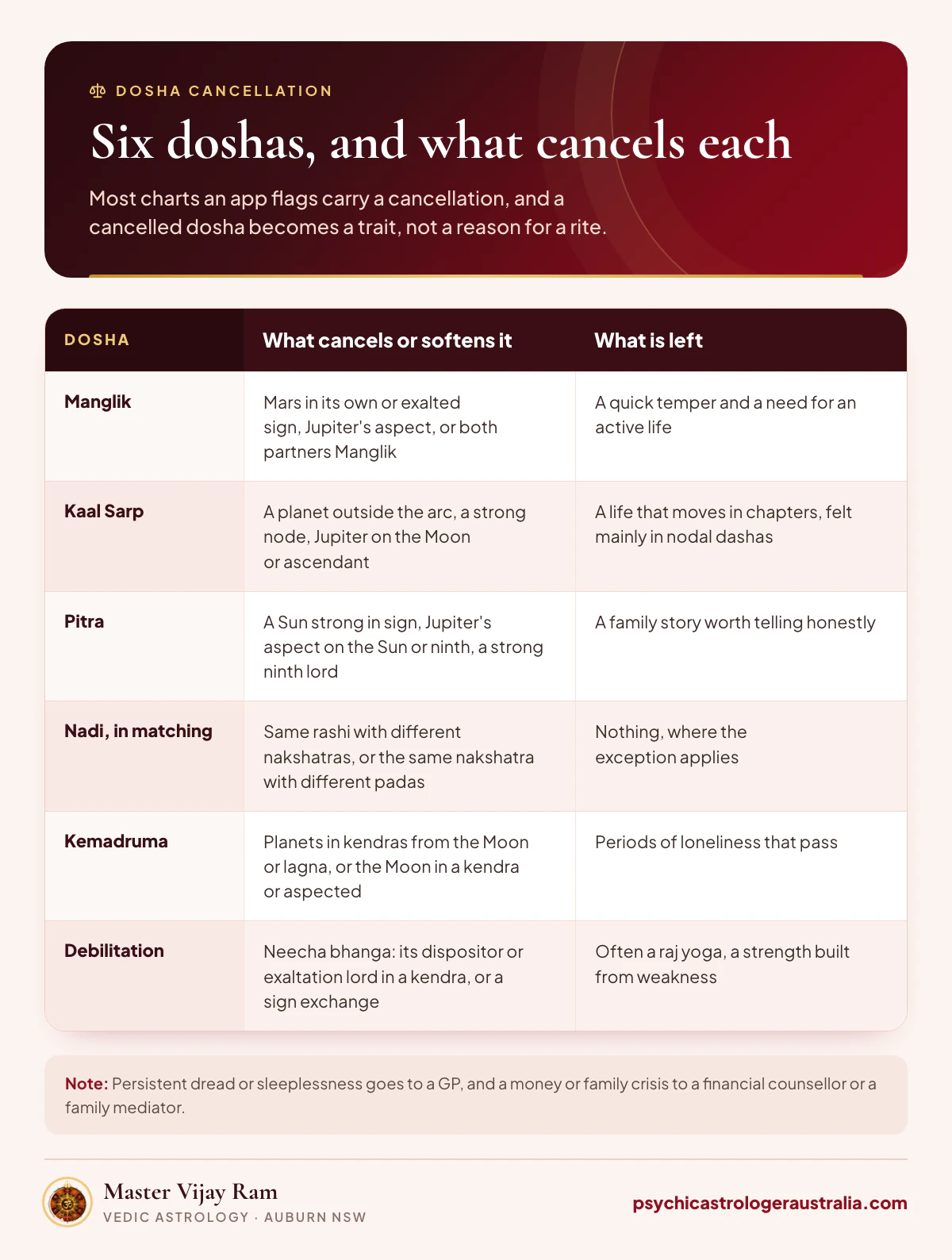
A table of the common doshas and what cancels them
| Dosha | What it needs to exist | What cancels or softens it | What is left when cancelled |
|---|---|---|---|
| Manglik (Mangal) | Mars in 1st, 2nd, 4th, 7th, 8th or 12th | Mars in own or exalted sign; Jupiter's aspect; the same dosha in the partner's chart; the placements listed above | A quick temper and a need for an active life, usually |
| Kaal Sarp | All planets between Rahu and Ketu | Any planet outside the arc; a node in own or exalted sign; Jupiter on the Moon or ascendant; strong ascendant lord | A life that moves in chapters, felt mainly in nodal dashas |
| Pitra | Afflicted Sun, Moon, 9th or 5th house | Sun strong in sign; Jupiter's aspect on the Sun or 9th; strong 9th lord | A family story worth telling honestly |
| Nadi (in matching) | Both partners in the same nadi | Same rashi with different nakshatras; same nakshatra with different padas, by most schools | Nothing, where the exception applies |
| Bhakoot (in matching) | Moon signs in a 6-8, 2-12 or 5-9 relation | Both Moon signs ruled by the same planet or by friendly planets | A difference in temperament to be managed |
| Gandmool | Moon in Ashwini, Ashlesha, Magha, Jyeshtha, Mula or Revati | Shanti on the nakshatra's return, traditionally the 27th day; benign padas | An intense Moon and nothing to fear |
| Kemadruma | No planet in the signs either side of the Moon | Planets in kendras from the Moon or the ascendant; Moon in a kendra; Moon with or aspected by a planet | Periods of loneliness that pass |
| Grahan (eclipse) | Sun or Moon conjunct Rahu or Ketu | Wide separation in degree; Jupiter's aspect; the luminary strong in sign | Sensitivity to the father's or mother's moods |
| Shrapit | Saturn conjunct Rahu | Jupiter's aspect; Saturn in own sign; the conjunction in a house where both are functional benefics | A need for honesty about the past |
| Neecha (debilitation) | A planet in its fall | Neecha bhanga: the dispositor or exaltation lord in a kendra from the Moon or ascendant; exchange of signs; the planet retrograde by some schools | Often a raj yoga, a strength built from weakness |
The table is a map, not the territory. Each cancellation has its own degree of strength, and two weak cancellations do not add up to one strong one; that is where the reading, rather than the rule, decides.
Kaal Sarp, Pitra and the nodal doshas
The nodal doshas are the ones most often announced and least often real. Kaal Sarp Dosh needs every planet inside the Rahu–Ketu arc, and a single planet outside it dissolves the pattern under the strict rule; the Kaal Sarp Dosh guide explains the mean-node and true-node question that decides borderline charts. Pitra Dosh needs several afflictions together around the Sun and the ninth house, and a strong Sun or a Jupiter aspect sets most of them aside, as the guide to Pitra Dosh shows.
A useful test for any nodal dosha is the question of dignity. Rahu in Taurus, Gemini or Virgo and Ketu in Scorpio, Sagittarius or Pisces are placements many schools treat as strong, and a strong node does not make a dosha; it makes an appetite.
Doshas in kundli matching: the two-chart rule
In matching, a dosha is cancelled most simply by being shared. Two Manglik charts are read as balanced; two charts with the same Nadi are the one exception to that rule and are read by their rashis and nakshatras instead. The guide to Gun Milan and low scores covers the Ashtakoot points in detail, and the principle behind all of it is that a match is read as a pair, never as two separate verdicts.
Vijay Ram ji's working rule for families in Australia, where a match often spans two cities and two time zones, is that no dosha in matching is decided until both charts are on the table at once.
Neecha bhanga: when a weak planet becomes a strong one
Debilitation is the dosha that most often turns into a gift. A planet in its fall is cancelled, and by the classical rule raised to a raj yoga, when the lord of the sign it sits in, or the lord of its exaltation sign, stands in a kendra from the Moon or the ascendant; when the planet exchanges signs with its dispositor; or, by some schools, when it is retrograde. The person with a debilitated Saturn in Aries and a well-placed Mars in a kendra tends to build the discipline Saturn lacked, and the chart shows the building.
The broader lesson is the point of this whole subject. The texts never treated a defect as a sentence, and the yogas that make a chart remarkable are often assembled from exactly the placements a dosha list would have condemned; the guide to raj yoga and dhan yoga shows how.
What is left after cancellation, and does it need a remedy?
A cancelled dosha is not erased; it becomes a trait. Cancelled Manglik is usually a quick temper and a need for exercise, cancelled Kemadruma a taste for solitude, cancelled Pitra Dosh a family story that needs telling. None of those needs a puja, and most of them need a habit: a run before an argument, a phone call on a Sunday.
The bad kundli remedies that are actually warranted are for the uncancelled cases, and there the rite is specific: a Mangal shanti for the rare true Manglik, a Rahu–Ketu shanti for a full and active Kaal Sarp pattern, a shraddha for a real Pitra Dosh. Master Vijay Ram performs those personally at his own place of practice in Auburn, on a muhurat chosen for the chart, with the family joining by video; the online puja and havan page explains the day.
What does a dosha reading cost?
A consultation is $50, and in the majority of dosha readings it ends with the news that nothing further is needed. Where a remedy is warranted, spell or prayer work starts from $250 and the figure is agreed with you before anything is performed. That is the whole price list; a practitioner who finds three uncancelled doshas in every chart and a puja for each is running a business model, not a reading.
Kundli dosh nivaran versus dosha parihar: the words
Kundli dosh nivaran is the North Indian phrase for removing a dosha, and it usually means a shanti puja. Dosha parihar is the South Indian phrase and leans towards remedy and setting aside, which can mean a puja, a vow, a donation or a change of conduct. Families who speak Hindi and Tamil at the same wedding sometimes argue about the words while agreeing about the chart, and Vijay Ram ji's advice is to argue less about the words and more about whether the dosha was ever real.
When the chart is not the problem
A reading that finds every dosha cancelled and a client still frightened has found the real subject. Persistent dread, sleeplessness and the conviction that something is wrong are matters for a GP, and money or family crises are matters for a financial counsellor or a family mediator. Vedic astrology is faith-based guidance, not medical, legal or financial advice, and it is at its most useful when it says so.
How Master Vijay Ram reads doshas from anywhere in Australia
Readings run by phone, video or WhatsApp in English, Hindi or Punjabi, with clients from Adelaide, Newcastle, the Sunshine Coast, the Central Coast, Melbourne and Hobart, and in person in Auburn by appointment. Send your birth details and, if the question is a match, the partner's as well; a screenshot of the app that frightened you is useful too, because he will show you on the same chart where the cancellation sits.
A full kundli reading places every dosha in the context of the yogas, the dasha and the strength of the planets, which is the only context in which a dosha means anything.
Read next
- Grahan Dosha: Sun or Moon with Rahu or Ketu in the Birth ChartGrahan dosha, the Sun or Moon with Rahu or Ketu, explained calmly: the four forms, what each colours, what changes it…
- Pitra Dosh: Signs Ancestral Karma Is Affecting YouPitra Dosh explained: the chart placements that show it, the signs families report, Pitru Paksha 2027 dates for Austr…
- Kundli Reading Explained: What Your Birth Chart RevealsWhat a Kundli reading reveals about your life, personality, career and destiny. Master Vijay Ram explains Vedic astro…
Frequently asked questions
What does dosha cancellation mean in a kundli?
It means a placement elsewhere in the chart neutralises or softens a defect. The texts call it bhanga, breaking, or parihar, setting aside. The common cancellations are a planet in its own, exalted or moolatrikona sign, Jupiter's aspect on the afflicted planet or house, a strong lord of that house, and in matching the same dosha in both charts. A cancelled dosha leaves a trait behind rather than a problem, and does not need a remedy.
How do I know if my Manglik dosha is cancelled?
Check where Mars sits and in which sign. Mars in Aries, Scorpio or Capricorn, Mars in the first house in Aries, the fourth in Scorpio, the seventh in Cancer or Capricorn, the eighth in Sagittarius or Pisces, or the twelfth in Taurus or Libra, all cancel it by the classical rules, as does Jupiter's conjunction or aspect. If both partners are Manglik the dosha balances. Master Vijay Ram reads both charts together before saying a word about it.
Is Kaal Sarp Dosh cancelled if one planet is outside the axis?
Under the strict rule, yes: Kaal Sarp Dosh needs all seven planets between Rahu and Ketu, and a single planet outside the arc dissolves it. Some astrologers read a partial pattern as a mild dosha; Master Vijay Ram reads it as a note rather than a headline. Borderline charts depend on whether the mean or true node is used and on the exact degree of a planet near the line, which is why an app cannot settle them.
What is Neecha Bhanga Raj Yoga?
It is the cancellation of a debilitated planet that turns weakness into strength. The classical conditions are that the lord of the sign the planet sits in, or the lord of its exaltation sign, stands in a kendra from the Moon or the ascendant; that the planet exchanges signs with its dispositor; or, by some schools, that it is retrograde. The person usually builds, through effort, exactly the quality the debilitated planet lacked, and the chart shows the building.
Does a dosha in both charts cancel in kundli matching?
For Manglik dosha, yes: two Manglik charts are read as balanced. Nadi dosha is the exception, since both partners sharing a nadi is the dosha itself; it is cancelled instead when the Moon signs are the same with different nakshatras or the nakshatra is the same with different padas, by most schools. Bhakoot dosha is cancelled when the two Moon signs are ruled by the same or friendly planets. All of it is read as a pair.
Do I need a puja if my dosha is cancelled?
No. A cancelled dosha survives as a trait, a quick temper, a taste for solitude, a family story, and traits need habits rather than rites. Master Vijay Ram recommends a shanti puja only for an uncancelled dosha that is active in the current dasha, and he says plainly when that is not the case. A practitioner who finds an uncancelled dosha and a puja in every chart is running a business model, not a reading.
How much does a dosha check cost with Master Vijay Ram?
A consultation is $50, and most dosha readings end there with the news that the chart is fine. Where a remedy is genuinely warranted, spell or prayer work starts from $250 and the figure is agreed with you before anything is performed. Readings run by phone, video or WhatsApp anywhere in Australia, in English, Hindi or Punjabi, and in person in Auburn by appointment.
What is the difference between dosh nivaran and dosha parihar?
Nivaran is the North Indian word for removal and usually means a shanti puja. Parihar is the South Indian word and leans towards remedy and setting aside, which can mean a puja, a vow, a donation or a change of conduct. The chart is the same whichever word your family uses; the useful question is not which word to use but whether the dosha was real and uncancelled in the first place.
Can a bad kundli be made good?
A chart does not change, but the phrase bad kundli almost always describes a chart read without its cancellations. Read properly, most such charts carry their defects already neutralised, and several carry raj yogas assembled from the very placements a dosha list condemned. For the rare uncancelled and active dosha there are specific remedies, and for the person carrying fear about their chart there is the reading itself, which is where the fear usually ends.
People also ask
Which dosha is most dangerous in a kundli?
None deserves the word, and the ranking people find online is marketing. In Master Vijay Ram's experience the doshas that cause the most harm are the ones announced without their cancellations, because fear does damage that no placement does. An uncancelled affliction of the ascendant lord or the Moon in a difficult dasha is what an astrologer actually watches for, and that is read from the whole chart.
How many doshas are there in Vedic astrology?
Dozens are named in the texts and in later practice: Manglik, Kaal Sarp, Pitra, Nadi, Bhakoot, Gandmool, Kemadruma, Grahan, Shrapit, Vish, Angarak and more. Every one of them comes with cancelling conditions in the same texts. The number matters less than the method, which is to weigh each placement against the dignity of the planet, the aspects on it and the dasha running.
Can a dosha be removed by puja?
A puja does not change the chart; it addresses the person and the pattern the chart describes. For a genuinely uncancelled dosha that is active in the current dasha, a specific shanti, performed personally with sankalp in your name, is the traditional remedy and often brings a steadiness people notice. For a cancelled dosha it is unnecessary, and Master Vijay Ram says so rather than performing it.
At what age does Manglik dosha end?
The belief that it ends at 28 is folk tradition rather than text, and the honest version is that Mars matures around that age and that most people have passed through the difficult Mars periods by then. The dosha itself is either cancelled at birth or not. A reading of both charts settles the question far better than waiting for a birthday.
Is a low gun milan score a dosha?
No. Gun Milan is a points system across eight factors, and a low score usually comes from Nadi or Bhakoot, both of which have their own cancellations. A match with eighteen points and both exceptions applying can be a better match than one with thirty and a conflict in the seventh houses. The score is a starting point for a reading, never the verdict.
References & further reading
Serving clients across Australia
Confidential consultations by phone, video & WhatsApp — including: