
Quick answer
Grahan dosha describes a birth chart where the Sun or the Moon shares a sign with Rahu or Ketu, named after the eclipses those nodes produce. The name is modern, not a classical Parashari yoga, and the pairing is common. How much it matters depends on the sign, how close the light is to the node, the house, the aspects and the dasha.
What is Grahan dosha?
Grahan dosha is a label given to a kundli when the Sun or the Moon occupies the same sign as Rahu or Ketu, the two lunar nodes. Grahan means eclipse, and the label borrows the image of a light being swallowed: the Sun or Moon, the two lights of the chart, sitting beside the shadow points that eclipses happen near. There are four forms, the Sun with Rahu, the Sun with Ketu, the Moon with Rahu and the Moon with Ketu.
People usually find the phrase grahan dosh in kundli reports produced by software, often printed in red with a puja suggested underneath. A calmer reading asks two questions: what does this pairing tend to colour, and what in this chart strengthens or softens it? Where a remedy is genuinely warranted, the usual rite is a graha shanti puja for the lights; a great many charts need nothing of the kind.
Why is it named after an eclipse?
An eclipse can only happen when a new or full Moon falls close to one of the nodes, the two points where the Moon's path crosses the Sun's. Vedic tradition gives those points bodies and names, Rahu and Ketu, and tells of a demon who drank the nectar of immortality and was cut in two, his head and tail chasing the Sun and Moon ever since. The story is a picture of real geometry.
A birth chart with the Sun or Moon beside a node does not mean the person was born during an eclipse. It means only that one of the lights shared a sign with a node on that day, and a sign is thirty degrees wide. The difference matters, and it comes up again further down.
Is Grahan dosha a classical yoga?
No. Like Guru Chandal and Shrapit, the name comes from modern writing rather than from the yogas of the Parashari tradition. The texts do discuss the Sun, the Moon and the nodes, and they treat an afflicted light seriously, but the single frightening name and the idea that it is a curse belong to modern writing.
The pairing still deserves attention. A light beside a node is read with the ordinary tools of a chart reading, its sign, house, aspects, strength and timing, and never by its nickname alone.
How common is the placement?
Very common. The Sun spends about a month in each sign and the nodes move slowly, so in any year the Sun shares a sign with Rahu for about a month and with Ketu for about another. The Moon passes both nodes every month, spending two to two and a half days in each sign, so it sits with one node or the other for several days of every month.
Put together, a good share of all people carry one of the four forms. Something that ordinary cannot be a rare misfortune, and Master Vijay Ram starts many readings by saying exactly that to a worried parent in Adelaide or Hobart.
What are the four forms, and what does each colour?
The Sun stands for the self, the father, authority and vitality; the Moon for the mind, the mother, feelings and sleep. Rahu magnifies and unsettles, and Ketu withdraws and detaches. The table pairs them.
| Pairing | Name used online | Traditionally said to colour | What tends to soften it |
|---|---|---|---|
| Sun with Rahu | Surya grahan dosha | Ambition with self-doubt, friction with fathers or bosses, a hunger for recognition | A dignified Sun, Jupiter's aspect, a strong ninth lord |
| Sun with Ketu | Surya grahan dosha | Modesty that undersells itself, distance from status, a distant father, spiritual interest | A strong lagna lord, a supportive tenth house |
| Moon with Rahu | Chandra grahan dosha | A vivid, restless mind, strong intuition, worry and broken sleep in hard periods | A bright, waxing Moon, Jupiter's aspect, a strong fourth house |
| Moon with Ketu | Chandra grahan dosha | Inwardness, detachment, emotional reserve, a deep spiritual pull | A well-placed Moon by sign, benefic company, a steady daily routine |
Each line is a tendency the tradition describes, not a prediction. The same Moon with Rahu that gives one person sleepless nights gives another a gift for storytelling, design or reading a room, and often it gives both at different times of life.
What does the Sun with Rahu or Ketu traditionally describe?
A Sun Rahu conjunction is read as a strong drive for recognition joined to a nagging doubt about whether it is deserved. The person may clash with fathers, teachers or managers, or may rise quickly in a field where they are the outsider, in government, media or a large organisation abroad. In the ninth house the tradition also links it with the father's line, which is why it appears among the indicators of Pitra dosh, read in the signs of Pitra dosh.
With Ketu the Sun's light turns inward. The tradition describes someone who does good work and dislikes taking credit for it, who may have had a father who was absent or remote, and who often feels more at home in service or spiritual life than on a stage. Neither form says anything about a person's worth; both say something about how they hold authority.
What does the Moon with Rahu or Ketu traditionally describe?
The Moon Rahu conjunction is the form people ask about most, because the Moon is the mind. The tradition reads a vivid imagination, sharp intuition, strong appetites and, in difficult periods, worry, overthinking and broken sleep. A nurse in Newcastle on rotating night shifts might ask whether her chart explains why she cannot switch off after work; the honest answer is that the chart may describe the tendency, and the shifts certainly feed it.
Chandra grahan dosh with Ketu reads differently: inward, private, sometimes detached from feelings that others expect to see, with a strong pull toward meditation or a quiet life. Any persistent low mood, anxiety or sleeplessness is a matter for a GP first, whatever the chart shows, and Healthdirect, listed below, is a good starting point. The Moon's own long period, when these themes are loudest, is described in the ten years of the Moon mahadasha.
What makes the conjunction heavier or lighter?
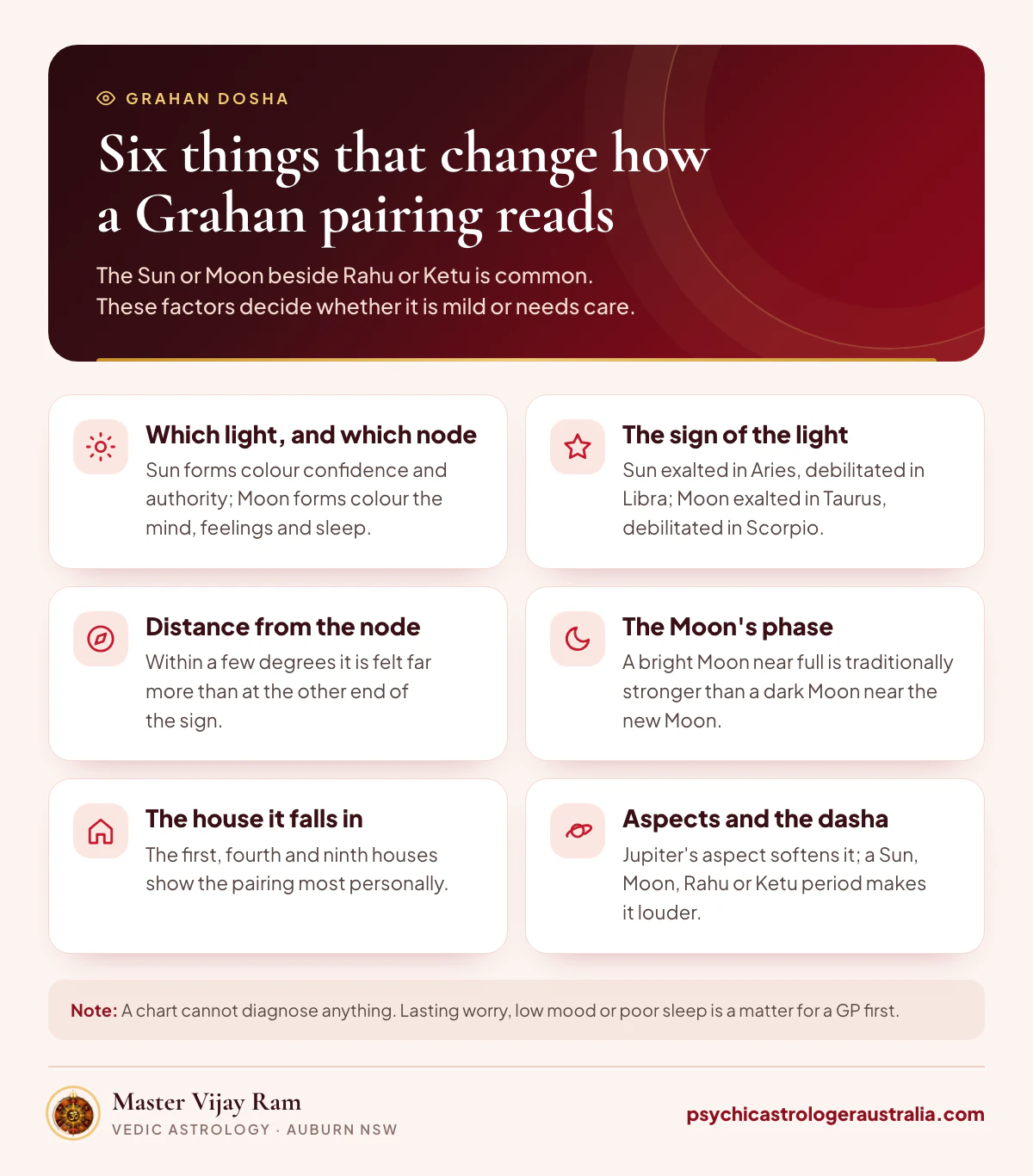
Several factors change the weight, and a reading goes through them in order:
- The sign: the Sun is exalted in Aries and debilitated in Libra; the Moon is exalted in Taurus and debilitated in Scorpio. A dignified light holds its own beside a node.
- The closeness: a light within a few degrees of a node is felt far more than one at the other end of the sign.
- The Moon's phase: a bright Moon near full is traditionally stronger than a dark Moon near the new Moon.
- The house: the fourth and the Moon, the ninth and the Sun, and the first house show the pairing most personally.
- The aspects: Jupiter's aspect is the classic softener, while Saturn or Mars bearing down on the pair makes it heavier.
When most of these point the same way the reading is clear. When they disagree, as they usually do, the result is a mixed and manageable picture rather than a dosha in the frightening sense.
When does a Grahan pairing become active?
In the dashas of the planets involved. The Sun's mahadasha runs 6 years, the Moon's 10, Rahu's 18 and Ketu's 7, and the sub-periods that join the light and the node are when the pairing speaks loudest. Many people carry the pairing quietly for years and only notice it in, say, a Moon period that coincides with university exams or a new baby.
The Sun's own six years are covered in the Surya mahadasha and its themes. Transits can also bring the natal pairing forward for a season, which is where the eclipses of the year come in.
Were you born during an actual eclipse?
A few people were, and that is a narrower thing than a Grahan conjunction. Being born during a solar eclipse means the Sun and Moon were together beside a node at that hour; during a lunar eclipse, the Moon stood opposite the Sun across the node axis. Some families ask for a shanti for a child born during an eclipse, and that is an old custom in its own right.
Most people with grahan dosh in kundli reports were born on an ordinary day. The software has simply noticed that a light and a node shared a sign, which, as above, happens for days or weeks at a time.
What do the 2027 eclipses mean for a natal Grahan?
Rahu stays in Capricorn and Ketu in Cancer for all of 2027, so the year's eclipses fall along that axis. An eclipse matters to a birth chart when it lands within a few degrees of the natal Sun, Moon or lagna; otherwise it passes as weather. The table gives the five eclipses and whether Australia can see them.
| Date (Sydney) | Eclipse | Greatest eclipse (Sydney) | From Australia | Notes |
|---|---|---|---|---|
| Sun 7 Feb 2027 | Annular solar eclipse | 3:00 am AEDT | Not visible from Australia | |
| Sun 21 Feb 2027 | Penumbral lunar eclipse | 10:13 am AEDT | Visible from Perth | Penumbral magnitude 0.93 |
| Mon 19 Jul 2027 | Penumbral lunar eclipse | 2:03 am AEST | Visible from Sydney, Brisbane, Adelaide, Darwin, Perth, Hobart | Penumbral magnitude 0.00 — too faint to notice |
| Mon 2 Aug 2027 | Total solar eclipse | 8:07 pm AEST | Not visible from Australia | |
| Tue 17 Aug 2027 | Penumbral lunar eclipse | 5:14 pm AEST | Visible from Sydney, Brisbane, Adelaide, Hobart | Penumbral magnitude 0.55 |
Computed with the Swiss Ephemeris (Lahiri ayanamsa for Vedic positions) and checked against US Naval Observatory data. Times are rounded to the minute.
Only the August lunar eclipse is visible in Adelaide, Hobart, Sydney and Brisbane, and the February one in Perth alone, while the two solar eclipses happen out of sight of Australia. What is traditionally observed during a visible eclipse, and why most of 2027 carries no sutak at all, is explained in the 2027 eclipses in Australia.
Which Grahan dosha remedies are traditionally used?
Grahan dosha remedies work on the light that is under strain. For the Sun, the tradition offers water to the rising Sun, the Aditya Hridayam or the Surya beej mantra, Om Hraam Hreem Hraum Sah Suryaya Namah, on Sundays, and respect for one's father and elders. For the Moon there is Monday prayer to Shiva, the Chandra beej mantra, Om Shraam Shreem Shraum Sah Chandraya Namah, care for one's mother and a regular sleep routine; spellings vary, and a family's own version is fine.
For the node itself, Durga worship is the usual practice for Rahu and Ganesha worship for Ketu. Many families also keep a mantra quietly through a visible eclipse. None of this replaces medical care, and none of it needs to be bought.
Does a Grahan pairing need a shanti, and at what price?
Only some do: those where the light is close to the node, weak by sign or phase, placed in a sensitive house and running the dasha of one of the planets involved. Master Vijay Ram performs it in person in Auburn, timed to a muhurat that suits the chart, and families in Canberra, Wollongong or the Gold Coast can watch by video. Spell or prayer work starts from $250 and the figure is agreed before anything is done; the online puja service describes the process.
When the Sun with Rahu sits in the ninth with other ancestral indicators, the reading may point instead to the rites described under Kaal Sarp and Pitra dosh remedies. Either way the consultation comes first and costs $50, and it often ends with no puja at all.
How does Master Vijay Ram read a light beside a node?
He looks at which light and which node, the sign and the degrees between them, the Moon's phase, the house, Jupiter's and Saturn's aspects, the navamsa and the dasha now running, and then sets out, without jargon, which parts of life the pairing touches and when it is likely to be loudest. He takes calls by phone, video or WhatsApp and speaks English, Hindi and Punjabi. Adelaide clocks run thirty minutes behind Sydney's, and the Vedic astrologer for Adelaide clients page explains how calls are set up.
What can a Grahan reading not do?
It cannot diagnose anything, and a Moon with Rahu is never a reason to delay seeing a doctor about sleep, mood or anxiety. It cannot tell you that your father failed you or that your mind is broken. It describes tendencies and the seasons in which they are strongest, which is useful, and no more than that.
This is guidance from a faith tradition, not medical, legal or financial advice. Beyond Blue and Healthdirect are listed below for anyone whose worry has gone past what a chart conversation can hold.
Read next
- Moon Mahadasha, Rahu Antardasha: A Restless MindMoon mahadasha Rahu antardasha: 1 yr 6 mo the tradition links with a restless mind, who to call first, the Grahan dos…
- Shrapit Dosha: Saturn with Rahu and the Remedies OfferedShrapit dosha, Saturn with Rahu, explained without fear: a modern label, what the conjunction colours, what changes i…
- Kundli Reading Explained: What Your Birth Chart RevealsWhat a Kundli reading reveals about your life, personality, career and destiny. Master Vijay Ram explains Vedic astro…
Frequently asked questions
Is Grahan dosha dangerous?
No. It is a common pairing of the Sun or Moon with a lunar node, given a frightening name in modern writing. It is read as colouring confidence, authority, the mind or sleep, and how strongly it shows is a matter of the sign, the closeness to the node, the house, the aspects and the dasha. It describes tendencies, not a danger or a curse.
What is the difference between Surya grahan dosha and Chandra grahan dosha?
Surya grahan dosha is the Sun with Rahu or Ketu and is read for the self, the father, authority and recognition. Chandra grahan dosha is the Moon with Rahu or Ketu and is read for the mind, the mother, feelings and sleep. The Moon forms are asked about more often because the Moon changes sign quickly and is tied to everyday emotional life.
Does Moon with Rahu cause anxiety or depression?
A chart cannot cause or diagnose a health condition. The tradition reads the Moon with Rahu as a vivid, restless mind that can tip into worry in hard periods, which can help a person recognise a pattern. Anxiety, low mood or poor sleep that lasts belongs with a GP first, and Beyond Blue and Healthdirect offer reliable Australian support.
Was I born during an eclipse if I have Grahan dosha?
Almost certainly not. Grahan dosha only means the Sun or Moon shared a sign with a node, and a sign is thirty degrees wide, so the pairing lasts days for the Moon and weeks for the Sun. Being born during an actual eclipse is much rarer and needs the Sun and Moon both close to the node at that hour.
Do the 2027 eclipses affect people with Grahan dosha?
Only when an eclipse falls within a few degrees of a natal light or the lagna. In 2027 Rahu is in Capricorn and Ketu in Cancer all year, so the eclipses fall along that axis; the August lunar eclipse is visible from Sydney, Brisbane, Adelaide and Hobart and the February one from Perth. For most charts the year's eclipses pass as weather.
What remedies are used for Grahan dosha?
For the Sun, water offered to the rising Sun, the Aditya Hridayam or the Surya beej mantra on Sundays, and respect for elders. For the Moon, Monday prayer to Shiva, the Chandra beej mantra, care for one's mother and regular sleep. Durga is worshipped for Rahu and Ganesha for Ketu. A shanti is reserved for charts that clearly warrant it.
Is Sun with Rahu the same as Pitra dosh?
Not by itself. The Sun with Rahu or Ketu, especially in the ninth house, is one of several traditional indicators of Pitra dosh, but a real Pitra dosh reading needs a combination of factors around the Sun and the ninth house without a cancelling influence. One conjunction alone is a note in the chart, not a family curse.
How much does a Grahan dosha shanti cost?
A first reading with Master Vijay Ram is $50, and many such readings finish with no puja because the light is strong or the node far away. Where a shanti is warranted, spell or prayer work starts from $250, the figure is agreed before anything is done, and he performs it in Auburn on a suitable muhurat, with the family watching by video if they wish.
Can Grahan dosha be a strength?
Often, yes. The Moon with Rahu turns up often among storytellers, designers and people who read a room quickly, and the Sun with Rahu among those who rise as outsiders in large organisations or public life. With a dignified light, Jupiter's aspect and a kind dasha, the conjunction usually reads as a talent with a restless edge.
People also ask
What is grahan dosha in kundli?
In a kundli, grahan dosha means the Sun or Moon sits in the same sign as Rahu or Ketu, and the eclipse name comes from the nodes' role in real eclipses. Modern writers coined the label, which is not one of the classical Parashari yogas. For the Sun it colours confidence and authority; for the Moon, the mind and sleep.
What are the effects of sun rahu conjunction?
The tradition reads a strong drive for recognition joined to self-doubt, friction with fathers, teachers or managers, and sometimes a rapid rise as an outsider in government, media or a large organisation. In the ninth house it is one of several indicators linked with Pitra dosh. Sign, house, Jupiter's aspect and the dasha decide how strongly it shows.
Is moon rahu conjunction bad?
Not by itself. It is read as a vivid, intuitive and restless mind, prone to worry and broken sleep in hard periods and gifted with imagination in good ones. A bright waxing Moon, Jupiter's aspect and a strong fourth house soften it considerably. Lasting anxiety or sleeplessness is a matter for a GP, whatever the chart shows.
How to remove grahan dosha?
Nothing removes a conjunction, but the light under strain can be supported. The tradition offers Sunday practices and the Surya mantra for the Sun, Monday prayer to Shiva and the Chandra mantra for the Moon, and Durga or Ganesha worship for the node. A graha shanti, where warranted, is priced from $250 and agreed with the family first.
What is chandra grahan dosh?
Chandra grahan dosh is the Moon sharing a sign with Rahu or Ketu. With Rahu the tradition reads a restless, imaginative mind and a tendency to worry; with Ketu, an inward, detached and spiritual temperament. Its weight depends on the Moon's sign and phase, its distance from the node, the house, the aspects and the Moon or node dasha.
References & further reading
Serving clients across Australia
Confidential consultations by phone, video & WhatsApp — including: