

Quick answer
A taweez or bundle found inside a home is most often protection a relative placed with love, an elder's hidden valuables, temple ash or a previous owner's custom. Ask everyone in the household first, photograph it, then retire it respectfully or wrap it for the bin. Anyone who entered without permission is a police matter.
What does it mean to find a taweez or bundle inside your home?
A taweez is a small amulet, usually a folded slip of paper carrying verses or a written diagram sealed in cloth, leather or a metal case, that is worn or kept near a person for protection. Finding one sewn into a child's pillow, or a cloth packet under a mattress, is unsettling precisely because it was hidden. Hidden, in most Indian and Pakistani households, usually means placed quietly by someone who loves the person, not by someone who wishes them harm.
This page covers what turns up inside the home and in its garden, who to ask before anyone else, how to handle and retire what you find, and when a reading or black magic removal from a Vedic practitioner is a sensible next step. Objects left on the front step, the gate or at a crossroads are a different situation with different answers: lemons, sindoor or thread found at your door deals with those.
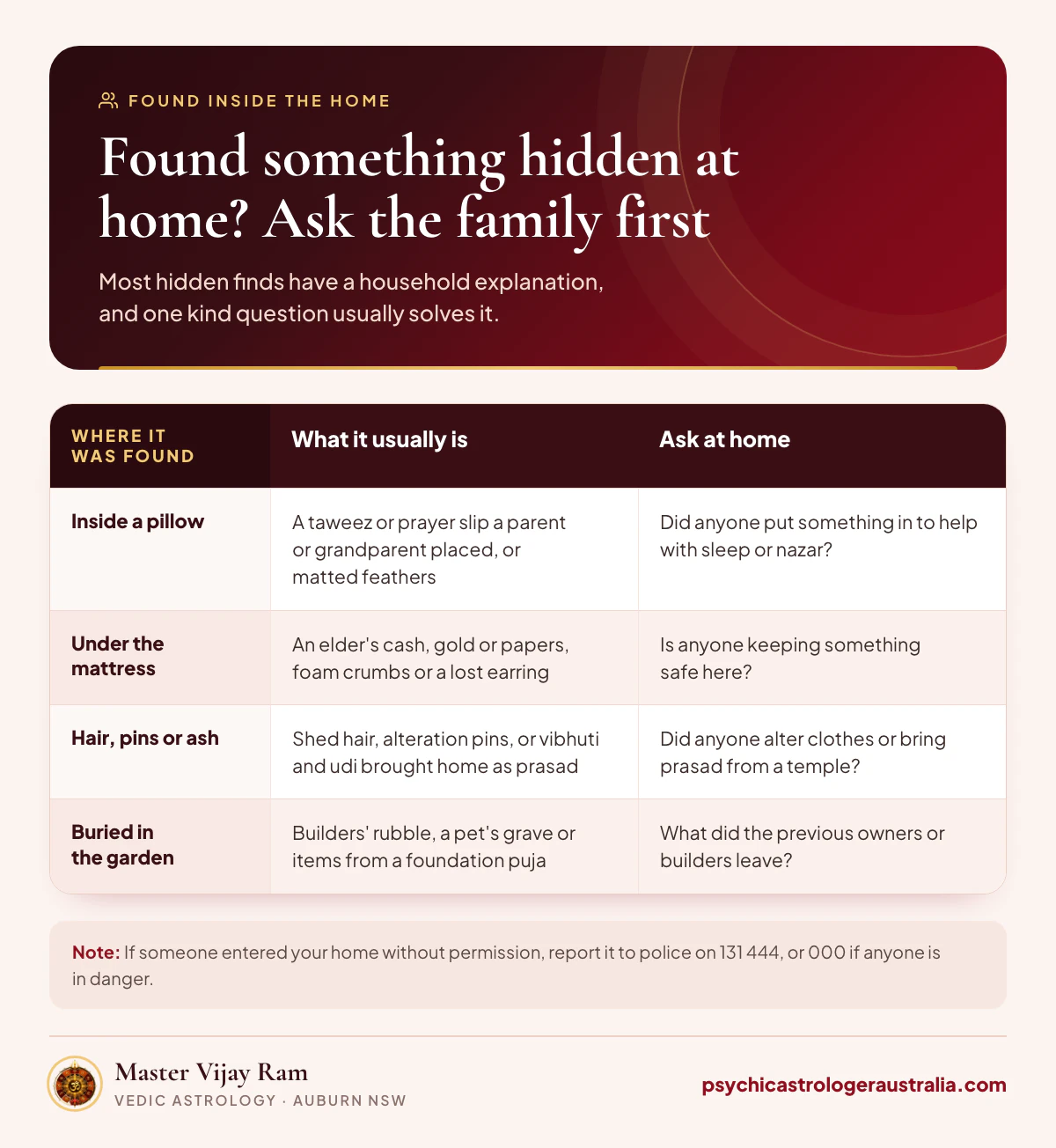
Who should you ask before anyone else?
Everyone who lives in the house, and everyone who has stayed in it recently. A grandmother visiting from Lahore or Ludhiana may have tucked a taweez into her grandson's pillow because he cried at night, and said nothing because her own mother did the same without asking.
A mother-in-law may have slipped a kavach under a newly married couple's mattress. A father may have put a packet of temple ash beside a daughter's bed before her exams.
Ask as a question about care, not as an accusation. "Did anyone put something in Aarav's pillow to help him sleep?" gets a warm answer; "Who did this?" gets silence, hurt feelings and, often, a denial from the very person who meant well. Most families who ring about black magic items found in a pillow end the call having found their answer at the dinner table.
If a relative did place it, thank them, and decide together whether it stays. Protection is better given openly, and telling a real taweez from a fake explains why a genuine amulet is made for one named person who knows they have it.
What is that lump in the pillow or the mattress?
Very often, the pillow itself. Feather and down fillings mat into hard lumps over years of moisture and pressure, and polyester fibre balls into clumps after a few hot washes. Foam toppers crumble, coir and latex layers break down, and inherited or second-hand mattresses give up lost earrings, coins and hair clips.
Then there is safekeeping. Some elders keep cash, a gold chain, a passport or a prayer slip wrapped in cloth inside a pillowcase or under the mattress, the way their own parents did. A cloth packet that turns out to hold money is not a black magic packet; it is somebody's savings, and it should go straight back to them.
Hair knots, pins and ash packets: what are they usually?
A ball of hair inside a pillowcase or behind the bedhead is shed hair rolled together by a sleeping head, and long hair does it faster. Some mothers keep a baby's first lock from the mundan in a twist of cloth or paper, and a keepsake like that can surface years later in a drawer or under a mattress lining. Pins in curtains, hems and new shirts come from alteration shops and packaging far more often than from anywhere else.
A folded paper packet of grey ash is very often vibhuti or bhasma, the sacred ash given as prasad at Shiva and Murugan temples, and Sai Baba devotees keep udi from Shirdi the same way. Families tuck it under pillows, into wallets and onto bedside tables for comfort. It is a blessing someone brought home, not a working.
What turns up buried in a garden?
Fears about buried black magic items are common, and what people actually dig up is nearly always ordinary. Builders bury rubble, offcuts and old pipe; previous owners bury pets, and sometimes a small marker with them; gardeners leave bulbs in mesh bags and root balls in hessian. Some families place a small copper pot, coins or a sealed box in the ground during a bhoomi pujan before a house is built, and some Catholic families bury a small statue of St Joseph in the garden to help a house sell.
A bundle found in the garden of a house you recently bought or rented almost always belongs to that history, not to you. Photograph it in the hole before lifting it, because a clear picture answers more questions later than a memory of something that frightened you.
Where was it found, and what does it usually turn out to be?
Here is each find beside the explanation that usually fits it, the question that tends to solve it at home, and what to do next.
| Where it was found | What it often turns out to be | Ask the household | Then |
|---|---|---|---|
| Inside a pillow | A taweez or prayer slip placed by a parent or grandparent; matted feathers | Did anyone put something in to help with sleep or nazar? | Return it, keep it, or retire it respectfully |
| Under or inside a mattress | An elder's cash, gold or papers; foam crumbs; a lost earring | Is anyone keeping something safe here? | Hand valuables back; vacuum the rest |
| A knot or ball of hair | Shed hair rolled by sleep; a baby's first lock kept as a keepsake | Has anyone kept hair from the mundan? | Return a keepsake; bin shed hair |
| Pins in fabric | Alteration or packaging pins in hems, curtains and new clothes | Was anything altered or bought new? | Remove carefully, bin them in a jar |
| A folded packet of ash | Vibhuti, bhasma or udi brought home as prasad | Did anyone bring prasad from a temple? | Keep it at the altar or retire it in the garden |
| Something buried in the garden | Builders' rubble, a pet's grave, foundation puja items, a statue buried for a sale | What did the previous owners or builders leave? | Photograph it; rebury sacred items, bin debris |
Should you open a taweez you have found?
You do not need to. Nothing about deciding what to do with it depends on reading what is inside, and a hand-sewn amulet that a relative made with care is spoiled once it is cut open. If the household agrees to look, wear gloves, open it over a clean sheet of paper and photograph each layer as it comes apart.
What families usually find is handwritten Arabic or Urdu, a grid of numbers or letters, or, in a Hindu kavach, a small yantra or a mantra on paper or thin copper. All of these are protective by design. Hair, nail clippings or a photograph of a third person inside a packet are a different matter, and are the one case worth showing to someone who knows the tradition.
What do you do with a found taweez?
That depends on where it came from. When a relative placed it with love, there are three good answers: give it back to them, keep it where it was if the person it protects is comfortable with that, or retire it with respect.
Retiring means wrapping it in a clean cloth and burying it in your own garden or taking it to a temple collection. For Quranic verses, a local mosque can say how the text is properly laid to rest.
When nobody in the household knows anything about it, treat it as you would anything unexplained. Photograph it, wrap it in paper and then a bag, and drop it in the wheelie bin outside. Whatever its origin, it never goes into a river, the sea or bushland, and it is never burnt indoors.
That is the whole answer to what to do with a found taweez: work out whose it is, return or retire it, and then stop thinking about it. Carrying it round the family, or across town to a baba ji for a verdict, keeps a small object at the centre of the household for weeks.
When is a hidden object something to worry about?
When someone outside the household has been inside it. A packet that appeared after a break-in, items placed in a rental by someone who entered without notice, a doll with pins, a photograph of a family member with writing on it, or a bundle that reappears after you removed it and changed the locks are matters for police, not for a ritual. Police take these reports on 131 444; ring 000 instead if anyone is in danger.
Keep the photographs and the dates, and tell the agent or landlord in writing if you rent, because entry to a rented home follows your state's tenancy rules. Reclaiming a home after a break-in covers the locks, the insurer and the steadying that comes afterwards.
How do you cleanse the room afterwards?
Start with the bedding, because that is where the worry lives. Wash the pillowcases, sheets and covers on a hot wash, replace a pillow that was old and lumpy anyway, and air the mattress in the sun for a few hours if the weather allows. Vacuum the bed base, the floor and behind the bedhead.
Then the custom, which many families find steadying. A wipe of the floor with salt water, described in salt-water mopping done safely, a lamp in the room at dusk, and a short mantra or the family's own prayer are enough. Keep incense away from anyone with asthma, and keep camphor locked away from small children, because swallowed camphor can cause seizures in young children.
When does a reading make sense?
When the object is answered but the person is not: the child still cannot sleep after the doctor has seen them, or the couple whose mattress held the packet still feel something changed on a date they can name. For $50, by phone, video or WhatsApp, Master Vijay Ram looks at the chart of the person whose bed or room it was, set against those dates. Many such calls end with nothing more than a clean room and a calmer family.
If something does show, he says so and quotes the work before it begins: a removal from $250, which he performs himself at Auburn while the family joins by video if it wishes; how a remote puja or havan works has the details. A protective kavach is prepared only where a consultation finds it will help, and the taweez and kavach page sets out what is honest to expect from one.
What can a reading not settle about a hidden packet?
Who put it there. A chart does not hold that, and he will not guess. Nor is a reading any substitute for the talk at your own dinner table, a locksmith or a police report; it comes with no guarantee, and it stays within faith-based guidance, outside medical, legal and financial advice.
Distance changes nothing about how the reading is done. Phone and video readings for Perth run exactly like a call about black magic removal in Dandenong; anyone who would rather sit across a table can see him at Auburn by appointment, the one place he practises.
What it can do is put a frightening discovery back in proportion. Most of the time the packet under the mattress was a grandmother's prayer, and the kindest thing to do with it is say thank you.
Read next
- Found Lemons, Sindoor or Thread at Your Door? What to Do NextFound a lemon, sindoor, thread or ash at your door or gate? What it usually is, how to clear it calmly, when it is a …
- How to Protect a New House From Black Magic Before Moving InProtecting a new house from black magic before moving in: the inspection first, objects found, griha pravesh on a muh…
- Black Magic Signs in the Family Home: A Household ChecklistA calm household checklist for black magic signs in the family home: what to rule out first, the shared-roof test, an…
Frequently asked questions
I found a taweez in my child's pillow. What should I do first?
Ask the household before doing anything else, especially grandparents and anyone who has stayed recently. Many South Asian elders place a taweez or kavach under a child's pillow to help with sleep or nazar and say nothing about it. Ask kindly, as a question about care. If someone placed it, decide together whether it stays; if nobody knows, photograph it and handle it as an unexplained object.
Is a packet under the mattress always black magic?
No, and usually it is not. Families find an elder's cash, jewellery or papers wrapped in cloth, temple ash, a prayer slip, foam crumbs or a lost earring. In a second-hand or inherited mattress the previous owner's belongings turn up too. Ask the household first; only a packet that nobody can explain, and that holds hair, nails or a photograph of someone, is worth a second look.
Is it dangerous to open a taweez?
Opening it does not harm you, but you rarely need to. What you do with it depends on whose it is, not on what is written inside. If the household wants to look, wear gloves, open it over paper and photograph each layer. Most contain handwritten verses, a grid of numbers or a small yantra, all of them protective in intent.
How do I dispose of a taweez respectfully?
If it was placed with love, return it to the person who placed it, or wrap it in a clean cloth and bury it in your own garden, or take it to a temple collection. For a taweez with Quranic verses, a local mosque can advise how the text is laid to rest. Never put it in a river, the sea or bushland, and never burn it indoors.
What does it mean to find hair knotted inside a pillow?
Almost always shed hair that a sleeping head has rolled into a ball, which happens faster with long hair and old pillowcases. Some mothers also keep a baby's first lock from the mundan in a twist of cloth, and it can turn up years later. Ask the household, return a keepsake to whoever kept it, and bin loose hair with the vacuum dust.
I found something buried in the garden of our new house. Is it a curse?
Very unlikely. Gardens hold builders' rubble, old pipes, pet graves, bulbs in mesh bags, items placed during a bhoomi pujan, and sometimes a small statue a Catholic family buried to help the house sell. Photograph it in the hole before lifting it. Rebury anything sacred respectfully, bin debris, and remember it belongs to the house's history rather than to your family.
When should I call the police about something found inside my home?
When someone outside the household has been inside it: after a break-in, in a rental entered without notice, when a doll with pins or a marked photograph of a family member appears, or when items return after you removed them and changed the locks. Report it on 131 444, ring 000 if anyone is in danger, and hold on to your photographs and dates.
Should I cleanse the room after finding a taweez or bundle?
Many families find it settles everyone. Wash the bedding on a hot cycle, air the mattress in the sun, vacuum the bed base and floor, then wipe the floor with salt water and light a lamp at dusk with a short prayer. Keep incense away from anyone with asthma and keep camphor locked away from small children.
Will Master Vijay Ram tell me who hid it?
No. He does not identify people from objects or charts, and he will not confirm a suspicion about a relative, a tenant or a neighbour. He reads the birth details of the person whose bed or room it was against the dates things changed. The consultation is $50, and a removal, only where the chart shows a pattern, starts from $250, agreed before anything is performed.
People also ask
What should I do if I find a taweez in my house?
Ask everyone in the household, gently, whether they placed it, because a parent or grandparent often has. If someone did, return it, keep it with the protected person's agreement, or retire it respectfully in your garden or a temple collection. If nobody knows, photograph it, wrap it and put it in the outside bin. Report anything placed by someone who entered without permission to police.
Can black magic items be hidden in a pillow?
Folk accounts describe it, and the fear is common, but most things found in pillows are matted filling, shed hair or a protective taweez a relative placed out of love. Ask the household first. A packet holding hair, nails or someone's photograph that nobody can explain is worth photographing and, if it suggests someone entered your home, reporting to police.
What are buried black magic items usually?
Things people dig up are usually builders' rubble, pipe, a pet's grave, bulbs, fertiliser sachets, items from a foundation puja, or a statue buried by a previous owner hoping to sell. Photograph the find before lifting it. Sacred items can be reburied respectfully; debris goes in the bin. A find in an old garden is part of the house's history, not a message to you.
Is it bad luck to throw away a taweez?
Folk belief varies, and many families feel uneasy binning anything with verses on it, which is why retiring it respectfully is better when a relative placed it. Return it, bury it wrapped in clean cloth in your garden, or take it to a temple or ask a mosque. An unexplained packet with no sacred writing can simply be wrapped and binned.
References & further reading
Serving clients across Australia
Confidential consultations by phone, video & WhatsApp — including: