

Quick answer
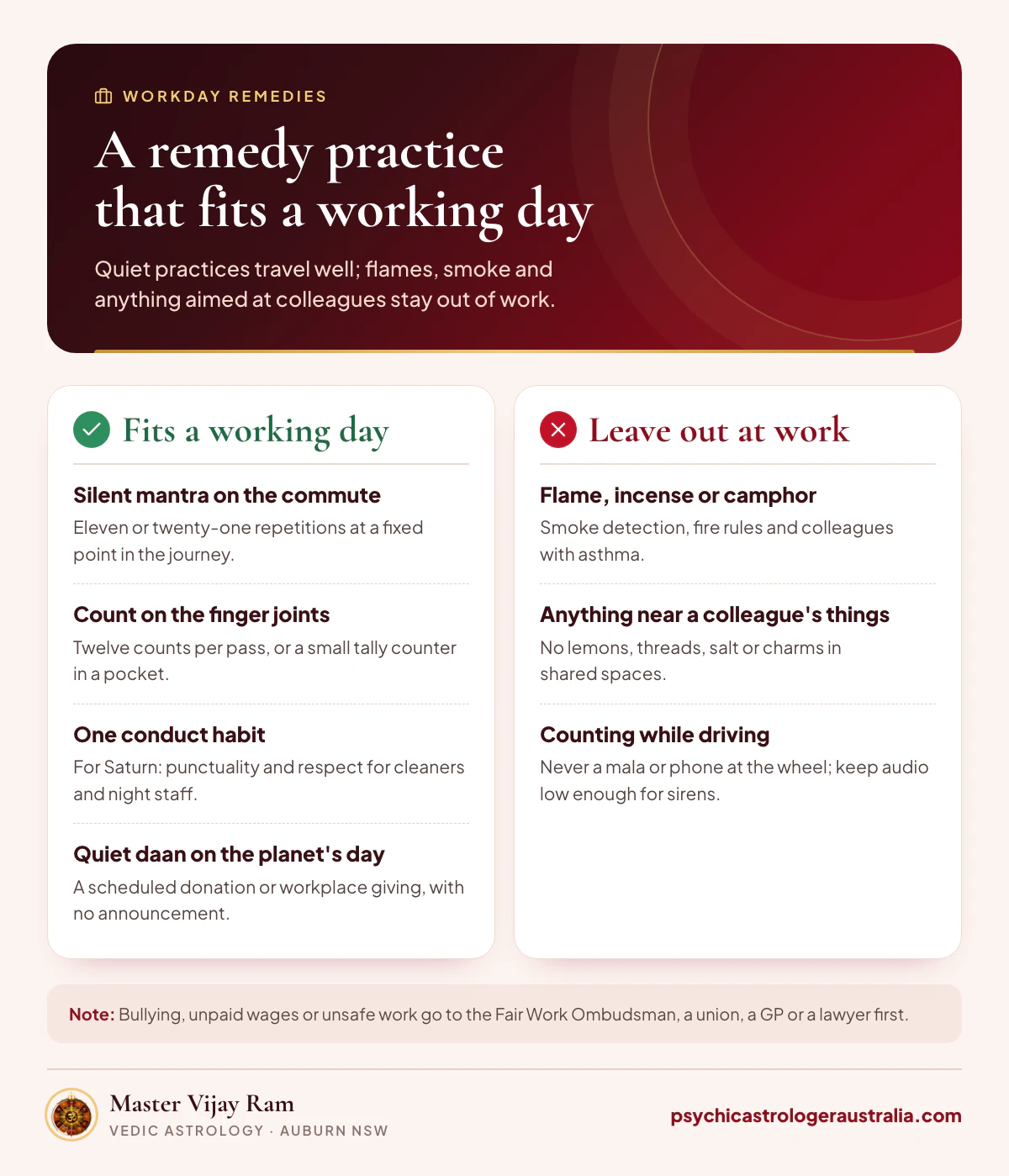
Most remedies a chart calls for can be done quietly inside a working day: a mantra said silently on the train, conduct that answers the planet in question, and a small regular gift. Nothing needs a flame, smoke or an audience. Flames, incense and rituals aimed at colleagues never belong at work, and safety on the road comes before any count.
What counts as a remedy you can do at work?
A workday remedy is a small, silent practice that answers a planet in your chart without needing an altar, a lamp or time off. It might be eleven repetitions of a mantra between stations, a habit of punctuality kept for Saturn, or a gift made every Thursday from your pay. These are the remedies at work that people with full-time jobs actually keep, because they fit inside the day rather than competing with it.
Many of the people who ring Master Vijay Ram have been handed a list of remedies that assumes a free morning, a temple nearby and a quiet house. A nurse finishing nights, a driver on a split shift or a parent who leaves home at six cannot keep that list for long. The list of daily remedies that lasts for busy people is the one built around the hours you already have.
Why does a quiet practice still count?
The tradition has always ranked the inward forms of worship highly. Japa said in the mind, called manasika japa, is described in many teaching lineages as the most refined of the three ways of repeating a mantra, above whispering and above chanting aloud. A mantra said behind closed lips on a crowded tram is not a lesser version of the real thing.
Conduct is the other half. The classical remedies were never only rituals; they included how a person spoke, gave and worked. A graha shanti puja for a troubled planet is one answer to a difficult period, but the steady, unseen answer is usually behaviour kept up over months, and a workplace gives more chances for that than anywhere else.
Which mantra can you say silently at a desk or on a train?
The mantra should come from your chart, not from a list of popular ones. In a reading the planet running your current period, or the one most strained in your chart, decides which mantra is suggested, and the short beej form is usually the easiest to carry through a day. Spellings vary between families and gurus; the version your family already uses is fine.
For a mantra on a commute, link it to something that happens anyway: the doors closing, the train leaving a particular station, the lift going up. Eleven or twenty-one repetitions at a fixed point in the journey are more useful than a large number attempted now and then. If you lose count, start the set again calmly rather than guessing.
Some people prefer a longer text such as the Hanuman Chalisa, which fits a twenty-minute ride. Listening on headphones is fine; reciting along under your breath is fine too. What matters is that the same practice happens on the same days.
How do you keep count without a mala on the desk?
A mala on a desk invites questions some people would rather not answer, and in some workplaces loose beads are a safety issue near machinery or food. There are quieter ways to count. The thumb can move across the finger joints of one hand, which gives twelve counts per pass in the commonest method, or a small tally counter can sit in a pocket.
Some people keep the count on a phone, though the phone also brings every distraction with it. Others simply use time instead of numbers: five minutes of silent repetition from the moment they sit down. A practice measured in minutes is still a practice, and the count can return on weekends when there is room for a full mala. Why jaap counts like 108 matter explains the numbers if you want them.
What are conduct remedies, planet by planet?
Office remedies of this kind are the oldest and most portable. Each planet is traditionally linked with people, qualities and duties, and treating those well is read as easing the planet. The table gathers the workplace versions; traditions differ in detail, and a reading narrows the list to one or two that suit your chart.
| Planet | Conduct at work | The traditional link |
|---|---|---|
| Sun | Respect for those in authority without flattery; owning your mistakes | Authority, the father, honour |
| Moon | Patience with anxious colleagues; a calm tone in tense meetings | The mind, care, the public |
| Mars | No shouting; physical tasks done safely and fully | Energy, courage, conflict |
| Mercury | Honest emails, accurate figures, promises kept in writing | Speech, trade, records |
| Jupiter | Teaching newer staff; advice given without taking credit | Teachers, wisdom, guidance |
| Venus | Courtesy, a tidy shared space, fairness with every gender | Comfort, beauty, relationships |
| Saturn | Punctuality; respect for cleaners, labourers and night staff | Labour, service, time |
| Rahu | No shortcuts, no gossip about the company, care online | Restless ambition, illusion |
| Ketu | Finishing what you start; letting credit go quietly | Detachment, completion |
Saturn's line is the one most often given, because so many people consult during Saturn periods and Sade Sati. Learning the name of the person who empties the bins and thanking them every week sounds small. Kept for a year, it is exactly the kind of steady humility the tradition asks of anyone running a Saturn period.
Can small daan fit into a working week?
Daan, a gift made without expecting anything back, is traditionally tied to particular days and planets: chana dal or yellow cloth on Thursday for Jupiter, black sesame or mustard oil on Saturday for Saturn, and so on. What to give for each planet sets out the full pattern. For people at work, the form can be simpler than the list suggests.
A regular donation scheduled for the planet's day, a meal bought for someone sleeping rough on the walk to the office, or a share of a Thursday lunch budget set aside for a food bank all fit the spirit. Many employers also run workplace giving through payroll, which keeps the gift steady without any ceremony. The rule that matters is consistency and quiet: no announcement, no photograph.
What should never be done at work?
No flame, no incense and no camphor at work, however small. Offices, hospitals, warehouses and kitchens have smoke detection, fire rules and colleagues with asthma, and setting off an alarm turns a private practice into a public problem. A lamp belongs at home, at a temple or in the puja Vijay Ram ji performs at his place of practice.
Nothing is placed on or near a colleague's desk, chair, car or belongings. No lemons, threads, salt or charms in shared spaces, nothing tied to a door, nothing sprinkled. Even a well-meant protective gesture can frighten someone from another background, and remedies are for your own conduct and your own chart, never aimed at another person.
Finally, no remedy replaces doing the work. A mantra said while a deadline slips is a mantra said in the wrong place.
What about driving, cycling or riding to work?
If you drive, ride or operate machinery, the road comes first. Never count on a mala or a phone while driving, never read a text at a red light, and keep any recording at a volume that lets you hear sirens and horns. Listening to a chant you know well is fine; anything that takes your eyes or hands is not.
A useful habit for drivers is to say a short prayer before turning the key and another after parking, so the journey is framed by the practice without being interrupted by it. Cyclists and motorcyclists can do the same at the start and end. On public transport the whole journey is available, which is one reason so many people find the train or bus the easiest place to keep a daily practice.
How do shift workers and FIFO workers fit remedies in?
A planet's day is traditionally counted from sunrise, but your working rhythm may not follow the sun. Shift workers can keep the practice at the start of their own day rather than at dawn, and keep the weekday rule by the calendar. A Saturday practice done at the start of a Saturday night shift still belongs to Saturday.
Fly-in fly-out workers often find the camp the hardest place to keep anything. A silent mantra after the pre-start meeting and a phone call home on the planet's day are both possible, and a larger observance can wait for the swing home. Simple daily practices for each planet gives the home versions for the days off.
Is it the job, or the chart?
Before any remedy, deal with the job as a job. If the trouble is bullying, unpaid wages, unsafe work or a dismissal, the Fair Work Ombudsman, your union, an employee assistance program, a GP or a lawyer are the first calls, and a chart reading never replaces them. Lifeline (13 11 14) is there when work pressure becomes too much.
What a chart can add is timing: whether a difficult stretch sits inside a period that is likely to ease, and what kind of effort the period rewards. A difficult boss and the chart covers the conflict side of this, and a career and business reading looks at direction and timing together.
When is a puja more fitting than a daily practice?
A daily practice suits a period that is demanding but steady. Where a chart shows a heavier pressure, for example a strained planet running its main period alongside a hard transit, a puja or jaap is sometimes suggested as well. It is performed personally by Master Vijay Ram at his place of practice in Auburn, on a chosen muhurat, with you joining by video if you wish.
A consultation is $50. A puja, havan or jaap starts from $250, and the figure is agreed before anything is performed; how an online puja or havan works gives the process. These remedies without puja do not depend on paying for anything else.
What can a workday remedy not do?
A silent mantra cannot fix a toxic workplace, guarantee a promotion or stop a restructure. It describes a way of meeting a period, not a way of controlling other people or results. This is faith-based guidance, not legal, financial, medical or employment advice.
What people describe, after keeping a small practice for a few months, is a steadier week: fewer arguments they regret, a sense of purpose on the train, and a period that feels met rather than merely endured. That is a modest claim, and it is the honest one.
How does a reading turn this into a routine?
In a consultation Vijay Ram ji looks at the planet running your period, the planets under strain and your actual timetable, then suggests one mantra, one conduct habit and, where it fits, one day for daan. Most people leave with three lines they can keep on a phone, not a page of rituals. Readings are by phone, video or WhatsApp, in English, Hindi or Punjabi, for clients from Melbourne to clients in Darwin.
Read next
- Navagraha Remedies: Simple Daily Practices for Each PlanetNavagraha remedies for the nine planets: the day, the mantra, a daily act and a habit to ease off, adapted to Austral…
- Mantra Jaap Counts: Why 108, and What a Lakh Jaap MeansMantra jaap counts explained: why a mala has 108 beads, how a lakh or sava lakh jaap is counted and shared, what an a…
- Ex Love Spell vs Vashikaran: What Actually WorksEx love spell or vashikaran: what each word really means, what a Vedic reading can honestly do about an ex, and the p…
Frequently asked questions
Can I chant a mantra silently at work and still have it count?
Yes. Many teaching lineages describe japa repeated in the mind as the most refined of the three ways of saying a mantra, ahead of whispering and chanting aloud. A short mantra said silently at your desk, on a break or on the train is a complete practice. What makes it effective in the tradition is regularity and attention, not volume or a special setting.
Which mantra should I say on my way to work?
The one your chart points to. In a reading the planet running your current period, or the one most strained, decides which mantra is suggested, and the short beej form is usually easiest to carry through a day. If you have no reading yet, a prayer your family already uses, such as the Hanuman Chalisa or the Gayatri Mantra, is a sound place to start.
How do I count mantra repetitions without a mala?
The commonest method moves the thumb across the joints of the fingers of one hand, giving twelve counts per pass. A small tally counter in a pocket works too, and some people simply use time, such as five minutes of silent repetition. The full mala can come back on weekends or at home when there is room for it.
Is it safe to listen to mantras while driving?
Listening to a familiar chant at a moderate volume is fine, provided you can still hear sirens and horns. Never count on a mala, read text or handle a phone while driving. A useful habit is to say a short prayer before starting the car and another after parking, so the practice frames the journey without distracting you on the road.
Can I light a lamp or incense at my desk?
No. Workplaces have smoke detection, fire rules and colleagues with asthma or allergies, and any flame or smoke can set off an alarm or breach site rules. Keep lamps, incense and camphor for your home altar or a temple. A silent mantra, a conduct habit and a regular gift give you a full workday practice without any of them.
What is a conduct remedy?
A conduct remedy is a change in behaviour that the tradition links with a planet. For Saturn it might be punctuality and respect for cleaners, labourers and night staff; for Mercury, honest records and promises kept in writing; for Jupiter, teaching newer colleagues without taking credit. They are among the oldest remedies and need no materials, only consistency over months.
How do shift workers keep a weekday remedy?
By keeping the weekday rule by the calendar and doing the practice at the start of their own working day rather than at dawn. A Saturday practice done at the beginning of a Saturday night shift still belongs to Saturday. Fly-in fly-out workers can keep a silent mantra on site and save larger observances for the time at home.
Will a workplace remedy stop me losing my job?
No remedy can promise that. A chart can show whether a difficult stretch falls inside a period likely to ease and what kind of effort it rewards, and a steady practice can help you meet it calmly. Redundancy, bullying or pay disputes go first to the Fair Work Ombudsman, your union or a lawyer, and a reading is faith-based guidance alongside them.
People also ask
What are quick astrology remedies for busy people?
The quickest are a short mantra said silently at a fixed point in the day, one conduct habit linked to the planet under strain, and a small gift on that planet's weekday. Each takes minutes or none at all. A reading narrows the choice to the one or two that suit your chart, so you are not trying to keep a long list.
Can remedies be done without a puja?
Yes. Most of the remedies a chart calls for are mantra, conduct and daan, none of which needs a formal puja. A puja or jaap is suggested only where a chart shows heavier pressure, and when it is, Master Vijay Ram performs it at his place of practice in Auburn, from $250 agreed beforehand, with you joining by video if you wish.
Is it disrespectful to chant on public transport?
Not if it is silent or under your breath. Saying a mantra in the mind disturbs nobody and is a traditional form of japa. Chanting aloud on a crowded train is a different matter for the people around you, so most practitioners keep commuting practice inward and save chanting aloud for home or a temple.
Which planet's remedies help most with work problems?
It depends on the chart. Saturn is the planet most often involved because so many people consult during Saturn periods, and its remedies are punctuality, service and respect for labour. The Sun relates to authority and bosses, Mercury to communication and records. A reading looks at the period you are running before choosing.
References & further reading
Serving clients across Australia
Confidential consultations by phone, video & WhatsApp — including: