

Quick answer
A genuine vashikaran specialist refuses four things: a guaranteed outcome, a fee that rises once the work has started, naming the person who supposedly caused your trouble, and any work meant to control another adult. Vetting turns on those refusals, not on rankings, reviews or how close the practitioner is to you.
What people are really asking when they search for the best vashikaran specialist
Type that phrase into a search bar and a wall of near-identical claims comes back. World famous. Guaranteed in three days. Solutions for every problem, no failure ever. The wording shifts from listing to listing, but the promise never does, and none of it can be checked.
Underneath the search is a narrower and more human question. Something has gone wrong between two people, ordinary effort has stopped working, and you want to know who can be trusted with private details and with money. Most people who write in are dealing with ongoing love problems, not a curse. Best, in that situation, has very little to do with fame. It means honest about limits, careful with what you share, and willing to say when nothing spiritual is going on.
Why the word specialist tells you nothing on its own
There is no register for this work, no licence to lose and no examining body. Nobody can be struck off. So the word specialist carries no information at all. It is typed by careful practitioners and by call-centre operators reading a script, in exactly the same font.
What you can examine is how a person describes vashikaran as it is actually practised once you ask them to slow down. Someone who has genuinely practised will talk about the chart, about timing, about the state of the person in front of him, and about the limits of what any of it can move. Someone who has not will reach straight for effect: powerful mantra, seven days, no failure. The first answer is duller and much harder to sell. It is also the one that survives being questioned.
The Four Refusals, and why they matter more than credentials
There is a quicker test than reading testimonials, and it works on the first call. Stop listening for what a practitioner promises and listen for what he refuses. Call it the Four Refusals.
- He refuses to guarantee a result, or to name the day it will arrive.
- He refuses to raise the fee once the work has started.
- He refuses to name the person who supposedly did this to you.
- He refuses any work whose purpose is to bind, control or harm another adult.
A practitioner who holds all four will sound far less impressive than one who holds none. That is rather the point. Each refusal costs him a sale, which is exactly why it carries weight. Where the four collapse under pressure, you are looking at the pattern described in Is Vashikaran Real or Fake? How to Spot a Scam.
Green, amber and red: sorting the ones in the middle
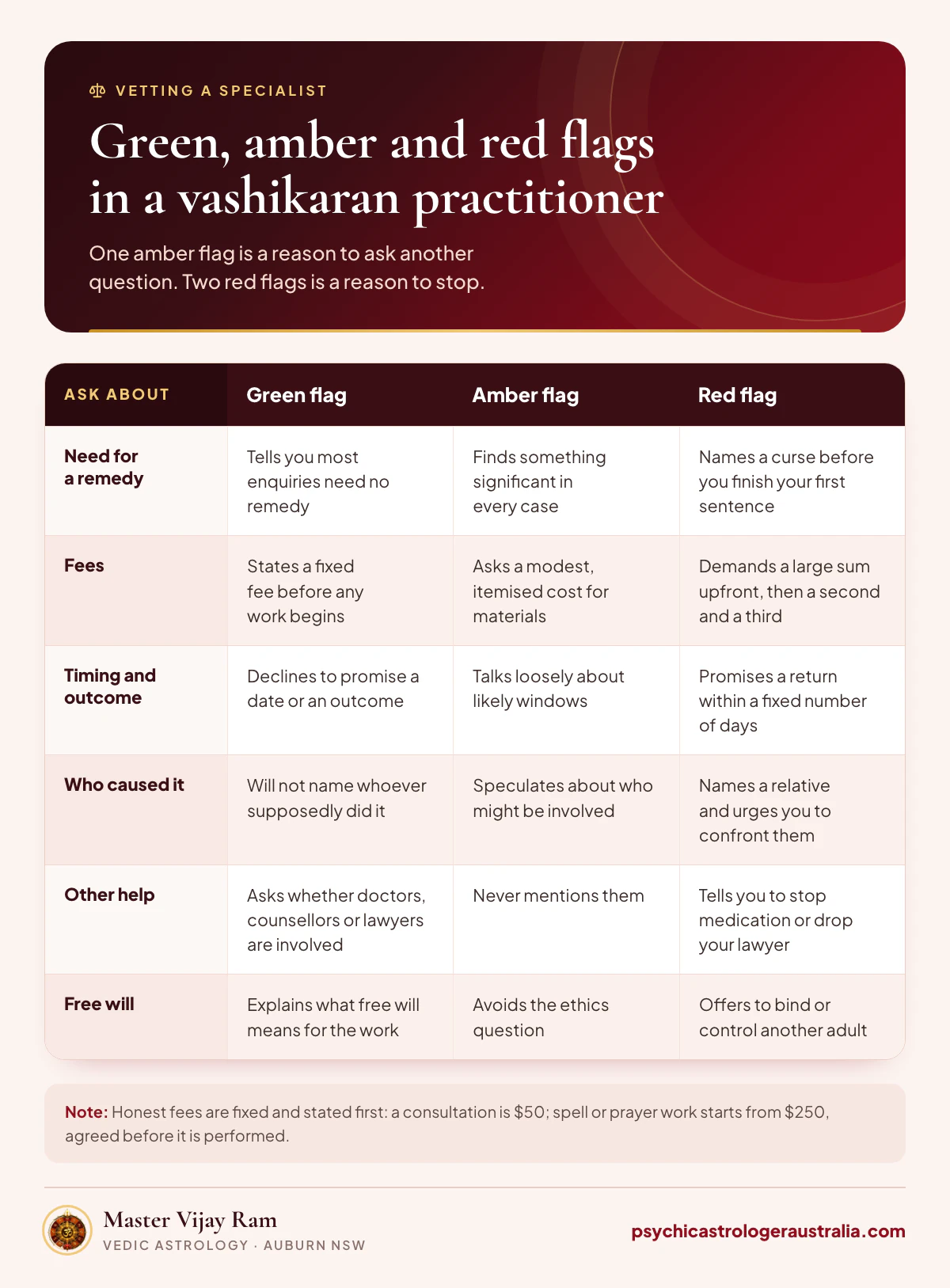
The Four Refusals — no guaranteed outcome, no fee that rises mid-work, no naming a culprit, no controlling another adult — settle the obvious cases. Most real decisions sit in the middle, where nothing is alarming but something feels slightly off. Run the name you are weighing up across the three columns below, whether it reached you through a family group chat, a noticeboard at the temple, or a page about greater Sydney.
| Green flag | Amber flag | Red flag |
|---|---|---|
| Tells you most enquiries need no remedy | Finds something significant in every case | Names a curse before you finish your first sentence |
| States a fixed fee before any work begins | Requests a modest, itemised cost for materials | Demands a large sum upfront, then a second and a third |
| Declines to promise a date or an outcome | Talks loosely about likely windows | Guarantees a return within a fixed number of days |
| Will not name whoever supposedly did it | Speculates about who might be involved | Names a relative and urges you to confront them |
| Asks whether doctors, counsellors or lawyers are involved | Never mentions them | Tells you to stop medication or drop your lawyer |
| Explains what free will means for the work | Avoids the ethics question | Offers to bind or control another adult |
One amber flag is a reason to ask another question. Two red flags is a reason to stop.
What an honest first conversation actually sounds like
An honest first conversation is mostly listening, and it is duller than people expect. There are no candles on a video call. The questions are ordinary. What changed. When it changed. What else changed in the same fortnight. Who else in the household noticed, and whether anyone has seen a doctor.
The person who rings about the reunion work done for Frankston households hears those same opening questions, and so do families further around the bay in Seaford, Langwarrin and Mount Eliza. Nothing is announced in the first ten minutes. A practitioner who tells you what is wrong before you have finished describing it has not diagnosed anything. He has guessed at the most common story and let you fill in the rest. Watch, too, what happens when you contradict him. Genuine assessment adjusts. Performance doubles down.
Consent, free will, and where an honest practitioner stops
The word vashikaran does its worst damage here, because a great deal of the marketing around it promises outright control over another person's will. That promise is the clearest sign you are in the wrong hands.
The honest version of the work addresses the atmosphere around a relationship, the timing of what you do next, and the state of the person asking. It does not make an adult act against their nature, and nobody worth consulting will claim it does. Where families are refusing to accept a match and the task is winning family approval for a marriage, the work sits on the resistance and on choosing the right moment to speak, not on overriding anybody. Ask directly what a practitioner will not do in your case. A man with no limits is not safe to hire.
How fear gets turned into a price
Scam pricing has a shape, and once you have seen it you cannot unsee it. It opens small. A reading is cheap, sometimes free. Then something is found: a curse, a jealous relative, a thread buried somewhere. The cost is suddenly larger and the reason for hurry is suddenly urgent. If you hesitate, the danger grows. If you pay, something further is found next week.
Master Vijay Ram keeps his fees fixed and stated first, which removes most of that leverage by design: a consultation is $50, and spell or prayer work, where it is warranted, starts from $250, agreed before it is performed, so no discovery can raise the price. Wherever you go, ask what a figure covers and what happens if nothing changes. The shape of an honest fee and an honest timeline is set out in Love Spell Cost, Timeline and What a Genuine Practitioner Says No To.
Reading reviews and testimonials without fooling yourself
Testimonials are the weakest evidence available and the most persuasive, which is an unfortunate combination. Anyone can write five reviews in ten minutes. Screenshots of grateful messages are trivial to fabricate. Genuine work is also confidential, so many of the people best placed to vouch for a practitioner will never say a word in public.
Read for texture rather than praise. A believable account names what was difficult, mentions being asked to wait, or records being told that nothing spiritual was found. Be especially careful when you are already desperate. Somebody looking up what this looks like for people near Ipswich in that state will read glowing copy far less critically than they would on a calm day. That is precisely the state a fabricated review is written to catch.
Six questions worth asking before you agree to anything
Six questions do most of the work, and how they are handled matters more than the answers themselves.
- What do you think is actually going on here, in plain words?
- What would make you tell me there is nothing to treat?
- What will you not do, under any circumstances?
- What do you need from me, and why that specifically?
- What happens if there is no change at all?
- Who else should I be speaking to, such as a doctor or a lawyer?
You are also entitled to know who you are speaking to. Background, training and years of practice should be stated plainly rather than implied, which is the whole purpose of the page about Master Vijay Ram. Impatience with any of these six is itself an answer, and a fairly complete one.
What a real assessment involves, before any remedy is mentioned
An assessment is not a ritual. It is a structured conversation followed by chart work, and almost all of it happens before anything is decided. Birth details where you have them. A clear account of the sequence of events. Often nothing more than dates and a timeline.
What should come back is a plain reading. This looks ordinary. Or this is worth watching for a month. Or this pattern is unusual, and here is what I would do about it. Most enquiries end at the first of those, which is not modesty but simply what the evidence usually shows. The stages are described at length in What to Expect From a Vashikaran Specialist: A Full Walkthrough. If a remedy is named before any assessment has happened, the order has been reversed.
Why nearest to me is the wrong filter
Distance is the filter people reach for first, and here it is close to useless. Consultations run by phone, video and WhatsApp. The remedy itself is performed by Vijay Ram ji at his own place of practice, which is exactly why your postcode makes no difference to the work. There is no premises in your suburb, and none is needed.
Somebody asking about reunion work from Joondalup, or ringing from anywhere along Perth's northern corridor through Wanneroo, Currambine and Ocean Reef, stands in the same position as somebody two streets away from him. Filter instead on how a practitioner handles being questioned, how he talks about money, and whether he can say the words: I do not think this is spiritual. Proximity tells you nothing about any of that.
Confidentiality, and what it looks like in practice
For many people confidentiality is the real anxiety, ahead of cost. Communities are small and news travels. The question is rarely asked outright, which is a pity.
Confidentiality in practice means your name is not repeated to anyone, your situation is not used as an illustration, and nothing you send is published or forwarded. It also means a practitioner does not contact your partner, your former partner or your relatives on your behalf. Anyone offering to make that call is treating your privacy as a tool. The standard should be identical whether an enquiry arrives from a village overseas or through a page about Vedic help across Melbourne. And if you are asked to keep the work secret from your own household while your details are shared elsewhere, the confidentiality is running in the wrong direction.
When this is not the answer
Most of what is brought to a vashikaran specialist has an ordinary cause, and most enquiries end without any remedy at all. Exhaustion, broken sleep, low mood and a partner drifting away are far more often depression, anxiety, thyroid disorder, anaemia, undiagnosed sleep apnoea, grief, heavy drinking or long-term financial stress than anything spiritual. See a doctor first, and keep seeing them.
Where a relationship has ended because of violence, coercion or a pattern of control, no ritual belongs anywhere near it. That is a safety and legal matter, and it comes before everything else. Family law, visa questions and property disputes need a lawyer, not a mantra.
Spiritual work sits alongside medical, psychological and legal help. It never replaces any of it, and a practitioner who suggests otherwise has told you exactly what he is.
After you choose: what a fair working relationship looks like
Choosing well is the beginning, not the end. A fair arrangement is quiet and slightly boring. You know what is being done and roughly when. You are told what to watch for in ordinary language, and what would count as no change at all. You are not messaged daily with fresh dangers.
You are also expected to do your part, which usually has nothing to do with ritual. Sleep. Distance from the argument. No midnight messages, no monitoring, no third parties carrying news back and forth. Where the hope is bringing an ex love back, that restraint does more than most people believe.
A fair practitioner also tells you when the work is finished. If there is always one more thing to pay for, the relationship has stopped being professional.
Read next
- Vashikaran by Photo: Why Master Vijay Ram Says NoVashikaran by photo: why Master Vijay Ram refuses to work from a photograph and a name, the scam pattern behind the o…
- Is Vashikaran Real or Fake? How to Spot a ScamVashikaran is a real Vedic practice, but much of what is sold under the name is not. Learn the claims scammers repeat…
- Best Black Magic Removal Specialist in Australia: How to ChooseHow to choose a black magic removal specialist in Australia: the four refusals a genuine practitioner makes, green an…
Frequently asked questions
How can I tell a genuine vashikaran specialist from one who is simply well marketed?
Marketing shows you claims; character shows in refusals. A genuine practitioner declines to guarantee an outcome, declines to raise the fee once the work has started, declines to name the person who supposedly did this, and declines any work meant to control another adult. Ask about all four on the first call. Someone selling will fold on at least two of them.
What should actually happen in the first ten minutes of a consultation?
Mostly questions, and mostly ordinary ones. What changed, when it changed, what else changed in the same period, who else noticed, and whether doctors or counsellors are already involved. Nothing should be announced yet. If a diagnosis arrives before you have finished describing the situation, that is a guess dressed as insight, and it usually flatters the most common story.
The practitioner named the person responsible without me telling him anything. Is that a good sign?
It is one of the strongest warning signs there is. Naming a relative or a neighbour feels like proof, yet it can never be tested, it damages a family permanently, and it leaves you dependent on the man who named them. A careful practitioner discusses patterns and refuses to confirm an identity. Confrontations on that basis have ruined more households than any curse.
Is it a bad sign if a practitioner tells me my case needs no remedy?
It is the opposite. That answer costs him money, which is exactly why it is worth trusting. Most situations brought to a vashikaran specialist have ordinary causes and ease with time, medical care, or plain distance from the argument. A practitioner who finds something significant in every single case is not unusually perceptive. He is selling.
How many practitioners should I speak to before I decide?
Two or three is sensible, and speak to them before you reach your most frightened point if you can. Compare how each one handles being questioned rather than what each one claims. If two describe the same situation in completely different terms, that is useful information about both. Leave a day between the last call and any decision you make.
Does a large social media following mean someone is skilled?
No. A following measures editing, posting frequency and advertising budget. Ritual footage is easy to film and impossible to verify, and the most theatrical clips tend to come from the least careful practitioners. Genuine work is confidential, undramatic and largely unfilmable. Judge instead by how someone answers an awkward question when nobody else is watching.
What personal details should I never hand over?
Birth details, dates and a plain account of events are reasonable. Bank logins, identity documents, passwords, your partner's private messages and intimate photographs are not, and no legitimate remedy needs any of them. Be wary too of anyone who wants your former partner's phone number. A practitioner has no business contacting them, and asking signals something other than spiritual work.
A practitioner asked for money upfront to buy materials. Is that normal?
A modest, itemised cost for physical items is not unusual and can be perfectly legitimate. What is not normal is a large opening figure, a refusal to say what it covers, or a second and third request that grow each time you hesitate. Master Vijay Ram keeps his fees fixed for that reason: a consultation is $50, and spell or prayer work, where it is warranted, starts from $250, agreed before it is performed. Ask what happens if nothing changes.
He asked me to keep the work secret from my own family. Should that worry me?
Yes. Confidentiality protects you from the outside world. It should never be used to separate you from the people closest to you. Secrecy inside your own household makes escalating demands easy, because nobody is there to offer you a second opinion. You may choose privacy for your own reasons. Being instructed into it is a very different thing.
What if two practitioners give me completely different readings of my situation?
Treat it as a reason to slow down rather than to pick a side. Ask each one what evidence shaped their view, and what would make them say nothing spiritual is happening. Whoever can answer that is the more careful reader. If neither can, the disagreement tells you the reading was never grounded in anything checkable.
Can I ask for the work to be stopped once it has started?
Yes, and how that request is received is revealing. A genuine practitioner will explain what has been done so far, say plainly whether stopping creates any difficulty, and accept your decision. Warnings that stopping will bring disaster on your family are coercion rather than guidance. Nobody ethical holds a client in place using fear.
Is it acceptable for a practitioner to contact my former partner directly?
No. There is no version of this work that requires a stranger to message the other person, and doing so risks distress, embarrassment and in some cases a legal problem for you. The work concerns you, your chart and your own situation. Anyone offering to make that call is interfering in a relationship, not performing a remedy.
How do I know I am speaking to the practitioner rather than a middleman?
Ask who will actually perform the work and who you will speak to next time. Call centres pass you between accounts, use scripted phrasing and rarely remember your details. A practitioner who does his own work recalls your dates without prompting and answers follow-up questions himself. Continuity across two separate calls is a simple and revealing test.
Should I be concerned if a practitioner will not tell me how long it will take?
Refusing to name a fixed date is honesty rather than evasion. Nobody can promise when another person will change their mind. What you can fairly expect is a rough window for reviewing progress, a description of what an early sign of movement would look like, and a plain statement of what would count as no change at all.
I have already seen one practitioner and nothing changed. Does that mean nothing will?
Not necessarily, though it is worth asking what actually happened rather than repeating it. Was any assessment done, or was a remedy sold immediately? Was something ordinary going on that nobody ever addressed? Many second enquiries end with a doctor, a counsellor, or simply time. Going straight to a bigger and costlier ritual is rarely the fix.
People also ask
What makes a vashikaran specialist genuine?
Genuineness shows in limits rather than in claims. A genuine practitioner explains what the work can and cannot touch, refuses to guarantee an outcome or a date, will not name whoever supposedly caused the problem, and turns away anything meant to control or harm another adult. He also tells most enquirers that no remedy is needed, which is the part nobody advertises.
Are vashikaran guarantees ever real?
No. A guarantee requires certainty about another person's choices, and nobody has that. What an honest practitioner offers instead is an assessment, a plain description of what he intends to do, a point at which progress is reviewed, and a statement of what would count as no change. Treat a guaranteed result, especially one with a fixed number of days attached, as a selling device.
Should I pay a large sum in advance for vashikaran?
No. A large sum demanded at once, before anyone has read your chart, is the mechanism behind most of the scams in this field. A consultation is $50, and spell or prayer work, where it is warranted, starts from $250 and is agreed before it is performed. A small, itemised cost for materials can be reasonable; an escalating series of urgent demands never is.
How do I check whether vashikaran reviews are real?
Read for detail rather than for enthusiasm. Believable accounts mention waiting, uncertainty, or being told that nothing spiritual was found. Identical phrasing across many reviews, an absence of specifics, and screenshots of grateful messages are all easy to produce in an afternoon. Remember too that genuine work is confidential, so the most satisfied clients are often the least likely to post anything publicly.
Can a genuine practitioner refuse to take my case?
Yes, and it happens often. Cases are declined when the picture looks medical, when a legal or safety matter should come first, when the request involves controlling another adult, or when someone is too distressed to make a clear decision. Being turned away is not a rejection of you. It is often the most useful thing you will hear.
References & further reading
Serving clients across Australia
Confidential consultations by phone, video & WhatsApp — including: