
Quick answer
Eco-friendly visarjan in Australia keeps the farewell and changes the route. Used flowers and leaves go to compost, the garden or the council green bin; a clay Ganesh dissolves in a bucket at home and its water goes on the garden; cooled ash and cotton threads return to your own soil. Nothing goes into a river, the sea or the bush.
What is visarjan, and why does it need a new route in Australia?
Visarjan is the farewell that closes a worship: the murti, flowers or other offered material is thanked, released from its sacred role and returned to the elements once its part in the puja is over. In India that has usually meant a river, a temple tank or the sea. In Australia the farewell stays the same and the route changes, because a creek, a beach or a patch of bush is not a place to leave anything, however sacred it is to the family leaving it.
The tradition already holds the answer. Water and earth are both elements, and a bucket of clean water and a garden bed belong to them as surely as a river does. This guide takes the leftovers of a home puja one at a time, from a festival Ganesh to a faded rakhi, and gives each an eco-friendly visarjan that an Australian council would recognise as sensible.
The same questions come from families who keep their own altar and from those who have a puja or havan performed on request: what is left afterwards, and where does it go without disrespect to the deity or harm to the place they now live?
What counts as nirmalya, and what else needs a respectful exit?
Nirmalya is the name for what has already been offered: flowers, garlands, tulsi, bel and durva leaves, rice, kumkum and sandal paste that have sat before the deity and finished their service. It is treated with respect because it was offered, and it is not eaten, sold or simply tipped out with the vegetable peelings. Most of it is also entirely natural, which makes it the easiest thing on the altar to return to the earth.
Beside the nirmalya sit the harder items: clay and plaster murtis at the end of a festival, havan and incense ash, coconut shells and husk, kalava and rakhi threads, faded pictures, clay diyas, and the sprouted barley of a Navratri kalash. Some of these break down in a garden within weeks; some never will. When disposing of puja items, the useful question for each is what it is made of, not how holy it is.
Why not the river, the beach or the bush?
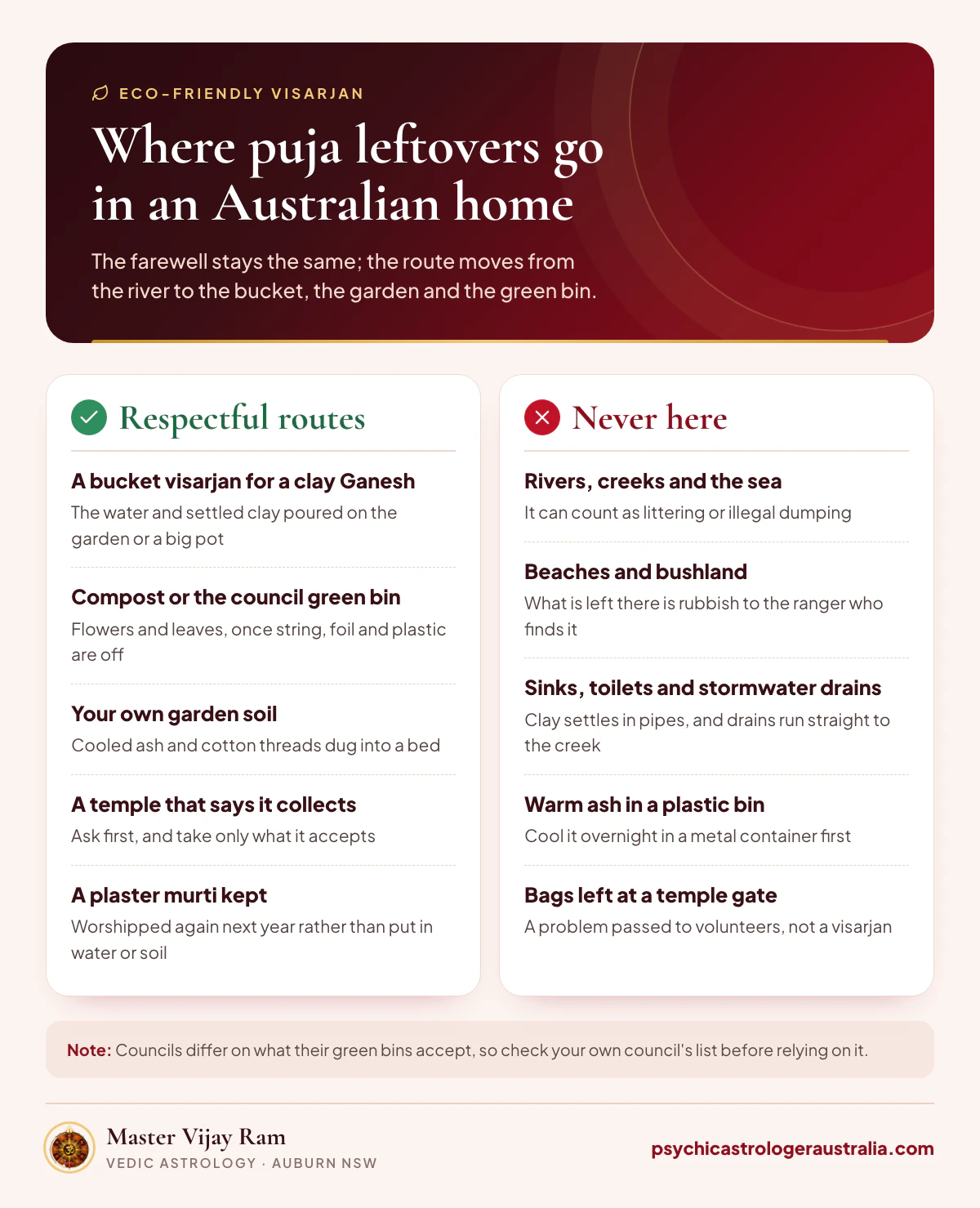
Because in Australia leaving material in a waterway or on public land can count as littering or illegal dumping, whatever the intention behind it. Plaster does not dissolve in a creek, paint and glitter wash into the water, plastic garlands and foil end up on the tideline, and even a heap of fresh flowers left in bushland is rubbish to the ranger who finds it. Good intentions do not change what the council officer sees.
There is also a quieter reason. The tradition asks that offered material be returned to the elements with care, and a garland snagged on a mangrove root does not feel like care to anyone. Stormwater drains are no better, since in Australian cities they carry what goes into them straight to the nearest creek or beach.
How do you do a Ganesh visarjan at home?
With a clay murti, a large bucket or tub of clean water, and the family gathered. After the final aarti the family offers flowers and a modak, thanks Ganesha for his stay, asks him to return next year, and lowers the murti gently into the water. A Ganesh visarjan at home done this way is complete in the tradition’s terms; nothing about it is a lesser version of the river.
Natural unbaked clay usually softens within hours and settles into a fine silt; a larger murti takes longer, and a gentle stir now and then helps. Once the water has settled, the clay and water are poured onto the garden, a large pot or the base of a tree, where the clay becomes soil again. Never pour the slurry down a sink or toilet, where it settles in the pipes.
Ganesh Chaturthi 2027 falls on Saturday 4 September 2027 in every Australian city, and the day of the farewell follows the family’s custom of a day and a half, three, five, seven or ten days. Ganesh Chaturthi 2027 dates and sthapana timing lists the visarjan day for each length of stay.
What about a plaster of Paris or painted murti?
Plaster barely dissolves in a bucket, and the bright paints on many imported murtis do not belong in a vegetable garden. That is one reason many families here choose clay for the festival, or keep one metal or marble Ganesh all year and perform the farewell with a small clay murti or a betel nut set beside it. Both are long-standing customs, not shortcuts.
For a plaster murti already in the house, the choices are to keep it and worship it again next year, to wrap it and ask a temple whether it collects murtis, or to retire it with a prayer and keep it wrapped until one of those is possible. A murti that broke during the year follows the steps in retiring a broken murti from the puja room before it reaches this stage.
Where do old puja flowers, leaves and garlands go?
To the soil, by the shortest respectful route. A compost bin or heap takes flowers, leaves and garlands happily, and the council green bin takes them in most areas; a family with a garden can dig them into a bed or lay them under a tree. This is the whole of nirmalya disposal for most households, and it can be done weekly.
Strip out anything that is not plant: the cotton or nylon string, the foil, the wire, the plastic beads and the cellophane that come with temple and florist garlands. Those go in the ordinary bin. A few families keep a separate small basket by the altar for nirmalya, so that the offered material never mixes with kitchen scraps on its way out.
Ash, coconut shells, threads and old pictures: what goes where?
The table sets out the commonest leftovers and a respectful route for each. Councils differ on what their green bins accept, so check your own council’s list before relying on it.
| Item | A respectful route | Take off first |
|---|---|---|
| Used flowers, leaves, garlands | Compost, your garden, or the council green bin | String, wire, foil, plastic beads |
| Clay Ganesh or clay murti | Bucket visarjan at home, then the water and clay on the garden | Decorations, cloth, any plastic crown |
| Plaster or heavily painted murti | Kept for next year, or wrapped and offered to a temple that says it collects | Flowers and cloth; then it is wrapped |
| Havan and incense ash | Cooled completely, then scattered on garden soil or a pot plant | Unburnt incense sticks and wire cores |
| Coconut shell and husk | The flesh shared as prasad; the shell broken and composted, or the green bin where accepted | Any thread or kumkum-stained cloth |
| Cotton kalava and threads | Buried in your own garden or added to compost | Beads, foil and plastic charms |
| Faded pictures and cards | The deity’s image retired with a prayer and buried or composted; the rest recycled | Frame, glass, lamination |
| Clay diyas | Washed and lit again, or broken into a garden bed | Wax, wicks and foil cups |
Ash needs one warning of its own. Havan and charcoal ash can hold heat for many hours, so it cools overnight in a metal container before it goes anywhere near a compost bin or a plastic wheelie bin; some families keep a pinch as vibhuti and return the rest to the garden. How the fire is kept small and safe in the first place is covered in a havan at home in an apartment.
Can a temple take puja items?
Some temples collect nirmalya, festival murtis or retired pictures, especially around Ganesh Chaturthi and Navratri, and some do not. Ring or ask at the counter first, and take only what they say they accept. A bag of flowers and broken frames left at a temple gate is a problem passed to volunteers, not a visarjan.
Canberra has several temples to ask, and families in the Illawarra have Sri Venkateswara Temple at Helensburgh in Wollongong’s north. Families in Hobart, Newcastle, Geelong and on the Sunshine Coast have no permanent temple of their own yet, so the garden, the compost and a community group’s festival arrangements do most of the work there; readings for Hobart families explains how consultations reach Tasmania.
What if you live in a unit with no garden?
Then the balcony and the building do the work. A large pot plant takes the water from a bucket visarjan and a pinch of cooled ash; a small compost bin or bokashi bucket on the balcony takes flowers and leaves; and some apartment buildings have a green or food-organics bin in the waste room. Ask the strata manager before pouring anything into the building’s own garden beds.
A friend or relative with a backyard is the traditional answer and still the best one. Some families in flats keep a sealed tub of dried nirmalya and carry it out to a garden once a month, which is entirely in keeping with the custom.
What happens to Navratri barley and the kalash water?
The barley sown beside the kalash on the first morning of Navratri is often given away as a blessing on the tenth day, a few shoots tucked behind an ear or into a book, and the rest returned to the earth. The tray of soil and sprouts goes onto a garden bed or into compost, and the kalash water is poured on a plant rather than down the drain. The coconut that sat on the kalash is broken and shared.
The dates and the fuller rite are in Navratri 2027 in Australia. Clay diyas from Diwali follow the same logic: washed and kept for next year where they are sound, broken into the soil where they are not.
Is a home visarjan less complete than one in a river?
No. What the tradition asks is that the deity be farewelled with devotion and the material returned to the elements, and a bucket, a pot plant and a garden bed meet both conditions. A family in Geelong pouring Ganesha’s water onto the lemon tree has done what a family in Pune does at the riverbank, with less traffic.
Many families find the home version more personal, because the children carry the bucket, see the clay soften and know where Ganesha went. The farewell prayer, the aarti and the invitation to return are the visarjan; the water is only where it ends.
Does any of this need a priest, a puja or a consultation?
None of it needs a priest. Where a family would rather have the festival puja done on its behalf, Master Vijay Ram conducts it in person at Auburn, where he practises, and the household may follow along on video; such a puja starts from $250, with the figure agreed in advance, and a consultation costs $50. For a family choosing the day of a farewell or a new installation, choosing an auspicious date and hour is the relevant service.
What a consultation cannot do is tell you what your council’s green bin accepts or whether a particular temple collects murtis this year. Those answers belong to the council and the temple; what a Vedic astrologer offers is guidance in faith, never legal, medical or financial advice.
Read next
- Preparing the Family Home for a Wedding: Cleansing and Ganesh SthapanaPreparing the family home for a Hindu wedding: the big clean, Ganesh sthapana, mandap muhurat, griha shanti, haldi st…
- Satyanarayan Katha After a Move or a Hard YearSatyanarayan katha at home after a move or a hard year: the five chapters, why Purnima, the 2027 full moons, the pras…
- Diwali 2026 House & Aura Cleansing: Clear the Year's Heavy EnergyDiwali 2026 house and aura cleansing done honestly: clean first, use the Five-Lamp Check, and learn when heaviness is…
Frequently asked questions
How do you dispose of old puja flowers in Australia?
Put them in a compost bin or heap, dig them into a garden bed, lay them under a tree, or place them in the council green bin, which takes garden material in most areas. Remove string, wire, foil, plastic beads and cellophane first and put those in the ordinary bin. Some families keep a small basket by the altar so the offered flowers never mix with kitchen scraps on the way out.
Can I immerse a Ganesh idol in the sea or a river in Australia?
It is best not to. Leaving an idol, flowers or puja items in a waterway or on a beach can count as littering or illegal dumping, plaster does not dissolve, and paint and decorations pollute the water. A clay Ganesh dissolved in a bucket of water at home, with the water and clay then poured onto the garden, is a complete visarjan in the tradition’s own terms.
How do you do Ganesh visarjan at home in a bucket?
After the final aarti, offer flowers and a modak, thank Ganesha for his stay and ask him to return next year, then lower the clay murti gently into a large bucket or tub of clean water. Let it soften and settle, stirring now and then. Pour the water and clay onto the garden, a large pot or the base of a tree, and never down a sink or toilet.
What do I do with the water after a bucket visarjan?
Pour it, with the settled clay, onto a garden bed, a large pot plant or the base of a tree, where the clay becomes soil again. Do not tip it down a sink, toilet or stormwater drain: clay settles in household pipes, and stormwater drains carry what goes into them straight to a creek or the sea. In a unit, a large balcony pot or a friend’s garden takes it.
How do you dispose of a plaster of Paris Ganesh?
Plaster barely dissolves and its paints do not belong in a garden, so it is never put in water or soil. Keep it and worship it again next year, perform the farewell with a small clay murti or a betel nut beside it, or wrap it and ask a temple whether it collects murtis. Many families now choose clay for the festival so the question does not arise.
What should be done with havan ash?
Let it cool completely, overnight in a metal container, because ash from charcoal or a havan can hold heat for many hours. Then scatter it on garden soil or a pot plant, or dig it into a bed. Some families keep a pinch as vibhuti. Take out unburnt incense sticks and their wire cores first, and never put warm ash into a plastic wheelie bin or a compost bin.
Can old god pictures go in the recycling?
Many families first retire the deity’s image with a short prayer, then bury or compost the printed paper picture and recycle the rest. The frame, glass and any lamination are removed and go to recycling or the ordinary bin as your council directs. Laminated prints are plastic and do not break down, so the image is cut out of them where possible before the rest is disposed of.
What do I do with old rakhis and kalava threads?
Cotton kalava and plain cotton rakhis can be buried in your own garden or added to compost, where they break down. Rakhis with foil, plastic, beads or glitter are stripped of those parts first, and the synthetic pieces go in the ordinary bin. Many families gather old threads through the year and return them to the soil together before a festival, which keeps the task simple.
When is Ganesh Chaturthi 2027 in Australia?
Ganesh Chaturthi 2027 falls on Saturday 4 September 2027 in every Australian city, and on the same Saturday in India. The day of the visarjan then follows the family’s chosen length of stay, whether a day and a half or ten days. A clay murti makes the home bucket visarjan simple, with the water and clay returned to the garden afterwards.
People also ask
Is it disrespectful to put puja flowers in the bin?
The council green bin, which sends garden material to composting, is a respectful route in most areas, because the flowers return to soil. Many families prefer compost or the garden where they have one. What feels disrespectful is mixing offered flowers with general rubbish or leaving them in a waterway, so the plastic and foil are removed and the flowers kept separate from kitchen scraps.
Can you bury a murti in your garden?
An unpainted clay murti can be dissolved in water and returned to the garden, which is the usual home visarjan. Burying a plaster or heavily painted murti is not advised, because the plaster does not break down and the paints do not belong in soil. Plaster murtis are kept for another year, offered to a temple that collects them, or wrapped and kept until one of those is possible.
Where can I do visarjan in Australia?
At home, in a bucket or tub of clean water for a clay murti, with the water then poured on your garden or a pot plant. Some temples and community groups organise collections or immersion arrangements at festival time, and only where they say so. Rivers, beaches, bushland and stormwater drains are not places for idols, flowers or puja items.
What do you do with a coconut after puja?
The flesh and water are shared as prasad, as the tradition intends. The shell and husk break down slowly, so they are broken into pieces for a compost heap or placed in the council green bin where its list accepts them. Any thread, cloth or kumkum-stained wrapping comes off first. A coconut is never thrown into the sea or a river in Australia.
References & further reading
Serving clients across Australia
Confidential consultations by phone, video & WhatsApp — including: