
Quick answer
Puja room cleansing is gentle and regular: yesterday’s flowers and water cleared each morning, the shelf wiped weekly, and each murti cleaned the way its material allows. A chipped murti or torn picture is retired with a short prayer rather than kept in worship, duplicates are thinned, fierce forms are kept with guidance, and ancestors’ photographs sit apart from the deities.
What is puja room cleansing, and how is it different from cleaning?
Puja room cleansing is the care of a household altar that keeps it fit for daily worship: the flowers, water and lamp renewed, the murtis and pictures cleaned the way their materials allow, and anything damaged or surplus retired with a prayer. Cleaning removes dust; cleansing, in the tradition’s sense, also decides what stays on the altar at all. Most families do the first without thinking and put off the second for years.
The questions that reach Master Vijay Ram are rarely about dust. They are about the Ganesh that lost the tip of its trunk in a move from Perth to Brisbane, the Lakshmi print that has faded to blue, the five Hanuman murtis that arrived as gifts, and the grandfather’s photograph that somehow ended up beside the deities. A vastu consultation for the home covers where the altar sits; this page covers what it holds and how it is kept.
What does a home mandir usually hold?
A working altar needs less than most families keep on it. One murti or framed picture of each deity the family worships, a lamp, an incense holder, a small bell, a copper vessel or kalash of water, boxes of kumkum and haldi, a few grains of rice and the plate used for the aarti. Many altars add a scripture, a Hanuman Chalisa booklet or a Gita, and some keep a shaligram, a small shivling or a yantra.
Then there is what collects. Wedding cards with Ganesh printed on the front, calendars from the Indian grocer, last year’s rakhis, prasad boxes from the temple, dried garlands, a coconut nobody remembers offering, three half-empty incense packets and a lighter that stopped working at Diwali. None of it is wrong, and most of it explains why an altar feels crowded rather than why it feels heavy.
How often should a puja room be cleaned?
On two clocks, with a deeper sort before the big festivals. Each morning, yesterday’s flowers come off before today’s go on, the water in the kalash or offering cup is changed, the lamp’s wick is trimmed and the incense ash is tipped out. It takes three minutes, and the tradition counts it as part of the prayer rather than a chore before it.
Once a week, often on the day the family keeps for its main deity, the shelf is cleared, wiped with a damp cloth and dried, the altar cloth is shaken out or changed, and the brass gets a quick polish. Before Diwali or Navratri the whole altar is emptied, the cabinet is wiped inside and out, and every object on it is looked at once to decide whether it stays.
In a hot Adelaide or Perth summer the flowers wilt by evening, and many families take them off at the evening lamp rather than leaving them overnight. The rule underneath every version is the same: nothing faded, sour or stale is left in front of the deity.
How do you clean murtis made of brass, marble, clay or paper?
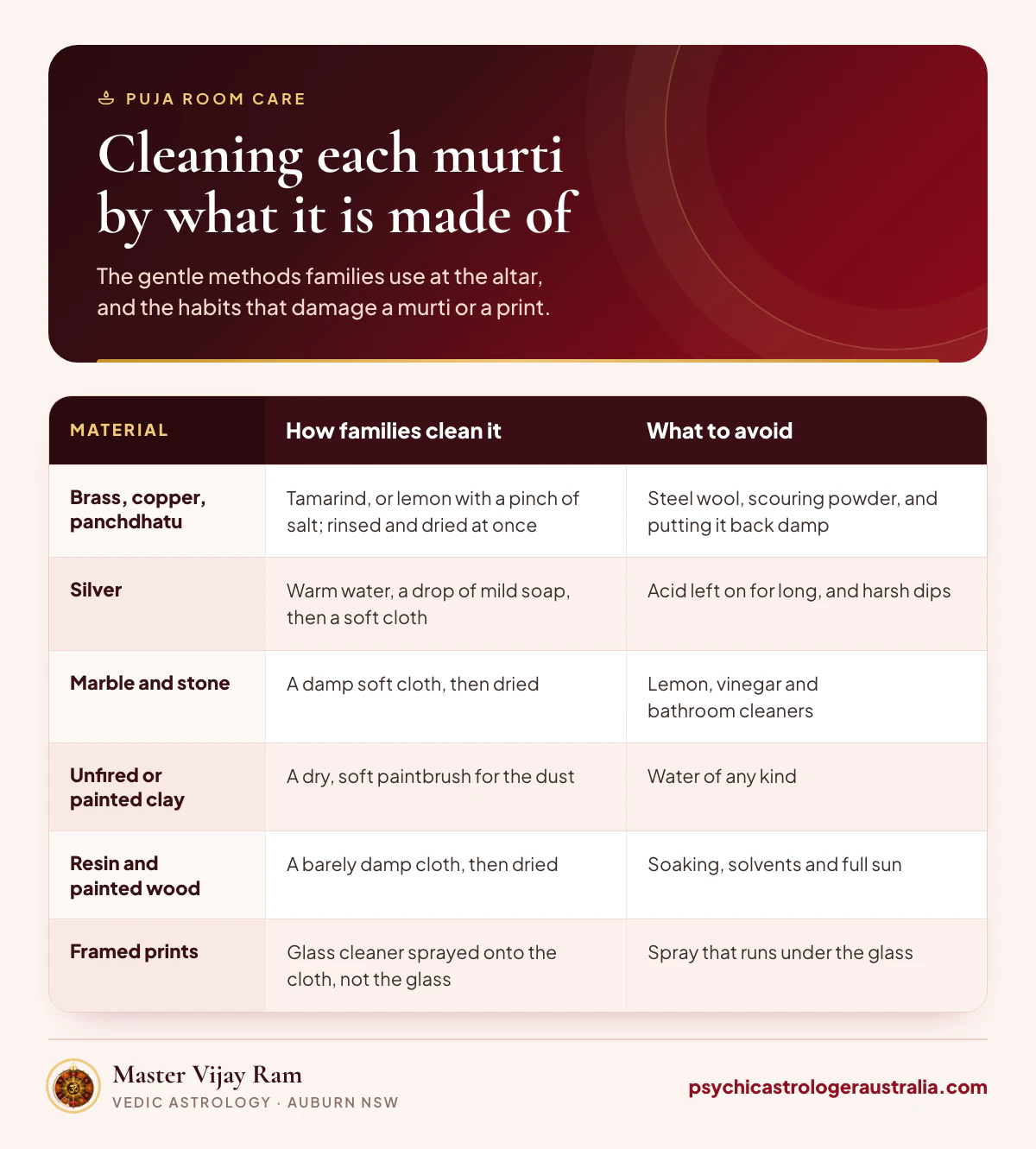
By material, gently, and never with the bathroom spray. The table sets out the methods families usually use; where a murti came with its own way of being cared for, handed down with it, that way wins.
| Material | How families usually clean it | What to avoid |
|---|---|---|
| Brass, copper, panchdhatu | Tamarind pulp, or lemon with a pinch of salt, rinsed off and dried at once; a soft cloth between times | Steel wool and scouring powder, which scratch the face; putting it back damp |
| Silver | Warm water with a drop of mild soap, then a soft polishing cloth | Acid left on for long; harsh dips that strip the fine detail |
| Marble and stone | A damp soft cloth, then dried; water or milk for an abhishek, rinsed and wiped | Lemon, vinegar and bathroom cleaners, which etch polished marble |
| Unfired or painted clay | A dry, soft paintbrush for the dust | Water of any kind, which softens the clay and lifts the paint |
| Resin, plaster, painted wood | A barely damp cloth, then dried | Soaking, solvents, and a spot in full sun |
| Framed prints and pictures | A dry cloth on the frame; glass cleaner sprayed onto the cloth, not the glass | Spray that runs under the glass and stains the print |
An abhishek with water, milk or panchamrit is worship rather than cleaning, and it belongs to murtis that can be bathed, which means metal and stone. Afterwards the murti is wiped completely dry, because moisture left in the folds of a brass Ganesh is what dulls and greens it.
What should you do with a broken murti or a torn picture?
Most traditions hold that a murti which is cracked through, chipped across the face or broken in two is no longer kept as a seat of worship, and families say the same of a picture that is torn, water-stained or faded past recognising. A broken murti is retired, not punished: it is thanked, a short prayer asks forgiveness for any lapse in its care, and it is wrapped in a clean red or yellow cloth and set aside. Saying the deity’s name or the family’s usual mantra over it is all the custom asks.
Traditions differ at the edges. Many families go on worshipping a metal murti with a small chip on its base, and natural stones such as a shaligram or a Narmada banalinga follow rules of their own that a family priest or temple should be asked about. Where a murti was formally installed with prana pratishtha, a prayer of release is said before it leaves the altar.
How the wrapped murti is finally let go is a separate step, set out in eco-friendly visarjan in Australia. There is no deadline: a murti in its cloth can wait on a high shelf until the family is ready.
Is a broken idol a bad omen?
No, and nobody should be frightened by one. Murtis fall because shelves get bumped, toddlers climb, cats explore and removalists pack in a hurry; a brass Ganesh dropped during a move from Adelaide to the Gold Coast is a dropped Ganesh, and the right response is the prayer above and a better bracket for the shelf. The tradition does not punish accidents.
Some families say a murti that breaks has taken a blow meant for the household; others say it has simply finished its service. Both readings are kind, and neither calls for a remedy. Things that keep breaking at home looks at the wider worry when glass and ornaments break one after another, which almost always has a plain cause.
How many idols should a home mandir have?
Fewer than most altars carry. The home mandir rules passed down in families are about crowding as much as theology: one murti or picture of each deity in daily worship, the family deity in the centre, and the rest kept respectfully elsewhere rather than lined up three deep. Some households add folk rules of their own, such as never setting two Ganesh murtis to face each other, and traditions differ on every one of them.
Duplicates arrive honestly, as wedding favours, gifts from visiting relatives and souvenirs from temple trips. Choose the one the family actually prays to and give it room; the others can sit in a closed cabinet, go to a relative who would like them, or be offered to a temple after asking whether it accepts murtis. Many families also keep home murtis small, about the size of a hand or less, because a large murti is traditionally said to ask for the fuller daily worship of a temple.
Can fierce forms such as Kali, Bhairav or Narasimha be kept at home?
Yes, in families whose tradition keeps them, and with the discipline that tradition asks. Kali is the household goddess of many Bengali families, Narasimha is worshipped in many Vaishnava homes in the south, and Bhairav is honoured as a guardian by many Shaiva families; none of them threatens a household that worships steadily. What the tradition warns against is a fierce form bought as decoration, left without regular worship, or set up as protection aimed at a particular person.
A family that inherits a Kali or Bhairav murti and does not know its customs should ask before placing it on the altar, whether of an elder, a temple priest or in a consultation. What Maa Kali is invoked for explains the devotion around the fierce goddess, and why any sadhana with such forms is undertaken only under a guru.
Where should the mandir go in a unit or a small house?
The north-east of the home is the traditional first choice, with the deities facing east or west and the shelf raised above waist height. In a small home it matters more where the altar should not be: not in a bedroom if there is any alternative, not under the stairs, not on a wall shared with a toilet, and not on the floor or in the cupboard with the shoes. A wall shelf or a cabinet with doors that close at night solves most of these.
A Southport unit or a Melbourne studio rarely offers a perfect corner, and the tradition accepts the best one available, kept clean. Vastu for apartments and units goes through the whole flat, including what to do when the north-east corner turns out to be the bathroom.
Why do pictures fade and brass tarnish so quickly here?
Because the sun sits in the north in Australia, and a north-east altar beside a window catches the strongest light of the day. Calendar prints and paper pictures fade towards blue in that light within a few summers, and plain glass in a frame slows it very little. Keeping pictures out of direct sun, behind a sheer curtain or UV-filtering glass, protects them better than any cleaning.
Climate does the rest. In a humid Brisbane or Gold Coast summer, mould spots appear on prints, cloth and the back panel of a wooden cabinet, and brass dulls faster near the sea; in Perth and Adelaide the trouble is dust and heat. Leaving the cabinet doors open on dry days, running a dehumidifier in a closed-up unit and wiping the back panel each season keep the altar from becoming the dampest corner of the house.
Where do ancestors’ photographs belong?
Apart from the deities. The tradition gives the gods and the ancestors different directions: the devas are worshipped facing east or north, while the pitris are remembered facing south, the direction of Yama, which is why many families hang photographs of departed parents and grandparents on a south or south-west wall rather than inside the mandir. A fresh garland and a lamp before the photograph on the anniversary are the usual customs.
Moving a grandmother’s photograph off the altar is not a slight to her. Families who keep old god photos, calendar prints and ancestors’ portraits on one crowded shelf usually find that separating them makes each easier to look after. A guru is a different case: many lineages place the guru’s picture with the deities, and the family’s own custom decides.
What else on the shelf can go?
Sort what has collected into three heaps: what stays, what is retired with a prayer, and what is simply recycled. Wedding cards and calendars with a deity printed on them are the commonest puzzle; many families cut out the image for the retired heap and recycle the rest. Prasad boxes, empty incense packets and the broken lighter go in the bin without ceremony, because they were never sacred.
Dried garlands, old sacred threads and an offered coconut join the retired heap. Give the altar a week with its new space before adding anything back, and notice how much easier the morning routine becomes.
When does a puja room need a vastu reading or a puja?
When the altar has nowhere good to go and the family is uneasy about it, or when a new home is being set up and the mandir is part of the griha pravesh and home blessing. Master Vijay Ram reads a floor plan and a few compass photographs by phone or video in a consultation, which is $50, and says which wall the altar can take and what can stay exactly where it is. A family in Canning Vale or Joondalup books in exactly the way a family near Auburn does; readings for Perth families explains the time difference.
Where a family wants a shanti after a hard year in which the altar was neglected, or a puja to mark a new altar in a new home, Master Vijay Ram carries out the rite himself at his place of practice in Auburn, and relatives anywhere can follow it on a video call if they choose. A puja or havan performed on request starts from $250, an amount fixed with the family before the day. A cleaned and sorted altar needs neither.
What can puja room cleansing not do?
It cannot settle a family argument, keep out a burglar or replace the electrician who should look at the frayed cord on the electric diya. A clean altar is a well-kept place of prayer, and that is its whole claim; it is not a remedy that acts on anyone. Vastu and Vedic astrology belong to faith and tradition, and neither is medical, legal or financial advice.
Nor can any reading tell you which of a grandmother’s pictures she would have wanted kept. That is a family decision, made slowly, and the tradition is content to wait for it.
Read next
- Leaving a Home Well: A Thank-You Puja Before You Sell or Move OutLeaving a home well: a thank-you puja before you sell or move out, moving the deities, the last lamp, a clean handove…
- House Cleansing for Negative Energy: A Room-by-Room Vedic GuideA room-by-room Vedic guide to house cleansing for negative energy: what to rule out first, what is safe to do yoursel…
- Vastu Shanti After a Renovation or Extension: Cleansing a Changed HomeVastu shanti after a renovation or extension: which changes call for one, approvals and asbestos checks first, a muhu…
Frequently asked questions
What do you do with a broken idol at home?
Take it off the altar, thank it, and say a short prayer asking forgiveness for any lapse in its care; the deity’s name or the family’s usual mantra is enough. Wrap it in a clean red or yellow cloth and keep it on a high shelf until the family is ready to let it go through visarjan, which is never into a creek, beach or bushland. Nothing has to happen the same day, and the breakage is not an omen.
Is it bad luck to keep a broken murti in the house?
No. Most traditions simply stop worshipping a murti that is cracked through or chipped across the face, and keep it wrapped and respected until it is retired. Many families continue to worship a metal murti with a small chip on its base, and natural stones such as a shaligram follow their own rules. The tradition does not punish accidents, and a family that keeps a broken murti wrapped for a few months has done nothing wrong.
How do you clean a brass murti for puja?
Rub it with tamarind pulp, or with lemon and a pinch of salt, using a soft cloth or an old toothbrush for the detail, then rinse it and dry it completely at once. Avoid steel wool and scouring powder, which scratch the face, and never put it back on the altar damp. A soft dry cloth between polishes keeps it bright, and brass near the sea needs polishing more often than brass inland.
Can I keep photos of dead relatives in the puja room?
The tradition keeps them apart from the deities. The gods are worshipped facing east or north and the ancestors are remembered facing south, the direction of Yama, so many families hang departed parents’ and grandparents’ photographs on a south or south-west wall outside the mandir. A garland and a lamp on the anniversary are the usual customs. A guru’s picture is different, and many lineages place it with the deities.
How many Ganesh idols can be kept at home?
One for daily worship is the common custom, given its own clear place on the altar. Extra Ganesh murtis from weddings, gifts and trips can be kept in a closed cabinet, given to a relative who would like them, or offered to a temple after asking whether it accepts murtis. Some families add folk rules, such as never setting two Ganesh murtis to face each other, and traditions differ on all of them.
Where should the puja room be in an apartment?
In the north-east of the flat if the plan allows, with the deities facing east or west and the shelf above waist height. Avoid a bedroom where there is any alternative, the space under stairs, a wall shared with a toilet, and the floor. A wall shelf or a cabinet with doors that close at night works well in a unit, and in a studio the doors or a curtain are drawn across the altar at night.
What should I do with old calendars and wedding cards that have gods printed on them?
Many families cut out the deity’s image, add it to the heap of items being retired with a prayer, and recycle the rest of the card or calendar. Prasad boxes, empty incense packets and similar packaging were never sacred and go in the ordinary bin or recycling. Doing the sort once a year, before Diwali or Navratri, stops the shelf filling up again.
How often should flowers and water on the altar be changed?
Every day. Yesterday’s flowers come off before fresh ones go on, and the water in the kalash or offering cup is changed each morning. In a hot Australian summer flowers can wilt by evening, and many families remove them at the evening lamp rather than leave them overnight. The principle is that nothing faded, sour or stale stays in front of the deity, which matters more than the exact hour.
Can a fierce deity such as Kali or Bhairav be kept at home?
Yes, where it is the family’s tradition and the worship is kept steadily, as in the many Bengali homes that keep Kali, or the Shaiva families who honour Bhairav. A family that inherits such a murti without knowing its customs should ask an elder, a temple priest or an astrologer before placing it. A fierce form should never be bought as decoration or set up as protection aimed at another person, and any sadhana with it is done only under a guru.
Does Master Vijay Ram come to clean or bless a puja room?
No. He meets people face to face only in Auburn, by appointment, and consults everywhere else by phone, video or WhatsApp. A $50 consultation reads the floor plan and compass photographs and says where the altar can go. A shanti or a puja for a new altar, if the family wants one, is done by him at Auburn from $250, a sum agreed before the rite, and the family may watch by video.
People also ask
What happens if an idol breaks at home?
In the tradition, nothing bad: the murti is thanked, a short prayer asks forgiveness for any lapse in its care, and it is wrapped in a clean red or yellow cloth and retired from worship. Some families say it took a blow meant for the household, others that it finished its service. A shelf that keeps dropping things needs a better bracket, and the retired murti is let go later through visarjan.
Which direction should god photos face at home?
The common custom is for the deities to face east or west, with the altar in the north-east of the home where the plan allows and the shelf above waist height. In an apartment the best available corner, kept clean and well lit, is accepted, and a cabinet with doors helps in a studio. Ancestors’ photographs are kept separately, usually on a south or south-west wall.
Can we keep a broken photo frame of God?
A cracked frame or glass can simply be replaced and the picture kept, because the frame was never the sacred part. If the picture itself is torn, water-stained or faded past recognising, many families retire it with a short prayer and replace it with a new print. Keep replacement prints out of direct sun, since a north-facing window in Australia fades them quickly.
How do you clean a puja room naturally?
With water, a soft cloth and a few kitchen staples. Tamarind pulp or lemon with salt brightens brass and copper, a damp cloth cleans marble and stone, a dry paintbrush dusts clay, and the shelf is wiped and dried weekly. Avoid bathroom sprays and acids on marble, keep everything dry afterwards, and run a dehumidifier or open the cabinet on dry days in humid months.
Is it okay to have a puja room in a bedroom?
Only where there is no alternative, as in a studio flat. The usual answer then is a cabinet with doors, or a curtain drawn across the altar at night, with the altar kept clean and raised above waist height. Where the home has any other suitable corner, such as a living room wall in the north-east, the tradition prefers it to the bedroom.
References & further reading
Serving clients across Australia
Confidential consultations by phone, video & WhatsApp — including: