

Quick answer
Mesha Sankranti, the Sun's entry into sidereal Aries, falls on Wednesday 14 April 2027 Sydney time. It is the solar new year behind Vaisakhi in Punjab, Puthandu in Tamil homes, Vishu in Kerala, Bohag Bihu in Assam and Pohela Boishakh in Bengal; each community confirms its own day through its gurdwara, temple or association.
What is Mesha Sankranti, and when is it in 2027?
Mesha Sankranti is the moment the Sun crosses into sidereal Aries, the first sign of the Vedic zodiac, and it is the hinge that turns the solar year over for half of India. In 2027 Mesha Sankranti 2027 falls on Wednesday 14 April by Sydney time, ten days after daylight saving ends in the south-east.
The Sun moves into each of the twelve signs once a year, and every crossing is a sankranti. Most pass with a quiet prayer; two carry great festivals, Makar Sankranti in January and this one in April, because one marks the Sun's turn northward in the old reckoning and the other marks the start of the zodiac itself.
| Sign | Dates (Sydney) | Sun enters (Sydney) | Sun enters (Perth) | Sankranti in India |
|---|---|---|---|---|
| Sagittarius (Dhanu) | 16 Dec 2026 – 14 Jan 2027 | Wed 16 Dec, 3:55 pm AEDT | Wed 16 Dec, 12:55 pm AWST | Wed 16 Dec, 10:25 am IST |
| Capricorn (Makara) | 15 Jan 2027 – 12 Feb 2027 | Fri 15 Jan, 2:40 am AEDT | Thu 14 Jan, 11:40 pm AWST | Thu 14 Jan, 9:10 pm IST |
| Aquarius (Kumbha) | 13 Feb 2027 – 14 Mar 2027 | Sat 13 Feb, 3:39 pm AEDT | Sat 13 Feb, 12:39 pm AWST | Sat 13 Feb, 10:09 am IST |
| Pisces (Meena) | 15 Mar 2027 – 13 Apr 2027 | Mon 15 Mar, 12:30 pm AEDT | Mon 15 Mar, 9:30 am AWST | Mon 15 Mar, 7:00 am IST |
| Aries (Mesha) | 14 Apr 2027 – 14 May 2027 | Wed 14 Apr, 7:58 pm AEST | Wed 14 Apr, 5:58 pm AWST | Wed 14 Apr, 3:28 pm IST |
| Taurus (Vrishabha) | 15 May 2027 – 14 Jun 2027 | Sat 15 May, 4:50 pm AEST | Sat 15 May, 2:50 pm AWST | Sat 15 May, 12:20 pm IST |
| Gemini (Mithuna) | 15 Jun 2027 – 16 Jul 2027 | Tue 15 Jun, 11:26 pm AEST | Tue 15 Jun, 9:26 pm AWST | Tue 15 Jun, 6:56 pm IST |
| Cancer (Karka) | 17 Jul 2027 – 16 Aug 2027 | Sat 17 Jul, 10:19 am AEST | Sat 17 Jul, 8:19 am AWST | Sat 17 Jul, 5:49 am IST |
| Leo (Simha) | 17 Aug 2027 – 16 Sep 2027 | Tue 17 Aug, 6:44 pm AEST | Tue 17 Aug, 4:44 pm AWST | Tue 17 Aug, 2:14 pm IST |
| Virgo (Kanya) | 17 Sep 2027 – 17 Oct 2027 | Fri 17 Sep, 6:41 pm AEST | Fri 17 Sep, 4:41 pm AWST | Fri 17 Sep, 2:11 pm IST |
| Libra (Tula) | 18 Oct 2027 – 16 Nov 2027 | Mon 18 Oct, 7:39 am AEDT | Mon 18 Oct, 4:39 am AWST | Mon 18 Oct, 2:09 am IST |
| Scorpio (Vrishchika) | 17 Nov 2027 – 15 Dec 2027 | Wed 17 Nov, 7:29 am AEDT | Wed 17 Nov, 4:29 am AWST | Wed 17 Nov, 1:59 am IST |
| Sagittarius (Dhanu) | 16 Dec 2027 – 14 Jan 2028 | Thu 16 Dec, 10:09 pm AEDT | Thu 16 Dec, 7:09 pm AWST | Thu 16 Dec, 4:39 pm IST |
Computed with the Swiss Ephemeris (Lahiri ayanamsa for Vedic positions) and checked against US Naval Observatory data. Times are rounded to the minute.
The table lists the Sun's entry into every sidereal sign through 2027 on the Sydney clock. Mesha's row is the one that matters here; the others are useful for anyone who keeps a monthly sankranti prayer. Families who want the hour of the crossing matched to a ceremony can ask for a muhurat and festival-date reading.
Why is the solar new year in April, not March?
A Western horoscope column says the Sun enters Aries on Sunday 21 March 2027, and a Vedic panchang says 14 April. Both are describing the same Sun, measured from two different starting points: the tropical zodiac begins at the equinox, while the sidereal zodiac is tied to the stars and has drifted about twenty-four degrees away from it over the centuries.
That gap, the ayanamsa, is why every Vedic sankranti falls about three and a half weeks after its Western namesake, and why the gap creeps a day later every seventy-odd years. The Makar Sankranti and Lohri page walks through the drift in detail, so this page simply takes the April date as given.
Which festivals share the solar new year?
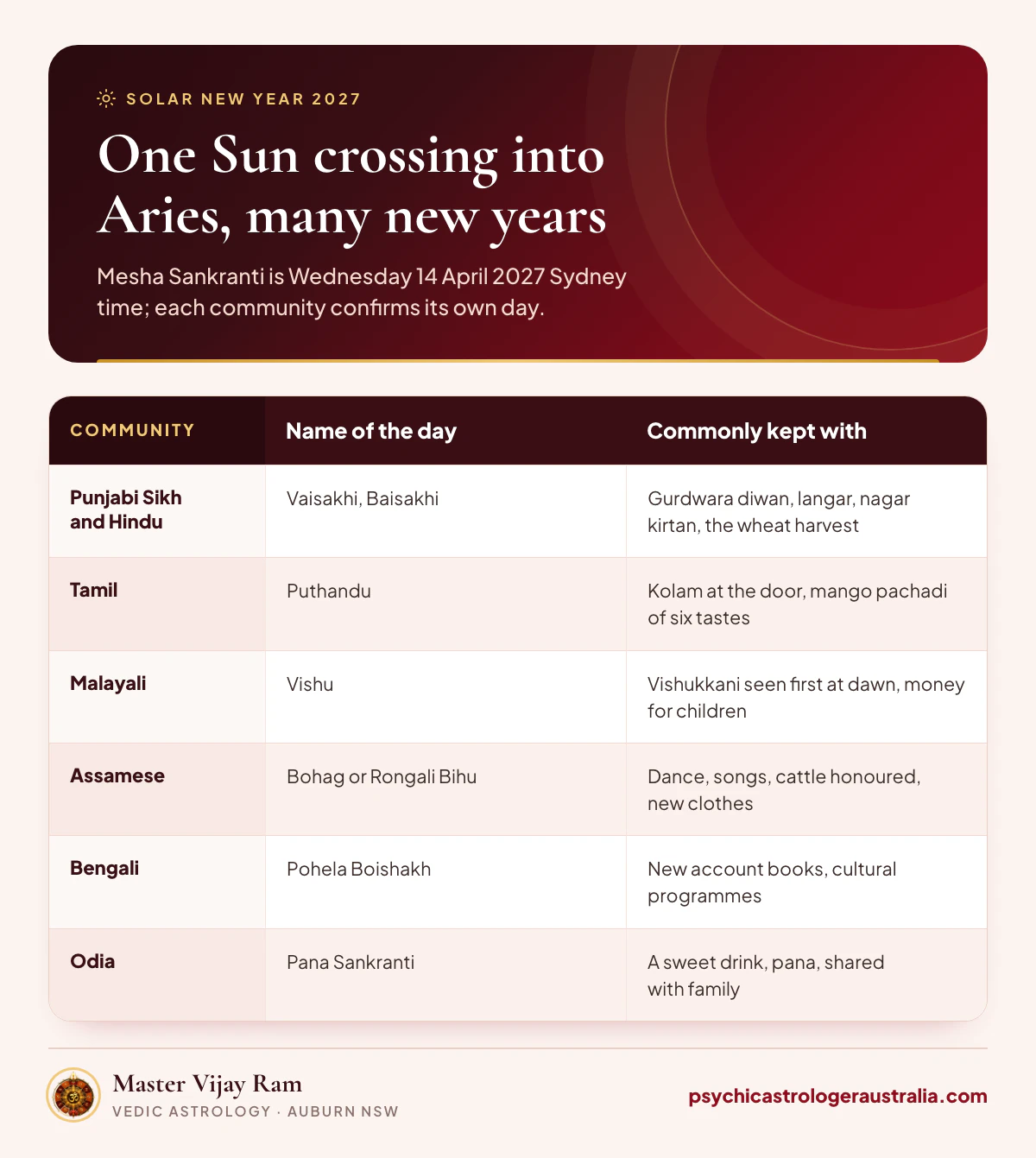
The solar new year 2027 wears many names across the subcontinent. Families arriving in Australia brought their own name with them, and a single street in Harris Park or Tarneit can hold four different new years kept on or near the same April day.
| Community | Name of the day | What is commonly kept |
|---|---|---|
| Punjabi Sikh and Hindu | Vaisakhi, Baisakhi | Gurdwara diwan and langar, the wheat harvest, bhangra and giddha |
| Tamil | Puthandu, Chithirai Vishu | Kolam at the door, mango pachadi of six tastes, temple visit |
| Malayali | Vishu | Vishukkani seen first at dawn, vishukkaineetam money for children |
| Assamese | Bohag or Rongali Bihu | Week of dance and songs, cattle honoured, new clothes |
| Bengali | Pohela Boishakh | New account books for traders, cultural programmes |
| Odia | Pana Sankranti, Maha Vishuva Sankranti | A sweet drink, pana, shared; Hanuman's birthday in Odia tradition |
| Mithila and Nepali | Jur Sital; Nepali new year | Cool water and stale food in Mithila; Bikram Sambat new year in Nepal |
Every one of these communities fixes its own day by its own calendar, and they do not always land on the same date as the Sydney ingress. Some follow the day of the crossing; others, when the Sun moves after sunset, keep the following morning. The right guide is the community's own notice, not a table drawn up for another state or another people.
How is Vaisakhi kept in Australian gurdwaras?
For Sikh families, Vaisakhi 2027 is first of all the remembrance of 1699, when Guru Gobind Singh founded the Khalsa at Anandpur Sahib. Gurdwaras hold a special diwan, many complete an Akhand Path timed to finish on the day, and the Nishan Sahib, the flag, is often re-dressed with fresh cloth.
Larger communities hold a nagar kirtan, a procession through the streets behind the Guru Granth Sahib, often on the nearest weekend rather than the weekday itself. Langar is served to anyone who comes, and visitors of every background are welcome if they cover their heads and remove their shoes.
It is worth saying plainly that astrology has no place in Sikh worship, and a Sikh family's Vaisakhi date and practice belong to their gurdwara. This page describes the astronomy behind the season and the Hindu observances of the day; the gurdwara's calendar is the only authority on the Sikh festival.
And for Punjabi Hindu families?
In Punjabi Hindu homes the day is Baisakhi 2027 in Australia as much as in Punjab, the harvest festival of the rabi wheat and the start of the solar month of Vaishakh. Many families bathe early, visit a temple, give wheat and jaggery in charity and share a festive meal; older relatives remember bathing in a river or a sacred tank on the morning.
Callers from Punjabi homes in Craigieburn, Blacktown or Mandurah often mix the two traditions without thinking about it, going to the gurdwara for langar and lighting a lamp at home in the evening. Readings for them are given in Punjabi, Hindi or English, and consultations in Hindi and Punjabi explains how those run.
What do Puthandu and Vishu add?
The southern new years carry a lovely idea: that the first thing you see on the first morning colours the year. For Vishu the women of the house arrange the vishukkani the night before, a bell-metal vessel with rice, a mirror, gold, a yellow cucumber, the golden konna flowers and an image of Krishna, and each person is led to it at dawn with their eyes covered.
Puthandu mornings begin with a kolam drawn at the threshold and a mango pachadi that mixes sweet, sour, bitter, salty, pungent and astringent, a dish that says the year will bring all six. Many Tamil families in Australia also listen to the panchanga sravanam, the reading of the new year's almanac, at their temple.
The konna tree, the Indian laburnum, does flower in parts of northern Australia, and Malayali families in Darwin and Townsville have been known to hunt for a branch. Everywhere else a yellow flower or a picture does the job, and no tradition holds that against anyone.
Is Mesha Sankranti the same as Ugadi?
No, and the difference catches people every year. Ugadi and Gudi Padwa are lunar new years, fixed by the first tithi of Chaitra's bright fortnight; in 2027 that is Thursday 8 April in Australia and Wednesday 7 April in India. Mesha Sankranti is solar, fixed by the Sun alone, and it arrives six days later in Sydney.
Telugu, Kannada and Marathi families keep the lunar new year, while Tamil, Malayali, Punjabi, Bengali, Odia and Assamese families keep the solar one. A Telugu-Tamil couple in Brisbane can therefore keep both, which several do with great enjoyment, and the Ugadi and Gudi Padwa 2027 dates cover the lunar one.
What does the Sun's entry into Aries mean in Vedic astrology?
In the Vedic scheme the Sun is exalted in Aries, reaching its highest dignity at ten degrees of the sign. Mesha Sankranti therefore opens the Sun's strongest month of the year, and astrologers have long read it as a good season for beginnings that need visibility, courage and a clear name.
Many north Indian families treat the month the Sun spends in Pisces as kharmas, a pause in weddings and house-warmings, and in 2027 that month runs from Meena Sankranti on 15 March. Mesha Sankranti closes it, which is one reason April and May are so busy with weddings; the actual wedding day still comes from a muhurat chosen for your own family, never from the season alone.
For an individual chart the Sun's month in Aries is read through the house it crosses from the lagna and from the Moon. Someone with Aries rising feels it in the first house, and someone with a Libra lagna in the seventh; the same Sun touches a different part of each life.
How can an Australian family keep the day simply?
A small observance fits easily around work or school, a week before the Chaitra full moon that brings Hanuman Jayanti 2027 by city. A bath before sunrise, water offered to the rising Sun from a copper or steel pot, a lamp in the evening and a gift of wheat, jaggery or a meal to someone who needs it are the elements most families share, whatever they call the day.
Water offered to the Sun should go onto a garden bed or a pot plant, never into a stormwater drain with flowers and powders in it. Food for charity is best given to a food bank, a gurdwara langar or a neighbour, and the guide to giving by planet explains why the Sun's gifts are wheat, jaggery and copper.
Which Australian cities keep the Sydney date?
The ingress is one moment for the whole planet, and in 2027 it falls on the Wednesday for every Australian capital, with daylight saving already over in the south-east. Canberra and Hobart keep Sydney's clock; Brisbane and the Gold Coast are on the same hour as Sydney once the clocks go back; Adelaide is half an hour behind and Perth two hours.
Communities still hold their celebrations on the nearest weekend more often than not. Adelaide families seeking a reading commonly meet in halls in the northern suburbs, and Perth's large Punjabi and Malayali communities each have their own programmes; where a festival day moves to a Saturday, the morning prayer can still be said at home on the Wednesday.
When does a sankranti call for a puja?
Rarely, for most people. A household prayer is the whole of the day, and nobody needs a priest to greet the Sun. Some families ask for a Surya puja or a Navagraha havan at the solar new year because a reading has found the Sun weak or afflicted in their chart, or because they want the year begun with a formal rite.
Where that is wanted, the rite is performed personally on request at Master Vijay Ram's place of practice in Auburn, the family joining by video if they wish. A consultation is $50; a puja or havan starts from $250, and the figure is agreed before anything is performed.
What can this page not settle?
It cannot fix the day for a gurdwara, a Tamil sangam or a Bengali association; each sets its own and should be followed. It does not give India's date for any of these festivals, because they depend on regional rules this page has not computed.
Nor can a new year change what a year holds. The Sun's crossing is a good moment to begin, to give and to take stock, and Vedic astrology reads tendencies, not fixed outcomes. If the old year left real trouble behind, with money, work or health, the National Debt Helpline, a GP or Lifeline on 13 11 14 belong in the new year's plans alongside the lamp.
Read next
- Satyanarayan Katha After a Move or a Hard YearSatyanarayan katha at home after a move or a hard year: the five chapters, why Purnima, the 2027 full moons, the pras…
- Ugadi and Gudi Padwa 2027 in Australia: New Year Date by CityUgadi and Gudi Padwa 2027: Thursday 8 April in every Australian city, Wednesday 7 April in India. City table, why Per…
- Diwali 2026 House & Aura Cleansing: Clear the Year's Heavy EnergyDiwali 2026 house and aura cleansing done honestly: clean first, use the Five-Lamp Check, and learn when heaviness is…
Frequently asked questions
When is Mesha Sankranti 2027 in Australia?
The Sun enters sidereal Aries on Wednesday 14 April 2027 by Sydney time. Daylight saving has ended by then, so Canberra, Hobart, Brisbane and the Gold Coast share the same clock as Sydney, with Adelaide half an hour behind and Perth two hours behind. The moment is the same for the whole planet; communities then decide which morning they keep.
When is Vaisakhi 2027 in Australia?
Vaisakhi follows the solar new year of mid-April, and Sikh families take their date and programme from their gurdwara, which publishes its own calendar. Many Australian gurdwaras hold the nagar kirtan on the nearest weekend. Punjabi Hindu families commonly keep Baisakhi on or near Mesha Sankranti, which falls on Wednesday 14 April 2027 Sydney time.
Is Baisakhi the same as Mesha Sankranti?
They are tied together. Mesha Sankranti is the astronomical event, the Sun entering sidereal Aries; Baisakhi or Vaisakhi is the Punjabi festival of that solar new year, which is also the wheat harvest. For Sikhs it carries the founding of the Khalsa in 1699 as well, and that meaning belongs to the gurdwara rather than to astrology.
Why is Vishu or Puthandu sometimes a day after the sankranti?
Communities have their own rules for a crossing late in the day. When the Sun enters Aries after sunset, many calendars keep the festival on the following morning, because the new year is greeted at dawn. Tamil and Malayali associations publish their chosen day each year, and following their notice is the simplest way to stay in step.
What is the difference between Ugadi and Mesha Sankranti?
Ugadi and Gudi Padwa are lunar new years set by the first tithi of Chaitra's bright fortnight, Thursday 8 April 2027 in Australia. Mesha Sankranti is the solar new year set by the Sun entering Aries, Wednesday 14 April 2027 in Sydney. Telugu, Kannada and Marathi families keep the first; Tamil, Malayali, Punjabi, Bengali and Assamese families keep the second.
Why does the Western zodiac put Aries in March?
The Western zodiac is tropical: it starts Aries at the March equinox, which in 2027 brings the Sun into Aries on Sunday 21 March. The Vedic zodiac is sidereal, measured against the stars, and the two have drifted about twenty-four degrees apart. That is why every Vedic sign begins roughly three and a half weeks after its Western namesake.
Is Mesha Sankranti a good day for a wedding?
It ends the month many north Indian families treat as kharmas, so weddings become possible again from that point. That does not make the sankranti itself the right day for a particular couple. A wedding date is chosen from both charts, the tithi, nakshatra and lagna, which is the work of a muhurat consultation, and tradition differs on whether the crossing day itself is used.
How do I keep Mesha Sankranti at home?
Bathe before sunrise, offer water to the rising Sun from a copper or steel pot onto a garden bed or pot plant, light a lamp in the evening and give wheat, jaggery or a meal to someone in need. A temple or gurdwara visit fits well. Nothing more is required, and nothing in the tradition threatens bad luck for keeping it simply.
Can I ask for a Surya puja at the solar new year?
Yes. Some families ask for a Surya puja or Navagraha havan when a reading has found the Sun weak or afflicted. Master Vijay Ram performs it personally at his place of practice in Auburn, with the family joining by video if they wish. A puja starts from $250, agreed before it is performed, and a consultation is $50.
People also ask
Is Vaisakhi always on 14 April?
Not always. Vaisakhi follows the Sun's entry into sidereal Aries, which falls on 13 or 14 April in most years and drifts very slowly later over the centuries. In 2027 the crossing is on Wednesday 14 April by Sydney time. Sikh families should follow their gurdwara's published date, which may follow its own calendar.
Which festivals fall on Mesha Sankranti?
Vaisakhi or Baisakhi in Punjab, Puthandu in Tamil Nadu, Vishu in Kerala, Bohag Bihu in Assam, Pohela Boishakh in Bengal, Pana Sankranti in Odisha and Jur Sital in Mithila all mark the same solar new year. Each community fixes its own day, and some keep the morning after the crossing when the Sun moves late.
What does the Sun in Aries mean in Vedic astrology?
Aries is the Sun's sign of exaltation, its highest dignity, with the peak at ten degrees. The month that begins at Mesha Sankranti is traditionally read as a strong season for beginnings that need courage and visibility. In a personal chart the effect depends on the house the Sun crosses from the lagna and the Moon.
Does Mesha Sankranti end kharmas?
For families who treat the Sun's month in Pisces as kharmas, yes. In 2027 that month runs from Meena Sankranti on 15 March until Mesha Sankranti on 14 April, Sydney time. Weddings and house-warmings resume afterwards, but the specific date for any ceremony is still chosen by muhurat for the family concerned.
References & further reading
Serving clients across Australia
Confidential consultations by phone, video & WhatsApp — including: