

Quick answer
The Durga Kavach, or Devi Kavacham, is a 61-shloka prayer of armour recited before the Devi Mahatmya, the 700-verse, 13-chapter text also called the Durga Saptashati. With the Argala and Kilaka it opens a path, and many families also say it alone each morning. It steadies the reciter; it replaces no doctor, lawyer or police officer.
What is the Durga Kavach, and how does it belong to the Devi Mahatmya?
The Durga Kavach, more properly the Devi Kavacham, is a Sanskrit prayer of sixty-one shlokas that asks the Goddess, in her many forms, to guard the reciter like armour, limb by limb and direction by direction. It is the first of three short preliminaries recited before the Devi Mahatmya, the great text of the Goddess, and it has also become a daily prayer in its own right. People who look up the Durga Kavach are usually frightened of something, and the honest place to begin is with what the text actually says.
Master Vijay Ram hears from families who have been told to recite it against black magic, and from many more who simply want a prayer that makes them feel held. This guide covers both, and black magic removal, approached honestly explains what he does when a family’s fear needs more than a prayer.
What is the Devi Mahatmya?
The Devi Mahatmya, the Glory of the Goddess, is seven hundred verses in thirteen chapters, forming chapters 81 to 93 of the Markandeya Purana. Because of its seven hundred verses it is also called the Durga Saptashati, and in Bengal and the east it is the Chandi Path. Its frame is a quiet one: a king named Suratha who has lost his kingdom and a merchant named Samadhi whose own family has turned him out meet in the forest hermitage of the sage Medhas.
Both men are puzzled that they still ache for what has betrayed them. The sage answers by telling them about Mahamaya, the Goddess whose power both binds the world in attachment and frees it, and the three stories that follow are his answer. A reader who arrives frightened often finds that the frame speaks to them before the battles do.
What happens in its three stories?
The thirteen chapters fall into three unequal parts, each with its own presiding form of the Goddess. The battles are vivid, and the tradition has always read them on two levels at once: as the Goddess restoring order in the world, and as the forces in a person, pride, greed, confusion, that she is asked to overcome.
| Part | Chapters | The story | Presiding form |
|---|---|---|---|
| First | Chapter 1 | The demons Madhu and Kaitabha threaten Brahma while Vishnu sleeps; Brahma praises the Goddess as sleep itself, she withdraws, and Vishnu wakes to defeat them | Mahakali |
| Middle | Chapters 2 to 4 | The buffalo demon Mahishasura has defeated the gods; their combined radiance becomes the Goddess, armed by each of them, who rides her lion into battle and slays him | Mahalakshmi |
| Final | Chapters 5 to 13 | Shumbha and Nishumbha seize heaven; Kali springs from the Goddess’s brow to destroy Chanda and Munda and to stop Raktabija’s blood breeding new demons; the Mothers join the fight, and the Goddess stands alone at the end | Mahasaraswati |
The Devi Mahatmya is often credited with bringing Kali into the Sanskrit mainstream, in the chapter where she destroys Chanda and Munda, and Maa Kali and what she is invoked for follows her from there to the Bengali Kali Puja.
Where does protection come into the text?
Mostly in its hymns, which balance the battles. Chapter 5 holds the hymn most families know without its source, Ya devi sarva bhuteshu, bowing to the Goddess who dwells in every being as consciousness, as hunger, as sleep, as forgiveness, as mother. In chapter 11 the gods sing the Narayani Stuti, and the Goddess promises that whenever trouble rises from demons she will come again and end it.
Chapter 12 is her own account of what reciting the text brings, and that is the passage behind the idea of Devi Mahatmya protection: calm in danger, courage among enemies, steadiness when the world turns. In chapter 13 the frame closes. The king asks for his lost kingdom and the merchant asks for understanding, and both are granted, which is the tradition’s gentle reminder that the Goddess answers more than one kind of need.
What does the Devi Kavacham actually say?
It opens with the sage Markandeya asking Brahma for a protection that has never been told to anyone, and Brahma answering with the kavacham itself. Early on it names the nine Durgas worshipped on the nine nights of Navratri, from Shailaputri to Siddhidatri, and then it moves through the directions and the body, asking a named Goddess to guard each one: the head, the eyes, the throat, the heart, the hands, the feet, the breath.
That is the armour, a kavacha, and the image is deliberate. The Devi Kavacham does not ask for an enemy to be struck; it asks for the reciter to be covered, piece by piece, by a mother who misses nothing. Its closing verses describe the benefits in the large language Sanskrit hymns always use, and they are best read as devotion rather than as a warranty.
Why are the Argala and Kilaka recited with it?
An argala is the bolt of a door and a kilaka is the pin that fixes it, and together with the kavacham they form the doorway into the full text. The Argala Stotram opens with Jayanti mangala kali bhadrakali kapalini, a string of the Goddess’s names, and each verse ends with the same request: rupam dehi, jayam dehi, yasho dehi, dvisho jahi, grant beauty, grant victory, grant good name, remove hostility.
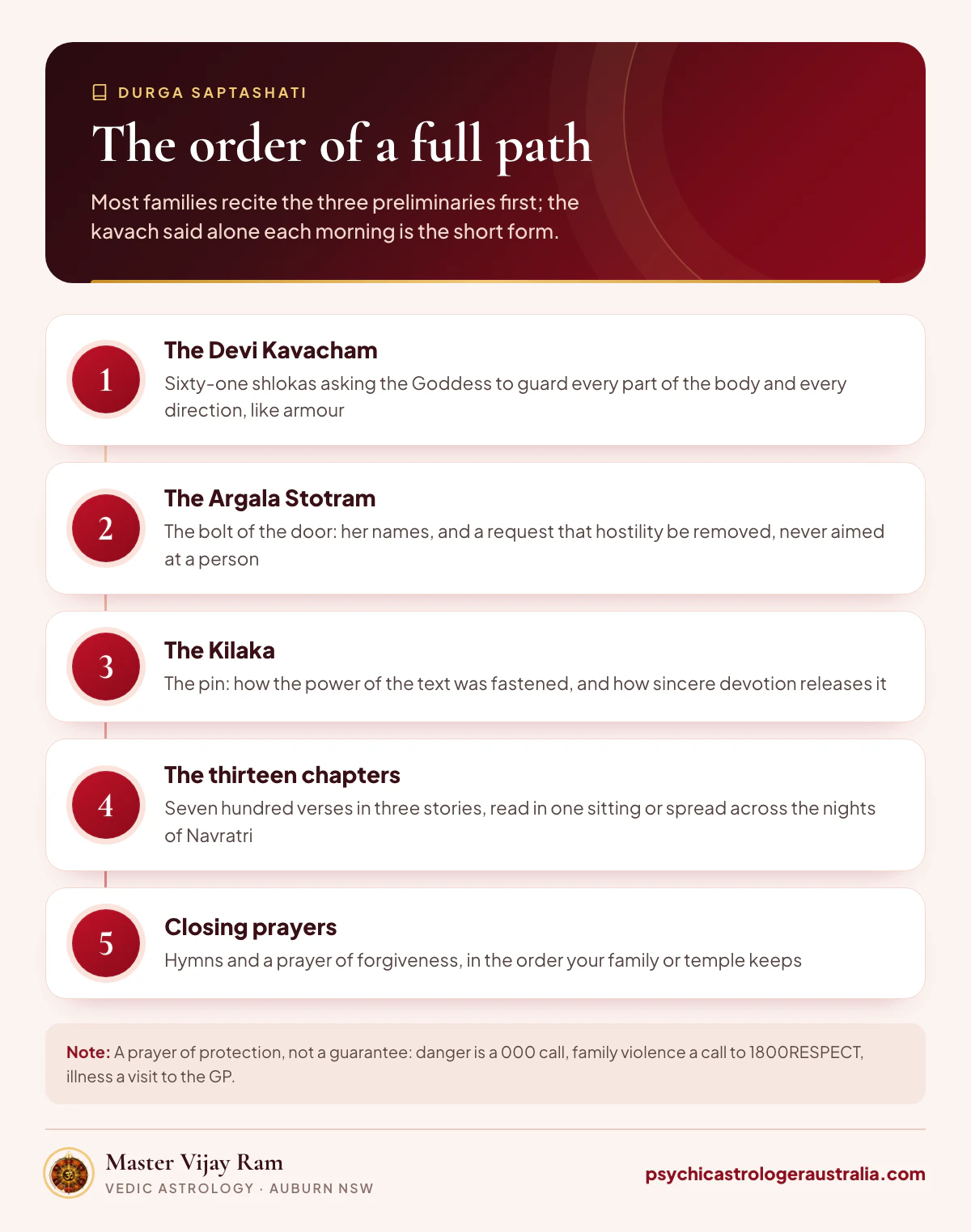
The Kilaka tells how the power of the text was fastened so that it could not be used carelessly, and how surrender to the Goddess releases it; in its own terms, a path recited with a sincere heart is open to the one who keeps it. Traditions differ on how strictly the order must be kept, and most families who recite the full path say the kavacham, the Argala and the Kilaka first, in that order.
Is a prayer to remove enemies a prayer against people?
Not in this tradition, and it matters. Dvisho jahi asks for hostility to be removed, the enmity and the danger, and devotees have always understood that the best end to an enemy is that the enmity stops. Nobody should recite the Argala with a relative, a neighbour or an ex in mind, and nobody should be told by a practitioner that a named person is behind their trouble.
The same line runs through all the fierce goddess traditions. Baglamukhi puja and its ethical limits sets out where prayer about an opponent stops, and the Kavacham itself is a defensive prayer from its first verse to its last.
Daily kavach or the full path: which suits you?
Most people do not need the full path every day, and nobody should feel guilty for that. The table sets out the usual forms, from a short morning prayer to a rite only a priest performs; traditions differ on whether the kavacham should ever be recited alone, and many families do so with their elders’ blessing.
| Practice | What it involves | When families keep it |
|---|---|---|
| The Devi Kavacham alone | The sixty-one shlokas of armour, said slowly | Each morning, or before a frightening appointment or journey |
| Kavacham, Argala and Kilaka | The three preliminaries together | Tuesdays and Fridays, or every day of Navratri |
| A chapter a day | The thirteen chapters spread over days, with the preliminaries each time | Across the nine nights, or as a month-long vow |
| The full path in one sitting | All seven hundred verses after the preliminaries | Durga Ashtami, Maha Navami, or the fulfilment of a vow |
| A Chandi havan | The text recited with offerings into a sacred fire, by trained priests | Navratri, or a family crisis, usually at a temple or on the family’s behalf |
A full Durga Saptashati path takes a few hours read carefully, and anyone keeping it should eat beforehand if their health needs it, since no tradition asks a diabetic or a pregnant woman to fast for the Goddess.
When do families recite it, and when is Navratri in 2027?
Navratri is the great season. Sharad Navratri begins on Friday 1 October 2027 in every Australian city and on Thursday 30 September in India, Durga Ashtami falls on Friday 8 October in Australia, and Dussehra on Saturday 9 October; Chaitra Navratri begins on Thursday 8 April 2027 here. Navratri 2027 dates and ghatasthapana gives the morning window for each city.
| City | Date | Ashwin Shukla Ashtami (local time) | Rule applied |
|---|---|---|---|
| Sydney | Fri 8 Oct 2027 | Thu 07 Oct 2027, 9:44 AM AEDT – Fri 08 Oct 2027, 11:58 AM AEDT | tithi present at sunrise (udaya tithi) |
| Melbourne | Fri 8 Oct 2027 | Thu 07 Oct 2027, 9:44 AM AEDT – Fri 08 Oct 2027, 11:58 AM AEDT | tithi present at sunrise (udaya tithi) |
| Brisbane | Fri 8 Oct 2027 | Thu 07 Oct 2027, 8:44 AM AEST – Fri 08 Oct 2027, 10:58 AM AEST | tithi present at sunrise (udaya tithi) |
| Perth | Fri 8 Oct 2027 | Thu 07 Oct 2027, 6:44 AM AWST – Fri 08 Oct 2027, 8:58 AM AWST | tithi present at sunrise (udaya tithi) |
| Adelaide | Fri 8 Oct 2027 | Thu 07 Oct 2027, 9:14 AM ACDT – Fri 08 Oct 2027, 11:28 AM ACDT | tithi present at sunrise (udaya tithi) |
| Canberra | Fri 8 Oct 2027 | Thu 07 Oct 2027, 9:44 AM AEDT – Fri 08 Oct 2027, 11:58 AM AEDT | tithi present at sunrise (udaya tithi) |
| Hobart | Fri 8 Oct 2027 | Thu 07 Oct 2027, 9:44 AM AEDT – Fri 08 Oct 2027, 11:58 AM AEDT | tithi present at sunrise (udaya tithi) |
| Darwin | Fri 8 Oct 2027 | Thu 07 Oct 2027, 8:14 AM ACST – Fri 08 Oct 2027, 10:28 AM ACST | tithi present at sunrise (udaya tithi) |
| New Delhi (reference) | Thu 7 Oct 2027 | Thu 07 Oct 2027, 4:14 AM IST – Fri 08 Oct 2027, 6:28 AM IST | tithi present at sunrise (udaya tithi) |
The tithi is one moment everywhere; only the clock and the sunrise differ, which is why a city can fall a day apart from India. Computed with the Swiss Ephemeris (Lahiri ayanamsa for Vedic positions) and checked against US Naval Observatory data. Times are rounded to the minute.
Outside Navratri, Tuesdays and Fridays are the Goddess’s days, and the Ashtami of each bright fortnight is kept in many homes. Bengali families have their own threshold: the dawn of Mahalaya, the new moon before the festival, when generations have woken early to hear the Chandi recited.
Can anyone recite it, and does the Sanskrit matter?
Anyone may say the Kavacham with devotion, and in many Australian homes it is the women of the family who keep it. Some lineages ask for initiation before the full path, and traditions differ on recitation during menstruation; many teachers now say that prayer from the heart is never barred, and a family can follow its own elders.
The Sanskrit is worth learning slowly, from a teacher or a careful recording, because the metre carries the meaning. Until then a Hindi or English rendering read with attention is a real prayer, and the Kilaka’s own message is that sincerity opens the door that perfect grammar alone cannot.
A kavach you recite, and a kavach you wear: what is the difference?
The word kavach is used for two different things, and families mix them up. The Devi Kavacham is a hymn that anyone can recite; a kavach in the other sense is a protective object, a small sealed amulet or locket prepared for one person. Taweez, kavach and yantra compared explains the objects and what is honest to expect from them.
Vijay Ram ji sells no kits, threads or ready-made lockets. A worn kavach is prepared only where a consultation finds it will genuinely help, and taweez and kavach protection describes how that is decided; the recited Kavacham, by contrast, needs nobody’s permission.
Where do Australian families recite it together?
Bengali associations in the capitals hold Durga Puja over the Navratri weekend, often in hired halls, and the Chandi is part of it; Gujarati families dance garba through the same nights, and temples in every capital mark the festival, Canberra’s at Mawson, Florey and Torrens among them. In Hobart, where many Nepali-speaking families resettled from Bhutan, the same season is Dashain, and its tenth day brings the tika from the elders.
Wherever the family lives, a reading happens by phone or video; readings for Hobart families describes how that works from Tasmania, and in-person consultations are held only at Auburn, by appointment.
When is a Chandi path or havan performed on your behalf?
When a family cannot read the Sanskrit, cannot keep the full path, or has been through something heavy enough that a reading suggests a fuller rite. Vijay Ram ji then recites the Saptashati, or performs a Chandi havan, at his own place of practice in Auburn on a Navratri night or another chosen day, with the family’s names in the sankalp and the family welcome to watch by video.
A Chandi path or havan performed for you starts from $250, and the amount is agreed with the family before anything is performed. First comes a $50 consultation, by phone, video or WhatsApp, and quite often it ends with the advice to keep the daily kavacham and nothing more.
What can the Kavach not do?
It cannot stop a car, cure an illness, end a court case or protect anyone from a violent partner, and the Durga Kavach benefits its closing verses describe are devotion, not a guarantee of anything. This page is faith-based guidance, not medical, legal or psychological advice: danger is a 000 call, family violence a call to 1800RESPECT, and illness a visit to the GP.
What the Kavacham does, recited slowly each morning, is put a frightened person inside a very old picture of being looked after, limb by limb, by a mother who does not sleep. For many families that is protection enough, and it was always meant to be the beginning rather than the end of looking after themselves.
Read next
- Taweez, Kavach and Yantra: Protection Objects ComparedTaweez, kavach and yantra compared: origin, how each is prepared, worn or installed, what it can and cannot do, and h…
- Narasimha and Sudarshana: The Protective Forms of VishnuNarasimha and Sudarshana: the man-lion who saved Prahlada at twilight on a threshold, Vishnu’s disc, the Sudarshana h…
- How to Break a Witchcraft Spell Safely: A Step-by-Step GuideA calm step-by-step guide to breaking a witchcraft spell safely: what to rule out first, the Standstill Week, the sta…
Frequently asked questions
What is the Durga Kavach?
The Durga Kavach, properly the Devi Kavacham, is a Sanskrit prayer of sixty-one shlokas asking the Goddess in her many forms to guard the reciter like armour, part by part and direction by direction. It names the nine Durgas of Navratri early on. It is the first of three preliminaries before the Devi Mahatmya, and many families also recite it alone each morning.
Can I recite the Devi Kavacham alone, without the full Saptashati?
Many families do, every morning or before a frightening day, and their elders bless it. Some lineages hold that the kavacham belongs with the full path and should be followed by at least part of the text, so traditions differ. If your family has a teacher, ask; if not, a slow, attentive recitation of the kavacham alone is a sincere prayer.
What is the Argala Stotram?
The Argala Stotram is the second preliminary recited before the Devi Mahatmya. Argala means the bolt of a door. It opens with a string of the Goddess’s names beginning Jayanti mangala kali, and each verse ends asking for beauty, victory and good name and for hostility to be removed. That last phrase asks for enmity to end, not for harm to anyone.
How many chapters and verses does the Durga Saptashati have?
Thirteen chapters and seven hundred verses, which is why it is called the Saptashati, the seven hundred. It forms chapters 81 to 93 of the Markandeya Purana and is also called the Devi Mahatmya and, in Bengal, the Chandi Path. The chapters fall into three stories, presided over by Mahakali, Mahalakshmi and Mahasaraswati.
When is the best time to read the Durga Saptashati?
Navratri above all: in 2027 Sharad Navratri begins on Friday 1 October in Australia and Durga Ashtami falls on Friday 8 October, the classic day for a full path. Outside Navratri, Tuesdays, Fridays and the Ashtami of the bright fortnight are the usual days. Many families spread the thirteen chapters across the nine nights instead of reading them in one sitting.
Can women recite the Devi Kavacham and the Saptashati?
Yes. Women keep the kavacham and the full path in households and temples across the world, and the text sets no bar against them. Some lineages ask for initiation before the full path, and traditions differ on recitation during menstruation; many teachers now say that prayer from the heart is never barred, and a family can follow its own elders.
Does the Durga Kavach protect against black magic?
In the tradition it is a prayer of protection against every kind of harm, and families who fear black magic often keep it daily. Most of what feels like an attack has ordinary causes that need a doctor, a counsellor or the police, and those come first. The kavacham steadies the person reciting it; it is not aimed at anyone and it guarantees nothing.
Is the Devi Kavacham the same as a kavach locket or amulet?
No. The Devi Kavacham is a hymn that anyone can recite. A kavach in the other sense is a protective object prepared for one person. Master Vijay Ram sells no ready-made lockets or kits; a worn kavach is prepared only where a $50 consultation finds it will genuinely help, while the recited Kavacham needs nobody’s permission.
Can a Chandi havan be performed for our family, and at what cost?
Yes. Master Vijay Ram recites the Saptashati or performs a Chandi havan himself in Auburn on a Navratri night or another chosen day, naming the family in the sankalp, and relatives are welcome to follow on video. Fees begin at $250 and are agreed before anything is performed, after a $50 consultation.
People also ask
What are the benefits of the Durga Kavach?
In the tradition, the kavacham covers the reciter with the Goddess’s protection in body, mind and every direction, and its closing verses describe courage, safety and calm. In practical terms a slow daily recitation gives a frightened person a steady practice. It cannot stop an accident, cure illness or replace the police, and no one can honestly guarantee any result.
What is the difference between the Devi Mahatmya and the Durga Saptashati?
They are the same text. Devi Mahatmya means the Glory of the Goddess; Durga Saptashati means the seven hundred verses of Durga; Chandi Path is the name used in Bengal and the east. All three refer to chapters 81 to 93 of the Markandeya Purana, thirteen chapters telling three stories of the Goddess.
In what order are the Kavach, Argala and Kilaka recited?
Most families recite the Devi Kavacham first, then the Argala Stotram, then the Kilaka, before beginning the thirteen chapters of the Devi Mahatmya. Some traditions add other preliminaries or follow the text with hymns and prayers of forgiveness. If your family or temple keeps a particular order, follow it; the order matters less than attention.
Which chapter of the Durga Saptashati is for protection?
Families often single out chapter 11, where the Goddess promises to return whenever trouble rises, and chapter 12, her own account of what reciting the text brings, including calm in danger and courage among enemies. Chapter 5 holds the Ya devi hymn many people know by heart. The tradition still treats the whole text as one prayer.
References & further reading
Serving clients across Australia
Confidential consultations by phone, video & WhatsApp — including: