
Quick answer
A taweez is an Islamic amulet carrying written verses, a kavach is a Vedic protection prepared with mantra and worn on the body, and a yantra is a sacred diagram installed at the altar or kept on the person. All three protect; none attacks or controls. Master Vijay Ram chooses from the birth chart, prepares the object personally and says what it cannot do.
Three objects, one purpose
A grandmother in Perth ties a black thread on a newborn's wrist, a shopkeeper in Auburn keeps a copper plate behind the till, and a young man in Canberra wears a small silver cylinder on a cord under his shirt. A taweez is an amulet of the Islamic tradition that carries written verses or names of God; a kavach is a protection of the Vedic tradition prepared with mantra and worn on the body; a yantra is a sacred diagram, most often engraved on copper, installed at an altar or carried on the person. All three exist to protect, and all three are misunderstood in the same way.
The comparison below is written for people deciding between them, or wondering whether the one they already have is doing anything. Master Vijay Ram prepares kavach and yantra personally and the taweez and kavach protection page describes the service; this article is about what the objects are, which is the question that comes before buying one.
What is a taweez?
A taweez, or ta'wiz, is a small case, usually of metal or leather, holding a paper on which verses of the Quran, names of God or a prescribed supplication have been written. It is worn around the neck or the upper arm, tied to a child, or kept in a purse or a car. Its authority comes from the words it carries, and within Islam there is long debate about which forms are permitted; a genuine one never contains anything that calls on other than God.
Muslim families should have a taweez written by someone within their own tradition, and Vijay Ram ji says so plainly rather than writing one himself. The taweez versus kavach question is, for most families, settled by which tradition the household keeps.
What is a kavach?
Kavach means armour. In the Vedic tradition the word covers both a hymn of protection, such as the Durga Kavach or the Hanuman Kavach, recited for the person, and a physical object, a small locket, a thread, a pendant of copper or silver, over which that mantra has been recited many times and which is then worn. A raksha kavach is one prepared specifically for protection from nazar, from ill-intent and from a hard planetary period.
The object is a vessel for the practice, not a battery. A kavach that was prepared with mantra and is worn by someone who also keeps a lamp and says the mantra now and then is a living thing; one bought by post and forgotten in a drawer is a piece of metal.
What is a yantra?
A yantra is a geometric diagram, a particular arrangement of triangles, circles, squares and lotus petals, each form belonging to a deity or a planet: the Sri Yantra for Lakshmi, the Durga or Baglamukhi yantra for protection, the Navagraha yantra for the nine planets, a Shani yantra for Saturn. It is engraved on copper or drawn on bhojpatra, energised with mantra on a muhurat, and then installed, at the home altar, behind a shop counter, or carried in a small form.
A yantra is more an instrument than an amulet. It is placed, faced, lit and used, and the tradition expects the household to sit in front of it from time to time. Using a yantra for protection without ever looking at it again is like installing a lamp and never switching it on.
How is each one prepared?
A taweez is written, by hand, by a person who knows what may be written, with ablution and intention, and sealed. A kavach is prepared by recitation: the chosen mantra is recited over the object a set number of times, often in the thousands across days, on a muhurat chosen from the chart of the person who will wear it, and then given with instructions. A yantra is engraved or drawn, washed, and brought alive with mantra and offerings, the pran-pratishtha, on an auspicious day, after which it is treated as present rather than as decoration.
None of this is done in a minute, and none of it is done by a factory. The preparation is the whole of the difference between a protection object and a souvenir, and it is why Vijay Ram ji prepares each one himself at his own altar in Auburn for the person it is for.
Worn, carried or installed: where does each one live?
A taweez and a kavach are worn: on a cord at the neck or the arm, as a thread at the wrist, sometimes in a wallet. They go where the person goes and are removed only for washing or when the tradition asks. A yantra is installed: it has a place, a direction, a cloth under it and a lamp near it, and the home or the shop is built around that place a little.
Which suits you is partly practical. A nurse who cannot wear a cord at work carries a small kavach in a pocket; a family that moves house every year prefers a yantra that travels in a box to one fixed on a wall; a child wears a thread and nothing heavier.
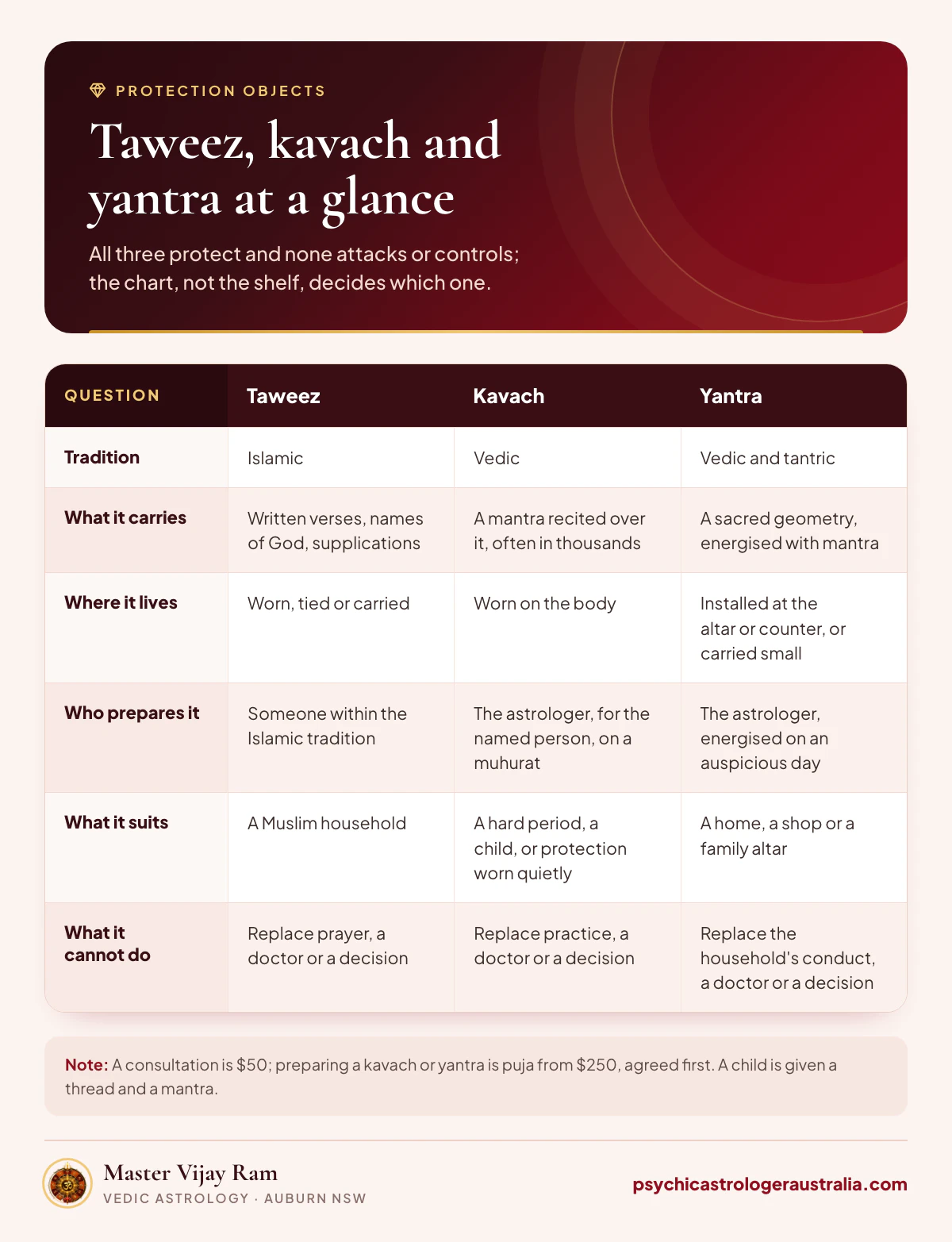
Taweez, kavach and yantra side by side
| Question | Taweez | Kavach | Yantra |
|---|---|---|---|
| Tradition | Islamic | Vedic | Vedic and tantric |
| What it carries | Written verses, names of God, supplications | A mantra recited over it, often in thousands | A sacred geometry of a deity or planet, energised with mantra |
| Form | A paper in a metal or leather case | A locket, pendant or thread of copper, silver or cotton | A copper plate or a drawing on bhojpatra |
| Where it lives | Worn, tied, or carried | Worn on the body | Installed at the altar, the counter, or carried small |
| Who prepares it | Someone within the Islamic tradition | The astrologer, for the named person, on a muhurat | The astrologer, energised on an auspicious day |
| What it suits | A Muslim household | A person in a hard period; a child; someone who wants protection worn quietly | A home, a shop, a family altar; a planet that needs steady attention |
| What it cannot do | Replace prayer, a doctor or a decision | Replace practice, a doctor or a decision | Replace the household's own conduct, a doctor or a decision |
What can a protection object actually do?
Three things, honestly stated. It is a reminder: a hand that goes to the kavach at the neck in a hard moment is a hand that reaches for the mantra. It is a boundary: a yantra at the counter tells a household, and tells the people who enter, that the place is kept. And it is a focus for practice, the point around which the lamp, the mantra and the weekly order of the house are arranged.
The tradition calls this raksha, protection, and means it. What it does not mean is a shield against a car on the Hume, a diagnosis, a bad contract or a cruel relative. A protection amulet in astrology is chosen to steady a person through a period the chart shows; it is not a substitute for seatbelts, doctors or lawyers, and Vijay Ram ji says so before any object changes hands.
What none of them will do: attack or control
A protection object protects. It is not turned around to harm the person you suspect, and it is not prepared to bind a lover, bend an employer or silence a relative. Objects sold for those purposes, under the name of a vashikaran yantra or a taweez for love, are refused here, and people who have been made to fear one are helped on the vashikaran removal page. The tradition's own word for a protection that was turned to control is misuse, and it is the first thing a genuine practitioner declines.
How does Master Vijay Ram choose from the chart?
The chart first, the shelf second. A Saturn period calls for a Shani yantra and a practice on Saturdays; a Rahu affliction for a yantra and a mantra that steady the mind; an afflicted Moon for a kavach worn close and a lamp at dusk. A child is given a thread and a short mantra for a parent to say, never a heavy object. A business is given a Sri Yantra at the counter and a Ganesh practice at opening, and someone with no daily practice is given a kavach they can wear without ceremony, because an object that asks more than the person will do is an object that will be abandoned.
A kavach is never prescribed as a cure for something the chart does not show. Where the trouble is nazar, evil eye and nazar removal comes first and the object follows as protection; where a person's work is found, black magic removal is the remedy and the kavach is the aftercare.
What about gemstones?
A gemstone is a different instrument, worn to strengthen a planet that is weak and well placed, not to protect against one that is afflicted, and the wrong stone does harm where the wrong kavach merely does nothing. The guide to gemstones by rashi explains the choice; a kavach and a stone are sometimes worn together, and the chart decides.
Care, renewal and retirement
A worn object is kept clean and respected, removed where the tradition asks, and not lent. A yantra is wiped, lit and sat with, and not buried under papers at the back of the shop. When the period it was prepared for has passed, the object is retired with thanks, into running water or the earth, or kept at the altar; it is not thrown in the bin and not sold on.
Renewal is for a new period, not a subscription, and a practitioner who tells you the kavach has expired and must be bought again every year is selling a product, not a protection.
Buying one online: what to check
Most objects sold online were never prepared for anyone, and some are unsafe for a child or contain things no tradition permits. The real taweez versus fakes guide sets out the four questions to ask; the short version is that a genuine object is prepared for a named person, by a practitioner who will tell you what is in it and what mantra was used, on a stated day, for a stated price. Australian consumer law covers the sale of a physical object and the claims made for it, and Fair Trading or Consumer Affairs can be told about a seller who promised more than metal can deliver.
What does it cost?
A consultation is $50, and it is where the chart is read and the object, if any, is chosen. The preparation of a kavach or yantra, with the recitation and the energising on a muhurat, is puja performed personally and starts from $250, agreed with you before anything is prepared and not raised afterwards; the object is posted or collected from Auburn. A child's thread and a parent's mantra are given in the consultation and need nothing further.
What to do next
Decide first which tradition your household keeps, because that answers the taweez question on its own. Then ring or message with your birth details and say what you want protection from, in plain words, in English, Hindi or Punjabi; a caller in Perth is served as a family in Auburn is, and the Perth page explains how.
Parents asking about a school-age child should read the guide to spiritual protection for children first, because a child's protection is mostly the parent's conduct, not an object.
Keeping a yantra or kavach in a Sydney apartment, rental or new estate
Plenty of Sydney households have no puja room at all. In an apartment in Parramatta, Strathfield or the CBD, a yantra can stand on a shelf at the family altar, on its cloth and in the direction given with it, so nothing needs drilling into a rented wall, and a kavach can rest in a drawer lined with clean cloth whenever it is not being worn.
In the new estates of Rouse Hill and Kellyville, families building from scratch sometimes ask where the altar should go before the plans are signed, and that question belongs with a Vastu consultation rather than with the object. For homes that feel heavy rather than simply new, the cleansing that comes before any object is described under clearing negative energy in Strathfield and nazar and negative energy help in Castle Hill.
Retiring a protection object follows the same rule in a unit as in a village: running water, the earth, or a place at the altar, never the bin. For a family without a garden, keeping a retired kavach at the altar is as respectful as burying it.
A prepared object can be posted anywhere in Australia or collected from Auburn, his only place of practice. Clients on the Central Coast can take a train towards Strathfield and change for Auburn, and Wollongong is a drive or a train ride away; everyone else starts with a phone, video or WhatsApp consultation, because the chart, not the shelf, decides which object it is.
Read next
- Durga Kavach and the Devi Mahatmya: The Goddess as ProtectionDurga Kavach and the Devi Mahatmya: the 700 verses and three stories, the 61-shloka Kavacham with the Argala and Kila…
- Taweez & Kavach for Protection: Real Ones vs FakesHow to tell a genuine taweez or kavach from a fake: what belongs inside one, what never should, which option suits yo…
- Spiritual Protection for Children at School and OnlineSpiritual protection for children at school and online: what a parent does first, the gentle practices a family keeps…
Frequently asked questions
Which is better, a taweez or a kavach?
Neither is better; they belong to different traditions and the household's own faith decides. A Muslim family has a taweez written within Islam; a Hindu or Sikh family, or one that keeps a lamp and a mantra, is given a kavach prepared with mantra for the named person. Both are protection, both are reminders and boundaries, and neither replaces prayer, a doctor or a decision.
Can I wear a kavach and a gemstone together?
Often, and the chart decides. A gemstone strengthens a planet that is weak and well placed; a kavach steadies a person through a period or shields against nazar and ill-intent. They do different work and are sometimes worn together, but the wrong stone does harm where the wrong kavach merely does nothing, so the stone is never chosen from a website and the two are read together.
Where should a yantra be kept in the house?
At the altar or in the north-east of the home, on a clean cloth, facing east or north, with a lamp near it and nothing stacked on top. In a shop it sits behind the counter where the owner can see it. It is wiped, lit and sat with now and then; a yantra under papers at the back of a drawer is doing nothing, and that is the commonest reason one seems not to work.
How is a kavach energised?
By recitation. The mantra chosen from the chart is recited over the object a set number of times, often in the thousands across several days, on a muhurat chosen for the person who will wear it, and the object is then given with instructions for wearing and care. Master Vijay Ram does this personally at his own altar in Auburn; nothing bought ready-made has had it done.
Can a yantra or taweez be used to make someone love me?
No, and anyone offering one for that purpose is offering misuse. Protection objects protect; they are not prepared to bind a partner, bend an employer or silence a relative, and such objects are refused here. People who have been told that one was used against them are helped through vashikaran removal, where the signs are read first and fear is treated as the main harm.
What should I do with an old kavach or taweez?
Retire it with thanks when the period it was prepared for has passed: into running water or the earth, or kept at the altar. It is not thrown in the bin, not sold on and not lent. A taweez is retired within the Islamic tradition's own practice. Renewal is for a new period in the chart, not a yearly subscription, and nobody should tell you it has expired.
Is it safe to put a taweez or kavach on a child?
A child wears a thread and nothing heavier, with a short mantra a parent says, and never anything that could be swallowed, caught or pulled tight. A newborn's thread is tied loosely, checked daily and taken off before sleep. The child's real protection is the parents' conduct, a calm home and a routine, and no object is ever given in place of a doctor or the school when a child is unwell or unhappy.
What does a kavach or yantra cost?
The consultation is $50 and is where the chart is read and the object, if any, is chosen. Preparation, with the recitation and the energising on a muhurat, is puja performed personally and starts from $250, agreed before anything is prepared and not raised afterwards. A child's thread and a parent's mantra are given in the consultation and need nothing more.
How do I know if the kavach I bought online is real?
Ask who prepared it, for whom, on what day, with which mantra, and for what stated price; a genuine object has answers to all five. Objects sold by weight from a catalogue were prepared for nobody, and some contain things no tradition permits or are unsafe for a child. Australian consumer law covers the sale and the claims made, and Fair Trading or Consumer Affairs can be told about a seller who promised too much.
People also ask
What is the difference between a yantra and a kavach?
A kavach is worn on the body, a locket or thread over which a mantra has been recited for a named person, and it goes where the person goes. A yantra is a sacred diagram, usually on copper, energised with mantra and installed at an altar or a counter, with a place, a direction and a lamp. One is armour for a person; the other is an instrument for a place.
Does a taweez work for Hindus?
A taweez belongs to the Islamic tradition and carries Quranic verses or names of God written by someone within that tradition, so it is not something a Hindu astrologer writes. A Hindu or Sikh household is given a kavach prepared with mantra, which does the same work within its own frame. Which object suits a family is settled by the tradition it keeps.
Which yantra is best for protection?
The one the chart calls for. A Durga or Baglamukhi yantra is the traditional protection against ill-intent, a Shani yantra steadies a Saturn period, a Navagraha yantra covers the nine planets, and a Sri Yantra at a counter is for a household's prosperity. None is best in general, and a yantra chosen from a website rather than a reading is usually the wrong one.
Can a protection amulet stop black magic?
A kavach or yantra is aftercare and protection, not a cure. Where a reading finds a person's work, black magic removal is the remedy and the object is given afterwards to keep the household steady; where the trouble is nazar, nazar removal comes first. An object worn by someone who was never assessed protects against nothing in particular, and the tradition does not pretend otherwise.
How long does a kavach last?
For the period it was prepared for, which the chart shows and which is told to you when it is given: a Saturn period, a year of transits, a child's early years. It is then retired with thanks or kept at the altar. It does not expire on a calendar, and a practitioner who sells a replacement every year is selling a product rather than a protection.
References & further reading
Serving clients across Australia
Confidential consultations by phone, video & WhatsApp — including: