
Quick answer
Cat's eye (lehsunia) is Ketu's stone in Vedic astrology, a chrysoberyl showing a single line of light. Because Ketu rules no sign, it is judged from Ketu's house, sign lord, companions and period, and it is suggested rarely, usually for a Ketu in the third, sixth or eleventh with a strong sign lord. It is avoided when Ketu troubles the Moon.
What is cat's eye in Vedic astrology?
Cat's eye, lehsunia in Hindi and vaidurya in Sanskrit, is the navaratna's gem for Ketu, the shadow planet of detachment, intuition, endings, inner search and the past. In cat's eye astrology it is the stone handled with the most reserve, because Ketu's gifts and Ketu's harms are close neighbours: the same planet that brings clear insight can bring withdrawal, and the stone strengthens both. That double edge is what the title means by risk.
This page sets out what a cat's eye is, how Ketu is read for a stone, when it is considered and when it is refused, the trial, the substitute and the imitations. A chart reading for gemstones is the only sound place to start with this stone in particular.
Why does Ketu get a stone with a line of light?
Ketu is the Moon's south node, the headless body of the demon Svarbhanu in the eclipse story, and the tradition reads it as the part of us that has already let go: no head, no appetite, only the memory of what was. The texts give it mixed, smoky colours, and a cat's eye, a muted honey or grey-green stone crossed by one bright line, suits a planet of sudden insight in an otherwise quiet field. A familiar saying holds that Ketu acts like Mars, which is one reason some lineages begin the stone on Mars's day, Tuesday.
Behind most questions about lehsunia stone benefits is Ketu at its best: focus for research, coding or healing work, steadiness in spiritual practice, the ability to let go of what is finished, and a sharp, intuitive read of situations. The tradition is equally clear about Ketu at its worst: confusion, isolation, losses that arrive without warning and a fading interest in ordinary life.
What makes a cat's eye a cat's eye?
The stone is chrysoberyl, a beryllium aluminium oxide with a hardness of 8.5 on the Mohs scale, and its eye is an optical effect called chatoyancy. Fine parallel needles or channels inside the crystal reflect light into a single bright band when the stone is cut as a smooth dome, and when it is lit from one side, one half often glows milky while the other stays honey-coloured, the effect dealers call milk and honey. Sri Lanka has long been the best-known source, and alexandrite, the colour-change gem, is another variety of the same mineral.
Other minerals can show an eye too, quartz, tourmaline and apatite among them, and in the gem trade the plain name cat's eye is generally kept for chrysoberyl, with the others named as quartz cat's eye and so on. For lehsunia the tradition means chrysoberyl, and a sharp, straight, centred eye that glides across the dome as it turns is the quality buyers look for.
What does Ketu bring, and what does the stone amplify?
Because a stone amplifies whatever a planet is already doing, it helps to see Ketu's qualities side by side with their excess. The table summarises how the tradition describes Ketu; it is not a list of promised effects.
| Ketu's quality | At its best | Amplified too far |
|---|---|---|
| Detachment | Calm, letting go of what is finished | Withdrawal, apathy, drifting away from family |
| Intuition | A quick, accurate read of people | Suspicion, confusion, second-guessing |
| Inward focus | Depth in research, coding, healing or spiritual practice | Isolation and neglect of daily life |
| Sudden change | Clean breaks and fresh starts | Abrupt losses and separations |
| The past | Old skills returning with ease | Being stuck in old hurts |
How is lehsunia judged when Ketu owns no sign?
Ketu, like Rahu, owns no sign in the classical scheme; a few lineages assign it Scorpio, and even its sign of exaltation is disputed between schools. A reading therefore looks at where Ketu sits by house, which planet rules that sign, who keeps Ketu company and which dasha is running, and Ketu is said to deliver the results of its sign lord and companions. That reading, rather than any table of signs, answers who should wear lehsunia:
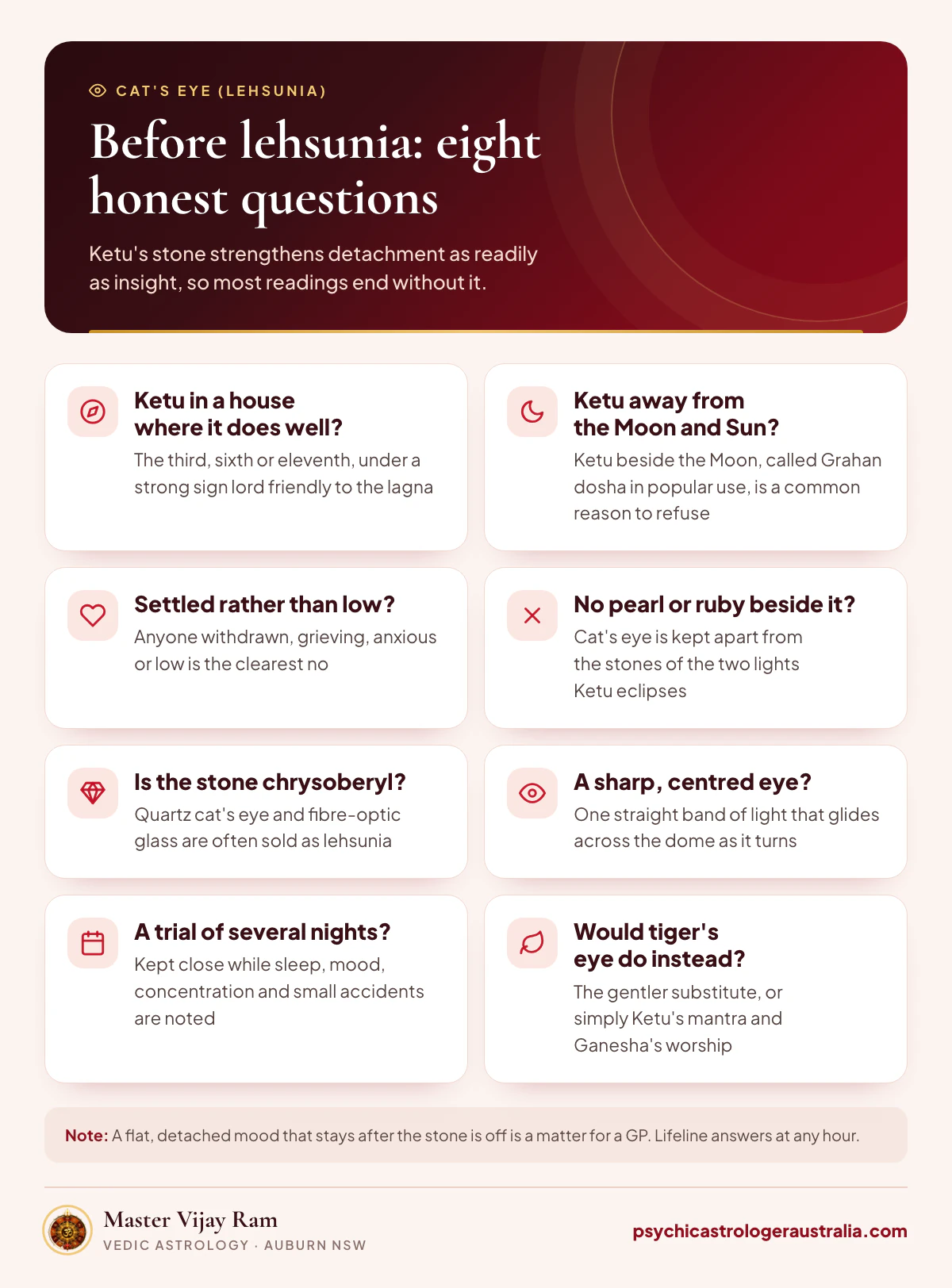
- Leaning towards it: Ketu in the third, sixth or eleventh house, where the tradition reads it as doing well, with a strong sign lord that is friendly to the lagna, during a Ketu period the reading judges favourable.
- Considered by some for a settled spiritual seeker: Ketu in the twelfth, the house of release, with a well-placed sign lord, though many practitioners still prefer mantra to a stone there.
- Leaning against it: Ketu with the Moon or the Sun, Ketu in a house the person is already struggling with, a weak or difficult sign lord, or a Ketu period already bringing confusion and loss.
How stones are matched to a birth chart explains the same weighing for the planets that do rule signs.
Who should not wear a cat's eye?
The clearest no is a person who is already withdrawn, grieving, anxious or low, because the tradition expects a stronger Ketu to deepen exactly that. A Ketu beside the Moon, the combination called Grahan dosha in popular use, is also a common reason to refuse the stone, and so is a Ketu period that is already bringing sudden losses. Cat's eye is kept away from pearl and ruby, the stones of the two lights Ketu eclipses, and most practitioners prefer it worn alone; the stones that need the most care explains why it sits on that list.
Why is cat's eye called the riskiest stone?
Partly because of Ketu itself, the least worldly of the nine, and partly because of the stone's reputation for acting suddenly, like neelam, in either direction. Ketu's helpful placements are fewer and harder to judge than those of the visible planets, so the margin for error is narrow. That is why many readings that consider cat's eye still end with Ketu's mantra and a graha shanti for Ketu instead, and why a trial is treated as essential rather than optional.
What does a cat's eye that does not suit feel like?
The cat's eye side effects people report are Ketu turned up too far: a flat, disconnected mood, loss of interest in work and family, confusion and indecision, broken sleep, sudden reversals, and small cuts or accidents in quick succession. The tradition takes that as a sign that Ketu was the wrong planet to feed, and the stone comes off immediately. If the low, detached feeling continues once it is off, a GP is the right person to see, and Lifeline is there at any hour when things feel unmanageable.
How is a cat's eye worn and trialled?
The common practice sets lehsunia in silver or panchdhatu, to be worn on the middle or little finger, and begins on a Tuesday or a Saturday, depending on the lineage, after Ketu's beej mantra, Om Sraam Sreem Sraum Sah Ketave Namah, and many families also turn to Ganesha for Ketu. Traditions differ on almost every detail here, and a family's own practice is a reasonable guide. Before setting, the stone is kept close for several nights, as with neelam, while sleep, mood, concentration and small accidents are noted.
Would tiger's eye do instead?
The tradition's uparatna for Ketu is tiger's eye, a golden-brown quartz whose fibrous inclusions give it a rolling band of light of its own. It is inexpensive, robust and gentle in the tradition's reading, so it is often the sensible trial for a person whose Ketu is judged helpful. It is not a softer way round a refused Ketu, and for many people in a Ketu period the steadier support is a Tuesday or Saturday practice, Ganesha's worship and the Ketu mantra.
Quartz, glass or chrysoberyl: what is actually on offer?
Quartz cat's eye is far cheaper than chrysoberyl and is often sold as lehsunia, and glass made from bundled fibres produces a convincing eye in almost any colour. Treatments are less common than with sapphire, but the identity of the stone matters a great deal, so ask for the mineral to be named on the invoice, chrysoberyl rather than just cat's eye, and get an independent report for anything costly. A lehsunia ratna sold as chrysoberyl must be chrysoberyl, a basic consumer right in Australia, buying advice is a gemmologist's work, and Master Vijay Ram does not deal in stones of any kind.
Does Ketu's mahadasha or transit call for lehsunia?
Neither does by itself. Ketu's mahadasha lasts seven years, and anyone whose birth Moon falls in Ashwini, Magha or Mula, the three Ketu nakshatras, begins life in it; a cat's eye is discussed most in that period, but only a favourable reading of Ketu justifies one. The Ketu mahadasha and its remedies describes the period, and Ketu in the seventh house shows how its detachment plays out in marriage.
The transit is a separate question. Ketu crossed into Cancer on 6 December 2026 by Sydney reckoning and remains there for all of 2027, a sky shared by everyone that cannot by itself show whether your natal Ketu should be strengthened.
What does a cat's eye consultation with Vijay Ram ji involve?
Master Vijay Ram looks at Ketu's house, what its sign lord means for your lagna, who sits with it and which dasha you are in, and asks how you are actually feeling before saying whether a cat's eye, a tiger's eye or no stone is right; with this stone, no stone is the commonest answer. Bring your birth details with the time to the minute, and say who suggested the stone and why. The fee is $50 for a consultation held over the phone, on video or via WhatsApp, with English, Hindi and Punjabi all fine, and anyone near enough can see him in Auburn by appointment.
As an illustration, a PhD student in Townsville, months from submission and struggling to concentrate, might ask whether lehsunia would sharpen her focus. If Ketu sits with her Moon in the fourth, the answer is no; the useful advice concerns sleep, routine and a conversation with her supervisor and the university's counselling service; readings for Townsville clients run on Queensland time. Where a Ketu shanti is warranted, the puja and havan service explains how he carries it out in person at Auburn, from $250, at a cost agreed before it begins.
Read next
- Hessonite (Gomed): Rahu’s Stone and When It Is SuggestedHessonite (gomed) in Vedic astrology: Rahu’s stone, how it is judged without a sign, when it is suggested or avoided,…
- Ruby (Manik) in Vedic Astrology: The Sun’s Stone and Who Should Avoid ItRuby (manik) in Vedic astrology: why it is the Sun’s stone, the lagnas it suits, who should avoid it, how it is worn,…
- Taweez & Kavach for Protection: Real Ones vs FakesHow to tell a genuine taweez or kavach from a fake: what belongs inside one, what never should, which option suits yo…
Frequently asked questions
Who should wear cat's eye (lehsunia)?
Rarely anyone, and only after a full reading. The tradition considers it where Ketu occupies the third, sixth or eleventh, its sign lord strong and friendly to the lagna, during a Ketu period judged favourable, and for a person who is settled rather than withdrawn. Some lineages also consider it for a steady spiritual seeker with Ketu in the twelfth. Ketu rules no sign, so lordship alone cannot decide it.
Who should avoid cat's eye?
Anyone already withdrawn, grieving, anxious or low; anyone whose Ketu sits with the Moon or the Sun; anyone whose Ketu period is bringing sudden losses; and anyone wearing pearl or ruby, which it is kept apart from. A person told to buy it from a general list, without a chart reading, should not. The tradition expects a stronger Ketu to deepen detachment, the wrong direction for most people in difficulty.
Is cat's eye safe to try without a reading?
The tradition would say no. Ketu's helpful placements are few and hard to judge, the stone is said to act suddenly, and its excess looks like withdrawal and confusion, which are easy to mistake for an ordinary low patch. If you want something gentle while you wait for a reading, tiger's eye is the accepted substitute, and Ketu's mantra suits every chart.
Does cat's eye help with meditation or spiritual practice?
Ketu is the tradition's planet of inner search, so a well-placed Ketu supported by a cat's eye is linked with steadier practice and insight. The same stone can deepen withdrawal in someone who is struggling, so practice and stability come first. A teacher, a regular routine and the Ketu mantra are the traditional foundation, and a stone is considered only on top of a favourable chart.
Can cat's eye be worn during Ketu mahadasha?
Sometimes, if the reading judges Ketu favourable in your chart. The seven-year Ketu period is when cat's eye is most often discussed, but a Ketu period bringing confusion, isolation or sudden loss is better answered by calming Ketu than by feeding it: the mantra, Ganesha's worship and, where warranted, a shanti. The stone question follows the chart, not the calendar.
Which day is used to start wearing lehsunia?
Lineages differ: some begin on a Tuesday, reflecting the saying that Ketu acts like Mars, and others on a Saturday, as with the stones of Rahu and Saturn. The stone is mounted in silver or panchdhatu, worn on the middle or little finger after Ketu's beej mantra, with a trial of a few nights before it is set. Families follow their own custom on the details, and that is fine.
Is quartz cat's eye the same as lehsunia?
No. Quartz cat's eye shows a similar line of light but is a different and much cheaper mineral, and in the gem trade the plain name cat's eye is generally reserved for chrysoberyl. The tradition means chrysoberyl by lehsunia. Ask for the mineral to be named on the invoice and get an independent report for anything costly, since fibre-optic glass imitations are common too.
Can cat's eye protect me from accidents or the evil eye?
Some sellers promise that, but the tradition reads the stone as strengthening Ketu, and a strengthened Ketu in the wrong chart is linked with sudden events rather than protection from them. No stone replaces careful driving, safety at work or proper insurance. Worries about nazar are a separate subject with their own traditional remedies, and none of them requires buying a stone.
Can a cat's eye be worn with a pearl?
No. Ketu is one of the two nodes that eclipse the Moon and the Sun in the tradition's story, so cat's eye is kept apart from pearl and ruby. Most practitioners prefer it worn alone, and where a second planet genuinely needs help, the two stones are chosen with the whole chart in view rather than added because each was recommended separately.
People also ask
What are the benefits of lehsunia stone?
When Ketu occupies a good house under a strong sign lord, cat's eye is traditionally worn to support focus in research, coding or healing work, steadiness in spiritual practice, intuition and the ability to let go of what is finished. None of this is promised; the tradition simply describes what a stronger Ketu leans towards, and it withholds the stone from most charts.
Can cat's eye make you feel detached?
In the tradition, yes, when it is worn on the wrong chart, because it strengthens Ketu, the planet of detachment. People describe a flat, disconnected mood, loss of interest and confusion. Take the stone off if that happens, and if the feeling continues afterwards, see a GP, because low mood has many causes and deserves proper care.
Does a cat's eye need a sharp line?
For quality, yes: buyers and gemmologists prize a single sharp, straight eye that sits centred and glides across the stone as it turns. That is a matter of the gem's beauty and value rather than of astrology, which first asks whether Ketu should be strengthened at all. A dull or broken eye is a question for the seller and a laboratory.
Is cat's eye good for people in research or healing work?
Ketu is linked in the tradition with research, technical precision and healing, the Ashvins of Ashwini nakshatra being the physicians of the gods, so the question comes up often in those fields; Ketu's house, sign lord and companions decide it, along with how you are coping, not your job title. Skill and training remain the main ingredients.
References & further reading
Serving clients across Australia
Confidential consultations by phone, video & WhatsApp — including: