
Quick answer
Ketu Mahadasha is the seven-year planetary period of the south lunar node in the Vimshottari system. It tends to bring detachment, confusion about direction, sudden endings that later look like clearings, and a pull towards the spiritual or the specialised. Its nine antardashas give it a shape, and how it is lived depends on Ketu's house, sign and dispositor in your chart.
What is Ketu Mahadasha?
Ketu Mahadasha is the seven-year major period ruled by Ketu, the south lunar node, in the Vimshottari dasha system. Ketu is the opposite point to Rahu, the place where the Moon's path crosses the Sun's going south, and the tradition reads it as the body without the head: instinct, memory, detachment, the past life's unfinished skill and the present life's loss of interest in what everyone else wants. Where Rahu's eighteen years are about appetite, Ketu's seven are about letting go, often before the person is ready.
Master Vijay Ram reads it as the period that strips a life back to what is actually its own. A graha shanti reading with him begins with Ketu's house and sign, because a Ketu period in the tenth and one in the twelfth are two different experiences with the same name.
Who gets Ketu Mahadasha, and when?
People born with the Moon in Ashwini, Magha or Mula nakshatra begin life inside it, and their early childhood, up to seven years at most, carries Ketu's themes of a changed home, an absent parent or an early illness that is later outgrown. For everyone else the period follows the seventeen-year Mercury Mahadasha and precedes the twenty-year Venus period, so it tends to fall in the thirties, forties or fifties, often right after a long stretch of study, business and busyness.
The start depends on the Moon's exact position in its nakshatra at birth, which the Vimshottari dasha guide explains; a birth time that is out by a few minutes can move the start of a Ketu period by weeks.
The nine antardashas of Ketu in order
Seven years divided nine ways makes for short sub-periods, and the Ketu antardasha sequence moves quickly enough that people often feel the period change tone every few months. Each sub-period is proportioned to its lord's own dasha length, so Venus and Saturn take over a year each while Ketu, Sun and Mars take only a few months.
| Antardasha | Length | What it tends to bring |
|---|---|---|
| Ketu–Ketu | 4 months 27 days | An abrupt start: something ends, a direction is lost, the mind turns inward |
| Ketu–Venus | 1 year 2 months | Relief and comfort, often a relationship or a home that steadies the period |
| Ketu–Sun | 4 months 6 days | Questions of authority and the father; a short, sharp test of confidence |
| Ketu–Moon | 7 months | The mind and the mother; restlessness, dreams, a need for rest |
| Ketu–Mars | 4 months 27 days | Energy, accidents or surgery for some, decisive moves for others |
| Ketu–Rahu | 1 year 18 days | Both nodes active: confusion, travel, sudden opportunity and sudden exit |
| Ketu–Jupiter | 11 months 6 days | Teachers, guidance, faith; the sub-period most people remember with gratitude |
| Ketu–Saturn | 1 year 1 month 9 days | Hard work in isolation, health that needs attention, slow consolidation |
| Ketu–Mercury | 11 months 27 days | Study, writing, the return of clarity; the bridge into Venus's twenty years |
The lengths are fixed; the character of each sub-period in your own life depends on how its lord relates to Ketu's dispositor and to the house Ketu occupies.
What are the Ketu Mahadasha effects on the mind?
The Ketu Mahadasha effects that people describe first are inward. Interest drains out of things that used to matter: the promotion, the bigger house, the argument that had run for years. Some describe a fog, an inability to say what they want, and a sense of watching their own life from a short distance. Others describe a sudden depth: meditation that finally works, old skills returning without effort, a pull towards healing, research or faith.
Both are Ketu. The difference between fog and depth is largely whether the detachment is accepted or fought, and the chart shows which way a person is inclined by Ketu's house and by the strength of Jupiter, the planet that gives Ketu its meaning.
What does Ketu Dasha do to career?
Ketu Dasha career questions come from people whose work has changed under them. The classical shape is the sudden exit: a role made redundant, a business wound up, a contract that ends without warning, or a resignation that surprises the person who writes it. The texts say Ketu removes what is not truly yours, and many people look back on a Ketu period as the one in which they left a career they had never chosen.
What Ketu favours is the specialised and the solitary: research, medicine and the healing professions, information technology and analysis, the occult sciences, work that needs a narrow and deep skill rather than a broad network. Ketu in the tenth house makes the period a career upheaval; Ketu in the sixth often improves work through service or health care. The guide to career astrology shows how the tenth house and its lord are read alongside the dasha, and the business and career page explains how Master Vijay Ram times a change.
Health in a Ketu period: the strange and the undiagnosed
Ketu's health signature is the condition that is hard to name: symptoms that move, test results that come back clear, skin and digestive complaints, injuries from carelessness, and the fatigue of a mind that has gone elsewhere. None of that is a reason to avoid a doctor, and Vijay Ram ji's rule is the opposite: a GP first, a second opinion second, and the chart only for timing. Ketu–Saturn and Ketu–Mars are the sub-periods in which health most needs attention.
Vedic astrology is faith-based guidance, not medical, legal or financial advice, and the post on astrology and mental health sets out when a doctor, not an astrologer, is the person to call.
Relationships and family in Ketu Mahadasha
Ketu withdraws, and partners notice. A spouse in a Ketu period may seem absent while present, uninterested in plans, drawn to solitude, temples or long walks. Marriages that rest on shared ambition feel the strain most; those that rest on affection usually deepen, especially in Ketu–Venus and Ketu–Jupiter. Ketu in the seventh house makes the period a genuine test of a marriage, and Ketu in the fifth touches children and the question of whether to have them.
The practical counsel is to say what is happening rather than to act it out. A partner told that this is a period of withdrawal and not of rejection can wait it out; one left to guess usually cannot.
How does Ketu's house and sign change the period?
Ketu has no sign of its own and takes on the lord of the sign it occupies, so the dispositor is the quiet key. Ketu in the twelfth gives the most spiritual and foreign-leaning period, often with long stays away from home; in the first it turns the person inward and changes their appearance or health; in the fourth it unsettles home and property; in the eighth it brings research, inheritance and sudden change; in the ninth it questions faith and teachers and then renews them. Ketu with the Moon brings the fog described above; Ketu with Mercury confuses speech and paperwork; Ketu with Jupiter can make a genuine seeker or a stubborn sceptic, depending on Jupiter's strength.
The opposite point always matters: Ketu's house is read with Rahu's, because what Ketu withdraws from, Rahu is pulling towards across the chart. The guide to Rahu Mahadasha is the companion to this one.
Ketu's transit in 2027
Ketu entered Vedic Cancer, with Rahu in Capricorn, on 6 December 2026, and stays there until 24 June 2028, so the transit axis runs through Cancer and Capricorn for all of 2027. Ketu transiting Cancer presses on the house that Cancer occupies in your chart and, for Cancer Moons, on the Moon itself, which brings a year of the inward turn described above. Anyone born with Ketu in Cancer has a nodal return in this period, a turning point in Ketu's themes whether or not the Ketu dasha is running.
Which Ketu Dasha remedies actually help?
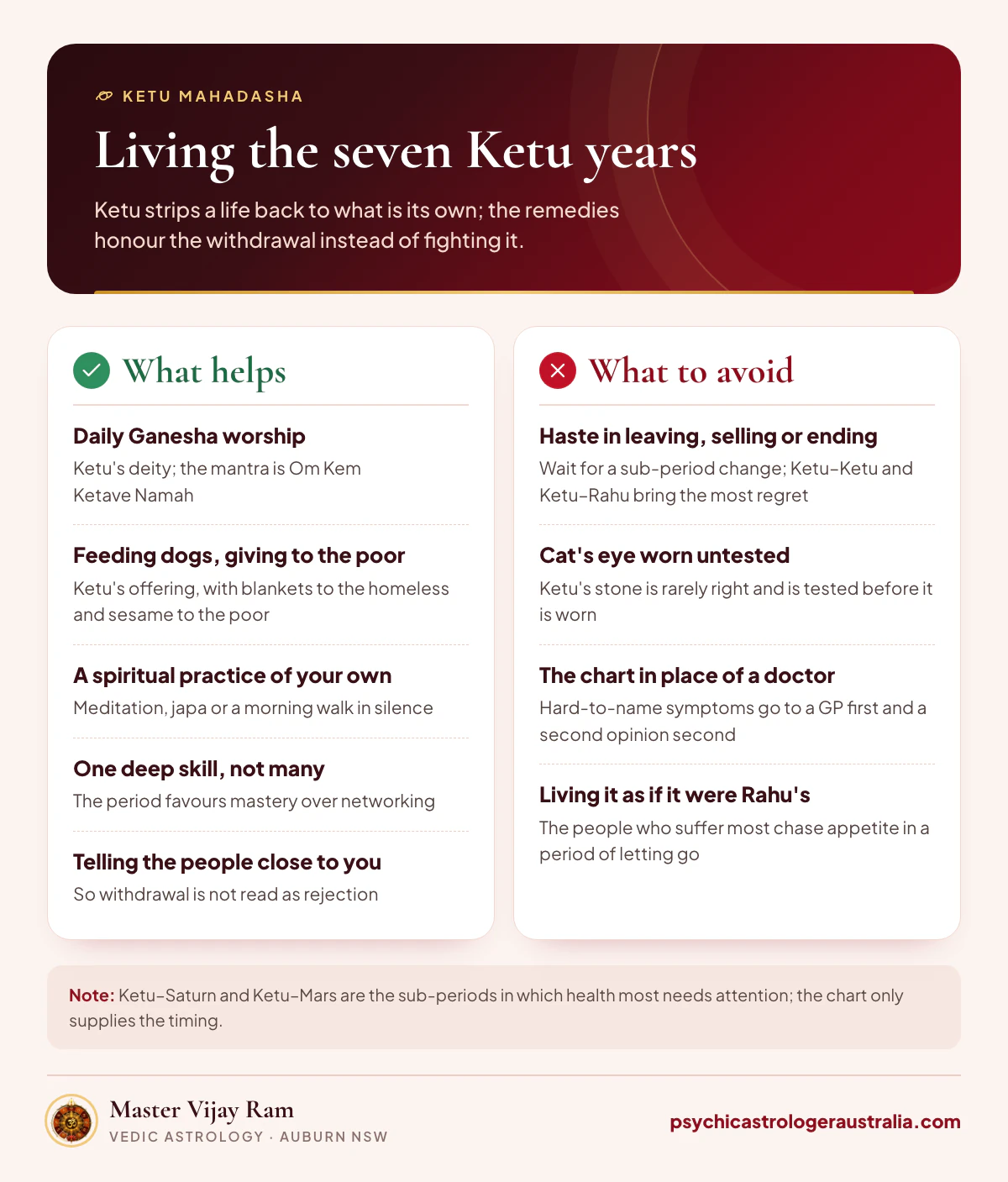
The Ketu Dasha remedies that help are the ones that honour the withdrawal instead of fighting it. Ganesha is Ketu's deity, and daily Ganesha worship, however brief, is the classical practice; the mantra is Om Kem Ketave Namah. Feeding dogs is Ketu's traditional offering and a good one in a country of dog owners; blankets to the homeless and sesame to the poor are the donations.
- Keep a spiritual practice that is yours alone: meditation, japa, a morning walk in silence; Ketu rewards it as no other planet does.
- Learn or return to one deep skill rather than scattering across many; the period favours mastery over networking.
- Tell the people close to you what the period is, so withdrawal is not read as rejection.
- Hold decisions about leaving, selling or ending until a sub-period change, unless the matter cannot wait; Ketu–Ketu and Ketu–Rahu are the sub-periods in which people most regret haste.
- Cat's eye, lehsunia, is Ketu's stone and is rarely right; it is tested before it is worn, and the guide to gemstones to avoid explains why Vijay Ram ji seldom recommends it.
When is a Ketu Shanti puja worth doing?
A Ketu Shanti, with Ganesha puja, the Ketu mantra, a havan with kusha grass and sankalp in your name, is worth doing at the start of the period when Ketu is badly placed, at the entry into Ketu–Saturn or Ketu–Rahu, or when the Moon is afflicted and the period has brought the fog rather than the depth. Master Vijay Ram performs it personally at his own place of practice in Auburn on a muhurat chosen for the chart, with the family joining by video; the online puja and havan page explains what the day includes. He recommends it when the chart warrants it and says plainly when it does not.
A consultation is $50; it is where the period is mapped sub-period by sub-period and the question of a puja settled. Spell or prayer work, including a Ketu Shanti, starts from $250, agreed with you before anything is performed.
Is Ketu Mahadasha bad?
It is short, and it is honest. Seven years is the briefest major period, and for a well-placed Ketu, in the third, sixth, ninth or twelfth house with a strong dispositor, it is a period of genuine depth: the study finished, the faith found, the specialised skill that becomes a career in the Venus years that follow. For an afflicted Ketu it is a period of losses that only later look like clearings. The people who suffer most in it are the ones who try to live it as if it were Rahu's.
How Master Vijay Ram reads a Ketu period from anywhere in Australia
Readings run by phone, video or WhatsApp in English, Hindi or Punjabi, with clients from the Gold Coast, Cairns, Darwin, Brisbane, Newcastle and the Sunshine Coast, and in person in Auburn by appointment. Send your date, time and place of birth; he confirms the dasha timeline, places Ketu by house, sign, nakshatra and dispositor, and walks you through the sub-periods still ahead. A full kundli reading sets the seven years in the context of the whole chart and of the Venus period waiting at the end of them.
Read next
- Guru Mahadasha: The Jupiter Years ExplainedGuru mahadasha explained: what the sixteen-year Jupiter period brings for study, children, marriage and money, its an…
- Chandra Mahadasha: Ten Years of the Moon and the MindChandra mahadasha explained: the ten-year Moon period, its nine antardashas, the mind, mother and home, why the Moon’…
- Love Spell Backfire: What Goes Wrong and How to Repair ItA love spell backfire rarely looks dramatic. Learn the three ways it goes wrong, when it tends to surface, and how ho…
Frequently asked questions
How long is Ketu Mahadasha?
Seven years, one of the shortest major periods in the Vimshottari system, with only the Sun's six shorter, which is why its nine antardashas are brief: Ketu–Ketu under five months, Venus fourteen months, Sun four, Moon seven, Mars under five, Rahu just over a year, Jupiter eleven, Saturn thirteen and Mercury twelve. People often feel the period change tone every few months. It follows the seventeen-year Mercury period and leads into the twenty-year Venus period.
At what age does Ketu Mahadasha come?
It depends on the Moon's nakshatra at birth. People born with the Moon in Ashwini, Magha or Mula begin life inside it and finish it by the age of seven at most. For everyone else it follows the Mercury Mahadasha, so it tends to arrive in the thirties, forties or fifties, often straight after a long stretch of study, business and busyness. A birth time that is out by a few minutes can shift the start by weeks.
What happens in Ketu Mahadasha?
Interest drains from things that used to matter and gathers around what is truly the person's own. Careers end suddenly or are left by choice, the mind turns inward, meditation or faith deepens, and health throws up symptoms that are hard to name. For a well-placed Ketu it is a period of depth and mastery; for an afflicted one it is losses that later look like clearings. The house Ketu occupies decides where the withdrawal lands.
Is Ketu Mahadasha good for career?
It is good for the specialised and the solitary: research, medicine and healing work, information technology and analysis, the occult sciences, any work that needs a narrow deep skill. It is hard on careers built on networking and titles, and sudden exits are common, especially with Ketu in the tenth house. Many people leave a career they never chose during the period and build the right one in the Venus years that follow.
Which antardasha in Ketu Mahadasha is the worst?
Ketu–Rahu, with both nodes active at once, has the reputation for confusion, travel, sudden opportunity and sudden exit, and Ketu–Ketu at the start is abrupt for most people. Ketu–Saturn asks for hard work in isolation and attention to health. Which is hardest in your life depends on how each sub-lord relates to Ketu's dispositor and to the house Ketu occupies, which is read from the chart rather than from the names.
Which antardasha in Ketu Mahadasha is the best?
Ketu–Jupiter is the sub-period most people remember with gratitude: teachers appear, faith returns and guidance arrives. Ketu–Venus, the longest at fourteen months, usually steadies the period with a relationship, a home or simple comfort. Ketu–Mercury at the end returns clarity and bridges into the Venus years. The best sub-period in your own chart is the one whose lord is strongest and friendliest to Ketu's dispositor.
What are the remedies for Ketu Mahadasha?
Daily Ganesha worship, the mantra Om Kem Ketave Namah, feeding dogs, and blankets to the homeless or sesame to the poor are the classical practices. Practically: a spiritual practice that is yours alone, one deep skill pursued rather than many, and telling the people close to you that the withdrawal is the period and not rejection. A Ketu Shanti puja is worth doing only when the chart warrants it, and cat's eye is tested before it is ever worn.
How much does a Ketu Shanti puja cost in Australia?
With Master Vijay Ram a consultation is $50, and that is where the period is mapped sub-period by sub-period and the need for a puja decided. Where it is warranted, spell or prayer work, including a Ketu Shanti with Ganesha puja, havan and sankalp in your name, starts from $250, agreed with you before anything is performed. The rite is performed personally in Auburn with the family joining by video; readings run anywhere in Australia by phone, video or WhatsApp.
What comes after Ketu Mahadasha?
The twenty-year Venus Mahadasha, the longest period in the system and the one the tradition associates with comfort, relationships, property and the arts. People often describe the changeover as colour returning: the detachment of Ketu's years gives way to an appetite for life, and the deep skill learned in solitude becomes something the world will pay for. The dasha sandhi, the changeover itself, is a stretch worth planning for in advance.
People also ask
Which nakshatras start life in Ketu Mahadasha?
Ashwini in Aries, Magha in Leo and Mula in Sagittarius, the three nakshatras Ketu rules. A child born with the Moon in any of them begins life in Ketu's period, with the balance remaining at birth depending on how far the Moon had travelled through the nakshatra. Such children often have an early change of home, an absent parent or an illness later outgrown, and the Venus period that follows is usually gentler.
Does Ketu Mahadasha give spiritual growth?
More reliably than any other period. Ketu is the planet of moksha in the texts, and its years tend to bring meditation that finally works, a faith found or renewed, and a loss of interest in what everyone else is chasing. Ketu in the twelfth, ninth or eighth house strengthens the pattern. Whether the period is felt as depth or as fog depends largely on whether the detachment is accepted or fought.
Is Ketu Mahadasha bad for marriage?
It is a strain on marriages built on shared ambition and often a deepening for those built on affection. A partner in a Ketu period seems absent while present and drawn to solitude, and Ketu in the seventh house makes the period a real test. The counsel is to say what is happening rather than act it out; a spouse told that this is withdrawal and not rejection can wait it out, and Ketu–Venus and Ketu–Jupiter usually bring the warmth back.
What should I avoid in Ketu Mahadasha?
Avoid big irreversible decisions in Ketu–Ketu and Ketu–Rahu, where haste is most often regretted; avoid scattering across many projects when the period rewards one deep skill; avoid reading every loss as a punishment when many turn out to be clearings; and avoid treating odd symptoms as fate when they need a GP. Avoid, too, living the period as if it were Rahu's, chasing what you no longer want.
Which planet period comes before Ketu?
Mercury's seventeen-year period comes before Ketu's seven in the Vimshottari order, which is why the Ketu years so often follow a long stretch of study, business and busyness and feel like a sudden stop. The full sequence is Ketu, Venus, Sun, Moon, Mars, Rahu, Jupiter, Saturn, Mercury, then Ketu again, with each person's starting point set by the Moon's nakshatra at birth.
References & further reading
Serving clients across Australia
Confidential consultations by phone, video & WhatsApp — including: