
Quick answer
Boksi is the Nepali word for a woman believed to harm others through witchcraft, and dayan is its north Indian counterpart. Both words have led to women being beaten, driven out and killed. Protection never needs a suspect: a lamp, prayers to Durga, Bhairav and Hanuman, the elders' Dashain blessing, and a reading of your own household's charts, never anyone else's.
What does boksi mean?
Boksi is a Nepali word for a woman believed to harm others through witchcraft, usually through envy, a look, a touch or food she has handled, and it is one of the most dangerous words a family can say aloud. In Nepali and Bhutanese Nepali homes the fear is old and sincerely held, and sooner or later it is pinned on a woman someone knows.
Master Vijay Ram hears it from Nepali-speaking families in Hobart, Adelaide, Canberra, Sydney, Melbourne and Brisbane. This page explains the words, the history that brought many of these families to Australia, and how black magic removal in the Vedic way protects a household without suspecting anyone at all.
A boksi is feared for what she supposedly is; a spoken curse is feared for what someone said in anger, and shrap and spoken curses covers that different fear.
How is dayan different, and why do both words put women at risk?
Dayan, or daayan, is in Indian folklore a malevolent female spirit, and in parts of north India and southern Nepal the same word is thrown at living women accused of witchcraft. In a quarrel, boksi and dayan do the same work: they turn a misfortune into a woman's fault.
The consequences are not folklore. Women accused as boksi or dayan, often widows, older women living alone or women with nobody to defend them, have been beaten, shamed, driven from their homes and killed; by NCRB figures, over 2,500 people were killed as alleged witches in India between 2000 and 2016, the great majority of them women.
A witch accusation in Nepal or India starts exactly where a frightened family's whisper starts. Telugu families know the same danger under another name, as banamati and the harm of accusation describes.
Who are the Bhutanese Nepali families in Australia?
Many are Lhotshampa, the Nepali-speaking people of southern Bhutan. More than 100,000 were displaced by the 1990s, and from 2007 most were resettled abroad, with Australia among the countries that took families in.
Hobart's small Hindu community includes many Nepali-speaking families from Bhutan, and Adelaide, Canberra, Sydney, Melbourne and Brisbane have their own. Alongside them live families who came directly from Nepal as students, workers and partners, so one Nepali-speaking street can hold two quite different histories.
Why does the fear follow families across borders?
Because displacement leaves people frightened, and fear looks for a face. A family that lost its land, waited years and then rebuilt in a cold new city carries a great deal of strain, and when a child falls ill or a job is lost, the old vocabulary of Nepali black magic is ready with an explanation.
Small communities sharpen it. Where most Nepali-speaking families know one another, as in a city the size of Hobart, a remark about an older woman's look can pass through every household in a week, and once it has, there is nowhere for her to go.
What do families fear a boksi has done?
The fears gather around the most precious and fragile things: a newborn who will not feed, a child with a fever after a visitor held him, a husband whose illness has no name yet, a business that stopped thriving, a meal from a neighbour's kitchen before someone fell sick. Each has an ordinary explanation that comes first, and none is a reason to look at a woman differently.
| What is feared | What usually explains it | What to do instead |
|---|---|---|
| A baby stopped feeding after a visitor held her | Reflux, an infection, a growth spurt, an exhausted mother | The GP or child health nurse; a lamp and a prayer at home |
| Someone fell ill after eating at another house | Food poisoning, an allergy, an illness already starting | The GP; Poisons Information on 13 11 26 if a substance is suspected |
| A run of bad luck since an older woman visited | Coincidence noticed afterwards; a hard season | Write the dates down and have your own household's charts read |
| A child frightened of one particular aunty | Something the child overheard adults saying | Stop the talk in front of children; reassure, never confirm |
| Nightmares and heaviness in the house | Stress, grief, old trauma, broken sleep | A GP or counsellor; Lifeline on 13 11 14 in distress |
What should a family never do when someone is called a boksi?
Never confront her, never test her, never ask a dhami or jhankri, the faith healers of village life, to point her out, and never repeat the word in front of children. In village stories it is often a healer who singles out the boksi, and that moment, a woman named, is where the worst harm has always begun.
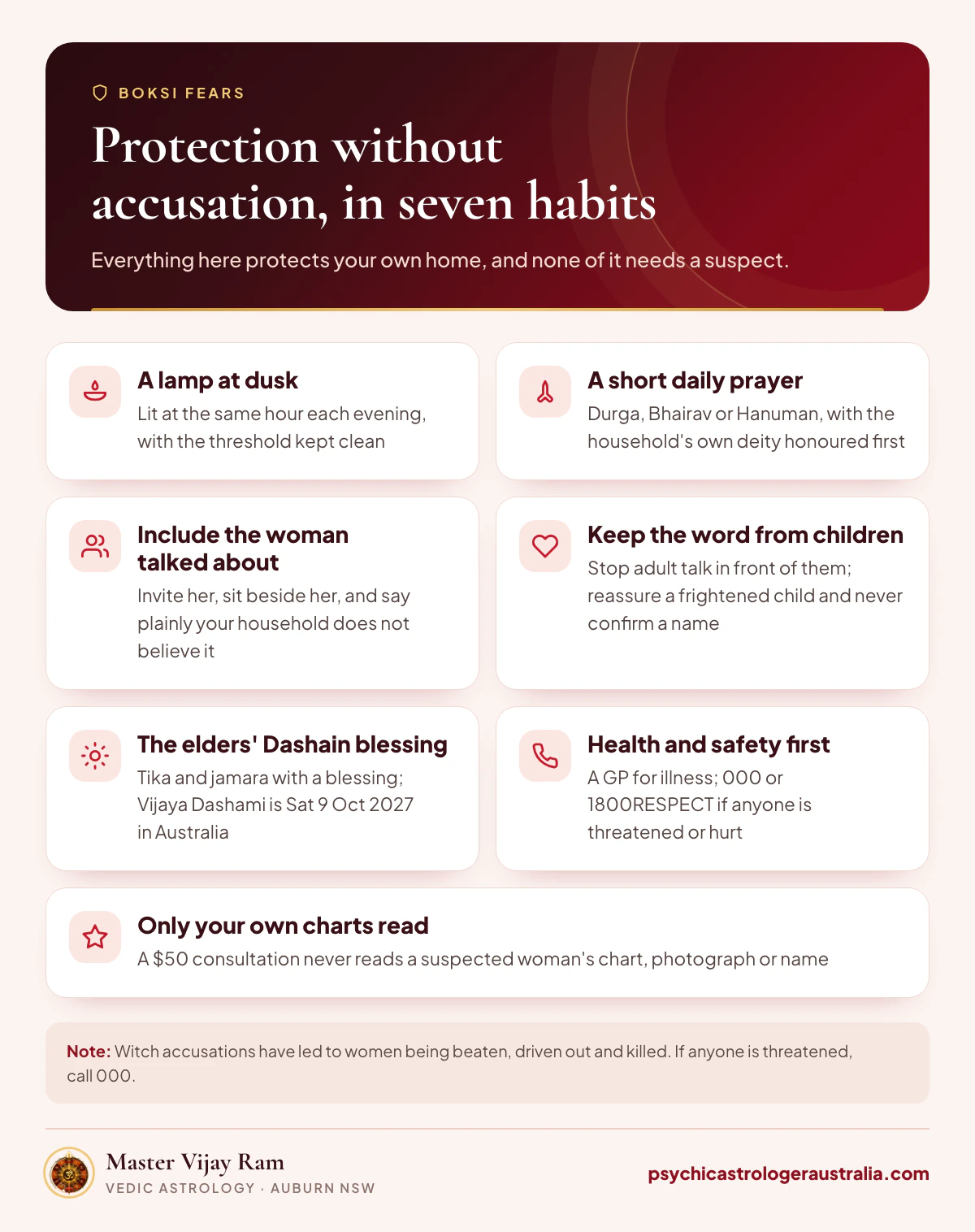
If a woman in your family or community is being whispered about, the protective act is to include her: invite her, sit beside her, and say plainly that your household does not believe it. If anyone threatens or hurts her, call 000, and 1800RESPECT supports anyone facing abuse within a family.
What if you are the woman being called a boksi?
Then the fear in the room is about you, and none of it is your fault. Being whispered about in a small community is isolating and frightening, and it is hard to answer, because nothing you say can prove a negative.
Tell someone you trust outside the circle of gossip, a GP, a counsellor or a community elder, and if anyone threatens you or turns on you at home, call 000 or 1800RESPECT. Lifeline on 13 11 14 answers at any hour, and a consultation, if you want one, reads only your own chart and timing, for your own protection and peace.
What does protection without accusation look like at home?
Protection without blaming anyone is the oldest form the tradition knows: a lamp lit at dusk, the threshold kept clean, a short prayer to Durga or Hanuman at the same hour each day, and the household's own deity honoured first. None of it requires knowing where a fear came from.
The Devi Kavacham, 61 shlokas recited before the Durga Saptashati, is a traditional armour-prayer for a frightened household, and the Durga Kavach and the Devi Mahatmya explains how families keep it. Where the fear is really of envy, nazar and evil eye removal is gentler and fits better than anything called black magic.
How do Dashain and Tihar carry protection?
Dashain celebrates Durga's victory, and its heart is the tika and jamara an elder places on a younger relative's forehead with a blessing; in many families that blessing is the year's real protection. Vijaya Dashami falls on Sat 9 Oct 2027 in Australia, but families follow their own Nepali calendar and samaj for the tika hour, and it can differ.
Tihar arrives with Diwali, whose Lakshmi Puja is Fri 29 Oct 2027, and its five days honour, among others, the crow, the dog and the cow before ending with Bhai Tika for brothers and sisters. Kukur Tihar, when many families garland a dog, carries a quiet lesson for this subject: the tradition protects by honouring, never by suspecting.
Why do Nepali families turn to Bhairav, Durga and Hanuman?
Bhairav, the fierce form of Shiva whose vahana is a dog, stands guard at the edge of fear, and many Nepali households keep him close; Kaal Bhairav as guardian against fear explains how he is approached with discipline. Durga, whose story fills the 700 verses of the Devi Mahatmya, is the mother who defeats whatever threatens her children.
Hanuman is the one people call on at night. All three are worshipped for courage and protection, and none is ever invoked against a neighbour, an in-law or a woman someone fears.
What does a Vedic reading look at, and what will it never look at?
It looks at the household's own charts: whose dasha has turned, which slow planets are crossing sensitive points this year, and how that matches the dates the trouble began. Most families learn that they are in a hard season with ordinary causes, and hear it said plainly.
It will never look at the chart, photograph or name of a woman the family suspects. He refuses those requests at once, because a reading that pointed at a person would do exactly what the word boksi has always done.
Can a Nepali-speaking parent join the consultation?
Yes. He consults in English, Hindi or Punjabi; many Nepali speakers follow Hindi comfortably, and where a parent does not, a son or daughter interprets. Let the parent describe the fear in Nepali first and translate afterwards, because the exact word, boksi, najar or something else, changes what the reading looks for.
What lies outside a reading?
It cannot tell anyone whether a particular woman is a boksi, because no such thing can be read, and it cannot replace a doctor, the police or a counsellor. It is faith-based guidance, not medical, legal or psychological advice, and it carries no guarantee.
What it can do is take the fear out of the whisper and return it to where the tradition keeps it: a household's own prayer, and its care for everyone in the community, including the woman people talk about.
What does it cost for families in Hobart and beyond?
The consultation is $50 by phone, video or WhatsApp, and most families need nothing more than that conversation and a steady practice at home. Where the chart and the dates warrant a havan it starts from $250, agreed before it is performed, and he performs it himself at his place of practice in Auburn while the family joins by video; online puja and havan explains how.
No temple is confirmed in Hobart, so many families there keep their worship at home, and readings for Hobart and Tasmania sets out how consultations reach the island, on the same clock as Sydney all year.
Read next
- Seivinai and Suniyam: Black Magic Fears in Tamil FamiliesSeivinai and suniyam in Tamil families: what the words mean, what to rule out, temples for archanai, the Kanda Sashti…
- Black Magic Through Food or Gifts: What Families Fear and What Is RealBlack magic through food or gifts: where the fear comes from, what a Vedic practitioner says, the ordinary causes tha…
- Protecting Children From Black Magic & Negative EnergyA grounded guide for parents worried about black magic or negative energy around a child: what it usually turns out t…
Frequently asked questions
What is a boksi?
In Nepali, a boksi is a woman believed to harm others through witchcraft, usually by envy, a look, a touch or food she has handled. It is a fear many families sincerely hold and a word that has done terrible damage, because it is always pinned on a real woman. Master Vijay Ram treats the fear seriously and never treats any woman as its cause.
Is boksi the same as dayan?
They do the same work. Dayan is a malevolent female spirit in Indian folklore, and in parts of north India and southern Nepal the word is also thrown at living women accused of witchcraft, just as boksi is in Nepal. Both turn a misfortune into a woman's fault, and both have led to women being beaten, driven out and killed.
My mother thinks a neighbour is a boksi. What should I do?
Take your mother's fear seriously and the accusation not at all. Ask what has happened and when, check whether anyone needs a doctor, and keep the word away from the children. Be kind to the neighbour. A reading of your own household's charts can then show whether the timing carries anything; nobody else's chart, photograph or name is ever read.
Can a dhami or jhankri tell us who the boksi is?
Nobody should be asked that question. In village stories the worst harm has often begun when a healer singled out a woman, and once a name is spoken it cannot be taken back. The tradition's protection works on your own household and needs no name at all. If anyone is threatening a woman in your community, call 000.
How do we protect a newborn when relatives fear a boksi?
With care first: the GP or child health nurse for any feeding problem, fever or crying that worries you. Then the gentle customs many families keep, a lamp at dusk, a prayer to Durga or Hanuman, visitors welcomed rather than watched. Nobody needs to be kept away on suspicion, and no older woman should feel unwelcome near the baby.
Which gods protect against a boksi in Nepali tradition?
Families turn to Durga, whose victory Dashain celebrates, to Bhairav, the fierce guardian form of Shiva whose vahana is a dog, and to Hanuman, called on at night for courage. The household's own deity always comes first. These are prayers for protection and steadiness, never something to aim at a neighbour or a relative.
Does Master Vijay Ram speak Nepali?
No. He consults in English, Hindi or Punjabi. Many Nepali speakers follow Hindi comfortably, and where a parent does not, a son or daughter interprets on a phone, video or WhatsApp call. Let the parent describe the fear in Nepali first, because whether the word is boksi, najar or something else changes what the reading looks for.
When is the Dashain tika in 2027?
Vijaya Dashami, the tika day at the end of Dashain, falls on Sat 9 Oct 2027 in Australia, after Sharad Navratri begins on Fri 1 Oct. Nepali community calendars set their own tika hour and can differ, so follow your samaj or family priest. Tihar follows with Diwali, whose Lakshmi Puja is Fri 29 Oct 2027.
How much does protection cost?
The consultation is $50 and is often the only cost, because most families need a calm reading and a home practice rather than a ritual. Where the household's charts and dates warrant a havan, it starts from $250 and is agreed before it is performed at Auburn, with the family joining by video from Hobart, Adelaide or anywhere else.
People also ask
What does boksi mean in Nepali?
Boksi means a woman believed to practise harmful witchcraft, usually said to work through envy, a look, a touch or food. The word is used in Nepal and in Bhutanese Nepali families, and it has been used to justify violence against women, often widows or older women living alone. Protection in the Vedic tradition never needs to identify any boksi.
Why are witch accusations dangerous?
Because they end in violence against real people, overwhelmingly women. Women accused as boksi or dayan have been beaten, shamed, driven from their homes and killed, and by NCRB figures over 2,500 people were killed as alleged witches in India between 2000 and 2016. In a small community, an accusation also isolates a woman for the rest of her life.
Who are the Lhotshampa?
The Lhotshampa are the Nepali-speaking people of southern Bhutan. More than 100,000 were displaced by the 1990s, and from 2007 most were resettled abroad, with Australia among the countries that welcomed them. Many Bhutanese Nepali families now live in Hobart, Adelaide and other Australian cities, keeping Dashain, Tihar and their Hindu worship.
How can you protect your home without blaming anyone?
Keep the protection on your own side: a lamp at dusk, a clean threshold, a daily prayer to Durga, Hanuman or your family deity, and blessings from elders at festivals. Check health and practical causes first. Include anyone who is being gossiped about, keep accusations away from children, and have only your own household's charts read if you want a reading.
References & further reading
Serving clients across Australia
Confidential consultations by phone, video & WhatsApp — including: