

Quick answer
Shrap is the spoken curse of the Hindu tradition, the ill wish of a wronged or offended person, carried with most weight when it comes from a parent or an elder. The epics tell of curses with a cause, a limit and a release. In practice, reconciliation and seeking the elder's blessing come first; a havan is added only where the chart agrees something remains.
What shrap means
Shrap, spelled shaap or shapa and translated as a curse, is a spoken ill wish in the Hindu tradition that is held to carry force because of who speaks it, why, and how deeply they were wronged. It is the opposite face of ashirvad, the blessing, and the two are spoken by the same mouths: parents, elders, teachers, and people who have been hurt. The tradition treats both as real, and it treats the second as more powerful.
Families in Australia use the word constantly and mean many things by it: a grandmother's bitter sentence at a wedding, a mother's words in a hospital corridor, a neighbour's muttered wish. This article sets out what the stories say, what a modern family usually means, what the tradition itself recognises about guilt and estrangement, and what helps first.
Shrap in the epics and the Puranas: stories, not history
The great stories are full of curses, and they are told as stories, not as records. Gandhari, grieving a hundred sons, curses Krishna that his own clan will destroy itself, and in time it does. Dasharatha, who killed a blind couple's only son by accident, is cursed to die of separation from his own, and the exile of Rama fulfils it years later.
Durvasa curses Shakuntala to be forgotten by the man she loves, with a release attached: he will remember when he sees the ring. Ahalya is turned to stone and freed by the touch of Rama's foot. Pandu is cursed by a sage he shot in the forest, and the curse shapes the whole Mahabharata. None of these is told to frighten; each is told to teach something about cause and consequence.
What the stories agree on: cause, limit and release
Read together, the stories share a logic. A curse answers a wrong; nobody in the epics is cursed for nothing. It is spoken aloud, in anger or grief, by a person with standing, a parent, a sage, a woman wronged. And almost always it carries a limit or a release: a ring, a touch, a period of years, an act of repair.
That last point is the one families forget. In the tradition a curse is not a permanent sentence but a debt with terms, and the terms are usually about the relationship that broke. The person who can release it most easily is the person who spoke it.
Why does the tradition give an elder's words such weight?
In dharma the parent stands in the place of the gods for the child, and the teacher for the student; their blessing is the first blessing a life receives. The spoken curse of such a person is weighty for the same reason their blessing is, because the relationship itself is sacred, and the words are a sign that it has been broken.
This is also why the tradition is uneasy about elders who curse freely. A parent who speaks a curse in anger is held to have spent something precious, and the stories often show the curser suffering as much as the cursed. Weight runs both ways.
What does a modern family mean by my mother cursed me?
In the calls Master Vijay Ram takes from Harris Park, Dandenong or Glen Waverley, the sentence is usually one of four. A marriage went ahead against a parent's wishes and the parent said something terrible. A will or a house split the siblings and an aunt wished them ill. A parent died angry, or died before an apology could be made. Or a stranger, a jilted partner, a business rival, said the words in public.
What follows is remembered through that sentence: a miscarriage, a failed business, a child's illness, years later, are filed under it. The curse of a parent in particular is carried like a stone, and it is carried by the person who feels they deserved it.
The psychology the tradition itself recognises
Jyotish and the texts around it did not pretend the mind was separate from fortune. The manas, the mind, is the field in which a curse grows, and a person who believes themselves cursed watches for it, sleeps badly, hesitates, and gives the next setback a meaning it did not have. Guilt and estrangement do real work, and the tradition says so.
That is not the same as saying the curse is imaginary. It is saying that the relationship, the guilt and the separation are where its force lives, which is also where it can be met. A counsellor and a priest are not rivals here; many families need both, and family problem work often begins with the conversation that nobody has had.
Do bad wishes have an effect? The honest Vedic answer
The tradition holds that intention matters, that bad wishes spoken with real feeling by a person with standing are not nothing, and Master Vijay Ram practises within that tradition and says so. He also says, after more than forty years, that most of the weight of a curse is carried by the broken relationship behind it, and that the chart usually shows an ordinary hard season where the family sees a sentence.
A stranger's muttered wish carries little; a parent's grief carries much; and a curse spoken over something you actually did carries the most, because the debt is real. The honest answer is therefore not yes or no but which, and that is what a consultation works out.
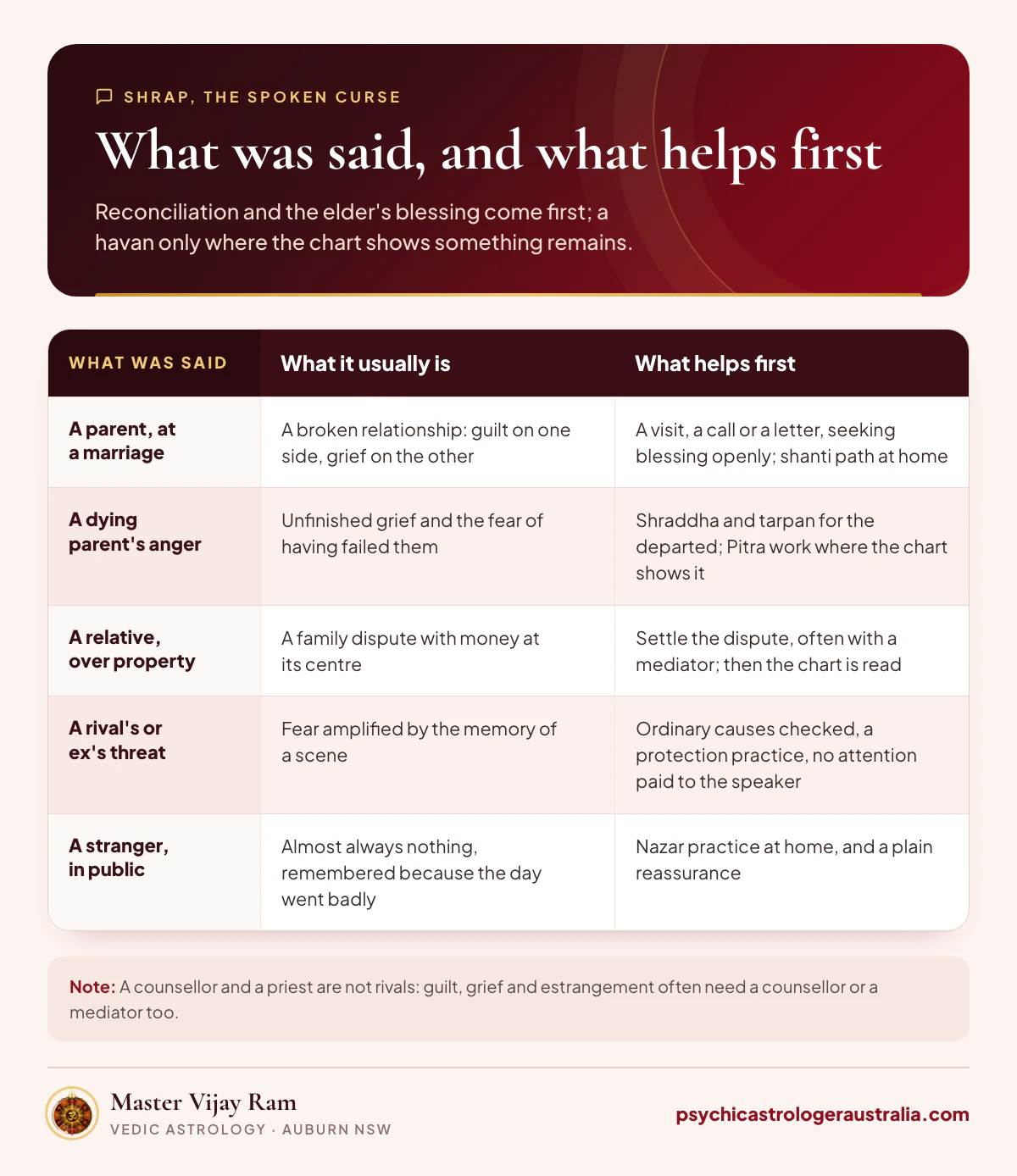
What was said, what it usually is, and what helps first
The table is the shape of the conversation rather than a diagnosis. Each row begins with the sentence a family brings.
| What was said | What it usually is | What helps first |
|---|---|---|
| A parent's words at a marriage they opposed | A broken relationship, guilt on one side and grief on the other, carried for years | A visit, a call, a letter; seeking blessing openly; shanti path at home |
| A dying parent's anger, never resolved | Unfinished grief and the fear of having failed them | Shraddha and tarpan for the departed; Pitra work where the chart shows it |
| A sibling's or an aunt's wish over property | A family dispute with money at its centre | Settle the dispute, often with a mediator; then the chart is read for what remains |
| A jilted partner's or a rival's threat | Fear amplified by the memory of a scene | Ordinary causes checked, protection practice, and no attention paid to the speaker |
| A stranger's muttered words in public | Almost always nothing, remembered because the day went badly | Nazar practice at home, and a plain reassurance |
Reconciliation and ashirvad: the first remedy
The tradition's own answer to a parent's curse is the parent's blessing, and that means a visit, a phone call to Ludhiana or Ahmedabad, a letter, an apology where one is owed, and the request for ashirvad spoken plainly. Many families find the curse lifts in that conversation, because what was broken has been repaired, and the chart afterwards reads like any other chart.
Where the elder will not speak, the tradition still asks for the attempt, made with humility and more than once. Where the elder has died, the attempt is made through shraddha and tarpan, the offerings that keep a relationship with the departed, and through the quiet work of forgiving and being forgiven in prayer.
When is a havan appropriate?
A havan is appropriate when the chart agrees that something remains after reconciliation has been tried, when the person who spoke the curse has died and the family carries the markers of Pitra dosh, or when the sentence was spoken over a real wrong that cannot now be repaired. In those cases Master Vijay Ram performs a shanti havan and mantra sadhana personally on a muhurat chosen for your chart, with Pitra work added where Kaal Sarp or Pitra dosh shows.
A havan is not appropriate as a substitute for the phone call you are avoiding. He will say so, and he will ask whether the call has been made before any ritual is discussed. The guide to curse removal in Australia sets out the full diagnostic order that applies to every kind of curse.
What shrap nivaran is not
Shrap nivaran, the lifting of a spoken curse, never involves naming anyone, sending anything back, or turning the curser into an enemy. The whole point of the tradition's remedy is repair, and a practitioner who offers to punish the elder who cursed you has misunderstood the word.
It is also not a product. A fixed-price ritual sold before anyone has asked what was said, by whom, and what happened in the family afterwards, is not shrap nivaran, whatever it is called. Curse and hex removal on this site begins with that conversation, and most of the time ends there.
Signs people describe, and the ordinary causes
The signs are the familiar ones: a run of trouble that arrived after the words, sleep broken at a repeating hour, a sense of being watched or weighed down, and setbacks that seem to prove the sentence right. Each has an ordinary cause that is checked first, including the plainest one, that a person who has been told they are cursed will find the evidence.
Where the family story includes deliberate work rather than words, the diagnosis changes, and the family curse guide and the suburb pages, such as black magic removal in Glen Waverley, describe that work.
What it costs and how a consultation runs
A consultation is $50, by phone, video or WhatsApp, in English, Hindi or Punjabi, with the elder welcome on the call if the relationship allows it. It covers the chart, the sentence and the story around it, and a plain answer about what is actually there.
Where a havan or Pitra work is warranted, spell or prayer work starts from $250, and the figure is agreed with you before anything is performed. Nothing is sold before the conversation, and many consultations end with advice about a phone call rather than a ritual.
How Master Vijay Ram handles a shrap question
He asks what was said, by whom, over what, and what has happened between you since. He reads the chart for the period you are in, so that an ordinary hard season is not mistaken for a sentence, and he asks whether the attempt at blessing has been made.
Then he tells you which of the four things you are carrying, and what helps first. Astrology here is faith-based guidance beside, never instead of, medical, legal or counselling help; a curse cannot be treated by a doctor, but grief and estrangement often need one, and he will say so.
Seeking an elder's blessing from Tarneit, Point Cook or Geelong
When a parent is staying for months in a house in Tarneit or Truganina, words spoken in anger across the kitchen bench carry as much weight under one roof as any sent across an ocean. The reconciliation the tradition asks for can begin at that same bench, the same evening, before anyone starts reading setbacks as a sentence.
Where the elder is in India, timing is part of the courtesy. A call placed after dinner in Werribee or Point Cook finds Punjab or Gujarat mid-afternoon, since India is behind Melbourne by four and a half hours through winter and by five and a half from October, when daylight saving begins, so nobody is woken to hear an apology.
Diwali, Lohri and Raksha Bandhan give a natural reason to ring, and a WhatsApp voice message asking for ashirvad is a real first step when an elder will not yet take a call. Most of what families call shrap turns out to be a broken relationship that a conversation can begin to mend, and Vijay Ram ji says so before any ritual is mentioned.
Where the family story has moved from words to deliberate work, that is a different question, covered on black magic removal in Tarneit, while heaviness in the house after the quarrel belongs with negative energy removal in Point Cook. Families around Corio Bay start from Vedic readings for Geelong families, about an hour from Melbourne on the V/Line, and everyone else speaks with him by phone or video, or on WhatsApp, in the family's own language; he sees people face to face only in Auburn.
Read next
- Curse Removal in Australia: How a Curse Is Diagnosed and LiftedCurse removal in Australia: the four kinds of curse people describe, how a genuine practitioner diagnoses one, what l…
- Family Curse Removal in Australia: Breaking the Generational CycleA grounded guide to family curse removal in Australia: what a generational curse means, the myths worth dropping, and…
- Kala Jadu, Sihr and Voodoo: Which Tradition Is Your Family Describing?Kala jadu, sihr, voodoo, hooniyam and the evil eye: what each tradition means by harm, what undoes it, and how a Vedi…
Frequently asked questions
What does shrap mean?
Shrap, also written shaap or shapa, is the Hindu term for a spoken curse: an ill wish spoken aloud by a person with standing, such as a parent, an elder, a teacher or someone who has been wronged. It is the counterpart of ashirvad, the blessing, and the tradition treats both as real and the blessing as the stronger. In the epics a curse always has a cause and almost always a release.
Can a parent's curse really affect my life?
The tradition says yes, and it says why: the parent's words carry weight because the relationship is sacred and the curse is a sign that it has been broken. In practice most of that weight is carried by guilt, estrangement and the way a person who believes themselves cursed reads every setback. Which is why the tradition's own remedy is the parent's blessing, sought openly, before any ritual is considered.
How do I remove a curse spoken by my mother or father?
Start with the relationship. A visit, a phone call, a letter, an apology where one is owed and a plain request for blessing lift more spoken curses than any ritual, because what was broken is repaired. Where the parent has died, shraddha and tarpan keep the relationship open. A havan is added only where the chart agrees something remains, and Master Vijay Ram will ask whether the call has been made first.
What is shrap nivaran?
Shrap nivaran is the lifting of a spoken curse in the Vedic tradition. It begins with reconciliation and the seeking of ashirvad, adds shanti path and mantra, and where the elder has died or Pitra dosh shows in the chart, ancestral work such as tarpan and a shanti havan performed personally on a muhurat. It never involves naming anyone, punishing the curser or sending anything back.
Do the curses in the Mahabharata and Ramayana prove curses are real?
They are stories, told to teach about cause and consequence, and this site treats them as stories rather than history. What they show is the tradition's logic: a curse answers a wrong, it is spoken by someone with standing, and it carries a limit or a release tied to repairing the harm. That logic is useful for a family today whether or not the stories are taken literally.
Do bad wishes from a stranger or a rival have any effect?
In the tradition intention matters, and Master Vijay Ram practises within it. He also says that a stranger's muttered words carry little, a rival's threat mostly carries fear, and a parent's grief carries much, because the force sits in the relationship and the wrong behind the words. A stranger's wish is answered with ordinary checks, simple protection practice at home and no attention paid to the speaker.
What if the person who cursed me has died?
Then the attempt at reconciliation is made through the rites that keep a relationship with the departed: shraddha, tarpan and the quiet work of forgiving and asking forgiveness in prayer. Where the family carries the markers of Pitra dosh in the chart, Pitra work and a shanti havan are added, performed personally by Master Vijay Ram on a muhurat chosen for the chart.
Can a counsellor help with something the family calls a curse?
Often, yes, and the tradition would not object. Guilt, estrangement and unfinished grief are where a spoken curse does most of its work, and those are exactly what counselling and family mediation address. Master Vijay Ram treats a counsellor as a colleague rather than a rival, and will say when the first step is a conversation, with a mediator if needed, rather than a ritual.
How much does it cost to have a spoken curse lifted?
A consultation is $50, held by phone, video or WhatsApp in English, Hindi or Punjabi, and it covers the chart, what was said and the story since. Many consultations end with advice about a visit or a phone call rather than a ritual. Where a havan or Pitra work is warranted, spell or prayer work starts from $250, agreed with you before anything is performed.
What signs suggest a spoken curse rather than an ordinary hard season?
There is no sign that settles it on its own. The chart is read for the planetary period you are in, so that a hard season is not mistaken for a sentence, and the story is read for whether the trouble followed the words and the estrangement, and whether it lands on the one who feels they deserved it. A person told they are cursed will find the evidence, and that is checked too.
People also ask
What is the meaning of shrap in Hinduism?
Shrap is a spoken curse, the ill wish of someone with standing or someone wronged, held to carry force because of the relationship behind it. It is the counterpart of ashirvad, the blessing. The epics present curses as having a cause, a limit and a release, and the release is usually an act of repair.
Can a curse from a parent be removed?
In the tradition the parent's blessing is the release of the parent's curse, so reconciliation comes first: a visit, a call, an apology where one is owed, and the request for ashirvad. Where the parent has died, shraddha and tarpan take that place. A havan is added only where the chart agrees something remains.
Is shrap nivaran a ritual?
It can include one, but it begins as a conversation. Shrap nivaran means lifting a spoken curse, and most of that is reconciliation and seeking blessing. Where something remains, shanti path, mantra and a shanti havan performed personally on a muhurat are added, with Pitra work where ancestors are involved. It never names or punishes anyone.
Why do curses in Hindu stories always come with a release?
Because the stories teach cause and consequence rather than permanent punishment. A ring, a touch, a period of years or an act of repair ends the curse once the wrong has been answered. The same logic applies in a family today: the curse is a debt with terms, and the terms are about the relationship that broke.
Do negative words from others affect your energy?
The tradition holds that intention spoken with real feeling is not nothing, and it also recognises that most of the effect lives in the mind of the person who heard the words. A stranger's wish carries little; a parent's grief carries much. Simple protection practice, ordinary checks and, above all, repairing the relationship are the answer.
References & further reading
Serving clients across Australia
Confidential consultations by phone, video & WhatsApp — including: