
Quick answer
Banamati and chetabadi are the Telugu words for black magic believed to be done deliberately, and chillangi is an older one. Accusations built on these words have cost lives, so safe removal never names anyone. Master Vijay Ram rules out medical and practical causes first, honours the family's Narasimha and Hanuman worship, and performs a havan only where it is warranted.
What are banamati and chetabadi?
Banamati is a Telugu word for black magic that families use when they believe someone has worked harm against them through ritual, and chetabadi is the other common word for the same fear. Which one a family reaches for often depends on the district it comes from, and plenty of households use both.
The words reach Master Vijay Ram from Telugu families in Canberra, Adelaide, Perth, Brisbane, Melbourne and Sydney, usually after a bad few months and a worried call from home. This page explains what the words mean, why accusations built on them have hurt so many people, what banamati removal looks like when it is done safely, and why black magic removal in the Vedic frame never begins with a suspect.
Where does chillangi fit in?
Chillangi is an older word some Telugu families use for the same thing, and elders sometimes say it where their children would say chetabadi. None of the three words is a diagnosis; each is a way of saying that something feels done to us.
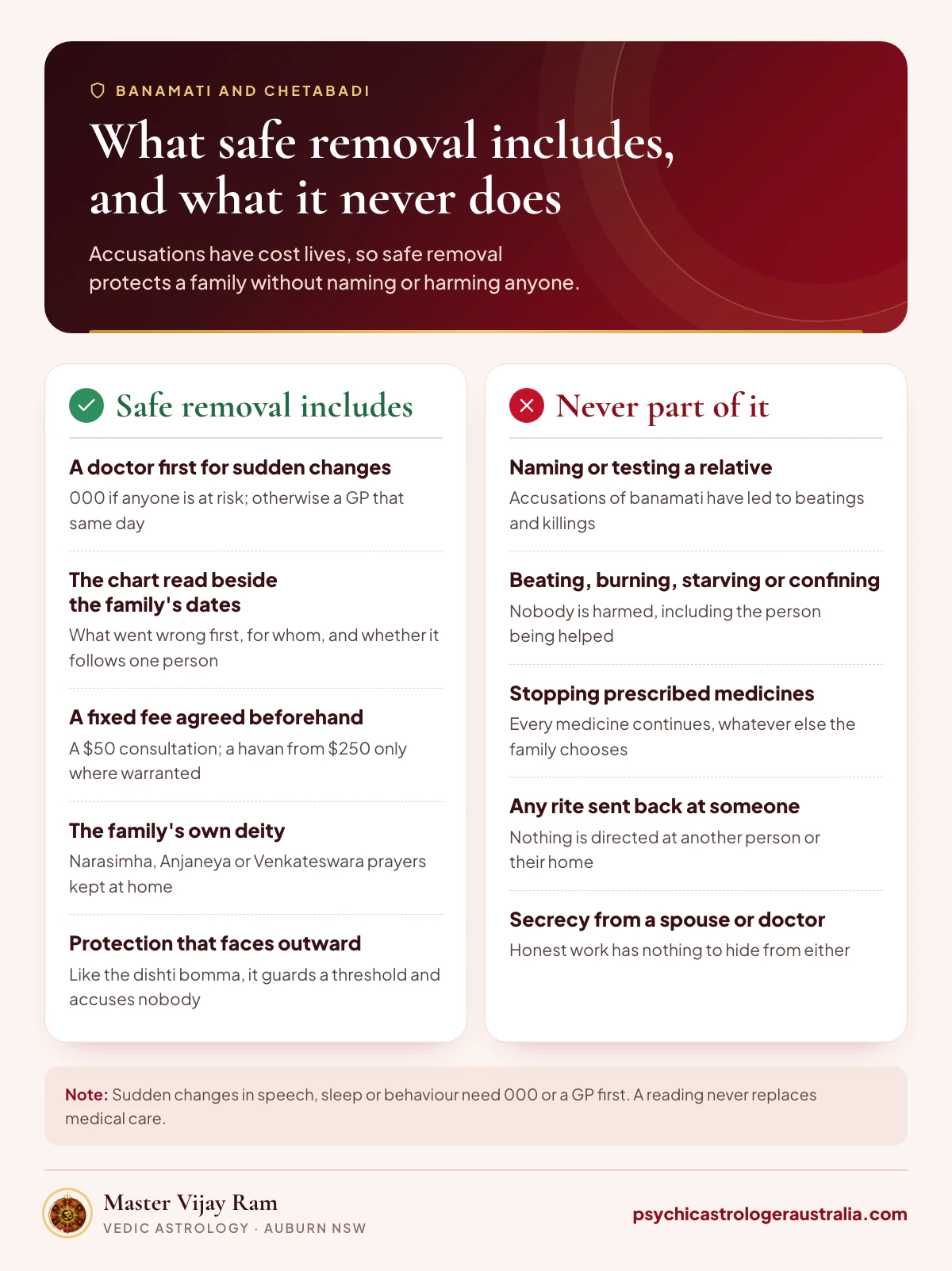
Dishti, the Telugu form of drishti, is different: it means the evil eye, harm by an envious or admiring look, and the dishti bomma, the fierce painted face hung on a house while it is built, is the tradition's answer to it. That figure faces outward and accuses nobody, which is a good model for everything else on this page.
Tamil neighbours speak of the same fears as seivinai and suniyam in Tamil families, and the wider family of words is set out in kala jadu, sihr and other traditions compared.
What do banamati stories describe, and what usually explains them?
The stories carried from villages are vivid: stones landing on a roof at night, clothes catching fire, a young woman who suddenly speaks in another voice, a buffalo that stops giving milk, an illness no hospital can name. In Australia the chetabadi symptoms people describe are quieter, and almost every one has an ordinary first explanation.
| What the family describes | Ordinary explanations to check | Who to see first |
|---|---|---|
| Someone suddenly changed: another voice, no sleep, afraid of their own family | Psychosis, severe anxiety, a reaction to medication, a head injury, drugs | 000 if anyone is at risk; otherwise a GP that same day |
| An illness the tests keep missing | Thyroid, anaemia, diabetes, sleep apnoea, months of strain | The GP, with the full history and every medicine listed |
| Money draining out of a business | Competition, rent, debts, a partner's decisions | An accountant or a financial counsellor |
| A spouse gone cold after the wedding | Two families' expectations, a long-distance start, overwork | Relationships Australia, or 1800RESPECT if anyone is unsafe |
| Lemons, kumkum or a doll by the door | A neighbour's own custom, an offering, children, a prank | Photograph it, gloves, the bin; police if a threat came with it |
A reading looks further only when the trouble started on a day the family can point to and has outlasted every one of those.
Why do accusations of banamati do so much harm?
Because the word has been turned against people, not only against misfortune. In parts of rural Telangana and Andhra Pradesh, a run of illness or deaths in a village has more than once ended with an elderly woman, a widow or a healer branded as the one doing banamati, then beaten, shamed, driven out or killed.
Across India, NCRB figures count more than 2,500 people killed in witch hunts between 2000 and 2016, overwhelmingly women. Each of those deaths began with someone deciding they knew who was responsible.
So no Telugu family should ever name, confront or test a relative, neighbour or in-law over banamati, here or back home. If someone in a village is being accused or threatened, the police there are the people to call, and a family in Australia helps most by refusing to repeat the accusation.
What makes a removal safe?
Safe removal harms nobody, including the person it is meant to help. Nobody is beaten, burnt, starved, shut in a room, made to swallow something a practitioner supplies or told to stop their medicines, and no child is ever made part of it.
It also comes with a fixed fee agreed in advance, no secrecy from a spouse or a doctor, and nothing aimed at another person: no rite to send the harm back and no object left at anyone's door. A practitioner who says you are cursed and must pay to have it removed may be engaging in misleading or unconscionable conduct, and NSW Fair Trading, Consumer Affairs Victoria, Queensland's Office of Fair Trading and WA Consumer Protection all take complaints.
Is it banamati, or is someone unwell?
This is the hardest question a family faces, and the honest answer is often both: a frightened household and a person who needs a doctor. Sudden changes in speech, sleep, fear or behaviour can be psychosis, which is treatable and needs care quickly, and healthdirect's page on psychosis, listed below, describes the signs.
Master Vijay Ram will not read a chart in place of that care. If anyone is at risk, call 000; if not, see the GP that day, and keep every prescribed medicine going whatever else the family decides.
Why do so many Telugu homes turn to Narasimha?
Narasimha, Vishnu's man-lion form, is the protector who keeps faith with a devotee: in the story he guarded the boy Prahlada and killed the demon king Hiranyakashipu at twilight, on a threshold, neither inside nor outside, neither by day nor by night. Many Telugu families count him as their family deity, and his stotras are said in homes where fear has come in.
What the story protects is a child's faith against a powerful father, not anyone's wish for revenge. Narasimha and Sudarshana as protectors explains how the form is approached with respect and discipline, and why he is never invoked to frighten anyone.
Where does Hanuman come in?
Anjaneya, as many Telugu homes call Hanuman, is the guard against fear itself, the one who crossed the sea for Rama and whom no darkness could stop. Many families know the Anjaneya Dandakam in Telugu, and the Hanuman Chalisa, written in Awadhi, has long been said in Telugu homes as well.
The Hanuman Chalisa for fear and protection covers when and how often it is recited. For a frightened household the steady habit, the same prayer at the same hour each evening, counts for more than the number of recitations.
Where do Telugu families in Australia pray?
For many, the anchor is the Sri Venkateswara Temple at Helensburgh, south of Sydney: Australia's first traditional-style Hindu temple, functioning since 1985, and home to the Lord of Tirumala whom Telugu families hold close. In Melbourne the Shri Shiva Vishnu Temple at Carrum Downs, in Brisbane the Shree Laxmi Narayan Mandir at Burbank and in Adelaide the Shri Ganesha Temple at Oaklands Park are within reach, and Perth and Canberra families have temples of their own nearby.
Ugadi, the Telugu new year, falls on Thu 8 Apr 2027 in Australia and Wed 7 Apr 2027 in India, and the ugadi pachadi eaten that morning mixes six tastes, sweet, sour and bitter among them, for a year that will hold all of them. It is a sound way to hold a hard season: one taste among several, not the whole year.
What does the Vedic reading look for?
He looks at the birth chart of whoever is suffering most, which planetary period is running and how this year's transits fall, then lays them beside the household's dates: what went wrong first, for whom, and whether it follows one person out of the house. Most often he finds a hard period with an ordinary cause, says so plainly and points to the help that fits.
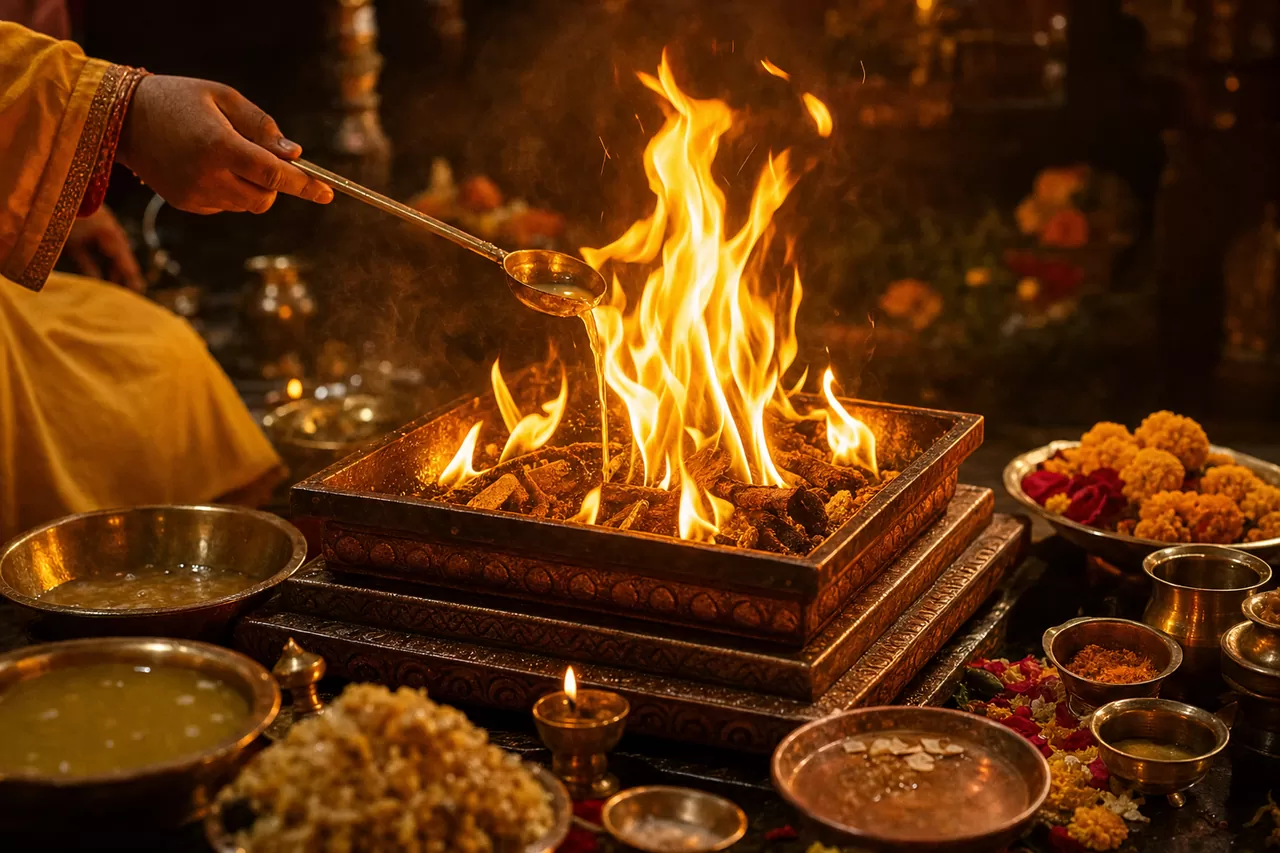
Sometimes the fear turns out to be words said in a quarrel, now dreaded as a curse, and then curse and hex removal is the gentler path. Only when both the chart and the dates suggest deliberate work does he recommend removal: a shanti havan, with Durga or Hanuman mantra, that he performs himself in Auburn at a muhurat chosen for the family.
Can a Telugu-speaking parent take part?
Yes, through a family member. He consults in English, Hindi or Punjabi, and a Telugu-speaking parent is usually brought in by a son, daughter or son-in-law who interprets on a video or WhatsApp call while the reading slows to let them.
The chart needs only the birth date, time and place, and Telugu names and village names can be written in Telugu script beside the English. An old jatakam from home is worth photographing page by page.
Where does a reading stop?
It cannot confirm that banamati was done, find out who did it, or settle a quarrel between two families. It is faith-based guidance, not medical, legal or psychological care, and it comes with no guarantee of any outcome.
What it can do is lower the temperature: give the family a calm account of the season, keep the doctor and the police in their proper places, and say clearly when nothing needs removing.
What does banamati removal cost?
The first step is a $50 consultation over the phone, on video or on WhatsApp, and for most families it is the only step. A havan, if the reading calls for one, starts from $250 and the figure is settled with the family beforehand; the online puja and havan service explains how relatives watch by video while he performs it at his Auburn practice.
A family in Harrisdale or Gungahlin is read exactly as one a few streets from Auburn, and consultations for Perth families explains the time difference in the west. Nobody is ever asked for gold, a larger offering or a second rite discovered halfway through.
Read next
- Seivinai and Suniyam: Black Magic Fears in Tamil FamiliesSeivinai and suniyam in Tamil families: what the words mean, what to rule out, temples for archanai, the Kanda Sashti…
- Black Magic Removal Near Me: What “Near” Actually Buys YouBlack magic removal near me: what a visit genuinely adds, what it does not, how the work reaches every suburb from Au…
- Black Magic on Marriage: Signs Your Relationship Is TargetedSigns that black magic may be affecting a marriage, how the drift unfolds week by week, and the ordinary causes to ru…
Frequently asked questions
What is banamati?
Banamati is a Telugu word for black magic: harm a family believes someone has done to it deliberately through ritual. It names a fear rather than a proven event, and most households who use it are going through an ordinary rough patch. Reading the chart beside the family's dates, after the doctor and the practical causes, usually shows which it is.
What is the difference between banamati and chetabadi?
Very little in meaning. Both are Telugu words for black magic done deliberately, and which one a family uses often depends on the district it comes from. Chillangi is an older word for the same idea. Dishti is the one that differs: it means the evil eye, harm by an envious look, and the protections against it accuse nobody.
What do people mean by chetabadi symptoms?
Families describe a person who suddenly changes, illnesses the tests keep missing, money draining from a business, a marriage gone cold, and things left by the door. Each has everyday explanations, from psychosis and thyroid trouble to debts and family pressure, which a GP, an accountant or a counsellor looks at first. Only a pattern that started on a known day and outlasts all of them is read further.
My mother in India says a relative did banamati on us. What should we do?
Listen to her fear without repeating the accusation, and ask what actually happened and when rather than who is to blame. Accusations of banamati have ended in beatings and killings, and naming a relative can split two families for good. Bring the dates to a reading; Master Vijay Ram reads your household's chart, never the suspected relative's, and no name is ever given.
Is it safe to take someone to a village healer for banamati?
Only if nothing harmful is done. A safe practice never beats, burns, starves or confines anyone, never makes them swallow something the healer supplies, never stops their medicines and never involves a child. Anyone showing sudden changes in speech or behaviour needs a doctor first, and in Australia 000 if anyone is at risk. Walk away from any healer who names a culprit.
Which god protects against banamati in Telugu tradition?
Many Telugu families turn to Narasimha, who protected the devotee Prahlada, and to Anjaneya, as Hanuman is often called, through the Anjaneya Dandakam or the Hanuman Chalisa. Venkateswara, worshipped at the Helensburgh temple near Sydney, is close to many households too. Traditions differ, and whichever deity the household already keeps leads any practice Master Vijay Ram suggests.
Can my Telugu-speaking parents join the consultation?
Yes. He consults in English, Hindi or Punjabi, so a son, daughter or son-in-law translates for Telugu-speaking parents on a video or WhatsApp call, and the reading slows down to make room for that. Names and village names can be written in Telugu script beside the English, and an old jatakam from home can be photographed and sent before the call.
How much does banamati removal cost?
The $50 consultation is the only charge for most families, since few cases turn out to need removal at all. If the reading does call for it, a shanti havan that he performs himself at Auburn starts from $250, with the figure settled before the day. It does not rise later, and no gold, larger offering or second rite is ever asked for.
Will Master Vijay Ram tell us who did banamati?
No. A chart does not name a person, and naming someone inside a frightened family is exactly how village accusations begin. He reads the chart of the person affected beside the family's dates, says whether that stretch of time shows anything, and offers protection only to the people who asked. No harm is returned to anybody, and requests for a name are declined.
People also ask
How do you remove banamati?
Safely, and in order: the doctor and the practical causes first, then a reading of the chart beside the family's dates. If deliberate work is indicated, he performs a shanti havan with Durga or Hanuman mantra at a chosen muhurat on behalf of those affected, and the household carries on with its Narasimha or Hanuman practice afterwards. Nobody is harmed, accused or sent anything in return.
Is banamati real?
Many Telugu families believe in it, and the tradition takes the fear seriously. In practice, most of what is called banamati proves to have everyday causes, including illness that needs a doctor. What is certainly real is the damage an accusation does to the person accused, most often a woman, and to the family that makes it.
Why is accusing someone of witchcraft dangerous?
Because accusations lead to violence. In Indian villages, people branded as witches, overwhelmingly women and often elderly or widowed, have been beaten, driven out and killed, and NCRB figures count more than 2,500 deaths between 2000 and 2016. An accusation in an Australian family causes rifts that last for decades. Protection never requires knowing or naming anyone.
What is a dishti bomma?
A dishti bomma is the fierce painted face that Telugu families hang on a house under construction or a new shop to turn away the evil eye. It faces outward and accuses nobody, which is why it is a good picture of the tradition at its best: protection for your own threshold without suspicion of anyone else.
References & further reading
Serving clients across Australia
Confidential consultations by phone, video & WhatsApp — including: