
Quick answer
Uttara Ashadha nakshatra is the twenty-first lunar mansion, from 26°40′ Sagittarius to 10° Capricorn, ruled by the Sun, with the Vishvadevas for deity and, as symbol, an elephant tusk or small bed. The name means the later unconquered. Births in it open with the Sun's six-year mahadasha; its first quarter gives a Sagittarius Moon, the other three a Capricorn Moon.
What is Uttara Ashadha nakshatra?
Uttara Ashadha nakshatra is the twenty-first lunar mansion, a star that begins at 26°40′ of sidereal Sagittarius and ends at 10° of Capricorn, so that its first quarter lies in one sign and its other three in the next. Uttara means later, and Ashadha the unconquered: where the star before it declares a victory, this one is read as the victory that holds. The tradition gives it to the Vishvadevas, the universal gods, with the Sun as its lord, and reads it as the star of people whose wins tend to stay won.
This page works through its deity and symbol, the Sun's short opening dasha and the long periods that follow, the unusual way its padas straddle two signs, what the tradition reads for character, work, marriage and health, and why muhurta texts trust it for things meant to last. The star is fixed from the Moon's degree in a kundli reading with Master Vijay Ram, and it describes a tendency inside a whole chart, never a sentence passed on a life.
Who are the Vishvadevas, and why do they rule a star of victory?
The Vishvadevas are the all-gods, a company of deities usually counted as ten, who stand for the agreement of every power rather than the triumph of one. Puranic accounts make them sons of Dharma, and they are honoured alongside the ancestors whenever a shraddha is performed. A star ruled by a council rather than a single god is read as a victory everyone can accept, which is the only kind that lasts.
That is the heart of the star's reputation. An Uttara Ashadha win is traditionally the one achieved by keeping faith with the rules, consulting the people affected and finishing what was promised, slower than the quick strike of its neighbour and far harder to overturn. Astrologers recognise it in the colleague who takes a year to build agreement and then never has to fight the same battle twice.
What do the tusk and the small bed signify?
The symbols given are an elephant tusk or a small bed, and traditions differ on which they prefer. The tusk is shared with Purva Ashadha, but here it is read as strength that has already proved itself and no longer needs displaying; the planks of a bed, the back half of a resting place, suggest the rest that is earned once a task is finished.
Both images point the same way. This is a star of completion: the long campaign finished, the house built, the qualification earned after years of night study, and the steadiness that makes such things possible.
Why does an Uttara Ashadha life open with the Sun?
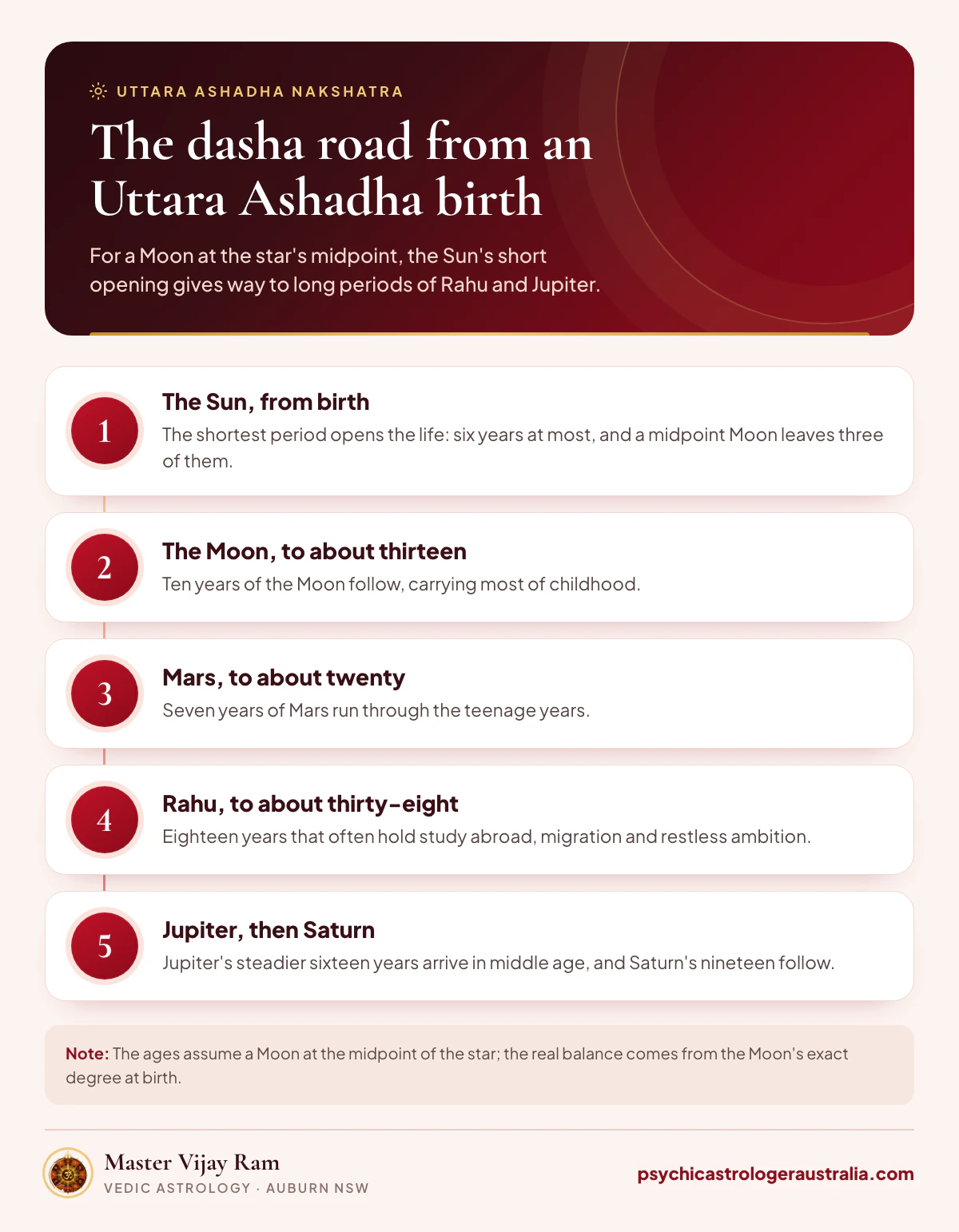
The Sun is the star's lord, and whichever planet owns the birth star runs the first mahadasha of a life. The Sun's period is the shortest in the Vimshottari scheme at six years, so an Uttara Ashadha childhood moves on quickly: a Moon at the midpoint of the star, 3°20′ Capricorn, leaves three years of the Sun before the Moon's ten-year period begins.
Followed through, that midpoint Moon gives the Moon's period to about age thirteen, Mars to twenty and then Rahu for eighteen years, to about thirty-eight, before Jupiter's sixteen and Saturn's nineteen. Many Uttara Ashadha people therefore live their twenties and most of their thirties under Rahu, the years of study abroad, migration and restless ambition, and come into Jupiter's steadier period in middle age. The Sun's authority is the star's nature; the timing of its life belongs to other planets.
How do the padas of Uttara Ashadha straddle two signs?
Its four padas run through the Sagittarius, Capricorn, Aquarius and Pisces navamsas, and the first two are vargottama: the Moon sits in the same sign in the birth chart and in the navamsa, a placement the tradition reads as steady and self-consistent. Only Punarvasu and Chitra share that feature of two vargottama quarters in a row, because they too cross from the end of a dual sign into the start of a movable one.
| Pada | Span | Moon sign (rashi) | Navamsa sign | Vargottama | Name syllable |
|---|---|---|---|---|---|
| 1 | 26°40′–30° Sagittarius | Sagittarius, ruled by Jupiter | Sagittarius | Yes | Be |
| 2 | 0°–3°20′ Capricorn | Capricorn, ruled by Saturn | Capricorn | Yes | Bo |
| 3 | 3°20′–6°40′ Capricorn | Capricorn, ruled by Saturn | Aquarius | No | Ja |
| 4 | 6°40′–10° Capricorn | Capricorn, ruled by Saturn | Pisces | No | Ji |
The syllables Be, Bo, Ja and Ji give the traditional first sound of a name, which nakshatra-based baby naming turns into a short list a family can actually use. The larger consequence is the Moon sign: a first-pada Moon is a Sagittarius Moon with Jupiter as its sign lord, while a Moon in the other three padas is a Capricorn Moon ruled by Saturn, and the two meet different transits.
In 2027, for example, Saturn's Dhaiya presses on a Sagittarius Moon until 2 June and again from 20 October to 31 December 2027, but on a Capricorn Moon from 3 June to 19 October 2027. Two people with the same birth star can therefore feel Saturn's weight in different months; a Sade Sati and Dhaiya reading sets that out for one chart, and finding your Moon sign explains how the rashi is fixed in the first place.
What temperament does the tradition read in an Uttara Ashadha Moon?
The Uttara Ashadha nakshatra characteristics the tradition lists are integrity, responsibility and staying power. These are people who keep promises, accept the job nobody else wants because someone has to, and care a great deal whether a thing is done properly; the Sun gives them a sense of their own standing, and Capricorn gives them patience.
The shadow is rigidity. A temperament built on principle can turn self-righteous, slow to forgive a broken rule and so devoted to duty that rest feels like failure. A father in Geelong with the Moon here might be the one who finishes every renovation he starts and still cannot sit down on a Sunday until the gutters are clear; the tradition would call that the star at its most typical, and suggest the Sunday matters too.
What work suits the star of lasting victory?
Questions about an Uttara Ashadha nakshatra career usually point towards work with structure and consequence: government and public administration, law and the courts, defence and policing, engineering and construction, project management, governance and compliance, and the leadership of schools and hospitals. The star likes work whose results outlive the person who did it.
An officer at Lavarack Barracks in Townsville, a site manager on a Newcastle construction project or a council planner on the Sunshine Coast might each find the description close to home. The star sketches a temperament; the career itself is read from the tenth house, and its timing from the dashas.
How is Uttara Ashadha read in marriage and matching?
In matching the star carries Manushya gana, Antya nadi and a yoni found nowhere else, the mongoose, which has no partner star of its own and whose traditional enemy is the serpent of Rohini and Mrigashira. Manushya gana is comfortable with Deva and Manushya partners and traditionally scores poorly against Rakshasa, and Antya nadi brings Nadi dosha with a partner in another Antya star, such as Shravana or Revati, which recognised exceptions can sometimes lift. How the star points are weighed in matching explains what those scores do and do not mean.
On Uttara Ashadha nakshatra marriage, astrologers describe a loyal, dependable partner who treats a vow as a contract with heaven and may forget that a marriage also needs play. Duty can crowd out tenderness, and a spouse may need to say so plainly. All three Uttara stars appear on the classical list of wedding stars, fitting for a star whose promises are meant to last.
What health habits are traditionally associated with it?
Capricorn is traditionally linked with the knees and the bones, and the Sun with vitality, the eyes and the heart, so the tradition's reading for this star is about endurance rather than sprinting. Knees that kneel on building sites or garden beds deserve care, eyes deserve rest from screens, and a body that works through every weekend eventually asks for the rest it was denied. In an Australian summer a star ruled by the Sun is also a fair reminder about the hat and the sunscreen.
These are tendencies of temperament, read for care. Any symptom, from a sore knee to a racing heart, goes first to a GP, and no reading replaces that.
Why do muhurta texts trust Uttara Ashadha?
Uttara Ashadha is one of the four dhruva, or fixed, stars, with Rohini, Uttara Phalguni and Uttara Bhadrapada, which muhurta texts traditionally favour for anything meant to last: laying foundations, a griha pravesh, planting trees, beginning a long course of study, taking up an office. Traditions differ in the details, and a muhurat always weighs the tithi, the weekday and the lagna as well.
Lists that count twenty-eight stars place a twenty-eighth, Abhijit, across the last quarter of Uttara Ashadha and the opening of Shravana, and treat it as especially auspicious; traditions differ on its exact span. Abhijit is also the name of the midday muhurta, a separate idea that shares the word for victory.
What can an Uttara Ashadha reading show, and what is beyond it?
It can show the temperament, the order and approximate timing of the dashas, the name sound, the Moon sign and its transits, and the matching points. It cannot decide a promotion, a court case, a visa or a diagnosis; a manager, a lawyer, Home Affairs or a registered migration agent, and a GP answer those first. Everything here is a faith-based reading of tendencies and timing, trustworthy only when the birth time behind it is sound.
When the Sun is weak and its period or sub-period pressing, the tradition begins with the Sun's mantra and water offered to the rising Sun, both given in the $50 consultation. Where a Surya shanti or other puja is warranted, Master Vijay Ram performs it himself at his place of practice in Auburn, starting from $250 with the amount settled before anything begins, and puja and havan performed on request describes how that works. He sells no rubies and no other stones.
How does Vijay Ram ji approach an Uttara Ashadha chart?
He first settles which side of the Sagittarius and Capricorn boundary the Moon falls on, because that decides the rashi, then reads the Sun by sign and house, Jupiter or Saturn as the sign lord, and the navamsa, paying special attention to a vargottama Moon. The current dasha comes next, usually Rahu, Jupiter or Saturn for an adult client, and that is where most practical questions are answered.
Vedic astrology for Townsville clients works the same way as for callers from Cairns, Newcastle, Wollongong, Geelong and the Sunshine Coast: a phone or video call or a WhatsApp conversation, in English, Hindi or Punjabi, with in-person appointments only at Auburn. Before this star comes Purva Ashadha, the star of water, and after it Shravana, the star of listening.
Read next
- Uttara Phalguni Nakshatra: The Star of Promises and PartnershipUttara Phalguni nakshatra, 26°40′ Leo to 10° Virgo: Aryaman, the Sun as lord, a star split across two signs, padas, m…
- Krittika Nakshatra: The Star of Fire and Sharp JudgementKrittika nakshatra: Agni, the Pleiades and Kartikeya, the Sun as lord, its split across Aries and Taurus, padas and v…
- Online Istikhara Service in Australia for Marriage & DecisionsHow online istikhara for marriage and other decisions works in Australia, what a genuine practitioner asks for, and t…
Frequently asked questions
Which planet rules Uttara Ashadha nakshatra?
The Sun rules Uttara Ashadha, so births in this star open with the Sun's mahadasha, at six years the shortest in the Vimshottari scheme, followed by the Moon, Mars and Rahu. The sign lord matters too: Jupiter for a first-pada Moon in Sagittarius and Saturn for the other three padas in Capricorn, and a reading weighs the Sun with whichever sign lord applies.
Is Uttara Ashadha in Sagittarius or Capricorn?
Both. The star runs from 26°40′ of Sagittarius to 10° of Capricorn, so its first pada lies in Sagittarius and its second, third and fourth in Capricorn. That makes the Moon sign depend on the pada: a first-pada Moon is a Dhanu rashi Moon, the rest are Makara rashi Moons, and each group meets transits such as Saturn's Dhaiya at different times.
What are the name syllables for Uttara Ashadha nakshatra?
The reference list gives Be, Bo, Ja and Ji for the four padas, and some regional lists write the first two as Bhe and Bho. Which syllable applies depends on the Moon's exact degree, so the time on the hospital record matters. Families who prefer a name without the syllable often keep the sound for a temple or rashi name instead, which the tradition accepts.
What does a vargottama Moon in Uttara Ashadha mean?
In the first two padas the Moon occupies the same sign in the birth chart and the navamsa, Sagittarius in the first and Capricorn in the second, which is what vargottama means. The tradition reads such a Moon as steady and self-consistent, its strengths and weaknesses both amplified. It is one factor among many, judged alongside the Moon's house, aspects and the dasha running.
Who should an Uttara Ashadha native marry?
No star list answers that. In matching the star is Manushya gana and Antya nadi, and its mongoose yoni has no partner star, with the serpent stars Rohini and Mrigashira as its traditional enemies. Those points shape a guna score, but the decision rests on two whole charts, the seventh house, Venus and the dashas, and on the two people themselves.
Is Uttara Ashadha good for a griha pravesh?
It is one of the four fixed, or dhruva, stars that muhurta texts traditionally favour for things meant to last, such as foundations and a house-warming, so it is often considered. A griha pravesh muhurat still looks at the lunar day, the day of the week, the lagna for the moment of entry and the family's own charts, and traditions differ, so the star is a starting point rather than the answer.
What is the connection between Uttara Ashadha and Abhijit?
Muhurta lists that count twenty-eight stars insert Abhijit across the last quarter of Uttara Ashadha and the opening part of Shravana, and treat it as especially auspicious; traditions differ on its exact span. Abhijit means victorious, which suits its place inside the star of lasting victory. The midday Abhijit muhurta shares the name but is a separate idea based on the hour.
What careers suit people born in Uttara Ashadha?
The tradition favours work with structure and lasting consequence: public administration, law and the courts, defence and policing, engineering, construction and project management, governance and compliance, and leadership in schools and hospitals. These describe a temperament that likes results to outlive the person who produced them. The career itself is read from the tenth house and its timing from the dashas.
Does Saturn affect Uttara Ashadha Moons in 2027?
Yes, through the fourth-house Dhaiya rather than Sade Sati, and at different times for different padas. A first-pada Moon in Sagittarius has Saturn in the fourth from it until 2 June and again from 20 October to 31 December 2027; a Moon in the other padas, in Capricorn, has it from 3 June to 19 October 2027. Its weight depends on the whole chart.
People also ask
What does Uttara Ashadha mean?
It means the later unconquered, the victory that comes second and holds. Ashadha is the invincible one and Uttara means later, so where Purva Ashadha declares a win, Uttara Ashadha is read as the win made permanent. It is the twenty-first nakshatra, ruled by the Sun, with the Vishvadevas, the universal gods, as its deity.
Who is the deity of Uttara Ashadha nakshatra?
The Vishvadevas, the all-gods, a company of deities usually counted as ten and honoured alongside the ancestors at a shraddha. Because a council rather than a single god rules the star, the tradition reads its victories as the kind everyone can accept, won by keeping faith with rules and promises, and therefore the kind that last.
What is the symbol of Uttara Ashadha nakshatra?
An elephant tusk or a small bed, with traditions differing on which they give. The tusk here stands for strength that has already proved itself, and the planks of the bed for rest that is earned once a task is finished. Both point to the star's theme of completion and staying power rather than the first strike.
Which mahadasha does Uttara Ashadha start with?
The Sun's, because the Sun rules the star. Its full period is six years, the shortest in the Vimshottari scheme, and the balance at birth follows from the Moon's position inside the star. The Moon's ten years, Mars's seven and Rahu's eighteen follow, so Rahu often covers the twenties and thirties.
Is Uttara Ashadha a fixed nakshatra?
Yes. Muhurta texts traditionally list it among the four dhruva, or fixed, stars with Rohini, Uttara Phalguni and Uttara Bhadrapada, and favour such stars for permanent undertakings: foundations, a house-warming, planting and long study. Traditions differ in detail, and an actual muhurat also weighs the tithi, the weekday and the lagna.
References & further reading
Serving clients across Australia
Confidential consultations by phone, video & WhatsApp — including: