
Quick answer
Jadu tona is the North Indian phrase for harm worked by a spell: jadu is magic, tona the charm that carries it, and totka the household counter-remedy. Most enquiries turn out to be a hard season; where a working is genuinely indicated, Master Vijay Ram cuts it with a havan performed personally at Auburn, names no culprit and states the fee first.
What does jadu tona mean?
Jadu tona is the everyday North Indian phrase for harm worked by a spell: jadu is magic, tona is the charm or working that carries it, and the pair names what a Punjabi or Hindi-speaking family suspects when a run of trouble feels aimed. The words travel with the families who use them, from Punjab, Haryana, Uttar Pradesh and Bihar to Nepal, Bangladesh, Fiji and the suburbs of Australian cities. Totka, the third word that usually follows, is something different, and the difference matters.
This page sets out the vocabulary plainly, the signs people report, the myths that have grown around the phrase, and how Master Vijay Ram responds to a jadu tona enquiry in the Vedic way. It is written for the person who has heard the words from an aunt or a neighbour and wants to know what they are dealing with before they ring anyone. Curse, hex and tona-totka removal is the service page that covers the work when it is warranted.
Jadu, tona and totka: three words, two different things
Jadu and tona together describe a working done against someone: a practitioner engaged, an object prepared, a name or a photograph or a strand of hair used, and a result intended. Totka describes a small folk remedy done for oneself: a lemon and seven chillies at the shop door, black thread on a child's wrist, salt across the threshold, a coin in a bowl of water. One is an attack; the other is a household precaution.
People run the words together as tona totka because a totka is often the first thing a family tries against a suspected tona. The pairing is harmless, but it hides a useful distinction: a totka is cheap, local and yours to do, and nobody should charge you for it. The work this page describes begins only when the totka has not settled things and the pattern still looks aimed.
Who uses the phrase in Australia?
The enquiries come from the places the words come from. Punjabi families in Harris Park, Blacktown and Tarneit, Hindi speakers from Uttar Pradesh and Bihar in Brisbane's southern suburbs and Perth's south-east, Nepali students in the inner city, Indo-Fijian families on the Central Coast and around Liverpool, and Bangladeshi households who use jadu tona and sihr side by side. Grandparents use it most freely; their grandchildren often ring to ask what it means.
The spread matters because jadu tona is a family word before it is a diagnosis. A phrase learnt at a kitchen table in Ludhiana arrives in Brisbane with the family, and it is used for everything from a failed business to a child who will not sleep. Kala jadu removal for Indian and Punjabi families describes the same vocabulary from the removal side; this page stays with the word itself.
What are the signs people describe?
The jadu tona signs that come up on a first call are consistent. A run of setbacks that began around a date and crosses unrelated areas of life, money and health and a marriage in one season. Sleep that breaks at the same hour, often between two and four. A home that changed character after a visitor, a wedding or a dispute. An object found at the gate, under a step or in a plant pot: a lemon stuck with pins, ash in a knotted cloth, a doll, a thread, a coconut smeared red.
Two signs carry more weight than the rest. One is a pattern that lands harder on one person than on the household, when an aimed working would be expected to be aimed. The other is a found object with a clear placement, because that is a thing in the world rather than a feeling. Neither is proof. Both are worth writing down with a date before anyone is rung.
What was found or felt, and what it usually is
The table sets the common reports beside their ordinary explanations and the circumstance in which each one starts to carry weight in a reading. Most enquiries sit in the middle column and end there.
| What was found or felt | What it usually is | When it carries weight |
|---|---|---|
| A run of setbacks across money, health and family in one season | A hard year: a job lost, a parent ill, a mortgage rate rise, all at once | When the run has a clear start date and lands far harder on one person than on the rest of the house |
| Sleep breaking at the same hour, bad dreams | Stress, shift work, a baby, screens, a medical cause that a GP should hear about | When it began with the other changes and stops when the person sleeps elsewhere |
| A home that feels heavy after a visitor or a celebration | Nazar, the evil eye, or simply a quarrel that has not been cleared | Rarely; this is the territory of home practices and a cleansing, not a removal |
| A lemon with pins, ash in a cloth, a thread, a doll at the gate | Sometimes a neighbour's own totka, sometimes a child's game, sometimes rubbish | When the placement is deliberate, the household is the clear target and the timeline fits |
| A child who cries at dusk or stops eating | Teething, illness, a change at school; the doctor first, every time | Almost never; a working against a child is diagnosed only after everything ordinary is ruled out |
| A relative who said something bitter before the trouble began | A family quarrel, remembered because the trouble followed it | This is a shrap, a spoken curse, read differently from a tona and answered with reconciliation first |
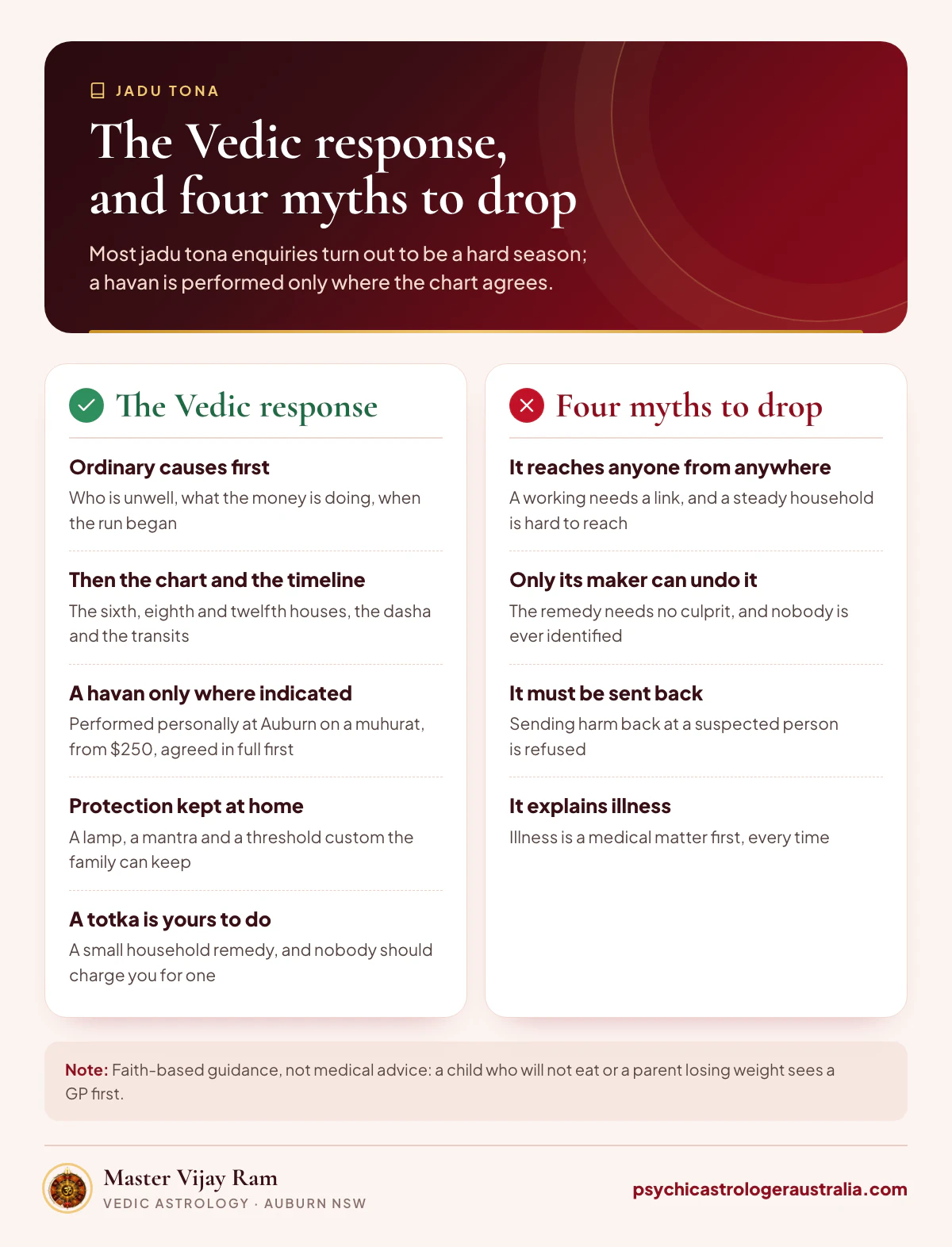
Myth one: jadu tona can be done to anyone from anywhere
The tradition does not hold that. In every account that has any discipline to it, a working needs a link: something of the person, a name spoken at a chosen time, an object placed where they pass. It also holds that the intent has to find a gap, which is why a household that keeps its lamp, its threshold and its peace is described as hard to reach. The fear that a stranger on another continent can harm you through a photograph is a modern one, and the sources the practitioners themselves cite do not support it.
Myth two: only the person who did it can undo it
This one keeps families paying the wrong people. The Vedic response does not need the culprit at all. A havan with mantra sadhana addresses the obstruction and the person it sits on, not the hand that placed it; it aims to cut the working, cleanse the person and protect the household, and nobody is identified. A practitioner who says the work can only be lifted by its maker, or who offers to find the maker for a fee, is describing a business model rather than a tradition.
Myth three: a counter-tona has to be sent back
Sending harm back at a suspected person is refused, and the reason is practical as well as moral. Suspicion inside an Indian family almost always lands on a relative or a neighbour, and a counter-working aimed at a name turns a hard season into a feud that outlasts the season by decades. Master Vijay Ram will hear the suspicion once and will not confirm it, from a chart or from anything else. The remedy, where one is warranted, is aimed at the obstruction and never at a person.
Myth four: jadu tona explains illness
It does not, and the order of care is fixed. A child who will not eat sees a GP; a parent who has lost weight sees a doctor before anyone else; a mind that has stopped sleeping is a medical matter first. The tradition itself puts the physician ahead of the priest, and a reading that is asked to explain a symptom will send the family to their doctor before it says anything about a charm. Faith-based guidance is not medical, legal or financial advice, and this page should be read that way.
How does the Vedic response begin?
With the ordinary causes. The consultation is $50, by phone, video or WhatsApp, and the first part of it is spent on the plain things: who is unwell, what the money is doing, what changed in the marriage, what happened at work, when the run began. Most jadu tona enquiries are answered here, with a hard season named as a hard season and a practical step suggested, and no remedy is offered for them.
The second part is the chart and the timeline. The sixth, eighth and twelfth houses, the running dasha, the transits over the months the trouble took hold, and whether the pattern in the household is lopsided in the way an aimed working would be. Only when the ordinary causes leave something unexplained and the chart agrees does he say that a working is indicated.
What does jadu tona removal involve?
Jadu tona removal, where it is warranted, is a havan with mantra sadhana performed by Master Vijay Ram personally at his own place of practice in Auburn, on a muhurat chosen for the work. The person does not travel; the family joins by video if they wish, or simply keeps the hour. Afterwards a protective practice is set up at home so that the household does not stay open to the same thing: a lamp, a mantra, a threshold custom the family can keep.
Remedy work starts from $250 and the figure is agreed in full before the muhurat is chosen; it does not rise once the work is under way and there is no stronger second round. Online puja and havan describes how a remedy is performed and witnessed from a distance. The found object, if there was one, is dealt with on his instruction and never brought into the house.
Jadu tona on a child or a newborn
The most anxious calls concern a baby who cries at dusk or a child who has stopped thriving, and the first answer is always the doctor. Where a family still wants the child protected, the tradition's own practices are gentle and inexpensive: a black dot behind the ear, a loose thread that comes off before sleep, a lamp at dusk, and the grandmother's nazar utarna with salt or chillies. Nazar on newborns and babies covers them in detail; a working against a child is diagnosed very rarely and only after everything ordinary is ruled out.
Food, gifts and the fear of being fed something
A specific jadu tona fear is the laced sweet, the gift that carries a working, the meal eaten at a relative's house before the trouble began. It is one of the oldest forms the phrase takes and one of the hardest on a family, because the suspect is always someone who fed you. Black magic through food or gifts takes the fear seriously and sets it against what is real; the short version is that the reading looks at the pattern, not the plate, and that no relative is ever named.
Jadu tona, sihr, voodoo or kala jadu: does the word matter?
Only to the family. Bangladeshi and Pakistani households say sihr for the same thing, Indo-Fijian and Caribbean families reach for obeah or voodoo, and a Punjabi grandmother says kala jadu or tona interchangeably. Which tradition is your family describing sorts the words; the reading is the same in each case, because the chart and the timeline do not speak Hindi, Urdu or Fiji Hindi.
When jadu tona is really something older
Some families who arrive with the phrase are describing a pattern that repeats across generations rather than a working done last spring: the men who do not prosper, the marriages that fail at the same age, the land that was taken two generations back. That is the territory of ancestral debt rather than a charm, and it is read differently, through the ninth and fifth houses and the family's history. Pitra dosh and the signs of ancestral karma explains that reading; black magic removal is the page for the dated, aimed working this page has mostly been about.
What should a jadu tona specialist never do?
A jadu tona specialist who announces a working in the first minute, names the relative responsible, quotes a fee that rises as the work proceeds, or asks for gold, jewellery or a photograph of the suspected person has told you everything you need to know. Keep the messages, stop paying, and bring the whole story, including what was said and paid, to a plain consultation. The honest version of this work is slow at the start, says no more often than yes, and states its fee once.
Read next
- Kala Jadu, Sihr and Voodoo: Which Tradition Is Your Family Describing?Kala jadu, sihr, voodoo, hooniyam and the evil eye: what each tradition means by harm, what undoes it, and how a Vedi…
- Kala Jadu Removal for Indians & Punjabis in AustraliaKala jadu removal explained for Indian and Punjabi families in Australia: the stage-by-stage process, what you are as…
- Black Magic on Marriage: Signs Your Relationship Is TargetedSigns that black magic may be affecting a marriage, how the drift unfolds week by week, and the ordinary causes to ru…
Frequently asked questions
What is the difference between jadu tona and totka?
Jadu tona is a working done against a person: a practitioner engaged, an object prepared, a link such as a name or hair used, and harm intended. A totka is a small household remedy done for oneself, such as a lemon and chillies at the door or black thread on a child's wrist. The two get said together, but one is an attack and the other a precaution, and a totka should never cost you anything beyond the lemon.
What are the most common signs of jadu tona that people report?
A run of setbacks that began around a date and crosses unrelated areas of life, sleep that breaks at the same hour, a home that changed character after a visitor or a dispute, and an object found at the gate or under a step. The two that carry more weight are a pattern that lands harder on one person than on the household and a found object with a deliberate placement. None of them is proof on its own.
I found a lemon with pins at my gate. What should I do?
Photograph it where it lies, do not bring it into the house, and do not spend the evening deciding who put it there. Dispose of it the way your family's custom says, usually away from the home, or on Master Vijay Ram's instruction if you would rather. Then write down the date and anything that has changed in the household recently, because a found object matters only when the timeline around it fits.
Can jadu tona be done through a photograph from overseas?
The tradition does not hold that a working reaches anyone from anywhere. Every account with any discipline to it needs a link, a chosen time and a gap in the household to enter through, and a home that keeps its lamp and its peace is described as hard to reach. The fear of harm sent through a photograph across continents is a modern one, and it is not what the sources the practitioners cite describe.
Do I need to know who did it before it can be removed?
No, and you will not be told. The remedy addresses the obstruction and the person it sits on, not the hand that placed it, so the culprit is not needed and is never named. Master Vijay Ram will hear a suspicion once and will not confirm it from a chart or anything else, because a name confirmed inside a family turns a hard season into a feud that outlasts it by decades.
Can jadu tona make someone physically ill?
Illness is a medical matter first, every time. A child who will not eat, a parent who has lost weight or a person who has stopped sleeping sees a doctor before anyone reads a chart, and the tradition itself puts the physician ahead of the priest. A reading will send a family to their GP before it says anything about a charm, and what this page offers is faith-based guidance, not medical advice.
How much does jadu tona removal cost?
The consultation is $50, by phone, video or WhatsApp, and most enquiries are answered within it with an ordinary cause found and no remedy offered. Where a working is genuinely indicated, the havan with mantra sadhana starts from $250 and the figure is agreed in full before the muhurat is chosen. It does not rise once the work is under way, there is no stronger second round, and no gold, jewellery or valuables are ever asked for.
Is a totka enough on its own?
Often, because most of what a family fears is a hard season or nazar rather than a working, and a lamp at dusk, a lemon at the door and a cleared quarrel settle a house more than people expect. A totka costs little and belongs to the household. The work described on this page begins only when the totka has not settled things, the pattern still looks aimed and the ordinary causes have been ruled out.
Is jadu tona the same thing as sihr or kala jadu?
For the purposes of a reading, yes. Punjabi and Hindi families say jadu tona or kala jadu, Bangladeshi and Pakistani households say sihr, Indo-Fijian and Caribbean families reach for obeah or voodoo, and all of them describe a working done against a person. The chart and the timeline are read the same way whichever word the family uses, and the remedy is the same havan performed personally at Auburn.
People also ask
What is jadu tona?
Jadu tona is the North Indian phrase for harm worked by a spell: jadu means magic and tona the charm or working that carries it. Families from Punjab, Uttar Pradesh, Bihar, Nepal, Bangladesh and Fiji use it when a run of trouble feels aimed at them. It is a family word before it is a diagnosis, and most enquiries about it turn out to be an ordinary hard season.
How do you know if someone has done jadu tona on you?
You cannot know from a feeling, and no honest practitioner will confirm it in a first minute. The signs that carry weight are a dated run of setbacks that lands harder on one person than on the household and a found object placed deliberately, and even those are read only after the ordinary causes, illness, money, a marriage under strain, have been ruled out and the chart and timeline agree.
What is tona totka?
Tona totka pairs two different things. A tona is a working done against someone; a totka is a small household remedy done for oneself, such as a lemon and seven chillies at a shop door, black thread on a child's wrist or salt across a threshold. Families say the phrase together because a totka is the first thing tried against a suspected tona, and a totka should never cost anything to speak of.
How is jadu tona removed?
In the Vedic tradition, by ruling out ordinary causes first, reading the chart and the timeline, and then, only where a working is indicated, a havan with mantra sadhana on a muhurat, performed by Master Vijay Ram personally at Auburn with the family joining by video if they wish. It aims to cut the working, cleanse the person and protect the household; no culprit is named and nothing is sent back at anyone.
Who can remove jadu tona in Australia?
Master Vijay Ram reads jadu tona enquiries from anywhere in Australia by phone, video or WhatsApp, in English, Hindi and Punjabi, with Auburn in Sydney the only place he practises in person. The consultation is $50 and remedy work, where warranted, starts from $250, agreed first. A practitioner who announces a working immediately, names a relative or quotes a rising fee is the one to walk away from.
References & further reading
Serving clients across Australia
Confidential consultations by phone, video & WhatsApp — including: