

Quick answer
The first house in Vedic astrology, tanu bhava, is the house of the body, vitality and temperament, and the house every other house is counted from. It is both a kendra and a trikona, the Sun is its natural karaka, and its strength is judged from its lord, the planets in and aspecting it, the navamsa and the dasha running.
What is the first house in Vedic astrology?
The first house in Vedic astrology is the house of the body and of the person living in it: your constitution, your vitality, your temperament and the manner in which you meet each day. Its Sanskrit name is tanu bhava, the house of the body, and it is the house every other house is counted from. Whatever a chart promises in marriage, money or work, this is the house that has to carry it.
The sign that occupies it is your lagna. How that sign is worked out from a birth time is covered in the Vedic rising sign, or lagna, so this page stays with the house itself: what it holds, which planets change it, how its strength is judged and why a full kundli and horoscope reading always begins here.
Why is the first house both a kendra and a trikona?
The twelve houses fall into families. The kendras, or angles, are the 1st, 4th, 7th and 10th, the four pillars that hold a life upright; the trikonas, or trines, are the 1st, 5th and 9th, the houses of grace and merit. One house appears on both lists, and it is this one.
Because of that double membership the tradition treats the planet ruling the first house as an ally of the whole chart, even when it also rules a difficult house. Mars rules the 1st and the 8th for an Aries lagna and the 1st and the 6th for a Scorpio lagna; Venus rules the 1st and the 8th for Libra and the 1st and the 6th for Taurus. Most texts let the first-house lordship speak first in each case.
Put simply, the first house is where effort, the business of the angles, meets fortune, the business of the trines. When it is well supported a person can use what the rest of the chart offers; when it is strained, the same promises arrive with more friction.
What does the first house govern?
Tanu bhava has a short, physical list in the classical texts: the body as a whole and the head in particular, the build and complexion, vitality and the capacity to recover, the temperament and habits of mind, and the dignity or standing a person carries. Some texts add general happiness and the circumstances of birth, since the house also describes the start of life.
The tradition keeps body and self in one house for a reason that still holds. How you feel in your body colours how you act, and how you act wears into the body over the years, so a reading of the first house in a kundli is never only about looks or only about personality: it is about the vehicle and the driver together.
Why is the Sun the karaka of the first house?
Every house has a natural significator, its karaka, which is read beside it whatever sign the house holds. For the first house it is the Sun, the planet of vitality, selfhood and the will to stand up and act. The Sun's condition is therefore checked with the house in every chart, not only in charts with Leo rising.
A Sun exalted in Aries or at home in Leo adds stamina and confidence to any first house. A Sun in Libra, its sign of debilitation, or squeezed between malefics, asks for more care with energy and with self-belief, and it often belongs to someone who learned confidence slowly and then held on to it well.
This is why the traditional practice for a tired first house starts with the Sun: water offered at sunrise, the Sun's mantra on a Sunday, and an honest look at sleep and routine. These are acts of devotion and discipline, and none of them is medicine.
Planets in the first house: what does each one add?
A planet in the first house colours the body and temperament directly, and because every planet aspects the seventh house from where it stands, it also shapes how you behave with a partner. The table gives the traditional reading of each of the nine grahas here and the factor that most often changes it.
| Planet in the 1st | What it tends to add | What changes the reading |
|---|---|---|
| Sun | Presence, pride and a strong will; leadership shown early; energy that needs pacing | Strong in Aries or Leo, weak in Libra; Saturn's aspect cools it |
| Moon | A responsive, changeable temperament and a face that shows feeling; a body that likes routine | Waxing or waning; strong in Taurus, strained in Scorpio |
| Mars | Drive, courage and a quick temper; an active, restless body, traditionally prone to cuts and heat | Steadier in Aries, Scorpio or Capricorn, unsettled in Cancer; Jupiter's aspect calms it |
| Mercury | A youthful look and manner, quick wit and a talkative mind; it gains directional strength here | Combust when too close to the Sun; sharpest in Gemini or Virgo, dreamier in Pisces |
| Jupiter | Dignity, generosity and sound judgement; people trust the person early; directional strength here | Exalted in Cancer, debilitated in Capricorn; Rahu's company complicates it |
| Venus | Charm, grace, care over appearance and a taste for comfort and the arts | Exalted in Pisces, debilitated in Virgo; at home in Taurus and Libra |
| Saturn | Seriousness, endurance and a slow start that improves with age; a tendency to carry worry | Exalted in Libra, debilitated in Aries; at home in Capricorn and Aquarius |
| Rahu | An unusual self-image, strong ambition, restlessness and ease with the foreign; a person who reinvents themselves | The lord of the sign it occupies, the aspects on it and the Rahu dasha |
| Ketu | Inwardness and detachment; either self-doubt or spiritual depth, often both at different ages | The lord of its sign, Jupiter's aspect and the Ketu dasha |
Read the table as tendencies. A benefic in a weak sign can give less than a malefic in its own sign, and the planets in the first house always share the stage with the lord of the house, wherever that lord happens to sit.
Which planets aspect the first house?
Any planet in the seventh house aspects the first in full, so the partner's house is always in conversation with the self. Three planets also have special aspects in the Parashari scheme: Mars reaches the 4th and 8th houses from itself, Jupiter the 5th and 9th, and Saturn the 3rd and 10th.
Counted back to the first house, that means Mars aspects it from the 6th, 7th and 10th; Jupiter from the 5th, 7th and 9th; Saturn from the 4th, 7th and 11th. Jupiter's glance is traditionally the kindest thing the house can receive, Saturn's adds weight and patience, and Mars's adds heat and drive. Some astrologers give Rahu and Ketu aspects of their own and others do not; traditions differ.
How do you judge the strength of the first house?
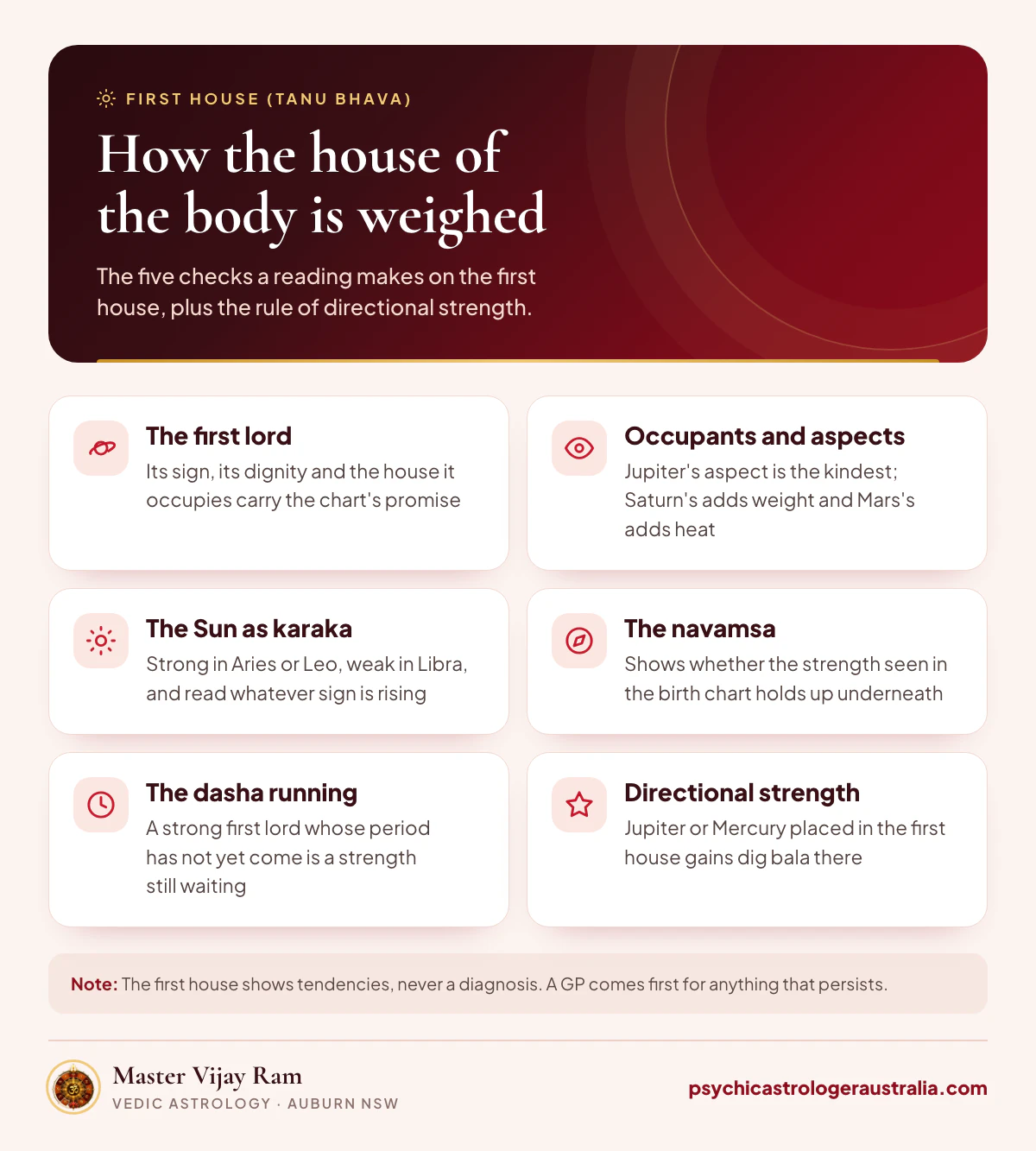
Master Vijay Ram weighs five things, roughly in this order. The first is the first house lord: its sign, its dignity and the house it occupies, since an exalted lord in a kendra or trikona carries a chart differently from a debilitated one in the eighth. The second is the set of occupants and aspects described above.
The third is the Sun, as karaka. The fourth is the navamsa, the ninth divisional chart: its own lagna and the sign the first lord falls in there, which show whether the strength seen in the birth chart holds up underneath. The fifth is the dasha, because a strong first lord whose period has not yet come is a strength still waiting for its turn.
One classical refinement helps. Jupiter and Mercury gain directional strength, dig bala, in the first house, so either one placed here gets a lift; the Sun and Mars gain theirs in the tenth, Saturn in the seventh, and the Moon and Venus in the fourth.
Three first houses: from the lagna, the Moon and the Sun
The tradition also reads the chart from three starting points at once, a method often called the Sudarshana approach. Counted from the lagna, the first house describes the body and outward circumstances; counted from the Moon, it describes the mind and how life feels; counted from the Sun, it describes the will and the sense of purpose.
When all three are supported, a person tends to feel, look and act strong together. When they disagree, for example a sturdy lagna with an afflicted Moon, the reading changes shape: the body may be robust while the mind does the worrying, and any practice suggested is aimed at the Moon rather than at the house.
What does the first house say about health habits?
It shows constitution and tendency, never a diagnosis. A fiery first house, with the Sun or Mars prominent, is traditionally read as quick to heat and quick to burn out; a watery one, with the Moon or Venus prominent, as sensitive to sleep, diet and routine; a Saturn-touched one as slow to start and steady once moving.
Those tendencies meet ordinary Australian working lives. A fly-in fly-out worker on a long roster out of Perth, with a Mars-heavy first house, might ask why the second week always feels like a wall; a chef on the Gold Coast with Saturn rising might ask why mornings are so hard. The chart can describe the pattern, but a GP examines the body, and a GP comes first for anything that persists.
Vedic health guidance alongside medical care sets out how a reading sits beside treatment rather than in place of it. The useful part of a first-house reading is usually practical: which habits a constitution needs and which periods ask for extra rest.
Does the first house show how other people see you?
Yes, and here it meets the seventh. The first house is the self you present and the seventh is the person or public you present it to; planets in either house aspect the other, so the axis works as a single conversation, and the seventh house of marriage and partnership reads the far end of it.
In practice the first house is what an interviewer, a new neighbour or a prospective in-law notices before you have said much. Jupiter rising often reads as trustworthy at once; Rahu rising as hard to place, which can help in a new country and puzzle a traditional family. Neither impression is fixed, and both soften or sharpen with the period running.
When does the first house come alive?
A house speaks loudest in the dasha of its lord or of a planet placed in it. The mahadasha of the first lord tends to be a period about the self: health, appearance, independence, a fresh start or a change of identity, such as a move overseas, a career rebuilt from scratch or a decision to look after the body properly at last.
Transits supply the trigger. Saturn crosses into sidereal Aries on 3 June 2027 and slips back into Pisces on 20 October 2027, so a Pisces Moon carries it for most of the year and an Aries Moon through the middle months: the peak of Sade Sati for each, a season of heavier responsibility rather than a misfortune. Sade Sati analysis and Saturn remedies looks at that overlay in a full chart.
Jupiter, the gentler trigger, returns to Leo on 26 June 2027 and stays until it moves into Virgo on 27 November 2027. The same movements fall on a first house counted from the lagna for anyone with Pisces, Aries, Leo or Virgo rising, and there they speak about the body and the self.
What sits on either side of the first house?
Houses are read in sequence, and the first sits between two that feed it. Behind it is the twelfth, the house of sleep, expense, retreat and life abroad, which drains or restores the body overnight; the twelfth house of expenses and foreign lands covers it, and a tired first house is often a first house with a busy twelfth.
Ahead of it is the second, the house of food, family and savings, the things that sustain the body from day to day. The second house of family, savings and food is the next post in this series and worth reading beside this one, because how a person eats and spends is often the most practical way a first house can be supported.
What the first house cannot tell you
It cannot diagnose an illness, predict an injury or tell you how long you will live. It cannot measure your worth, and it does not decide whether you will be confident; it describes the starting conditions and the seasons in which they are tested.
A reading is faith-based guidance within the Vedic tradition. It sits beside a doctor, a physiotherapist or a psychologist and never in front of them, and anyone who offers to repair a body through a chart alone is selling something the tradition does not support.
How does Master Vijay Ram read the first house?
He casts the chart with the Lahiri ayanamsa from your date, time and place of birth, then reads the first house from the lagna, the Moon and the Sun before anything else: the occupants, the aspects, the first lord and its navamsa, and the dasha now running. Then he tells you, in plain language, what the house describes and which coming periods ask for more care.
A consultation is $50, by phone, video or WhatsApp from anywhere in Australia, in English, Hindi or Punjabi. Clients in Perth and Western Australia book around a two-hour gap in winter and three hours in summer; in person he sees clients only at his place of practice in Auburn, by appointment.
Most first-house questions end with a practice rather than a ritual: the Sun's mantra, the first lord's day, a steadier routine. Where an afflicted first lord in a pressing period does call for a shanti, he performs it personally in Auburn, from $250, agreed before anything is done, and online puja and havan in Auburn explains how a client can join by video.
Read next
- The Tenth House in Vedic Astrology: Career, Reputation and KarmaThe tenth house in Vedic astrology: career, reputation and karma, its four karakas, the tenth lord in each house, pla…
- The Ninth House in Vedic Astrology: Father, Fortune, Teachers and DharmaThe ninth house in Vedic astrology: father, fortune, teachers, faith and long journeys, the ninth lord in each house …
- Signs of Jinn Disturbance at Home and How Ruqyah HelpsJinn disturbance at home: which signs matter, which have ordinary causes, what ruqyah really is, and how a settled ho…
Frequently asked questions
What does the first house represent in Vedic astrology?
The first house, tanu bhava, represents the body and the person in it: constitution, vitality, the head, build and complexion, temperament, and the standing a person carries. It is the house every other house is counted from, which is why it is read before anything else. It is also the only house that is both a kendra and a trikona, so its condition affects how much of the rest of the chart a person can use.
Is the first house the same as the lagna?
Nearly. The lagna is the sign that was rising when you were born, and in the whole-sign method used here that sign fills the first house, so the two are read together. The difference is one of emphasis: the lagna names the sign and its exact degree, while the first house is the department of life it opens, with its occupants, its aspects and its lord. One says where the chart starts; the other, what is kept there.
Which planet is best in the first house?
Jupiter is the classic answer: it gains directional strength in the first house and tends to give dignity, sound judgement and a presence people trust. Mercury also gains directional strength here, and a well-placed Venus adds charm. Sign and dignity still matter more than the planet's name, and Saturn rising in Libra or Capricorn can serve a person better over a lifetime than Jupiter debilitated in Capricorn.
Is Saturn in the first house bad?
No. Saturn in the first house tends to give seriousness, endurance and a slow start, and people with Saturn rising are traditionally described as growing into themselves as the years pass. In Libra, Capricorn or Aquarius it is comfortable; in Aries, its sign of debilitation, it asks for more patience. It is a planet of effort and time, read with its sign, its aspects and the dasha running.
What does an empty first house mean?
Nothing worrying. Many charts have no planet in the first house, and the house is then described by its sign, its lord and the aspects it receives, together with the Sun as karaka. A strong first lord with an empty first house often gives a sturdier constitution than a crowded first house with a weak lord. Occupants add colour to a house; they are not required for it to work.
Does Mars in the first house make someone manglik?
Mars in the first house is one of the placements counted for manglik dosha, alongside the 2nd, 4th, 7th, 8th and 12th, because from the first it aspects the 4th, 7th and 8th houses. Many traditions cancel it, for example when Mars is in its own sign Aries or Scorpio, exalted in Capricorn, or joined or aspected by Jupiter. Both charts are checked in full before any remedy is considered.
Can the first house show health problems?
It shows tendencies the tradition links with a constitution, such as a fiery temperament that runs hot or a watery one that is sensitive to routine, and the periods in which the body asks for more care. It cannot diagnose an illness or stand in for a test. Anything persistent, painful or worrying goes to a GP first; a reading can then help with habits, timing and the patience recovery takes.
Who is my first house lord?
The planet that rules your rising sign. An Aries or Scorpio lagna has Mars as first lord, Taurus or Libra has Venus, Gemini or Virgo has Mercury, Cancer has the Moon, Leo has the Sun, Sagittarius or Pisces has Jupiter, and Capricorn or Aquarius has Saturn. Wherever that planet sits in the chart, it carries the first house's business into that part of your life.
What does Rahu in the first house do to a personality?
Rahu rising is traditionally read as an unusual or hard-to-place self-image, strong ambition, restlessness and comfort with other cultures, often in someone who reinvents themselves more than once. It can suit migration and new careers well. Its effect depends on the lord of the sign it occupies, the aspects on it and above all the Rahu dasha, when the placement tends to speak most clearly.
How can I strengthen my first house?
The tradition starts with conduct and devotion: water offered to the Sun at sunrise or its mantra, the first lord's mantra on its day, and a routine that respects your constitution. A gemstone for the first lord is considered only after a full chart reading, and Master Vijay Ram sells no stones. A shanti is rare; when one is warranted he performs it in Auburn, from $250, agreed beforehand, after a $50 consultation.
People also ask
What does the 1st house rule in a birth chart?
The 1st house rules the body, vitality, temperament, the head and the general standing of a person, and it is the starting point for counting every other house. Its sign is the lagna and its natural karaka is the Sun. In Vedic astrology it is the one house that is both an angle and a trine, which is why it carries so much weight in any reading.
What happens if the first house lord is weak?
A weak first lord, debilitated, combust or placed in a difficult house without support, is traditionally read as a life in which the chart's promises take more effort to use. It is not a sentence: cancellations of debilitation are common, the navamsa can show hidden strength, and the first lord's own dasha often brings a turn. The tradition responds with the lord's mantra and steady habits first.
Which house represents the self in Vedic astrology?
The first house, tanu bhava, represents the self as it is lived in a body: health, vitality, temperament and presence. The house counted from the Moon adds the mind's experience of that self, and the house counted from the Sun adds the will, which is why a careful reading checks the first house from all three starting points before drawing conclusions about character.
What does Jupiter in the first house mean?
Jupiter in the first house is one of the most welcome placements in the tradition: it gains directional strength there and tends to give dignity, generosity, sound judgement and a presence others trust. From the first it aspects the 5th, 7th and 9th houses, touching children, partnership and fortune. In Capricorn, its sign of debilitation, or joined by Rahu, the promise needs a closer look.
Can the first house change over a lifetime?
The house is fixed at birth, but the way it shows itself changes with the dasha and the transits. The first lord's mahadasha can bring a reserved person into view, and a Saturn-touched first house often feels lighter as the years pass. Habits matter too: the constitution described in the chart is a starting point that daily conduct can steady or strain.
References & further reading
Serving clients across Australia
Confidential consultations by phone, video & WhatsApp — including: