
Quick answer
The ninth house in Vedic astrology is the dharma bhava, the ninth sign from your lagna and the strongest of the three trikonas. It is read for fortune, the father, teachers, faith, higher study and long journeys, with Jupiter as its karaka and the Sun for the father. Its lord, aspects, navamsa and dasha show how that fortune is earned and when it arrives.
What is the ninth house in Vedic astrology?
The ninth house in Vedic astrology is the dharma bhava, also called the bhagya bhava: the house of fortune, the father, teachers, faith, higher study and long journeys. Count nine signs from your lagna and you arrive at it: the most auspicious of the three trikonas, the houses of grace, which is why its lord counts as a helpful planet for every rising sign. When an old astrologer calls a person lucky, this is the house he has been looking at.
Below you will find the reasoning behind the house, the two planets that signify it, the ninth lord placed house by house, the tests of its strength and the places it turns up in an Australian life: a father overseas, a supervisor, a pilgrimage, a move. A kundli reading with Master Vijay Ram applies it to your chart, and the series continues on either side with the eighth house of sudden change and the tenth house of career.
Why are fortune, the father and the teacher in one house?
Because each is something given before it is earned. A father’s name and protection, a teacher’s knowledge, a tradition to stand in and the good timing people call luck all reach a person from outside, and the tradition reads them as the fruit of merit carried from before. The word dharma holds them together: the right way of living that a family, a teacher and a faith pass on.
There is a counting logic too. The ninth house is the fifth from the fifth, and the fifth is the house of past merit, purva punya, so the ninth is read as that merit ripening into fortune in this life. That is why a strong fifth and a strong ninth together are one of the most valued pairings in a chart.
Why does the ninth house have two karakas, Jupiter and the Sun?
Jupiter is the natural karaka of the ninth, the planet of teachers, wisdom, faith and expansion, and its dignity colours every ninth-house matter. The Sun is the karaka of the father, so a reading of the father always looks at the Sun beside the ninth house and its lord. A strong Jupiter with a troubled Sun often describes good fortune with a complicated father; the reverse describes a respected father and luck that has to be built.
Traditions differ on where the father lives in the chart. Most North Indian practice reads him from the ninth; some lines, following a reading of the Parashari text, read him from the tenth, and careful astrologers check both before saying anything about a parent.
What does the ninth lord show in each house?
The ninth house lord is whichever planet rules that ninth sign, and wherever it sits is where the tradition looks for your fortune. Because it is a trikona lord it is a functional benefic for every lagna, and where it also rules a kendra it becomes a yogakaraka: Saturn for Taurus rising, Mars for Leo rising and Venus for Aquarius rising each rule the ninth and a kendra together. The table gives the traditional reading of each placement in brief.
| Ninth lord in | Where fortune tends to be found | The father, teachers and faith |
|---|---|---|
| 1st | In the person: principled, self-made luck | A father’s support felt early |
| 2nd | Family money, savings, speech, teaching | Values handed down at the table |
| 3rd | Effort, writing, media, short travel | Faith that has to be argued for |
| 4th | Home, land, vehicles, the mother’s line | A settled, devout household |
| 5th | Study, children, mantra, creative work | Merit ripening; a gifted teacher |
| 6th | Service, medicine, law, hard competition | Friction with a father or a guru |
| 7th | Marriage, partners, trade, a spouse from afar | A partner who brings a new faith |
| 8th | Interrupted, then found again; research | A father’s health watched; faith tested |
| 9th | Its own house: steady fortune | A respected father; a lasting teacher |
| 10th | A career that carries a sense of duty | Public honour; a mentor at work |
| 11th | Networks, elder siblings, steady gains | Teachers who open doors |
| 12th | Abroad, in charity, in pilgrimage | A father far away; faith lived quietly |
The tenth-house row has a name of its own. A link between the ninth and tenth lords, by placement, exchange or conjunction, is the classical dharma-karma adhipati yoga, read as duty and work pulling in the same direction, and it is one of the more reliable raja yogas when both lords are dignified.
How does each planet in the ninth house colour fortune?
The Sun in the ninth tends to give a strong father, principled views and a pull toward government or teaching, sometimes with friction between father and child over who is right. The Moon gives devotion, a mother who shapes the family’s faith and a liking for pilgrimage; Mars gives a person who fights for beliefs and a forceful father; Mercury gives higher study in commerce, languages or law and a quick, questioning faith.
Jupiter in the ninth sits in its natural house and is traditionally read as fortune, wise teachers and a generous outlook. Venus brings luck through art, beauty and marriage; Saturn gives faith earned slowly, a strict or older father and fortune that matures late; Rahu gives unconventional beliefs, foreign teachers and distance from the father’s tradition; Ketu gives an inward spirituality that distrusts ceremony. Planets in the ninth house are read with their sign and the aspects on them, never alone.
How is the strength of the ninth house judged?
Begin with the ninth lord: its sign, its dignity, whether it is combust or retrograde, and the house it sits in. Then see which planets cast their glance on the house and its lord: Jupiter strengthens nearly everything it sees, while a node or Saturn tends to delay fortune or route it through hardship.
The navamsa comes next, both for the ninth lord’s real strength and for the ninth house of the navamsa itself, which many astrologers read for the deeper fortune of a life. Last comes the dasha: a strong ninth house gives its fruit most clearly in the periods of the ninth lord, of Jupiter, and of planets placed in or aspecting the house, so the same chart can feel unlucky at thirty and blessed at forty.
What does the ninth house say about a father overseas?
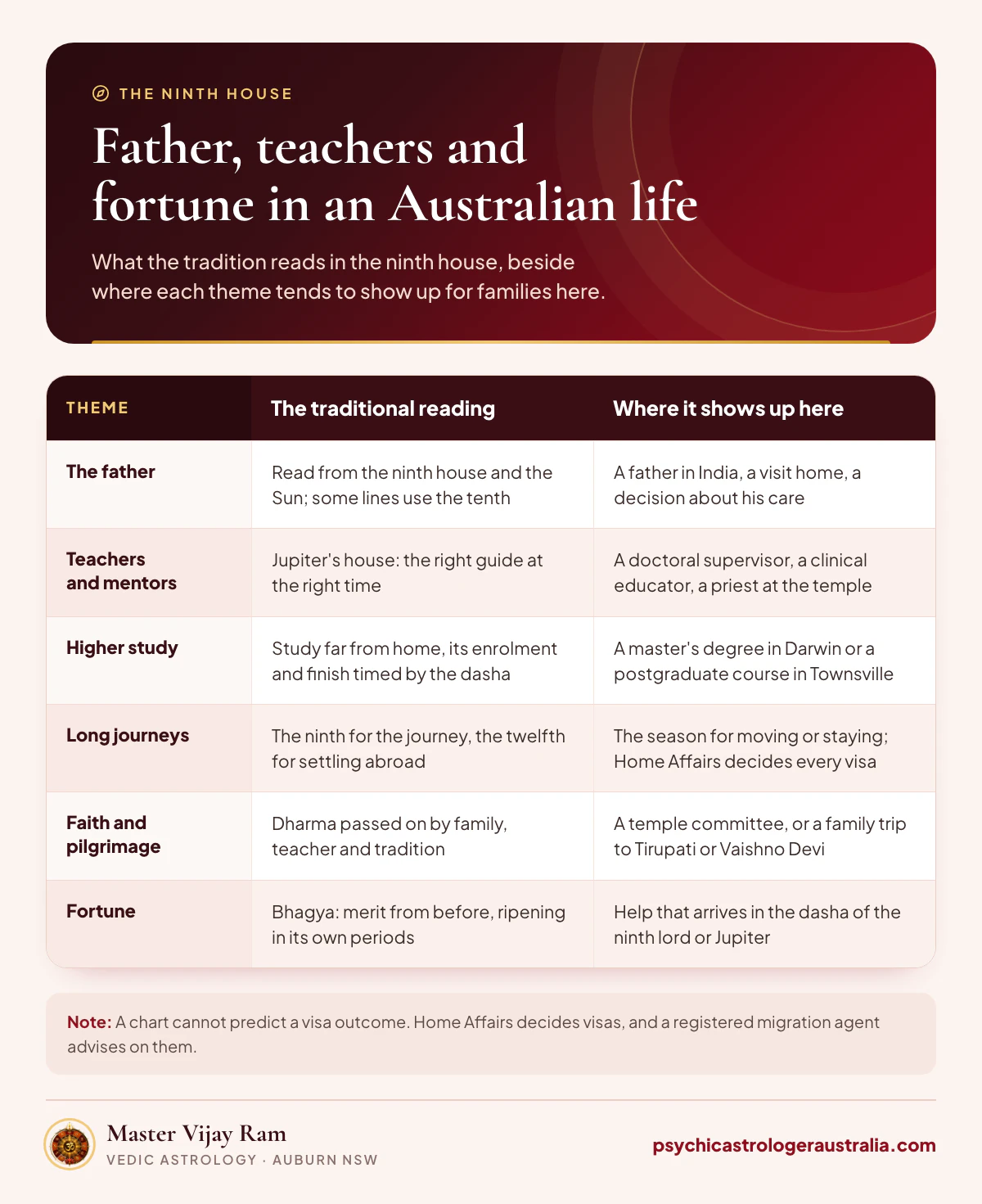
For Indian families in Australia the ninth house is often a question about a father in Jalandhar, Hyderabad or Kathmandu who is ageing out of reach. A period of the ninth lord, or of a planet afflicting the ninth or the Sun, tends to bring the father’s matters forward: a visit home, a decision about care, a long talk that was overdue. The chart can suggest the season; the father’s doctors, and your own family, decide what the season needs.
The house also describes the relationship rather than only the man. A Sun with Saturn in the ninth often belongs to a child who grew up with a stern, distant father and later became that steady presence for a family of their own. Reading it can soften an old grievance, which is one of the quieter things a chart does well.
Where do teachers, mentors and higher study fit?
The ninth is the house of the guru in the old sense and of the teacher in the modern one: a doctoral supervisor, a clinical educator, a foreman who taught a trade, a priest at the temple. A well-placed ninth lord tends to bring the right teacher at the right time; an afflicted one gives brilliant teachers and difficult partings, or a person who learns best alone.
Higher study belongs here as well, especially study far from home. A master’s student at Charles Darwin University or a nurse finishing a postgraduate certificate at James Cook University in Townsville is living the ninth house, and the dasha often shows which year suits enrolment and which suits finishing.
Can the ninth house say anything about migration or a visa?
The tradition reads long journeys from the ninth and settlement abroad from the twelfth, so a migration question always looks at both, with Rahu, the planet of the foreign, beside them. What a reading offers is the season: whether the years ahead lean toward moving, staying put or waiting, and roughly when that lean changes.
A chart cannot predict a visa outcome. Visas are decided by the Department of Home Affairs, and the person to advise on one is a registered migration agent, not an astrologer; anyone who offers a puja to secure a visa is selling something nobody can deliver. Astrology for international students sets out the same line for the study years.
Faith, pilgrimage and dharma far from India
The ninth house also describes how a person keeps faith, and in Australia that often means building it rather than inheriting it. In Darwin the Sri Sithy Vinayakar Temple at Malak has been the Hindu community’s home for decades; in Townsville a purpose-built temple is under way; on the Central Coast, Hindu Temple Central Coast Inc. keeps festivals such as Janmashtami and Ganesh Chaturthi. A strong ninth house is what an astrologer would expect to find in the person who ends up on the committee.
Pilgrimage is a ninth-house act too, whether it is a family trip to Tirupati or Vaishno Devi or a first visit to a grandparent’s village. A family in Darwin and the Top End might time such a trip around the dry season and a favourable antardasha together, which is a sensible use of both calendars.
Is pitra dosh read from the ninth house?
The ninth holds the father and, behind him, the family line, so it is where the tradition looks for pitra dosh, the sense of an unpaid debt to one’s forebears: Rahu, Ketu or Saturn joined to the Sun in the ninth, or a ninth lord badly placed, are the usual signs. One such placement alone is a note rather than a dosha, and a cancellation is usually found beside it. A Kaal Sarp and Pitra Dosh reading checks the whole pattern before anyone suggests a remedy.
What strengthens a weak ninth house?
The practices that suit the ninth are acts of respect. Care for your father and your teachers, in person or by a regular call; Thursday kept for Jupiter with the guru mantra, Om Graam Greem Graum Sah Gurave Namah, and a gift to a school, a library or a student; water offered to the rising Sun on Sundays for the father’s karaka. Keeping a promise made to an elder is counted as a remedy in its own right.
Where the ninth lord or Jupiter is badly afflicted in a running dasha, Master Vijay Ram performs a graha shanti himself, at his own place of practice in Auburn, and the family can join by video from wherever they live. It starts from $250 and the amount is agreed before it is performed; the puja and havan service explains how, and he says plainly when a ninth house needs nothing more than the daily practices.
What a ninth-house reading cannot tell you
It cannot say whether a visa, a scholarship or a job offer will come through, and it cannot predict a parent’s death or recovery. It cannot settle a disagreement about faith or decide which teacher is right for you. 9th house astrology describes where fortune tends to come from and in which seasons it ripens; Home Affairs, doctors, universities and your own judgement decide the rest.
How Master Vijay Ram reads the ninth house
With your birth date, time and place, Vijay Ram ji finds the ninth sign and its lord, checks Jupiter and the Sun, reads the occupants and aspects, compares the navamsa and lays the running mahadasha and antardasha over all of it. You come away knowing where your fortune is traditionally drawn from, how the father and the teacher appear in your chart, and which coming years favour study, travel or a move.
A consultation is $50, by phone, video or WhatsApp from Cairns to Melbourne, in English, Hindi or Punjabi, and online astrology readings let a parent in India join the same call. In-person appointments are only at Auburn, by arrangement.
Read next
- The Tenth House in Vedic Astrology: Career, Reputation and KarmaThe tenth house in Vedic astrology: career, reputation and karma, its four karakas, the tenth lord in each house, pla…
- The First House in Vedic Astrology: Body, Vitality and SelfThe first house in Vedic astrology (tanu bhava): body, vitality and temperament, the Sun as karaka, planets in the fi…
- Signs of Jinn Disturbance at Home and How Ruqyah HelpsJinn disturbance at home: which signs matter, which have ordinary causes, what ruqyah really is, and how a settled ho…
Frequently asked questions
What does the ninth house signify in Vedic astrology?
The ninth house is the dharma bhava, the ninth sign from your lagna and the most auspicious trikona. It is read for fortune, the father, teachers and gurus, faith, higher study, pilgrimage and long journeys. Jupiter is its natural karaka and the Sun is the karaka of the father. A strong ninth house is what the tradition means by a fortunate chart, and its lord helps every rising sign.
Is the father read from the ninth house or the tenth?
Traditions differ. Most North Indian astrologers read the father from the ninth house and the Sun; some lines, following a reading of the Parashari text, read him from the tenth. Master Vijay Ram checks both houses, their lords and the Sun before saying anything about a parent, and he does not predict a parent’s illness or death from either.
What does the ninth lord in the tenth house mean?
It is one form of the dharma-karma adhipati yoga, a link between the lords of the ninth and tenth houses that the tradition reads as duty and career pulling the same way. People with it often find work that feels like a calling, or rise through a mentor. Its strength depends on both lords’ dignity and aspects; with a debilitated or combust lord the yoga gives the direction more clearly than the reward.
Does the ninth house show settling abroad?
It shows long journeys, and settlement abroad is read mainly from the twelfth house, so a migration question looks at both together with Rahu. A ninth lord in the twelfth, or a twelfth lord in the ninth, is a common signature in the charts of people who built their lives in another country. The chart describes a season and a tendency, never the outcome of an application.
Can the ninth house tell me whether my visa will be approved?
No. A chart cannot predict a visa outcome; the Department of Home Affairs decides visas, and a registered migration agent is the right adviser on one. What a reading can add is the season, whether the years ahead lean toward moving or staying, which some people find useful for planning. Anyone who offers a puja to secure a visa is promising something nobody can deliver.
What does Jupiter in the ninth house mean?
Jupiter is the karaka of the ninth, so in that house it is traditionally read as fortune, wise teachers, a generous outlook and a respected father or mentor. In Sagittarius or Pisces, its own signs, or exalted in Cancer, the reading is stronger; debilitated in Capricorn, combust or afflicted by a node, it gives the same themes with more struggle. Its periods are often when study and faith move forward.
What does Rahu in the ninth house mean?
Rahu in the ninth tends to give unconventional beliefs, teachers from another culture, travel or study abroad, and some distance from the father’s tradition or from the father himself. It is common in the charts of migrants and of people who rebuild their faith in their own way. With the Sun or Jupiter badly placed it is one of the patterns checked for pitra dosh, usually with a cancellation beside it.
Does a weak ninth house mean bad luck for life?
No. A weak ninth house usually means fortune that is built rather than given: help that arrives late, teachers found by effort, a father who could not offer much. The dasha matters as much as the house, so the same chart can feel unlucky in one period and fortunate in the next. Respect for elders, study and steady practice are the traditional ways the house is strengthened.
Which remedies strengthen the ninth house?
Care and respect for your father and teachers, Thursday kept for Jupiter with the guru mantra, a gift to a school or a student, and water offered to the rising Sun on Sundays for the father’s karaka. Where the ninth lord is badly afflicted in a running dasha, he performs a graha shanti in Auburn himself, from $250 and agreed in advance, once a $50 consultation has shown the need.
People also ask
What does the 9th house represent?
Fortune, the father, teachers, faith, higher study, pilgrimage and long journeys. In a Vedic chart it is the ninth sign from the lagna, the strongest of the trikonas, with Jupiter as its karaka and the Sun for the father. Its lord is a functional benefic for every rising sign, which is why the house is so closely tied to the idea of luck.
Which planet is good in the 9th house?
Jupiter, the house’s own karaka, is the classic good placement, especially in its own signs or exalted. The Sun and the Moon in good dignity also do well there, giving principle and devotion. Saturn, Rahu and Ketu are not bad in the ninth so much as slow or unconventional, giving fortune that matures late or arrives by an unusual road.
What is bhagya bhava?
Bhagya bhava is another name for the ninth house, the house of bhagya, fortune or destiny. It describes the help that reaches a person from outside their own effort: a father’s support, a teacher’s knowledge, good timing and the merit the tradition says is carried from before. Its lord and Jupiter show how much of that help the chart promises and in which periods it arrives.
What happens when the 9th lord is in the 12th house?
Traditionally it describes fortune found abroad or through charity and pilgrimage, a father who lives far away or a faith lived quietly. Many people who built lives in Australia have this placement. How it works out turns on the lord’s dignity: well placed, it gives a good life away from home; afflicted, it gives expenses on faith or travel and a sense of distance from the family’s roots.
Is the ninth house the house of luck?
In the Vedic tradition, yes: luck is read from the ninth house as bhagya, the fortune earned by past merit. It is not luck in the gambling sense, which is read more from the fifth and eleventh houses, but the good timing, protection and help that make a life go well. A strong ninth lord in a good period is the classic description of a fortunate stretch.
References & further reading
Serving clients across Australia
Confidential consultations by phone, video & WhatsApp — including: