
Quick answer
The tenth house in Vedic astrology is the karma bhava, ten signs on from your lagna and the most powerful kendra. It is read for career, status, authority and public reputation, with the Sun, Mercury, Jupiter and Saturn as its karakas. Its lord, its occupants, the aspects on it and the running dasha describe the shape of a working life and its turning points.
What is the tenth house in Vedic astrology?
The tenth house in Vedic astrology is the karma bhava, the house of action: the work you do in the world, the standing it earns you and the way the public sees you. It sits ten signs from your lagna and is the most powerful of the four kendras, the angular houses that hold a chart up, which is why planets there are hard to ignore. Career is its everyday meaning; reputation and duty are the deeper ones.
This page reads the house itself: its four significators, why difficult planets often thrive there, its lord house by house, its strength and its timing, with a table for 2027. The question of which field suits a chart is covered in career astrology by birth chart, and a complete kundli reading brings both together. On either side sit the ninth house of dharma and the eleventh house of gains.
Why is it called the house of karma?
Karma here means action, not fate. The tenth house describes what a person does, publicly and repeatedly, and what that doing makes of them: a title, a trade, a name in the community, a position that carries responsibility for others. The old texts list rank, honour, command, livelihood and good deeds under it, and some lines also read the father from it, though most North Indian practice keeps him in the ninth.
The Bhagavad Gita’s teaching of action done as duty, without clutching at its fruit, is the spirit the tradition brings to this house. A strong tenth house is not a promise of fame; it is a capacity to act effectively and be seen doing it.
Why does the tenth house have four karakas?
Most houses have one natural significator. The tenth has four, because work in the world has four faces, and the strongest of them in a chart tends to set the flavour of a career.
| Karaka | What it adds | Where it is strongest |
|---|---|---|
| Sun | Authority, government, leadership, a title and public standing | Exalted in Aries, own sign Leo |
| Mercury | Skill, trade, numbers, communication and adaptability | Exalted and own sign in Virgo, own sign Gemini |
| Jupiter | Counsel, ethics, teaching, law, finance and respect | Exalted in Cancer, own signs Sagittarius and Pisces |
| Saturn | Labour, service, endurance and rank earned slowly | Exalted in Libra, own signs Capricorn and Aquarius |
A public servant in Canberra with a strong Sun and Saturn and a self-employed bookkeeper on the Gold Coast with a strong Mercury may both have good tenth houses; they are simply good in different ways. Reading the karakas first stops a chart being forced into the wrong kind of success.
Why do Saturn and Mars often do well in the tenth?
The tenth is both a kendra and an upachaya, one of the four houses (with the third, sixth and eleventh) whose matters improve with time and effort. Malefics are traditionally said to do well in upachayas, because their grit becomes useful there, so Saturn in the tenth tends to give a slow, solid rise and Mars a capacity for command, engineering, policing or surgery.
The classical teaching of directional strength, dig bala, adds that the Sun and Mars are at their best in the tenth, the house at the top of the chart. Jupiter and Mercury take that strength in the first house, the Moon and Venus in the fourth and Saturn in the seventh, which is why a tenth-house Sun is so often read as a natural authority figure.
How is the tenth lord read in each house?
The tenth house lord carries the business of the house wherever it goes, and its placement says where work tends to happen and what kind of name it builds. The table gives the traditional reading in brief; the lord’s dignity and the aspects on it decide how much of it shows.
| Tenth lord in | Where the work tends to happen | The name it builds |
|---|---|---|
| 1st | Under your own name; self-employment; public-facing roles | Known for yourself |
| 2nd | Family business, finance, food, speech, teaching | The reliable provider |
| 3rd | Media, sales, writing, trades, travel for work | The one who gets it started |
| 4th | Property, vehicles, education, land, work from home | Known locally |
| 5th | Teaching, advising, creative work, politics | Known for ideas |
| 6th | Health, law, service, competitive employment | Steady under pressure |
| 7th | Clients, partnerships, business, public dealing | Known through partners |
| 8th | Research, insurance, mining, surgery; one sharp turn | Respected after a reversal |
| 9th | Law, teaching, faith, overseas work, mentors | Known for principle |
| 10th | Its own house: a strong, visible career | Known across a field |
| 11th | Large organisations, networks, regular income | Known in a network |
| 12th | Abroad, hospitals, institutions, behind the scenes | Valued more than credited |
What do planets in the tenth house do?
As occupants, the Sun brings authority and friction with bosses until the person becomes one; the Moon brings public-facing work, popularity that waxes and wanes, and several changes of role; Mars brings command and conflict in equal measure; Mercury brings two jobs at once, or one job made of words and numbers.
Jupiter in the tenth is read as respect, ethics and advisory work; Venus as pleasant workplaces and careers in design, beauty or hospitality; Saturn as the karaka of labour at home, rising late and staying; Rahu as hunger for status, foreign employers and sudden rises that need guarding; Ketu as indifference to titles and a career that changes direction more than once. For all planets in the tenth house, an afflicted occupant tends to give the same field with more struggle rather than a different field.
How do you tell whether the tenth house is strong?
Start with the tenth lord’s dignity, its house and whether it is combust, then the planets that aspect the house: Jupiter’s aspect lends respect, Saturn’s lends patience and a slow climb. The tenth counted from the Moon is read beside the tenth from the lagna, because the mind’s experience of work matters as much as the work.
The dashamsa, the tenth divisional chart, is used to confirm what the birth chart suggests, much as the navamsa is used for marriage. Last comes the dasha: a strong tenth house in a kundli still waits for the periods of its lord or its occupants before it delivers its biggest changes.
Reputation: what the tenth says about your name
Reputation is the tenth house’s quieter subject and, for many families, the more anxious one. A dignified tenth lord with benefic aspects describes a name that grows steadily; Rahu or Saturn afflicting the house describes a reputation that has to be defended, sometimes after one public mistake. Such a period is a reason for care with what is signed and said, not a sentence.
In a close community, reputation also travels through the temple, the WhatsApp group and the extended family. The tenth house cannot stop a rumour, but its dasha often shows when a name is most exposed and when it recovers, and that timing helps people decide when to speak and when to let a thing settle.
Changing fields in Australia: what the chart adds
Many people who ask about the tenth house are mid-career migrants: an engineer from Pune having qualifications assessed in Brisbane, a pharmacist retraining in Adelaide, a teacher from Kerala working in aged care while she requalifies. The chart cannot recognise a degree or open a vacancy. What it can do is show which periods favour a change of field, which favour finishing a qualification, and which favour holding steady.
Moves of this kind cluster in the periods of planets tied to the tenth, by lordship, occupation or aspect, and whether a move lifts you or knocks you back follows the condition of that planet. What is actually possible is decided elsewhere, by the assessing body, a TAFE or university and a good careers adviser; the reading only suggests when to push.
Starting a business: the tenth with the seventh and eleventh
A business is read from the tenth for the work, the seventh for clients and partners, the eleventh for gains and the second for capital. If a chart favours working for yourself while the second house, the house of capital, is thin, the usual advice is to build savings first and keep the wage meanwhile; business astrology for a launch covers timing an opening and choosing a partner.
Before anything else comes the practical order: an accountant, a business adviser, the right registrations, insurance and a lease read by a lawyer. A business and career reading sits after that advice, not before it, and it is honest when the chart says wait.
When does the tenth house come alive in 2027?
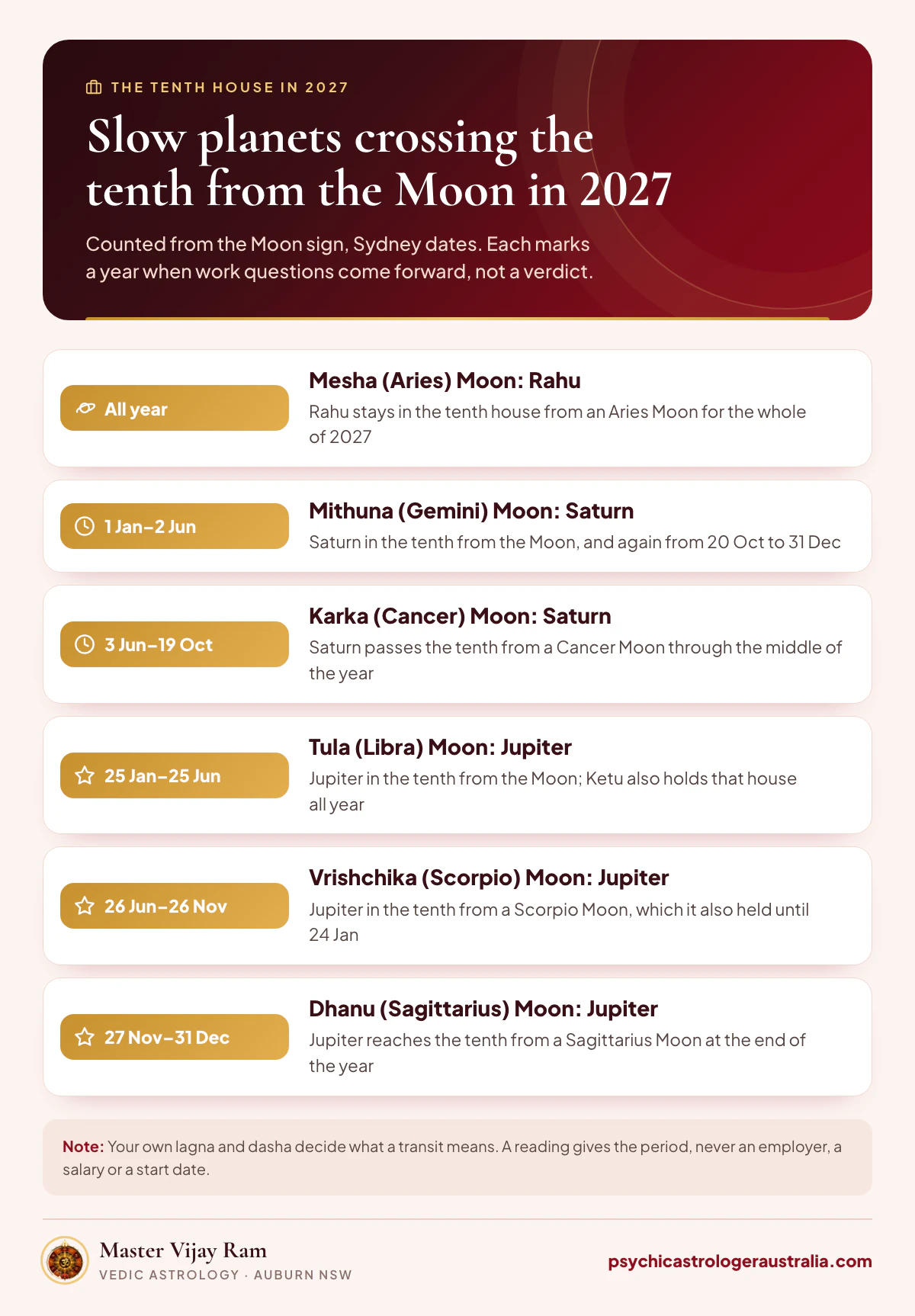
A house speaks through its dasha, and the slow transits add the trigger. Transits are traditionally counted from the Moon sign as well as the lagna, and the Moon-sign view is the one that can be printed for everyone; your own lagna and dasha decide what it means for you. In 2027 these Moon signs have a slow planet passing their tenth house.
| Moon sign | Planet in the tenth from the Moon | When |
|---|---|---|
| Mesha (Aries) | Rahu | All year |
| Mithuna (Gemini) | Saturn | 1 Jan–2 Jun and 20 Oct–31 Dec |
| Karka (Cancer) | Saturn | 3 Jun–19 Oct |
| Tula (Libra) | Jupiter, and Ketu | Jupiter 25 Jan–25 Jun; Ketu all year |
| Vrishchika (Scorpio) | Jupiter | 1–24 Jan and 26 Jun–26 Nov |
| Dhanu (Sagittarius) | Jupiter | 27 Nov–31 Dec |
None of these is good or bad on its own; each marks a year in which work questions come forward. A yearly forecast reading lays the transits over your own dasha month by month.
Which remedies suit a troubled tenth house?
The tradition’s first remedy for the tenth is the work itself, done honestly and offered rather than hoarded. To that it adds water offered to the rising Sun for the karaka of authority, Saturday service to labourers, the elderly or the poor for Saturn, and the mantra of whichever planet rules or afflicts the tenth, said on its day. Keeping one’s word at work is counted among them.
Where the tenth lord is badly afflicted in a hard dasha, Master Vijay Ram can perform a graha shanti for that planet at his Auburn place of practice, with the client watching by video if they like. The cost starts from $250 and is settled before the puja is performed, as online puja and havan explains; most career readings end with practical steps and no puja.
What a tenth-house reading cannot do
No reading of the tenth names the employer, the pay, the start date or how an interview goes, and none can assess a qualification or stand in for a careers adviser, an accountant or an employment lawyer. 10th house astrology describes the shape of a working life and its seasons; the market, the paperwork and your own effort decide the rest. It is faith-based guidance, never financial or employment advice.
How Master Vijay Ram reads the tenth house
Vijay Ram ji casts the chart from your birth date, time and place, weighs the four karakas, reads the tenth lord, its occupants and the aspects from the lagna and from the Moon, checks the dashamsa, and then lays the coming dasha periods and the year’s transits over it. You hear what kind of success the chart describes, which years favour a move, and where effort is likely to pay.
A consultation is $50. Readings run by phone, video or WhatsApp for clients from Hobart to Perth, two or three hours behind Sydney, in English, Hindi or Punjabi; the only in-person appointments are at Auburn.
Read next
- The First House in Vedic Astrology: Body, Vitality and SelfThe first house in Vedic astrology (tanu bhava): body, vitality and temperament, the Sun as karaka, planets in the fi…
- The Ninth House in Vedic Astrology: Father, Fortune, Teachers and DharmaThe ninth house in Vedic astrology: father, fortune, teachers, faith and long journeys, the ninth lord in each house …
- Signs of Jinn Disturbance at Home and How Ruqyah HelpsJinn disturbance at home: which signs matter, which have ordinary causes, what ruqyah really is, and how a settled ho…
Frequently asked questions
What does the tenth house show in Vedic astrology?
The tenth house is the karma bhava, reached by counting ten signs on from the lagna; of the four kendras it is the most powerful. It shows career, status, authority, public reputation and the duties a person carries in the world. The Sun, Mercury, Jupiter and Saturn are its four karakas. Its lord, its occupants, the aspects on it and the dasha running describe the shape of a working life and the years in which it turns.
Why is the tenth house called the karma bhava?
Because karma in this context means action, not fate. The tenth house describes what a person does publicly and repeatedly, and what that action earns: a livelihood, a title, a name and responsibility for others. The tradition brings to it the teaching of the Bhagavad Gita that work is done as duty, without clutching at its results, and reads a strong tenth house as the capacity to act effectively.
Which planet is best in the tenth house?
The Sun and Mars take directional strength in the tenth and are traditionally read as natural authority and command there. Jupiter gives respect and advisory work, and Saturn, the karaka of labour, gives a slow but lasting rise because the tenth is an upachaya. The best planet in practice is the one in good dignity with supportive aspects; a debilitated benefic can do less than a well-placed malefic.
Is Rahu in the tenth house good for a career?
It is often read as strong ambition, success with foreign employers, technology or media, and rises that come quickly. The same placement asks for care with reputation and shortcuts, because Rahu’s gains can reverse when they are not built on solid ground. With a dignified tenth lord and Jupiter’s aspect it tends to work well; heavily afflicted, it gives restlessness and a career that changes direction abruptly.
What does an empty tenth house mean?
Nothing troubling. Most charts have several empty houses, and an empty tenth means the career is described by the tenth lord, the aspects on the house, the four karakas and the dashamsa rather than by an occupant. Many steady, successful working lives belong to people with nothing in the tenth and a dignified tenth lord. Changes then tend to come in the dasha of that lord.
What does the tenth lord in the twelfth house mean?
Traditionally it describes work found abroad, in hospitals or institutions, or behind the scenes, and effort that is valued more than it is credited. For many Indian families in Australia it describes exactly what happened: a career that only began after migration. How it plays out rests on the lord’s dignity and the aspects it receives: well placed, a good career away from home; afflicted, expense and hidden strain.
Is my tenth house strong enough for a business of my own?
It contributes to the answer. A business is read from the tenth for the work, the seventh for clients and partners, the eleventh for gains and the second for capital. When self-employment is favoured but the second house is thin, saving comes first. The practical answer belongs to your accountant and to a business adviser, and the reading follows their advice rather than leading it.
When will my career improve according to my chart?
Improvement tends to arrive in the periods of planets bound up with the tenth, its lord, its occupants and the planets that aspect it, and most visibly when Jupiter or Saturn crosses the house or its lord by transit. Whether the change is a rise depends on that planet’s dignity. A reading gives the periods in which change is likely; it cannot give a date, a salary or the outcome of a particular interview.
Does the tenth house show reputation and fame?
It shows reputation more than fame: how a person is seen in their field and community and how that standing moves over time. A dignified tenth lord with benefic aspects describes a name that grows steadily; Rahu or Saturn afflicting the house describes a reputation that has to be defended. The dasha shows when a name is most exposed and when it recovers.
People also ask
What is the 10th house in a kundli?
It is the tenth sign from the lagna, the karma bhava, read for career, status, authority and reputation. It is the strongest kendra and also an upachaya, a house that improves with time, so effort shows there more than anywhere. Its lord and occupants describe the setting and style of the work, and its dasha periods show when a working life changes.
Is the 10th house only about jobs?
No. It covers any public action: a business, a profession, community service, politics, and the duties a person takes on for others, as well as the reputation that follows. Some traditions also read the father from it. A homemaker who runs a temple committee is living the tenth house as fully as a chief executive, which is why the reading looks at the whole house rather than a job title.
What is dig bala in the tenth house?
Dig bala is directional strength, a classical measure by which each planet is strongest in one house. The Sun and Mars take it in the tenth, Jupiter and Mercury in the first, the Moon and Venus in the fourth and Saturn in the seventh. A tenth-house Sun or Mars is therefore traditionally read as a natural authority, provided its sign and aspects support it.
What does the 10th lord in the 10th house mean?
The tenth lord in its own house is traditionally read as a strong, visible career and a reputation known across a field. The person tends to be identified with their work. Its strength still depends on the sign, the aspects and the dashamsa; a combust or heavily afflicted lord in its own house gives the drive without all of the recognition.
How do I know if my 10th house is strong?
Look for a tenth lord in good dignity and a good house, not combust; benefic aspects on the house, especially Jupiter’s; the tenth from the Moon in agreement; and a dashamsa that confirms the birth chart. A strong tenth still waits for its own dasha periods to deliver its biggest changes, which is why timing is read alongside strength.
References & further reading
Serving clients across Australia
Confidential consultations by phone, video & WhatsApp — including: