
Quick answer
The second house in Vedic astrology, dhana bhava, is the house of family, accumulated savings, speech, food and early schooling, with Jupiter as its karaka. It shows what a person holds rather than what they earn, its lord shows where family money flows, and it is one of the two maraka houses, read with care but never with fear.
What is the second house in Vedic astrology?
The second house in Vedic astrology is the house of what you hold on to: the family you belong to, the money you keep, the words you speak and the food you eat. Its usual Sanskrit name is dhana bhava, the house of wealth, and older texts also call it kutumba, the house of the household. It follows the first house of the body, and the tradition reads it as everything that keeps that body going.
This guide covers what the house holds, how its lord and its occupants are read, why it is listed as a maraka, and how its themes turn up in Australian family life, from savings goals to money sent home. A detailed kundli reading applies all of it to your own chart.
Why does one house hold family, money, speech and food?
Because the tradition sees them as one circuit. Food goes into the mouth and words come out of it; a household eats at one table and keeps its savings in one place; family values are handed on in speech long before they are written down anywhere. The second house is the house of the mouth and of the family store, and every item on its list follows from that.
The classical list adds early schooling, the face and truthfulness of speech, and many texts include the right eye. The practical consequence is that the house rarely shows one theme alone: a strained second house tends to appear as tension about money and tension in how the family talks, often in the same months.
Is the second house about savings or income?
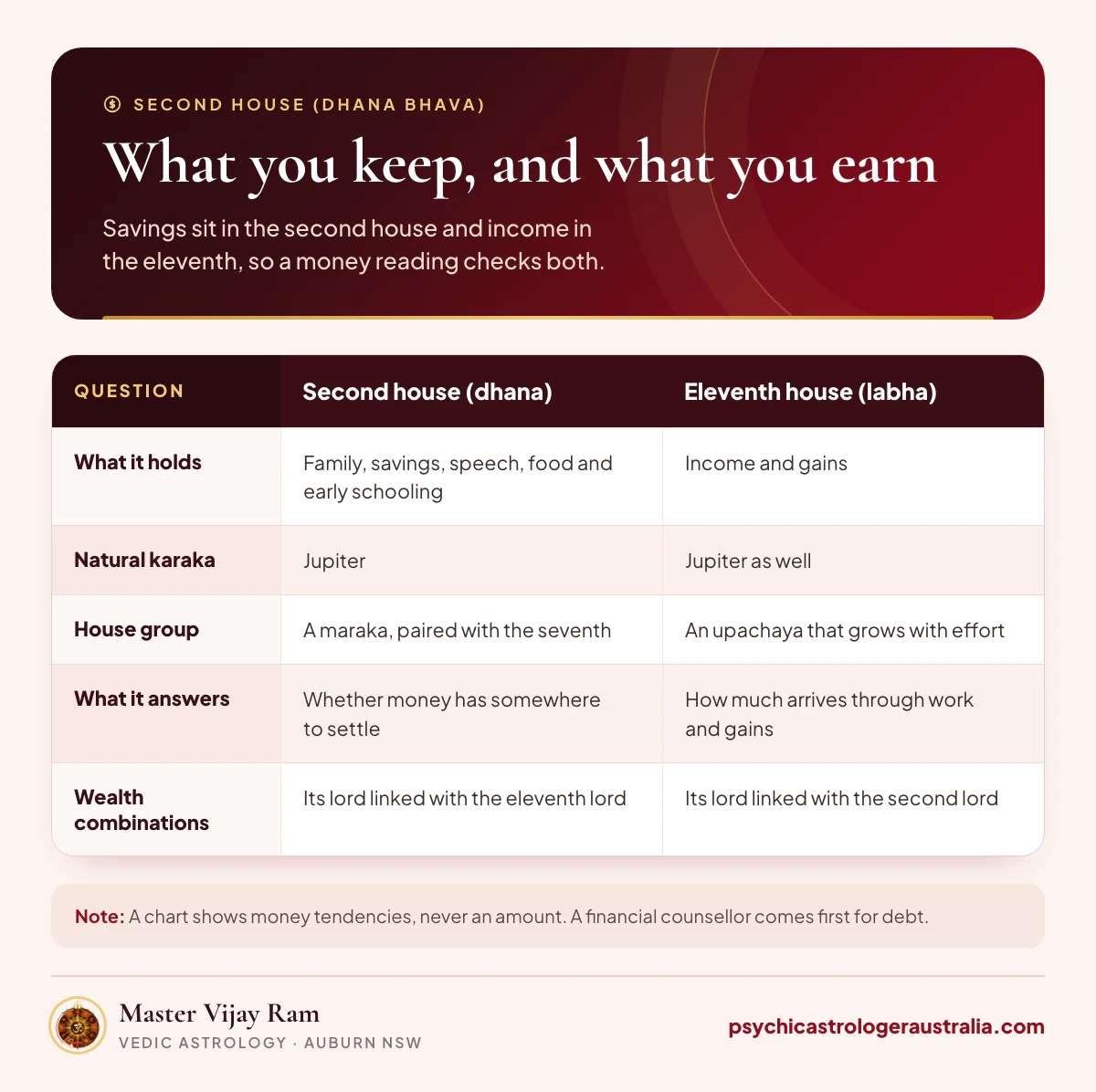
Savings, mostly. Dhana bhava is the store, what is accumulated, kept and passed down; income and gains belong to the eleventh house, labha bhava, an upachaya that grows with effort. A person can have a strong eleventh and a weak second, earning well and holding little, and the reverse is just as common.
That is why the classical wealth combinations, the dhana yogas, are built on links between the lords of the second and eleventh houses and the lords of the first, fifth and ninth. Dhan yoga and the other wealth combinations sets them out; for this house the point is simpler, because the second shows whether money has somewhere to settle.
Why is Jupiter the karaka of the second house?
Jupiter is the planet of expansion, wisdom and right conduct, and the second house keeps a family's wealth and its values, so the tradition makes Jupiter its natural significator; Jupiter is the karaka of the eleventh house of gains as well. Its sign and condition are read beside the second whatever sign the house holds: exalted in Cancer it supports the store, while debilitated in Capricorn it asks for more care with money and with promises.
The link with speech belongs to the same idea. Jupiter is the guru, the teacher whose words carry weight, and a second house supported by Jupiter is traditionally read as truthful, measured speech that people listen to. When the karaka is weak, the tradition's first remedy is conduct: keeping one's word, feeding others, and saying less in anger.
Where does your second house lord sit?
Count two signs from your lagna, inclusive, and the planet ruling that sign is your second house lord. For an Aries lagna it is Venus, ruling Taurus; for Cancer it is the Sun, ruling Leo; for Capricorn it is Saturn, ruling Aquarius. The house that lord occupies shows where family money comes from and where it goes, and the table gives the traditional reading of each placement.
| Second lord in | Traditional reading | Where it often shows up |
|---|---|---|
| 1st | Money made through your own personality and effort; you become the family's voice | The relative who handles everyone's paperwork and budgets |
| 2nd | The lord at home: steady accumulation and close family ties | A household that saves before it spends |
| 3rd | Earnings through effort, writing, sales or siblings; money spent on short trips | A side business run with a brother or cousin |
| 4th | Savings turned into home, land and vehicles; support from the mother | The deposit for a first home |
| 5th | Wealth through intelligence, teaching, children or careful investment | Children's education treated as the family's main project |
| 6th | Money through service and employment; lending and borrowing inside the family | A personal loan taken out to help a relative |
| 7th | Money through a spouse, partnership or trade; both maraka lords linked, so watched in later life | A two-income household or a business run with a partner |
| 8th | Inheritance, insurance, joint accounts and the in-laws' wealth; sudden gains and losses | Settling a parent's estate across two countries |
| 9th | Fortunate money, help from a father or teacher, wealth linked to faith | A parent's help with a first deposit |
| 10th | Earnings through career and standing; the family name carried into work | A family trade or practice continued |
| 11th | A classic wealth link: income that turns into savings | A pay rise that actually reaches the savings account |
| 12th | Spending, money for family far away, savings that leave the country | Regular transfers to parents in India |
No row is a forecast on its own. The sign of the lord, its dignity, the aspects on it and the dasha running decide whether a placement shows its kinder side or its harder one.
Planets in the second house: speech, appetite and the family purse
Mercury in the second gives a quick, persuasive tongue and often earnings from words or numbers; Venus gives a pleasant voice, a love of good food and money through the arts or the comfort trades. Jupiter, the karaka, gives a respected voice in the family and a habit of saving, though some texts add that it can make a person generous to a fault. The Moon makes savings rise and fall with feeling and gives a fondness for home cooking.
The Sun gives an authoritative voice and money tied to government or senior roles; Mars gives sharp, quick speech and spending in bursts, and many traditions count it among the manglik placements. Saturn gives slow, careful accumulation, a terse manner and sometimes a lean childhood that turns into disciplined adulthood. Rahu brings unusual diets, money from foreign sources and a habit of exaggeration, while Ketu brings detachment from family wealth and few words, sometimes very wise ones.
As always, the planets in the second house act through their sign and the aspects they receive. Saturn in Libra here is a patient saver; Saturn in Aries can be an anxious one.
Why is the second house called a maraka, and should it worry you?
The second and seventh houses are the two marakas. The reasoning is arithmetic: the third and eighth are the houses of longevity, and the second and seventh are twelfth from them, the houses of their loss, so their lords' periods are watched in the classical texts for strain on health in later life.
That does not make the second house dangerous or its lord an enemy. Maraka periods are weighed only alongside the whole chart, the person's age and the strength of the longevity houses, and in practice the same periods more often bring family events, money matters and changes of household. The seventh is the other maraka, and the seventh house of marriage explains why its lord is read with the same care.
No honest astrologer predicts a death from a maraka, and Master Vijay Ram does not. A health worry belongs with a doctor.
How do savings and family obligations show up for Australian families?
For many Indian-Australian households the second house describes a monthly tug-of-war: the deposit being saved here, the parents being supported there, a sibling's wedding in Punjab or Kerala that the whole family is expected to help with. A second lord in the twelfth, or a crowded twelfth house, is the traditional picture of savings that leave the country, which is simply how many migrant families live.
A nurse in Newcastle sending part of every pay to her parents in Hyderabad might ask why she never seems to get ahead; a couple in Wollongong might ask whether to clear a relative's debt or keep building their own buffer. The chart can describe the pattern and the periods when it eases, but it cannot set a budget, and a financial counsellor or adviser is the first call for debt, superannuation or tax.
When the strain sits between people rather than in the account, family problem guidance and remedies looks at the charts of those involved, and the conversation usually turns to how money is talked about at home.
How does the second house shape the way you speak?
Vak, speech, is one of the house's oldest meanings. The second shows the tone a person uses with the people closest to them, whether their words build trust or wear it down, and whether promises are kept; communication with the wider world belongs to the house next door, and the third house of courage and communication picks up that thread.
A Mars-touched second house is traditionally read as a sharp tongue that apologises later; a Saturn-touched one as few words and long silences; Mercury as fluent speech that can talk its way out of anything. In family disputes, which are so often fought over money at the dinner table, the tradition's first advice is plain: speak less in heat, make small promises and keep them.
What does the second house say about food and the face?
The second is also the house of food: what a family eats, how meals are shared, and a person's appetite and taste. Vegetarian households, fasting days and the dishes cooked when relatives visit all belong here, and a Venus or Moon in the second is traditionally read as a love of home cooking that may need watching later in life.
Because the house covers the mouth, the face and, in many texts, the right eye, older astrologers looked here for complaints of those parts. That is tradition, not diagnosis: teeth go to a dentist and eyes to an optometrist or GP, and the useful reading concerns habits, such as when a family's eating pattern is likely to come under pressure.
The house just before this one, the first house of body and vitality, is the body that this food sustains, and the two are best read side by side.
Early schooling and the values a family hands on
The tradition gives the second house a child's early schooling, the years in which language, manners and the family's way of doing things are learned. In Australian homes this often means the language spoken at the table, whether Hindi, Punjabi, Tamil or Gujarati, and whether grandparents are part of daily life.
Formal schooling and higher study are read elsewhere, in the fourth, fifth and ninth houses. What the second adds is the foundation, a stable household and steady speech around a child, which the tradition treats as the ground that a person's later habits with money grow from.
2027: which Moon signs have Saturn or Jupiter on the second house?
Counted from the Moon, Saturn's passage through the second house is the last phase of Sade Sati, traditionally the phase that presses on savings, family and speech. In 2027 (Sydney dates) it falls on Kumbha (Aquarius) Moons while Saturn is in Pisces, from 1 January to 2 June and again from 20 October, and on Meena (Pisces) Moons while Saturn is in Aries, from 3 June to 19 October.
Jupiter's passage through the second from the Moon is read the other way, as a season that helps savings and family harmony: for Karka (Cancer) Moons from 1 to 24 January and from 26 June to 26 November, for Mithuna (Gemini) Moons from 25 January to 25 June, and for Simha (Leo) Moons from 27 November. Rahu sits in the second from Dhanu (Sagittarius) Moons all year, and Ketu in the second from Mithuna Moons.
For a Sade Sati sign the useful response is usually budgeting and patience rather than ritual, and Saturn remedies during Sade Sati describes what the tradition offers when more is warranted.
How strong is your second house?
Three questions settle most of what the second house in a kundli has to say: is the second lord in a good sign and a helpful house, clear of combustion; is Jupiter, the karaka, in reasonable dignity; and are the planets occupying or aspecting the house at ease in its sign?
Then come the refinements. The hora, the second divisional chart, which splits each sign into a solar half and a lunar half, is traditionally read for wealth, and the second house counted from the Moon shows how secure money feels. Last is timing: the dasha of the second lord or of a planet in the second is when the house's promise, generous or tight, is most likely to show.
Where the second house stops
It does not show a bank balance, a share price or the right investment, and no reading should be used to choose one. It cannot tell you whether to lend to a relative or how to divide an estate; it can describe the family dynamics and the periods in which such decisions weigh more.
A reading is faith-based guidance in the Vedic tradition, not financial, legal or medical advice. For debt, see a financial counsellor; for wills and estates, a lawyer; for anything in the body, a GP.
A second-house reading with Master Vijay Ram
He reads the house from the lagna and from the Moon, follows the second lord to wherever it sits, checks Jupiter and the hora chart, and lays the current dasha and the 2027 transits over the result. You leave knowing what the house describes, which periods are likely to be tight and which open, and what everyday conduct the tradition pairs with them.
The fee for a consultation is $50, whether you ring, video call or message on WhatsApp, in English, Hindi or Punjabi; astrology readings for Newcastle clients run the same way on Sydney time, and in-person appointments are only at Auburn. If a Jupiter or second-lord shanti is warranted, Vijay Ram ji performs it himself in Auburn, from $250 and agreed before it is done, and a puja or havan performed in Auburn explains how you can join by video.
Read next
- The Tenth House in Vedic Astrology: Career, Reputation and KarmaThe tenth house in Vedic astrology: career, reputation and karma, its four karakas, the tenth lord in each house, pla…
- The First House in Vedic Astrology: Body, Vitality and SelfThe first house in Vedic astrology (tanu bhava): body, vitality and temperament, the Sun as karaka, planets in the fi…
- Signs of Jinn Disturbance at Home and How Ruqyah HelpsJinn disturbance at home: which signs matter, which have ordinary causes, what ruqyah really is, and how a settled ho…
Frequently asked questions
What does the second house represent in a kundli?
The second house, dhana bhava, represents what a person holds: family and household, accumulated savings, speech, food and appetite, the face, and early schooling. Its natural karaka is Jupiter. The tradition reads these together because they share one circuit, the mouth and the family store, so a strained second house often shows as money worries and sharp words in the same season.
Does the second house show how much money I will have?
It shows the tendency to accumulate, not an amount. Savings are read from the second house, its lord, Jupiter and the hora chart; income is read from the eleventh; and the dasha shows when each is emphasised. A strong second house on a modest income can still mean steady savings. No chart gives a figure, and investment decisions belong with a qualified financial adviser.
What does Saturn in the second house mean?
Saturn in the second house is traditionally read as slow, careful accumulation, a reserved or terse way of speaking, and sometimes a lean start in life that becomes disciplined saving. In Libra, Capricorn or Aquarius it tends to be a patient, reliable saver; in Aries it can bring worry about money. Its dasha and the aspects it receives decide when the placement is felt most.
Is the second lord in the twelfth house bad for savings?
It is traditionally read as money that leaves: spending on travel, on family far away or on life abroad. For many Indian-Australian families that simply describes sending money to parents or relatives in India. It becomes a strain only when the outflow is larger than the household can carry; the chart can show which periods are tighter, and the budget itself is a job for a financial counsellor.
Why is the second house linked to speech?
Because it governs the mouth, and the tradition treats what goes in, food, and what comes out, words, as one area of life. The second house shows the tone a person uses with family, whether promises are kept and how disagreements are voiced at home. The third house covers communication with the wider world, while the second covers the voice inside the household.
Should I be afraid because the second house is a maraka?
No. The second and seventh are called marakas because they are twelfth from the houses of longevity, so their lords' periods are watched for strain on health in later life. That is one consideration among many, read only with the whole chart and the person's age, and the same periods more often bring family and money events. No honest astrologer predicts a death from a maraka.
What does Rahu in the second house mean?
Rahu in the second house is traditionally read as unusual tastes in food, money from foreign or unconventional sources, a persuasive or exaggerating way of speaking, and sometimes distance from the family's customs. For a migrant it often describes earning in one culture while supporting family in another. Its effect is judged from the lord of its sign, the aspects on it and the Rahu dasha.
Who is my second house lord?
Count two signs from your lagna and take the ruler of that sign. Aries rising has Taurus in the second, ruled by Venus; Gemini rising has Cancer, ruled by the Moon; Leo rising has Virgo, ruled by Mercury; Scorpio rising has Sagittarius and Aquarius rising has Pisces, both ruled by Jupiter. The house that lord occupies shows where family money tends to flow.
Can a remedy improve my second house?
The tradition starts with conduct: keeping your word, speaking less in anger, feeding others and saving before spending, with Jupiter's mantra on Thursdays. A puja or shanti for Jupiter or the second lord is suggested only when the chart warrants it, performed by Master Vijay Ram in Auburn from $250 and agreed beforehand, after a $50 consultation. No remedy replaces a budget or a financial counsellor, and he sells no gemstones.
People also ask
What does the 2nd house rule in Vedic astrology?
The 2nd house rules family and household, accumulated wealth and savings, speech, food and the mouth, the face and early schooling. Its Sanskrit name is dhana bhava and its natural karaka is Jupiter. It is also one of the two maraka houses, which is why its lord's periods are read carefully in later life, though they more often bring family and money events.
Which planet is good in the 2nd house?
Jupiter and Mercury are the traditional favourites: Jupiter for a respected voice and a habit of saving, Mercury for persuasive speech and earnings from words or numbers. Venus brings a pleasant voice and money through comfort and the arts. The sign matters as much as the planet, and a well-placed Saturn in the second can make a better long-term saver than a weak benefic.
What if the 2nd house is empty?
An empty second house is common and says nothing bad. The house is then read through its sign, its lord, the aspects it receives and Jupiter as karaka. Many careful savers have no planet in the second at all, only a well-placed second lord, because a house works through its lord whether or not anything sits inside it.
Which house shows savings in astrology?
In Vedic astrology savings and accumulated wealth belong to the second house, while income and gains belong to the eleventh. The wealth combinations called dhana yogas are built on links between the second and eleventh lords and the lords of the first, fifth and ninth, and the hora, the second divisional chart, is traditionally read beside them for wealth.
What is the second house called in Sanskrit?
It is usually called dhana bhava, the house of wealth, and it is also known as kutumba, the house of the family or household, because the tradition reads family and savings together. Many texts also stress vak, speech, as one of its chief meanings. All three names point at what a person holds and keeps rather than what they earn.
References & further reading
Serving clients across Australia
Confidential consultations by phone, video & WhatsApp — including: