

Quick answer
The lagna is the zodiac sign that was rising on the eastern horizon at the moment and place of your birth. It changes about every two hours, every house is counted from it, and its lord shapes your health, approach and luck. It needs a birth time, and may sit one sign behind a Western rising sign.
What is the lagna?
The lagna is the sign of the zodiac that was rising on the eastern horizon at the moment and place of your birth, the first house of the kundli and the point from which every other house is counted. The word means the point of attachment, where the sky was fastened to the earth for you, and in Vedic astrology it outranks the sun sign that newspaper horoscopes are built on. Your lagna is the frame; the planets are the picture inside it.
This page explains why the lagna matters so much, how fast it changes, why your Vedic lagna can differ from the rising sign a Western app gives you, what the twelve lagnas and their lords are, and what can honestly be done when a birth time is unknown. A kundli reading with Master Vijay Ram begins with it.
Why does the lagna matter more than the sun sign in a kundli?
Because the houses are counted from it. The sign rising becomes the first house, of self, body and approach; the next sign is the second house, of family and speech; and so on round to the twelfth. Move the lagna by one sign and every planet changes house, the seventh house of marriage becomes the eighth, the tenth house of career becomes the eleventh, and the whole reading changes with it.
The sun sign, by contrast, changes once a month and is shared by a twelfth of humanity, which is why it can describe nobody in particular. In a Vedic reading the Sun is one planet among nine, and the ascendant in a kundli is the thing the astrologer establishes first and checks hardest.
How fast does it change, and what does that mean for your birth time?
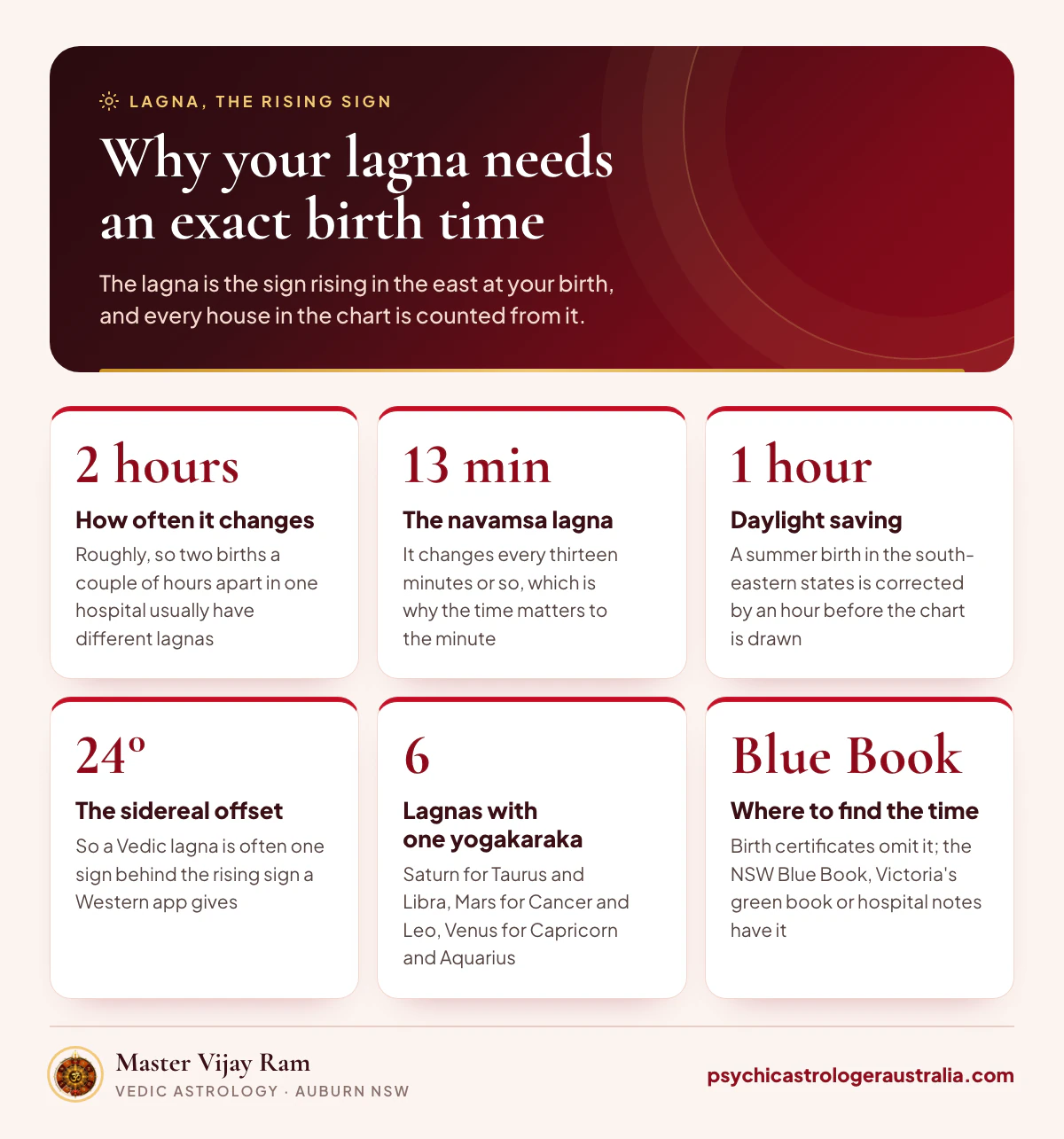
The whole zodiac rises in a day, so the lagna changes roughly every two hours, faster for some signs and slower for others depending on the latitude. A birth at 9:10 am and a birth at 11:10 am in the same hospital usually have different lagnas, and a birth near the boundary can turn on a few minutes, which is why he asks for the time to the minute and the place to the town.
Australian birth certificates do not show the time of birth, but the baby health book given at the hospital usually does: the Blue Book in New South Wales and the green book in Victoria record the birth details on the first pages, and a hospital discharge summary records them too. Daylight saving is the other trap: the south-eastern states have kept it since the early 1970s and Queensland does not, so a summer birth in Melbourne is entered an hour differently from the same clock time in Brisbane, and a chart drawn without that correction is a chart for someone born an hour later. Brisbane clients are usually the easy case, because Queensland's clock has not moved since 1992; a Queensland birth needs the same correction only in the daylight saving summers of 1971–72 and 1989 to 1992, or in wartime.
Why can your Vedic lagna differ from your Western rising sign?
Western astrology uses the tropical zodiac, which starts at the equinox point, and Vedic astrology uses the sidereal zodiac, which starts at a fixed star and is currently about twenty-four degrees behind it. The difference, the ayanamsa, means that a Western rising sign at ten degrees of Leo is a Vedic lagna at about sixteen degrees of Cancer. Most people born with a Western rising sign in the first twenty-four degrees of a sign find their Vedic lagna one sign earlier; the rest keep the same sign.
Neither is wrong; they are different reference frames, and each tradition reads its own consistently. What is wrong is mixing them, reading a Vedic kundli with a tropical lagna or the reverse, which is the commonest error he corrects in charts that clients bring from apps. Sun sign, moon sign or rising sign sets the three side by side.
The twelve lagnas and their lords
| Lagna | Sanskrit | Lagna lord | Yogakaraka | Usually described as |
|---|---|---|---|---|
| Aries | Mesha | Mars | none single; Sun and Jupiter help | direct, quick, first to act |
| Taurus | Vrishabha | Venus | Saturn | steady, sensual, slow to change |
| Gemini | Mithuna | Mercury | none single; Venus helps | curious, talkative, restless |
| Cancer | Karka | Moon | Mars | protective, moody, home-centred |
| Leo | Simha | Sun | Mars | proud, warm, needs a stage |
| Virgo | Kanya | Mercury | none single; Venus helps | precise, anxious, useful |
| Libra | Tula | Venus | Saturn | fair, social, slow to decide |
| Scorpio | Vrishchika | Mars | none single; Jupiter and Moon help | intense, private, loyal |
| Sagittarius | Dhanu | Jupiter | none single; Sun and Mars help | frank, hopeful, travelling |
| Capricorn | Makara | Saturn | Venus | dutiful, dry, late-blooming |
| Aquarius | Kumbha | Saturn | Venus | detached, principled, odd |
| Pisces | Meena | Jupiter | none single; Mars and Moon help | gentle, imaginative, easily led |
The yogakaraka is the planet that rules both a kendra and a trikona house for that lagna, and it is the one planet whose period brings the lagna's best results; the six lagnas without a single yogakaraka rely on combinations. The descriptions in the last column are the tradition's shorthand, modified in every chart by the planets in the first house and the lagna lord's placement.
What does the lagna lord do?
The lagna lord, the lagnesh, is the planet that rules the rising sign, and its placement says where your life's energy goes. In the first house it gives self-possession; in the seventh, a life lived through partnership; in the tenth, a career that defines the person; in the sixth, eighth or twelfth, a life spent overcoming, transforming or serving, which is harder and often more interesting.
Its strength, by sign, by aspect and by its own dasha, is the single best measure of how much of a chart's promise a person can actually use. He has seen charts full of good yogas in people whose lagna lord was debilitated and unaspected, and the yogas went unused; and plain charts with a strong lagna lord in people who made the most of a little. How to read your birth chart shows where the lagna lord sits in the order of reading.
The Moon as a second lagna, and the navamsa
Vedic astrology also counts houses from the Moon, the chandra lagna, and reads both frames together: the lagna for the body and the circumstances, the Moon for the mind and the way those circumstances are felt. It is why Sade Sati and most transit predictions are given by moon sign. Your moon sign is the second thing he establishes after the lagna.
The navamsa, the ninth divisional chart, has a lagna of its own that changes every thirteen minutes or so, and it is read for marriage and for the inner strength of each planet; the seventh house is read in both charts. The navamsa lagna is the main reason the birth time matters to the minute.
What is my lagna if I do not know my birth time?
Then the margins widen, and he says so. A time known to within an hour usually fixes the lagna to one sign or a choice of two, and the reading proceeds with the Moon chart carrying more of the weight; a time unknown entirely leaves the lagna open and the reading is given from the Moon, with clear statements of what depends on the missing hour. Nothing is invented to fill the gap, and no reading pretends to a precision the record does not support.
Before settling for that, look for the record: the baby health book, the hospital's notes, a parent's memory of the hour, the time on a photograph. Most Australians born in a hospital can recover the time to within a few minutes, and the question what is my lagna is then answered the ordinary way.
What does the lagna say, and what does it not?
It says something about the body, the health tendencies the tradition links to each sign, the way a person approaches the world and the first impression they give; a Leo lagna walks into a room differently from a Cancer lagna, and people notice. It says, through the lagna lord, which part of life carries the person's energy, and through the houses, where everything else sits.
It does not fix a fate, pick a career, or diagnose anything. The health tendencies of a lagna are tendencies, read for care rather than for alarm, and a symptom belongs with a doctor. The rising sign in Vedic astrology is a frame, and a frame changes what you see without deciding what is in the picture.
Strengthening the lagna lord: practice, gemstone and the rare rite
When the lagna lord is weak and running by dasha, the tradition's first step is the planet's own practice, its mantra on its day, which is given in the consultation. The second, for a lagna lord that is weak rather than hostile, is its gemstone, the one stone most astrologers agree a person may wear for life; a gemstone and numerology reading chooses it from the chart rather than from a birth month.
A shanti for the lagna lord is rare and is performed only when the planet is afflicted and its period is pressing, personally, by Master Vijay Ram at his own place of practice in Auburn, with the client joining by video if they wish. A consultation is $50; spell or prayer work starts from $250 and is agreed before it is performed; online puja and havan explains what a rite includes, and most lagna questions end with a mantra and a clearer sense of self.
The honest limits of a lagna reading
It is faith-based guidance within the Vedic tradition, not medical, legal, financial or psychological advice. A lagna reading can describe a temperament and the shape of a life with uncanny accuracy when the birth time is good, and it can be a sign off when the time is bad; a practitioner who gives you a confident lagna from a vague afternoon is guessing. Ask how the time was handled, and be told.
How does Master Vijay Ram read your lagna?
He takes the date, the time to the minute, the place, and the source of the time, corrects for daylight saving where it applied, calculates the sidereal lagna and the navamsa lagna, and checks the result against the life: the build, the health history, the way you describe yourself, the timing of a known event. A woman born in Brisbane in summer and her brother born in Melbourne in summer arrived with charts from the same app showing the same lagna; his was an hour out for daylight saving, and the corrected chart put his Moon in a different house and explained the career the app's chart could not.
Consultations run by phone, video or WhatsApp anywhere in Australia, in English, Hindi or Punjabi, or in person at Auburn by appointment. The lagna meaning for you is not a label from a list; it is the frame of your own chart, and the reading is about what sits inside it.
Read next
- Dhanu Lagna (Sagittarius Ascendant): The Seeker’s ChartDhanu lagna, the Sagittarius ascendant: Jupiter ruling self and home, the Sun on fortune, Mercury on both marriage an…
- Kanya Lagna (Virgo Ascendant): The Analyst’s ChartKanya lagna (Virgo ascendant) in Vedic astrology: Mercury ruling self and career, Venus as the friend, marriage, why …
- Kundli Reading Explained: What Your Birth Chart RevealsWhat a Kundli reading reveals about your life, personality, career and destiny. Master Vijay Ram explains Vedic astro…
Frequently asked questions
What is the lagna in a kundli?
The sign of the zodiac that was rising on the eastern horizon at the moment and place of birth. It becomes the first house of the kundli, and the remaining eleven houses are counted from it in order, so it is the frame of the whole chart. The planet that rules the rising sign is the lagna lord, and its strength and placement are read before anything else. The lagna changes roughly every two hours, which is why the birth time matters.
How do I find my lagna?
From your date, time and place of birth, calculated in the sidereal zodiac with the daylight saving correction applied where it was in force. The time to the minute matters most; Australian birth certificates do not show it, but the baby health book given at the hospital and the discharge summary usually do. An app can calculate it, and a consultation checks the time's source, the daylight saving and the ayanamsa, which is where app charts most often go wrong.
Why is my Vedic lagna different from my Western rising sign?
Because the two traditions use different zodiacs. Western astrology measures from the equinox point, the tropical zodiac; Vedic astrology measures from a fixed star, the sidereal zodiac, which currently sits about twenty-four degrees behind. A Western rising sign in the early or middle degrees of a sign usually becomes a Vedic lagna one sign earlier; one in the last few degrees stays the same. Neither is wrong, and each tradition reads its own frame consistently.
What is the lagna lord and why does it matter?
The lagna lord is the planet that rules the rising sign: Mars for Aries and Scorpio, Venus for Taurus and Libra, Mercury for Gemini and Virgo, the Moon for Cancer, the Sun for Leo, Jupiter for Sagittarius and Pisces, Saturn for Capricorn and Aquarius. Its house says where the person's energy goes and its strength says how much of the chart's promise can be used; a strong lagna lord in a plain chart often outperforms a weak one in a chart full of yogas.
Which lagna is the best?
None. Every lagna has a lord, friends and enemies among the planets, and strengths and difficulties of its own; a Capricorn lagna with Saturn well placed does better than a Leo lagna with the Sun debilitated. The six lagnas with a single yogakaraka, Taurus, Cancer, Leo, Libra, Capricorn and Aquarius, have a planet whose period reliably brings good results, which is an advantage of clarity rather than of luck. The chart is read as a whole.
Does daylight saving affect my lagna?
Yes, if you were born during a daylight saving period in a state that kept it: New South Wales, Victoria, South Australia, Tasmania and the ACT since the early 1970s, with wartime periods in the 1940s and short trials in Queensland and Western Australia. The recorded clock time must be corrected by an hour to standard time before the chart is drawn; a chart drawn without the correction belongs to someone born an hour later and may have a different lagna.
What if I do not know my time of birth?
The margins widen and Master Vijay Ram says so. A time known to within an hour usually fixes the lagna to one sign or a choice of two, and the Moon chart carries more of the reading; a time unknown entirely leaves the lagna open and the reading is given from the Moon with clear statements of what depends on the missing hour. Before settling for that, look for the baby health book, hospital notes, a photograph with a time stamp or a parent's memory.
Is the lagna the same as the ascendant?
Yes. Ascendant is the English term, lagna the Sanskrit, and both name the degree of the zodiac rising in the east at birth. The Vedic lagna is calculated in the sidereal zodiac and the Western ascendant in the tropical one, so the sign named can differ by one between the two systems for the same birth. In a kundli the lagna is also the first house, which is why the two words are used for both the point and the house.
What does the lagna say about health?
The tradition links each sign to parts of the body and reads the lagna, its lord and the sixth house for the tendencies a person should care for: digestion for some, the chest or the knees for others. These are tendencies read for care, not diagnoses, and a reading never replaces a doctor. Master Vijay Ram mentions them when the chart is clear about them and sends any actual symptom to a GP without exception.
People also ask
How often does the lagna change?
Roughly every two hours, because the whole zodiac rises over the eastern horizon in a day. Some signs rise faster and some slower depending on the latitude, so the window varies from about an hour and a half to nearly three hours in Australian cities. A birth near a boundary can turn on a few minutes, which is why the time to the minute is asked for.
What is the difference between lagna and rashi?
The lagna is the sign rising at birth and the first house of the chart; the rashi, in everyday use, is the sign the Moon occupied at birth. Vedic astrology reads both, the lagna for the body and circumstances and the Moon sign for the mind and how circumstances are felt, and most transit predictions such as Sade Sati are given by the Moon sign.
Can my lagna be wrong on an app?
Easily, in three ways: an uncorrected daylight saving hour, a tropical rather than sidereal calculation, or a birth time recorded loosely. Any of the three can move the lagna by one sign and every planet by one house. A consultation checks the source of the time, the daylight saving that applied and the ayanamsa before anything is read.
What is a yogakaraka planet?
The planet that rules both a kendra and a trikona house for a given lagna, so that it carries power and fortune at once. Six lagnas have one: Saturn for Taurus and Libra, Mars for Cancer and Leo, Venus for Capricorn and Aquarius. Its period tends to bring the lagna's best results, and it is the planet an astrologer most hopes to find well placed.
Which house is the lagna?
The first. The rising sign becomes the first house of self, body and approach, and the other eleven follow in zodiac order: the second sign from the lagna is the second house of family and speech, the seventh the house of marriage, the tenth the house of career. Shift the lagna by one sign and every planet changes house, which is why it is established first.
References & further reading
Serving clients across Australia
Confidential consultations by phone, video & WhatsApp — including: