

Quick answer
The eighth house in Vedic astrology is the ayur bhava, the eighth sign from your lagna. It is read for longevity, sudden change, inheritance, a partner’s family wealth, research and hidden matters, with Saturn as its karaka. Its lord’s placement, the aspects on it, the navamsa and the running dasha decide how it is lived: tendencies and timing, never a fixed fate.
What is the eighth house in Vedic astrology?
The eighth house in Vedic astrology is the ayur bhava, the house of the length and texture of life and of everything that arrives without asking: sudden change, inheritance, the wealth of a partner’s family, research and matters kept out of sight. It is the eighth sign counted from your lagna, and it is the house people most often ring about in a fright, usually after an app has called their eighth house bad. It is not bad; it is deep, and a deep house needs a slower reading.
This guide covers what the house signifies and why, its karaka, how its lord is read in each house, how its strength is judged and the ordinary Australian situations it describes. A full kundli reading puts all of it into your own chart, and the houses either side of it, the seventh house of marriage and the ninth house of fortune, are worth reading alongside it.
Why does one house hold longevity, inheritance and sudden change?
Because the tradition files them by one quality: each stays hidden until it happens. The eighth is a dusthana, one of the three difficult houses with the sixth and the twelfth, and what lives there tends to arrive abruptly, from outside your own effort, often through someone else’s ending. A legacy needs a death, a windfall needs a loss somewhere else, and a discovery needs digging.
The house has a second logic as well. Counted from the seventh, the partner’s house, the eighth is the second, and the second is money and family, so the eighth also describes the partner’s resources and the in-laws’ property. That is how a classical list can put long life, a spouse’s family wealth and an unearned gain side by side without contradicting itself.
Saturn as karaka: what the significator adds
Every house has a natural significator, a karaka, read beside its lord, and the eighth house has Saturn, the planet of time, endurance and slow consequence. Saturn’s condition colours how eighth-house events are lived: a dignified Saturn tends to give staying power through a crisis and patience with an estate that takes years to settle, while a troubled one makes the same events feel heavier.
A well-known tradition reads Saturn placed in the eighth itself as support for a long life, the karaka sitting in its own house of time. Like every such rule it is weighed against the rest of the chart, and it describes resilience rather than a number of years.
Does the eighth house show how long a person will live?
The old texts do contain methods for estimating longevity, and the eighth house sits at the centre of them. Master Vijay Ram does not use them to tell anyone how long they or a parent will live, and he declines when asked: the methods disagree with each other, birth times are rarely exact enough, and a frightened person cannot un-hear a number.
What he reads instead is the pattern of the house: which years may bring health questions forward, when check-ups deserve to be kept current, when a period favours rest. Any symptom, test result or worry about a parent goes to a GP first, and a health and wellbeing reading sits beside the doctor’s advice, never in front of it.
Where does the eighth lord sit, and what does it change?
The eighth house lord is the planet ruling the eighth sign from your lagna, and the house it occupies is where eighth-house business tends to surface. Two Parashari rules soften it: when the lagna lord also rules the eighth, as Mars does for Aries rising and Venus for Libra rising, the eighth lordship is not held against it, and the Sun and the Moon are traditionally spared the blemish of owning the eighth. Traditions differ in the detail, so the table gives the common reading and the condition that most often changes it.
| Eighth lord in | Traditional reading | What changes the picture |
|---|---|---|
| 1st | A temperament shaped by change; a private, searching mind; a body that needs care | A strong lagna lord steadies it |
| 2nd | Family money with ups and downs; speech that can cut; inherited assets | The 2nd is a maraka, so its dasha is read carefully |
| 3rd | Courage found after setbacks; friction with a younger sibling; writing and research | The condition of Mars |
| 4th | Moves of house; property that comes through a death; a mother’s health watched | Benefic aspects on the 4th |
| 5th | A mind drawn to hidden subjects; care with speculation; worries over children | The strength of Jupiter |
| 6th | Sarala yoga: rivals, debts and illness overcome | The dignity of the 6th lord |
| 7th | The partner’s family and money loom large; contracts with hidden terms | Venus and the navamsa |
| 8th | Its own house: resilience, research, an inheritance; Sarala yoga | Aspects from malefics |
| 9th | Fortune after a reversal; a father’s life with turns in it; a break with custom | Jupiter and the 9th lord |
| 10th | A career with one sharp turn; research, insurance, mining or surgery | The strength of the 10th lord |
| 11th | Gains from unexpected sources: a legacy, a payout, a partner’s family | Planets aspecting the 11th |
| 12th | Losses that release; settlement abroad; a quiet spiritual turn; Sarala yoga | The condition of the 12th lord |
The sixth, eighth and twelfth rows are the reversals the tradition likes: a difficult lord in a difficult house tends to cancel trouble rather than add to it. For the eighth lord the pattern is called Sarala yoga, and Vipreet Raja Yoga explained plainly sets out the family it belongs to.
What do planets in the eighth house bring?
An occupant gives the house a voice. The Sun there tends to bring friction with authority and a father whose life holds sharp turns; the Moon, a feeling nature that needs privacy and rest; Mars, the traditional reading of surgery, injury and sudden expense, and it is one of the placements counted in manglik dosha; Mercury, a mind for accounts, tax, investigation and puzzles.
Jupiter in the eighth is often read as protection through crises and as wealth through a partner’s family; Venus as comfort and money through marriage; Saturn as the karaka at home, slow and enduring; Rahu as sudden events, foreign money and a taste for the unusual; Ketu as intuition and an abrupt letting go. For any of the planets in the eighth house, sign, dignity and aspects decide whether the gift or the strain shows first.
How do you judge whether the eighth house is strong?
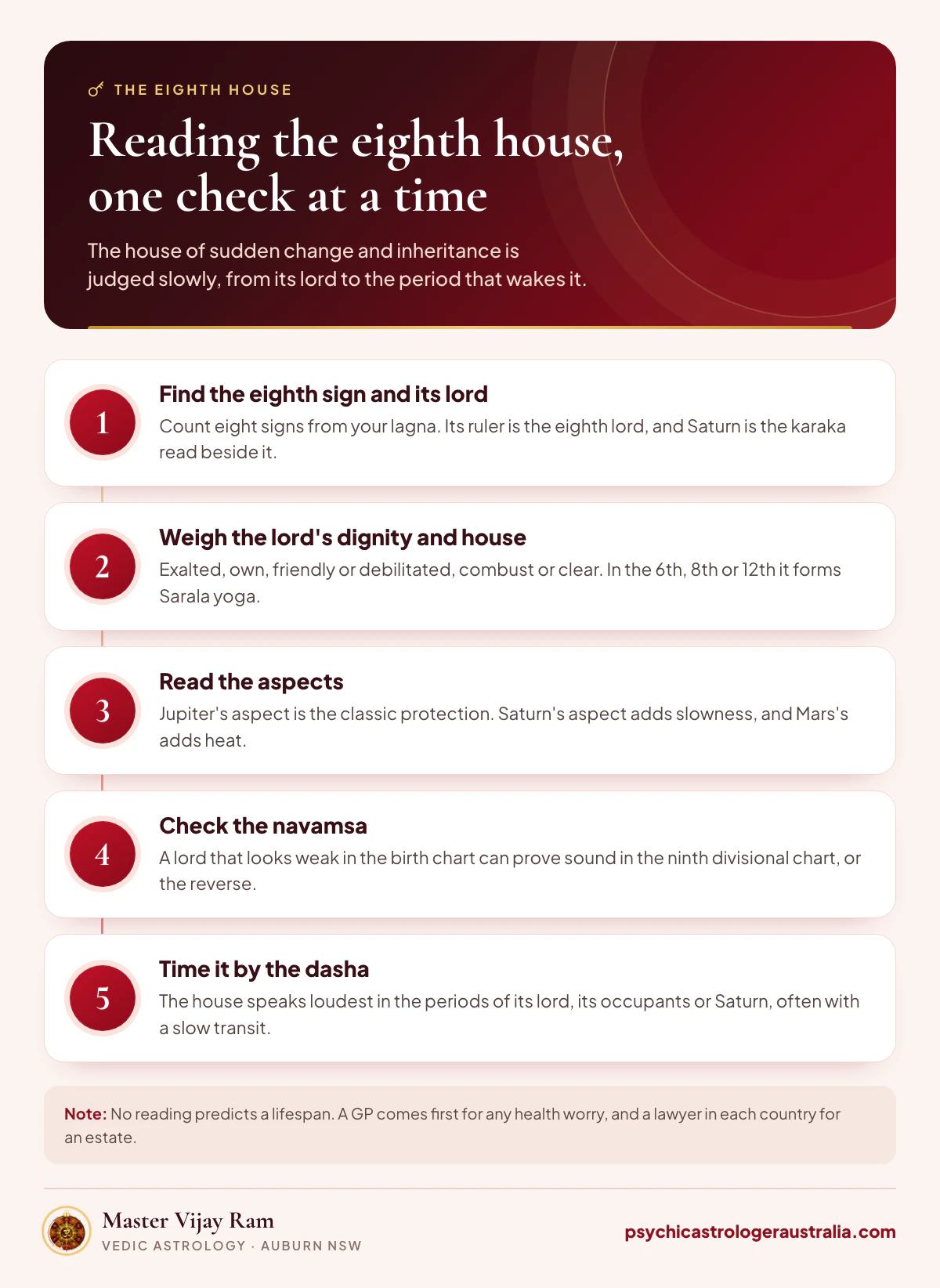
Four checks, in this order. First the lord: its sign, whether exalted, own, friendly or debilitated, whether it is combust, and the house it occupies. Second the aspects on the eighth and on its lord, where Jupiter’s aspect is the classic protection, Saturn’s adds slowness and Mars’s adds heat.
Third the navamsa, the ninth divisional chart, where a lord that looks weak in the birth chart can prove sound, or the reverse. Fourth the dasha: the eighth house in a kundli speaks loudly only in the periods of its lord, its occupants or Saturn, and a well-guarded eighth can pass through a whole life with nothing louder than an estate to settle.
Inheritance and in-laws’ property: what can a chart say?
Inheritance is the eighth house’s most practical question for Indian families in Australia, because so many estates sit in two countries. Picture three siblings, one in Geelong, one in Hobart and one still in Amritsar, and a parent’s flat in Chandigarh with no clear will. Each sibling’s chart might show an eighth-lord period bringing the matter forward, a Jupiter aspect that favours settlement or a Rahu link that warns of a tangle, but none of them can say who is legally entitled to what.
That belongs to a lawyer in each country, and to a will that is written down and kept current. The same holds for in-laws’ property, read from the eighth as the partner’s family resources: the chart can describe whether such wealth is likely to matter in your life, never whether you are owed it. A family in Geelong with land back in Punjab might bring both questions to one call, and the reading keeps them apart.
Sudden change: redundancy, moves and the year that turns
The eighth is where the tradition looks for the change nobody scheduled: a contract not renewed, a site closing, a move forced by a landlord’s sale, a diagnosis in the family, a windfall that rearranges every plan. A fitter in Newcastle whose roster is cut and a researcher in Wollongong whose grant ends are living the same house in different clothes.
Read well, the house describes how a person meets the shock more than the shock itself. A strong eighth lord and a dignified Saturn tend to turn a crisis into a second start; a weak one asks for more support, more time and earlier help from a GP, a financial counsellor or a lawyer. Redundancy, debt and grief are practical problems first, and the chart is a way of pacing them.
Surgery and the eighth house, handled gently
The tradition files operations among eighth-house matters, especially where Mars is involved, and families sometimes ask whether a surgery date should be chosen by muhurat. The honest answer is that the surgeon and the hospital decide: an urgent operation is never delayed for a chart, and an elective one can at most be matched to the more suitable of the dates the hospital actually offers.
A chart showing an eighth-house period does not mean an operation is coming, and it does not mean one will go badly. Healthdirect, listed below, is a sound place to begin on any medical question, and the GP is the right next step.
Research, secrets and hidden work
The bright face of the eighth is depth: the capacity to dig, to keep a confidence and to stay with a hard problem. A strong eighth house, or its lord joined to the tenth, is traditionally read toward research, investigation, forensic and tax work, insurance, mining, surgery, psychology and the study of astrology itself. A doctoral candidate at the University of Newcastle or a fraud analyst in Canberra may be living the house well without ever calling it that.
The same depth has a shadow: secrecy that strains a marriage, money kept from a partner, a fascination with the occult that crowds out ordinary life. The house asks for depth with honesty, and a reading names the difference.
When does the eighth house wake up, and what about 2027?
A house speaks in its periods: the mahadasha or antardasha of the eighth lord, of a planet placed in the eighth, or of Saturn as karaka, usually while a slow transit touches the house or its lord. Saturn’s transit of the eighth sign from the Moon, one of the two dhaiyas and sometimes called ashtama Shani, is the transit most tied to the house.
In 2027 Saturn stands in the eighth from a Simha (Leo) Moon until 2 June 2027 and again from 20 October 2027, and in the eighth from a Kanya (Virgo) Moon from 3 June to 19 October 2027. Sade Sati and Dhaiya remedies covers what the tradition suggests for those months, and many people meet a dhaiya as a slower, more serious year rather than a disaster.
What helps a troubled eighth house?
The remedies tied to the house are steady and unglamorous. The Mahamrityunjaya mantra, addressed to Shiva as the conqueror of death, is the classic prayer of the eighth; water offered to a Shiva lingam on Mondays, a sesame-oil lamp on Saturdays for Saturn the karaka, and service to the sick and the bereaved belong with it. Practical order counts too: a current will, insurance papers your family can find, and no secrets in joint money.
Where the eighth lord is badly afflicted and its dasha is running hard, a graha shanti for that planet is performed personally by Master Vijay Ram at his place of practice in Auburn, on a suitable muhurat, with the client joining by video if they wish. It starts from $250 and the figure is agreed before anything is performed; online puja and havan explains the arrangement, and most eighth houses need no puja at all.
What an eighth-house reading cannot do
It cannot give the date of a death, the outcome of an operation, the result of a probate dispute or proof that a relative has hidden money. It cannot replace a doctor, a lawyer, a financial counsellor or a grief counsellor, each of whom sees their part of the problem more clearly than a chart does. And it cannot turn a frightening placement into a fixed fate: 8th house astrology describes tendencies and timing, and the rest of the chart and your own choices decide how they are lived.
How Master Vijay Ram reads the eighth house
From your date, time and place of birth Vijay Ram ji draws the chart, finds the eighth sign and its lord, notes the occupants, the aspects, Saturn’s condition and the navamsa, and only then lays the running dasha and the year’s transits over the house. You hear what the house is likely to bring forward in the next few years and what tends to steady it, in plain words rather than warnings.
A consultation is $50 and runs by phone, video or WhatsApp from Canberra to the Sunshine Coast, in English, Hindi or Punjabi, with in-person appointments only at his place of practice in Auburn. Remedies are suggested only where the chart calls for one.
Read next
- The Tenth House in Vedic Astrology: Career, Reputation and KarmaThe tenth house in Vedic astrology: career, reputation and karma, its four karakas, the tenth lord in each house, pla…
- The First House in Vedic Astrology: Body, Vitality and SelfThe first house in Vedic astrology (tanu bhava): body, vitality and temperament, the Sun as karaka, planets in the fi…
- Signs of Jinn Disturbance at Home and How Ruqyah HelpsJinn disturbance at home: which signs matter, which have ordinary causes, what ruqyah really is, and how a settled ho…
Frequently asked questions
What does the eighth house mean in a birth chart?
The eighth house is the ayur bhava, the eighth sign counted from your lagna. It is traditionally read for the length and texture of life, sudden change, inheritance, the wealth of a partner’s family, research and hidden matters, with Saturn as its karaka. It is one of the three dusthanas, which means its events tend to arrive abruptly and from outside your own effort, not that the house is a curse.
Is the eighth house always bad?
No. A dignified eighth lord, Jupiter’s aspect on the house, or the eighth lord placed in the sixth, eighth or twelfth, the pattern called Sarala yoga, can make the house a source of resilience, research ability and unexpected gains. Busy eighth houses are common in the charts of surgeons, investigators and researchers. The difficult version needs several afflictions together, and even then it describes harder years rather than a fixed fate.
Can the eighth house tell me when I will die?
The classical texts contain longevity methods built around the eighth house, but Master Vijay Ram does not use them to predict anyone’s lifespan or a parent’s death. The methods disagree, birth times are rarely precise enough, and a number cannot be un-heard. He reads which periods may bring health questions forward and suggests keeping check-ups current, and any symptom or worry goes to a GP first.
Does the eighth house show an inheritance?
It is the house the tradition reads for legacies, unearned money and the property of a partner’s family, so a period of the eighth lord, or a strong eighth lord linked to the second or eleventh house, is often when an inheritance question comes forward. The chart describes tendency and timing only. Who is entitled to an estate in Australia or in India is decided by the will, the law and a lawyer in each country.
What does Mars in the eighth house mean?
Mars in the eighth is traditionally read for surgery, injury, sudden expense and a forceful response to crisis, and it is one of the placements counted in manglik dosha. In a strong sign, with Jupiter’s aspect, it often suits surgeons, paramedics, miners and emergency workers. It is not a forecast of an accident or an operation; it asks for care with driving, tools and temper in Mars periods.
Is Saturn in the eighth house good?
Saturn is the karaka of the eighth, and a well-known tradition reads it in that house as support for a long, enduring life, with chronic rather than sudden matters and inheritances that settle slowly. In Libra, Capricorn or Aquarius it is steady; in Aries, its sign of debilitation, it asks for more patience. Its periods can feel heavy, and the practices that suit it are routine, service and Saturday restraint.
What does the eighth lord in the twelfth house mean?
It is one of the three placements that form Sarala yoga, where a difficult lord in a difficult house tends to cancel trouble rather than add to it. Traditionally it describes losses that turn out to release a person, settlement abroad, quiet spiritual interests and spending nobody else sees. Its value depends on the lord’s dignity and aspects, and a debilitated or heavily afflicted lord gives the reversal less cleanly.
Should a surgery date be chosen by astrology?
The surgeon and the hospital decide when an operation happens, and an urgent operation should never be delayed for a chart. Where an elective procedure offers a choice of dates, some families ask for the more suitable of those dates to be checked, and that is the most a muhurat should do. A chart showing an eighth-house period does not mean an operation is coming or that it will go badly.
Which remedies suit a troubled eighth house?
The Mahamrityunjaya mantra to Shiva, water offered to a Shiva lingam on Mondays, a sesame-oil lamp on Saturdays for Saturn and service to the sick and the bereaved are the traditional practices, and a current will and honest joint finances count as well. A graha shanti for an afflicted eighth lord is performed personally in Auburn from $250, agreed beforehand, after a $50 consultation finds it warranted.
People also ask
What does the 8th house represent in astrology?
In the Vedic list it represents longevity, sudden change, inheritance, a partner’s family wealth, research and hidden matters. It is the eighth sign from the lagna, ruled by its own lord and signified by Saturn, and it is read with its occupants, the aspects on it, the navamsa and the running dasha before anything is said about a person’s life.
What if my 8th house is empty?
An empty eighth house is common and usually quiet. The house is then described by its lord, by the aspects falling on it and by Saturn as karaka, and its events tend to come in the periods of the eighth lord. Many calm charts have nothing in the eighth at all; an occupant adds a voice to the house rather than switching it on.
Which house shows in-laws’ property in Vedic astrology?
The eighth, read as the second house counted from the seventh: if the seventh is the partner, the second from it is the partner’s family wealth. A strong eighth lord linked to the second or eleventh house is traditionally read as money or property that comes through marriage. The in-laws as people are read from other houses counted from the seventh, and traditions differ on which.
What does a strong 8th house give?
Staying power through crisis, a talent for research and investigation, the ability to keep a confidence, and unexpected gains such as a legacy or a payout. It is traditionally read in the charts of surgeons, analysts and people who rebuild well after a setback. Strength means a dignified eighth lord, benefic aspects and a sound navamsa, not simply a crowded house.
Why is the eighth house called a dusthana?
Dusthana means a house of difficulty, and the tradition gives the name to the sixth, eighth and twelfth houses because their matters, illness and debt, sudden change and loss, expense and separation, are the parts of life nobody chooses. The label describes subject matter, not a verdict, and a dusthana lord placed in another dusthana is traditionally read as cancelling trouble.
References & further reading
Serving clients across Australia
Confidential consultations by phone, video & WhatsApp — including: