

Quick answer
Vipreet Raja Yoga forms when the lord of the sixth, eighth or twelfth house sits in the sixth, eighth or twelfth: Harsha for the sixth lord, Sarala for the eighth, Vimala for the twelfth. It is read as a difficulty turning against itself, giving standing through or after trouble, mainly in the forming planet's dasha.
What is Vipreet Raja Yoga?
Vipreet Raja Yoga is a combination formed when the lord of the sixth, eighth or twelfth house sits in the sixth, eighth or twelfth house of the birth chart. Those three are the dusthanas, the houses of disputes, upheaval and loss, and vipreet means reversed: a difficulty placed in a difficult house is traditionally read as turning against itself. The result the texts promise is standing that arrives through, or after, trouble.
Spellings vary, and viparita raja yoga is the same combination under its Sanskrit name. This page explains its three named forms, how to find the right planets for your rising sign, a worked example, what spoils it and when it shows, and a full kundli reading applies it to your own chart.
Why would trouble in a troubled house help?
Each house lord carries its house's business wherever it goes. The sixth lord carries debts, disputes, illness and rivals; the eighth carries sudden change and hidden matters; the twelfth carries expense, loss and distance. When one of these lords lands in another dusthana, the tradition reads its trouble as weakened by the setting, like a problem that undermines another problem instead of the person.
That is why the yoga sounds paradoxical and why it is so often misunderstood. It does not say that bad things are good. It says that a particular kind of difficulty, placed in a particular way, tends to resolve in the person's favour, often after a testing stretch.
Harsha, Sarala and Vimala: what are the three forms?
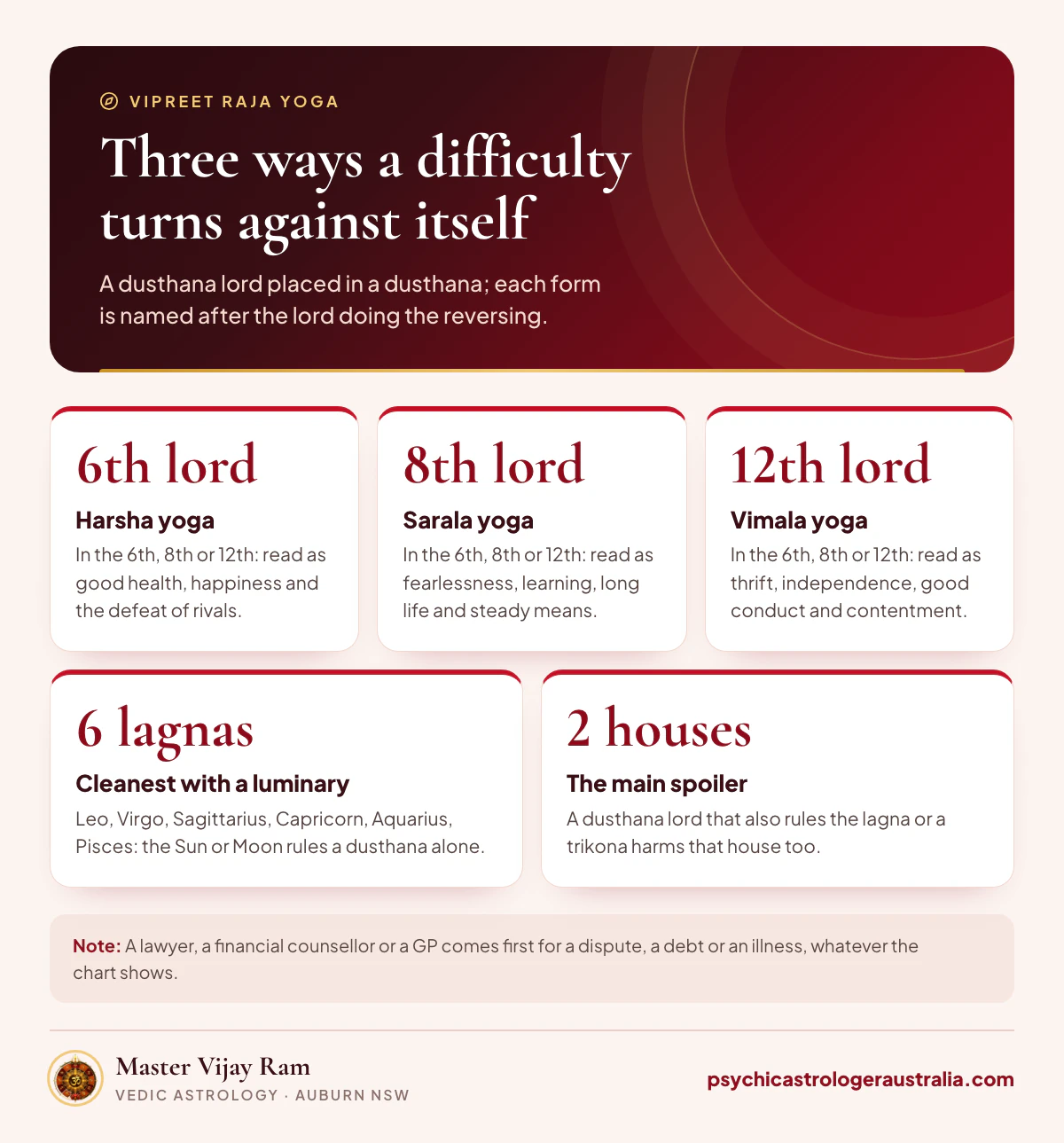
The texts name the yoga by the house whose lord does the reversing. The sixth lord in a dusthana forms Harsha yoga, the eighth lord forms Sarala, and the twelfth lord forms Vimala, and a chart can hold one, two or all three.
| Yoga | Formed by | Traditionally read as | How it often looks today |
|---|---|---|---|
| Harsha (joy) | The 6th lord in the 6th, 8th or 12th | Good health, happiness and the defeat of rivals | Winning the dispute, outlasting the competitor, recovering well |
| Sarala (straight) | The 8th lord in the 6th, 8th or 12th | Long life, fearlessness, learning and steady means | Calm in a crisis; work in research, risk or emergencies |
| Vimala (spotless) | The 12th lord in the 6th, 8th or 12th | Thrift, independence, good conduct and contentment | Careful with money, self-reliant, quietly respected |
Does a lord in its own dusthana count?
The broad definition counts any of the three lords in any of the three houses, so a sixth lord in the sixth qualifies. Some astrologers read that case differently: a lord in its own house protects the house, which strengthens the sixth's capacity to fight and to serve rather than reversing anything. Traditions differ, and a reading should say which view it takes.
The cleaner examples, on which most schools agree, are cross-placements and exchanges: the sixth lord in the eighth, the eighth lord in the twelfth, the twelfth lord in the sixth.
Which planets are your dusthana lords?
The dusthana lords change with the rising sign, so the first step is to name them. The table counts whole signs from each lagna and shows any second, better house the same planet rules, which matters for the next section.
| Lagna | 6th lord | 8th lord | 12th lord |
|---|---|---|---|
| Mesha (Aries) | Mercury (also 3rd) | Mars (also 1st) | Jupiter (also 9th) |
| Vrishabha (Taurus) | Venus (also 1st) | Jupiter (also 11th) | Mars (also 7th) |
| Mithuna (Gemini) | Mars (also 11th) | Saturn (also 9th) | Venus (also 5th) |
| Karka (Cancer) | Jupiter (also 9th) | Saturn (also 7th) | Mercury (also 3rd) |
| Simha (Leo) | Saturn (also 7th) | Jupiter (also 5th) | Moon (no other) |
| Kanya (Virgo) | Saturn (also 5th) | Mars (also 3rd) | Sun (no other) |
| Tula (Libra) | Jupiter (also 3rd) | Venus (also 1st) | Mercury (also 9th) |
| Vrishchika (Scorpio) | Mars (also 1st) | Mercury (also 11th) | Venus (also 7th) |
| Dhanu (Sagittarius) | Venus (also 11th) | Moon (no other) | Mars (also 5th) |
| Makara (Capricorn) | Mercury (also 9th) | Sun (no other) | Jupiter (also 3rd) |
| Kumbha (Aquarius) | Moon (no other) | Mercury (also 5th) | Saturn (also 1st) |
| Meena (Pisces) | Sun (no other) | Venus (also 3rd) | Saturn (also 11th) |
One pattern stands out. The Sun and the Moon rule one sign each, so where a luminary is the dusthana lord, as for Leo, Virgo, Sagittarius, Capricorn, Aquarius and Pisces rising, it carries no second house that a dusthana placement could damage, and the yoga it forms is the cleanest kind.
What turns a clean Vipreet into a mixed one?
Dual lordship is the main spoiler. For an Aries lagna Mars rules both the first and the eighth, so Mars in the twelfth forms Sarala by the book while also putting the chart's own lord in the house of loss, and the reading has to weigh both facts. The same caution applies when a dusthana lord also rules a trikona, as Jupiter does for a Cancer lagna, where it holds both the sixth and the ninth.
Company matters too. Many astrologers want the yoga's planet clear of any association with the lagna lord or the lords of the fifth and ninth, because joining a good-house lord in a dusthana drags that lord down with it. Beyond that, the navamsa, the aspects received and the dasha decide how much of the promise reaches the life.
Worked example: two reversals in a Virgo chart
Consider a chart drawn up for illustration only. Virgo is rising; the Sun, lord of the twelfth and of nothing else, sits exalted in Aries in the eighth house, which forms Vimala. Mars, lord of the eighth, sits in Leo in the twelfth, which forms Sarala, with the caveat that Mars also rules the third house of effort and siblings.
The two planets have also exchanged signs, the Sun in Mars's Aries and Mars in the Sun's Leo, which binds the two yogas together. The Moon sits early in Purva Ashadha, a star ruled by Venus, so the chart opens with about nineteen years of Venus, after which the Sun's six years run from about nineteen to twenty-five and Mars's seven from about thirty-five to forty-two.
The tradition would read the Sun's years as an early independence that pays, perhaps a move away for study or a first job in another city, with money handled carefully because it has to be. It would read Mars's seven years as a time of steadiness in other people's crises, the stretch in which a person becomes the one called when something goes wrong, while the third house's matters carry some of the strain.
When does the reversal arrive?
In the dasha of the planet forming it, and the order of events is part of the yoga. Typically the period opens with the difficulty the dusthana describes, a dispute, an upheaval or an expense, and the reversal follows: the dispute resolves well, the upheaval clears away a bad arrangement, the expense turns out to have been an investment. The sixth house of debts and disputes, the eighth house of sudden change and the twelfth house of expense and distance each have a page of their own.
Transits of Saturn and Jupiter over the planet tend to mark the turning points within the period. Outside that dasha the yoga describes a temperament, a capacity to stay upright in hard conditions, more than a series of events; the wider guide to yogas explains why every yoga waits for its period.
Is this success at someone else's expense?
The old verses speak of rising as enemies fall, and some modern writing repeats that as if the yoga were a licence to profit from others' misfortune. A plainer reading fits most lives better: the yoga suits people whose work is other people's problems. The debt counsellor, the emergency nurse, the claims assessor after a flood, the auditor and the mediator all earn their standing by handling difficulty well, and none of them needs to wish anyone harm.
For a reader on the Gold Coast or in Wollongong the yoga often appears as a career that grew out of a hard year, which is exactly the kind of question a business and career reading is built for.
Disputes, debts and illness: who comes first?
A chart that carries Harsha yoga still needs a lawyer for a legal dispute, a financial counsellor for debt and a GP for a health worry, and none of those should wait for a dasha. Legal Aid NSW and its counterparts in the other states and territories can advise on legal problems, and a GP is the first stop for anything in the body.
The yoga describes how difficulty tends to resolve; it does not resolve it for you. This is faith-based guidance in the Vedic tradition, not legal, financial or medical advice.
Is there a puja for Vipreet Raja Yoga?
No rite creates it, and in its clean form it needs nothing. Where dual lordship spoils it, for instance a lagna lord sitting in the twelfth, and that planet's period is heavy, the tradition offers the planet's mantra, its weekday observance and sometimes a shanti. Master Vijay Ram performs any such puja himself at his place of practice in Auburn, from $250, agreed before it begins, and online puja and havan explains how you can take part by video.
A consultation is $50, and in most readings of this yoga the useful part is the timing rather than any remedy.
What will a Vipreet reading never claim?
It cannot promise that a lawsuit will be won, a debt cleared or an illness pass, and it cannot turn reckless choices into lucky ones. It describes a tendency for certain difficulties to resolve in the person's favour, in a certain season, and the rest of the chart can outweigh it.
How is your Vipreet Raja Yoga checked in a reading?
He identifies your three dusthana lords from the lagna, checks where each sits, notes any second house they rule, their company, aspects and navamsa, and then dates the periods that will carry the yoga. You learn whether you hold a clean Vipreet, a compromised one or none, and what its next season is likely to ask of you.
Readings run by phone, video or WhatsApp across Australia, and clients in Canberra keep the same clock as Auburn, where in-person appointments are held.
Read next
- Dusthana Houses 6, 8 and 12: Difficult Houses Without FearThe dusthana or trik houses 6, 8 and 12 read calmly: what the tradition finds hard in them, what they also give, how …
- Lakshmi Yoga: What the Wealth Yoga RequiresLakshmi yoga in a kundli: a dignified ninth lord in a kendra or trikona with a strong lagna lord, why versions differ…
- 11 Signs of Negative Energy in Your Life (and How to Clear It)Eleven signs of negative energy, the ordinary causes to rule out first, and the three-doors test that tells you wheth…
Frequently asked questions
Is Viparita Raja Yoga the same as Vipreet Raja Yoga?
Yes. Viparita is the Sanskrit word and vipreet the common Hindi pronunciation, and both mean reversed. The condition is the same in either spelling: the lord of the sixth, eighth or twelfth house placed in the sixth, eighth or twelfth. The three named forms are Harsha for the sixth lord, Sarala for the eighth lord and Vimala for the twelfth lord.
Is Vipreet Raja Yoga good or bad?
Good in the tradition's reading, but in an uncomfortable way: it gives standing through or after difficulty rather than an easy run. It is cleanest when the planet rules no other house and keeps away from the lords of good houses. When the planet also rules the lagna or a trikona, the yoga is mixed and the reading weighs both sides.
What is Harsha yoga?
The sixth lord placed in the sixth, eighth or twelfth house. Harsha means joy, and the tradition reads it as good health, happiness and victory over rivals: the person who outlasts competitors and comes through disputes well. It delivers mainly in the dasha of the sixth lord, and a legal dispute still belongs with a lawyer whatever the chart shows.
What is Sarala yoga?
The eighth lord placed in the sixth, eighth or twelfth house. Sarala means straight or simple, and the tradition reads it as long life, fearlessness, learning and steady means: a person who stays calm when others panic. Today it often shows in research, risk management, emergency work or any role that handles upheaval on behalf of others.
What is Vimala yoga?
The twelfth lord placed in the sixth, eighth or twelfth house. Vimala means spotless, and the tradition reads it as thrift, independence, good conduct and contentment: a person who spends carefully and keeps a clean name. It often shows as quiet financial discipline and self-reliance, especially in the dasha of the twelfth lord.
How common is Vipreet Raja Yoga?
Not rare. Three lords and three houses give many ways to form at least one version, so plenty of charts carry it on paper. Fewer carry a clean version, with a dusthana lord that rules no good house, keeps away from good-house lords and runs its dasha at a useful time of life, and that is the version the tradition prizes.
When does Vipreet Raja Yoga give results?
In the mahadasha or antardasha of the planet forming it, often after the trouble its house describes has run its course. Transits of Saturn and Jupiter over that planet tend to mark the turning points. Outside its periods the yoga reads more as a temperament, a capacity to stay steady under pressure, than as a run of events.
Does Harsha yoga mean I will win my court case?
No chart can promise that, and a legal dispute belongs with a lawyer or Legal Aid first. A strong Harsha yoga is traditionally read as a tendency for disputes to resolve in the person's favour, especially in the sixth lord's period, but evidence, advice and the court decide the case. A reading can only describe the season you are in.
Can the lagna lord form Vipreet Raja Yoga?
Yes, when the lagna lord also rules a dusthana, as Mars does for Aries rising, ruling the first and eighth, or Venus does for Taurus rising, ruling the first and sixth. Placed in a dusthana it forms the yoga by definition, but it also puts the chart's own lord in a difficult house, so the result is mixed and vitality may carry some cost.
People also ask
What is Vipreet Raja Yoga in simple words?
It is a chart combination in which the ruler of a difficult house sits in another difficult house, so that one problem works against another. The sixth, eighth and twelfth houses govern disputes, upheaval and loss, and when their lords occupy each other's ground, the tradition reads the person as rising through or after trouble.
Which houses form Vipreet Raja Yoga?
The sixth, eighth and twelfth, the dusthanas. The lord of any of these placed in any of them forms the yoga: the sixth lord gives Harsha, the eighth lord Sarala and the twelfth lord Vimala. Some astrologers count a lord in its own dusthana, while others count only cross-placements and exchanges between the three houses.
Is Vipreet Raja Yoga a true raja yoga?
It belongs to the raja yoga family because it gives standing, but it works by reversal rather than by joining a kendra lord with a trikona lord. Its success usually comes through difficulty or after it, which is why astrologers describe it as a real but uncomfortable strength rather than a smooth rise.
Who has Viparita Raja Yoga?
Anyone whose sixth, eighth or twelfth lord sits in one of those three houses. Which planets those are depends on the rising sign: for Leo rising, for example, Saturn rules the sixth, Jupiter the eighth and the Moon the twelfth. A full chart shows which version you hold and how clean it is.
References & further reading
Serving clients across Australia
Confidential consultations by phone, video & WhatsApp — including: