

Quick answer
The Surya mahadasha is the six-year Sun period of the Vimshottari dasha, shorter than any other planet’s. Its years usually bring authority, visibility, dealings with government and the father, and a focus on vitality and health. How it feels depends on the Sun’s sign, dignity and the house it rules for your lagna, and on whichever antardasha is running.
What is the Surya mahadasha?
The Surya mahadasha is the period of the Vimshottari dasha ruled by the Sun, six years long in the classical tables and the shortest of the nine planetary periods. It is a public period: the Sun stands for authority, the father, government, recognition and the vitality that keeps a body going, and its years tend to put a person where they can be seen. Six years is short enough to pass quickly and long enough to change a reputation.
This page sets out what the Sun’s period traditionally brings, how its sign, dignity and lordship change it, the nine sub-periods one by one, the seams at either end and the remedies that suit it. The arithmetic behind the dates is in how Vimshottari dasha timing works, and a kundli reading with Master Vijay Ram gives your own dates and what they mean for your chart.
Who meets the Sun’s period, and when in life?
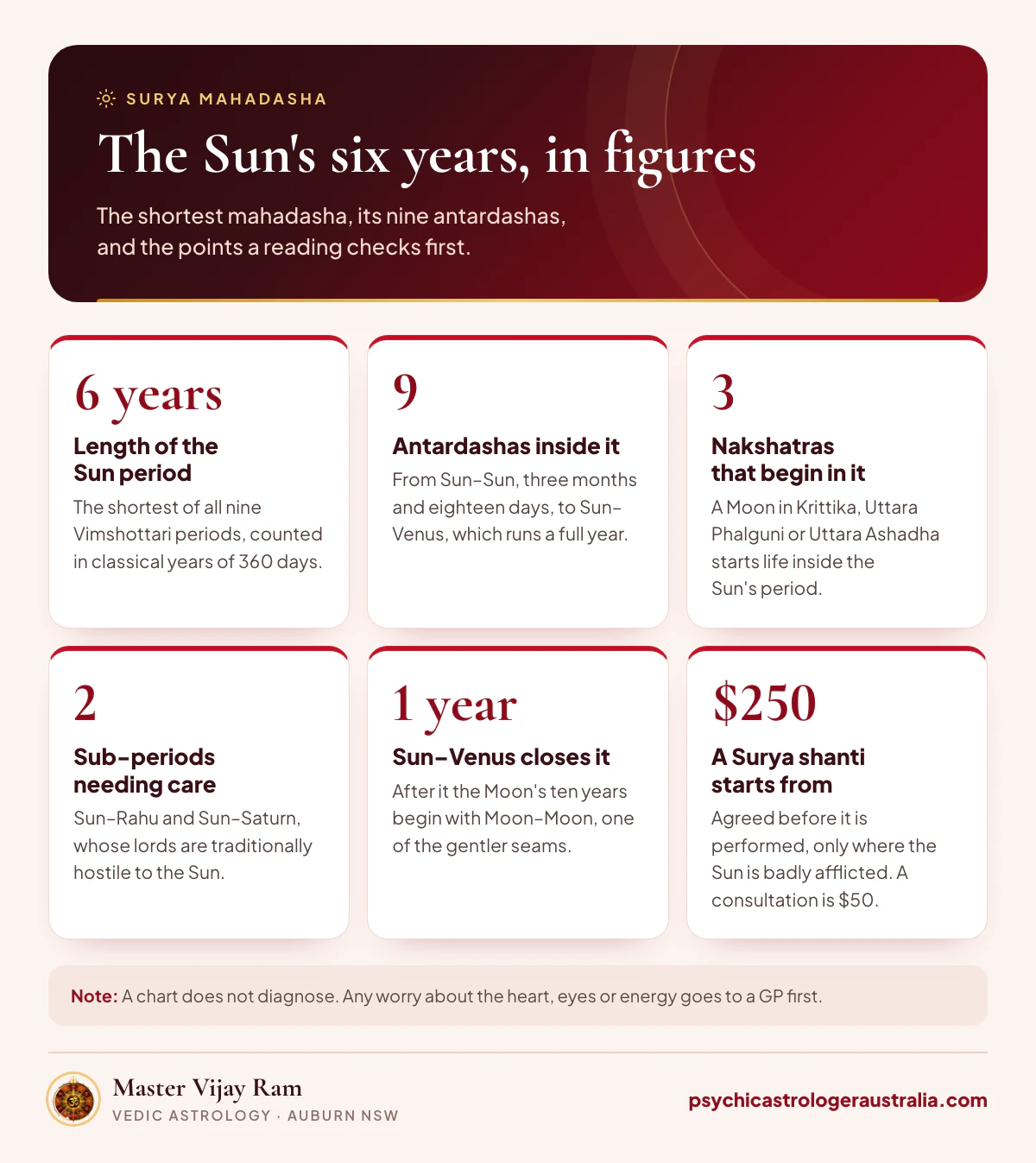
The Vimshottari sequence runs Ketu, Venus, Sun, Moon, Mars, Rahu, Jupiter, Saturn, Mercury, so the Sun’s years always follow Venus’s twenty and precede the Moon’s ten. People born with the Moon in Krittika, Uttara Phalguni or Uttara Ashadha, the three nakshatras the Sun rules, begin life inside the Sun period with whatever balance remains; for everyone else it arrives after Venus, at an age set by the birth nakshatra.
That makes it a childhood period for some, a mid-career period for many and a late-life period for others, and the same six years read very differently at eight, thirty-eight and sixty-eight. A child in the Sun’s period is read for confidence and the father’s presence; an adult for rank and health; an elder for respect and the body’s reserves.
What does the Sun’s period traditionally bring?
The Sun mahadasha effects the tradition lists are recognition, responsibility, contact with government and people in power, a sharper sense of self, and matters concerning the father. People often find themselves leading something in these years: a team, a household decision, a community event, a business that needs a face. The shadow side is pride, friction with bosses and a habit of taking every disagreement personally.
Because the Sun is the karaka of vitality, the period also turns attention to the body: energy, the heart, the eyes and the bones are the areas the old texts associate with it. That is a reason to keep check-ups current, not a forecast of illness, and the section on health below says where the line sits.
How do the Sun’s sign and dignity change the six years?
The Sun is exalted in Aries, at home in Leo and debilitated in Libra, and a strong Sun gives a period of earned authority while a weak one hands out the same themes grudgingly: recognition that is withheld, a boss who blocks, a father who is distant or unwell. A debilitated Sun can be repaired by neecha bhanga, the cancellation of its fall, and a reading always checks for it before concluding anything.
The Sun’s company matters too. It is friendly with the Moon, Mars and Jupiter and at odds with Venus and Saturn, and planets that sit close to it are combust, lost in its glare, which becomes visible when their own sub-periods arrive inside the Sun’s years. Combust planets explains why a clever Mercury can freeze in this period.
Which house does the Sun rule for your lagna?
The Sun rules only Leo, so for each rising sign it owns a single house, and that house is the business the period brings forward. The table follows the lagna reference: whole signs counted from the rising sign.
| Lagna | Sun rules | The period tends to emphasise |
|---|---|---|
| Mesha (Aries) | 5th | Children, study, creative work; a trikona lord, usually kind |
| Vrishabha (Taurus) | 4th | Home, mother, property, vehicles |
| Mithuna (Gemini) | 3rd | Effort, courage, siblings, media and short travel |
| Karka (Cancer) | 2nd | Family money and speech; a maraka house, read with care |
| Simha (Leo) | 1st | The self and the body; the lagna lord’s own years |
| Kanya (Virgo) | 12th | Expenses, distance, rest and time abroad |
| Tula (Libra) | 11th | Gains, networks, elder siblings |
| Vrishchika (Scorpio) | 10th | Career and authority; a strong working period |
| Dhanu (Sagittarius) | 9th | Fortune, the father, teachers, faith |
| Makara (Capricorn) | 8th | Change and hidden matters, softened because the Sun escapes the eighth-lord blemish |
| Kumbha (Aquarius) | 7th | Marriage and partners; also a maraka |
| Meena (Pisces) | 6th | Work, service, competition and health routines |
The house the Sun occupies is read beside the house it rules. A Scorpio-rising chart with the Sun in its own sign in the tenth gives the textbook Sun period of rising rank; a Virgo-rising chart with the Sun debilitated in the second gives a period of spending and family strain that needs patience.
The nine antardashas of the Sun period, one by one
Inside the six years each of the nine planets takes a turn as sub-lord, beginning with the Sun itself. The Surya mahadasha antardasha sequence is short, and several sub-periods last only a few months, so it is often the antardasha rather than the mahadasha that a person actually notices.
| Antardasha | Length | What it traditionally brings |
|---|---|---|
| Sun–Sun | 3 months 18 days | The Sun steps forward: a new role, a test of confidence, the father’s matters |
| Sun–Moon | 6 months | Home, mother and public dealings; a move or a change in mood |
| Sun–Mars | 4 months 6 days | Energy, property and decisive action; heat, haste and small injuries |
| Sun–Rahu | 10 months 24 days | An eclipse in miniature: clashes with authority, confusion, foreign matters |
| Sun–Jupiter | 9 months 18 days | Blessing and counsel: teachers, children, recognition, faith |
| Sun–Saturn | 11 months 12 days | Authority meets duty: workload, delay, tension with a father or boss |
| Sun–Mercury | 10 months 6 days | Study, paperwork, trade and contracts, unless Mercury is deeply combust |
| Sun–Ketu | 4 months 6 days | Withdrawal, a role let go, a spiritual turn |
| Sun–Venus | 1 year | Comfort, relationships and art, with pleasure and duty pulling apart |
Each line is a tendency, read with the sub-lord’s own placement: a Sun–Saturn stretch for a Libra-rising chart, where Saturn is the yogakaraka, can be the most productive year of the six. The two that most often need care are Sun–Rahu and Sun–Saturn, because both sub-lords are traditionally hostile to the Sun.
Why can the Sun period strain things with a father or a boss?
As karaka of the father and of every figure with authority over you, the Sun brings those relationships into focus in its years. Sometimes that means a father’s illness or retirement, a reconciliation, or a role reversal in which the child becomes the decision-maker; sometimes it means a manager who suddenly matters a great deal, for better or worse.
The useful reading is about pride. A strong Sun period goes well for people who can lead without needing to win every point, and badly for those who cannot hear a correction; the period tests that quality in almost everyone it touches.
Does the Sun’s period touch health and vitality?
The tradition ties the Sun to the heart, the eyes, the bones, the head and general vitality, and to heat in the body. A Sun period is a sensible time to keep up with blood pressure, heart and eye checks, particularly from middle age, and to take tiredness seriously rather than push through it. That is ordinary prudence that the chart happens to underline.
No chart diagnoses anything, and no remedy treats anything. A symptom is a matter for your GP before anything else, and a health and wellbeing reading is meant to accompany medical care, not replace it; Healthdirect, listed below, is a reliable place to begin.
What does the Sun period mean for work and leadership here?
The Sun is the planet of government and administration, so its period is often noticed by people in the public service, health administration, the defence forces and local councils. A public servant in Canberra and the ACT might find the Sun’s years bring an acting role at a higher level, a move to a policy team, or a clash with an executive that shapes the next decade.
For people outside government the period tends to push toward visibility: a promotion to manager, a business that needs its owner out front, a community role at the temple or the cricket club. Starting a business in these years is a decision for your accountant and adviser first; the chart can only say whether the Sun is strong enough to carry the extra exposure.
The seams at either end: from Venus, and on to the Moon
The Sun period begins as twenty years of Venus end, so the opening seam is a turn from comfort and relationships toward duty and visibility, and many people feel it as a call to grow up. It ends with the year-long Sun–Venus antardasha, after which the Moon’s ten years begin with the Moon–Moon sub-period, a change from public concerns to home, mother and the mind.
The tradition counts Sun to Moon among the gentler junctions, and it often passes as a move of house or a change in family life rather than a crisis. Dasha sandhi explains how the months around any changeover are read.
Which remedies suit the Sun’s period?
The Sun dasha remedies the tradition trusts are simple and early in the day: water offered to the rising Sun from a copper vessel, the Aditya Hridayam or the Gayatri mantra, the Sun’s seed syllables, Om Hraam Hreem Hraum Sah Suryaya Namah, chanted on Sundays, and wheat or jaggery given in charity. Respect shown to your father, or care for him if he needs it, is counted as the most important of them.
A ruby is the Sun’s stone, and it belongs only to charts where a full reading shows the Sun as a planet the chart wants strengthened; for some lagnas it does more harm than good, as the ruby and who should avoid it explains, and Vijay Ram ji does not sell stones of any kind. Where the Sun is badly afflicted and its sub-period is hard, a Surya graha shanti is performed by him in person at his Auburn place of practice, from $250 with the cost agreed in advance, and online puja and havan describes how clients take part by video.
Where a Sun-period reading stops
No reading of the Sun’s years can promise a promotion, foretell a father’s health or settle a dispute with an employer. The body’s warnings belong to a doctor and a workplace grievance to a lawyer, and no reading can shorten the six years or remove what they ask of you. It is faith-based guidance about tendencies and timing, never medical, legal or financial advice.
Booking a reading of your Sun period
Once the date, time and place of your birth are in hand, Vijay Ram ji works out where your Sun period falls, reads the Sun’s sign, dignity, house and lordship for your lagna, marks the combust planets and the hostile sub-periods, and lays the current antardasha and the year’s transits over the whole. You leave knowing what your Surya dasha is for, which months ask for care and which carry the openings.
Sessions are $50 and take place over the phone, on video or by WhatsApp for clients anywhere from Adelaide to the Gold Coast, in English, Hindi or Punjabi; face to face, he sees people only at Auburn, by appointment.
Read next
- Guru Mahadasha: The Jupiter Years ExplainedGuru mahadasha explained: what the sixteen-year Jupiter period brings for study, children, marriage and money, its an…
- Chandra Mahadasha: Ten Years of the Moon and the MindChandra mahadasha explained: the ten-year Moon period, its nine antardashas, the mind, mother and home, why the Moon’…
- Love Spell Backfire: What Goes Wrong and How to Repair ItA love spell backfire rarely looks dramatic. Learn the three ways it goes wrong, when it tends to surface, and how ho…
Frequently asked questions
How long does the Surya mahadasha last?
Six years in the classical tables, which use 360-day years, making it the shortest of the nine Vimshottari periods. It always follows Venus’s twenty years and precedes the Moon’s ten. Its nine antardashas run from Sun–Sun, three months and eighteen days, to Sun–Venus, a full year. Your own start and end dates come from the Moon’s exact position at birth, which a kundli calculates.
Does the Sun mahadasha bring a government job?
The Sun is the planet of government and administration, so its period often brings contact with public institutions: a government role, a promotion in the public service, a licence or an official decision. Whether that means a job turns on the Sun’s strength and the house it owns in your chart; a Sun ruling the tenth for a Scorpio lagna points that way far more than a Sun ruling the twelfth.
Which months of the Sun period tend to be the toughest?
Sun–Rahu and Sun–Saturn usually need the most care, because both sub-lords are traditionally hostile to the Sun: Rahu brings confusion and clashes with authority, Saturn workload, delay and tension with a father or a boss. Sun–Jupiter is often the kindest. Each is read with the sub-lord’s own placement, so a well-placed Saturn can make Sun–Saturn a productive year.
Is the Sun mahadasha good for a Leo lagna?
Leo rising makes the Sun the lagna lord, so its period belongs to the person in a special way: health, confidence and direction come forward, and a strong Sun usually makes them good years. A debilitated Sun in Libra, or a Sun in the sixth, eighth or twelfth, gives the same focus with more strain on energy and standing. The antardasha running decides which part of that shows first.
What does a debilitated Sun mean for the Sun mahadasha?
With the Sun in Libra, its sign of debilitation, the period’s themes arrive the hard way: recognition withheld, friction with authority, a father who is distant or unwell, and lower energy. A reading always checks for neecha bhanga, the cancellation of the fall, which can turn the period into a late rise. Dignity is one factor among several; the house the Sun rules and the antardasha matter as much.
Should I wear a ruby during the Sun mahadasha?
Only if a full chart reading shows the Sun as a planet your chart wants strengthened, and never on the strength of the dasha name alone. For some lagnas the Sun rules a difficult house, and strengthening it helps nobody. He neither sells gemstones nor earns from their sale, and any purchase belongs with a gemmologist and Australian Consumer Law rather than with a promise.
Can the Sun mahadasha cause health problems?
The tradition associates the Sun with the heart, eyes, bones, head and vitality, so its period is a sensible time to keep up with blood pressure, heart and eye checks, especially from middle age. That is prudence, not a forecast of illness. A chart cannot diagnose anything and a remedy cannot treat anything; any symptom belongs with a GP first.
What happens when the Sun period hands over to the Moon?
The Moon mahadasha begins, ten years long, opening with the Moon–Moon antardasha. The Sun period ends with the year-long Sun–Venus sub-period, so the seam runs from relationships and comfort straight into home, mother and the mind. The tradition counts Sun to Moon among the gentler junctions, and many people meet it as a move of house or a change in family life.
What are simple remedies for the Sun dasha?
Water offered to the rising Sun from a copper vessel, the Aditya Hridayam or the Gayatri mantra, the Sun’s beej mantra on Sundays, and wheat or jaggery given in charity are the traditional practices, with respect and care for your father counted above all. If the Sun is badly afflicted, he can perform a Surya shanti himself in Auburn; it starts from $250, the figure is agreed first, and it follows a $50 consultation.
People also ask
What does the Sun mahadasha do?
It brings the Sun’s significations forward for six years: authority, recognition, government, the father and vitality. Many people lead something in these years, deal with officials, or find their relationship with a parent or a boss changing. How it goes depends on the Sun’s dignity, the house it rules for your lagna and the antardasha running at the time.
At what age does the Surya mahadasha come?
It depends on the birth nakshatra. People born with the Moon in Krittika, Uttara Phalguni or Uttara Ashadha start life in the Sun period; everyone else reaches it after Venus’s twenty years, which can fall in childhood, mid-career or late life. A kundli calculated from the exact birth time gives the start date.
Which antardasha is best in the Sun mahadasha?
Sun–Jupiter is traditionally the kindest, bringing counsel, teachers, children and recognition, and Sun–Moon and Sun–Mars are usually supportive because the Moon and Mars are the Sun’s friends. The real answer depends on where each sub-lord sits in your chart and which houses it rules for your lagna.
Is the Sun mahadasha good for career?
Often, because the Sun is the planet of rank and government, and its period tends to push people into view. It is strongest for career when the Sun rules or occupies the tenth, as for a Scorpio lagna, or is exalted or in its own sign. A weak Sun gives the same push with more friction, especially with bosses.
What is the Surya dasha?
Surya dasha is another name for the Sun’s period in the Vimshottari system, six years in the classical tables. The word is also used for a Sun antardasha inside another planet’s mahadasha, which is shorter and colours that larger period with the Sun’s themes of authority, the father and vitality.
References & further reading
Serving clients across Australia
Confidential consultations by phone, video & WhatsApp — including: