

Quick answer
Dasha sandhi is the junction between two planetary periods, when one mahadasha ends and the next begins. Its last and first antardashas belong to planets of unlike nature, so the months either side of the change often bring moves, endings and new starts at once. The tradition names a few junctions as sharp and prescribes a simple welcome for the incoming lord.
What is dasha sandhi?
Dasha sandhi is the junction between two planetary periods in the Vimshottari system, the months in which one mahadasha is ending and the next is beginning. Sandhi means a joint or a seam, the same word used for the meeting of two bones or two words, and the tradition treats the seam between periods as a time of its own, with its own character and its own small rite. It is the moment in a life when the weather changes.
This page explains why the changeover is felt, how long it lasts, which junctions are sharp and which are gentle, and what the tradition asks a person to do as a new lord takes over. A kundli reading with Master Vijay Ram gives you your own dates; how the Vimshottari dasha system works is the background.
Why does the changeover feel like a cliff?
Two reasons. The first is that neighbouring lords in the sequence are of unlike nature: Venus hands over to the Sun, comfort to authority; Mars hands over to Rahu, direct force to oblique ambition; Jupiter hands over to Saturn, expansion to contraction. A life that has run on one planet's terms for years is asked to run on the opposite terms, and the adjustment is felt in work, home and relationships at once.
The second is a double change that most people never hear about. Inside each mahadasha the antardashas run in the fixed order starting with the lord itself, so the final antardasha of any period belongs to the planet that comes before the lord in the sequence, and the first antardasha of the next period belongs to the new lord. The seam therefore changes two planets at the same time, and that is the mahadasha change as it is actually lived.
How long does a sandhi last?
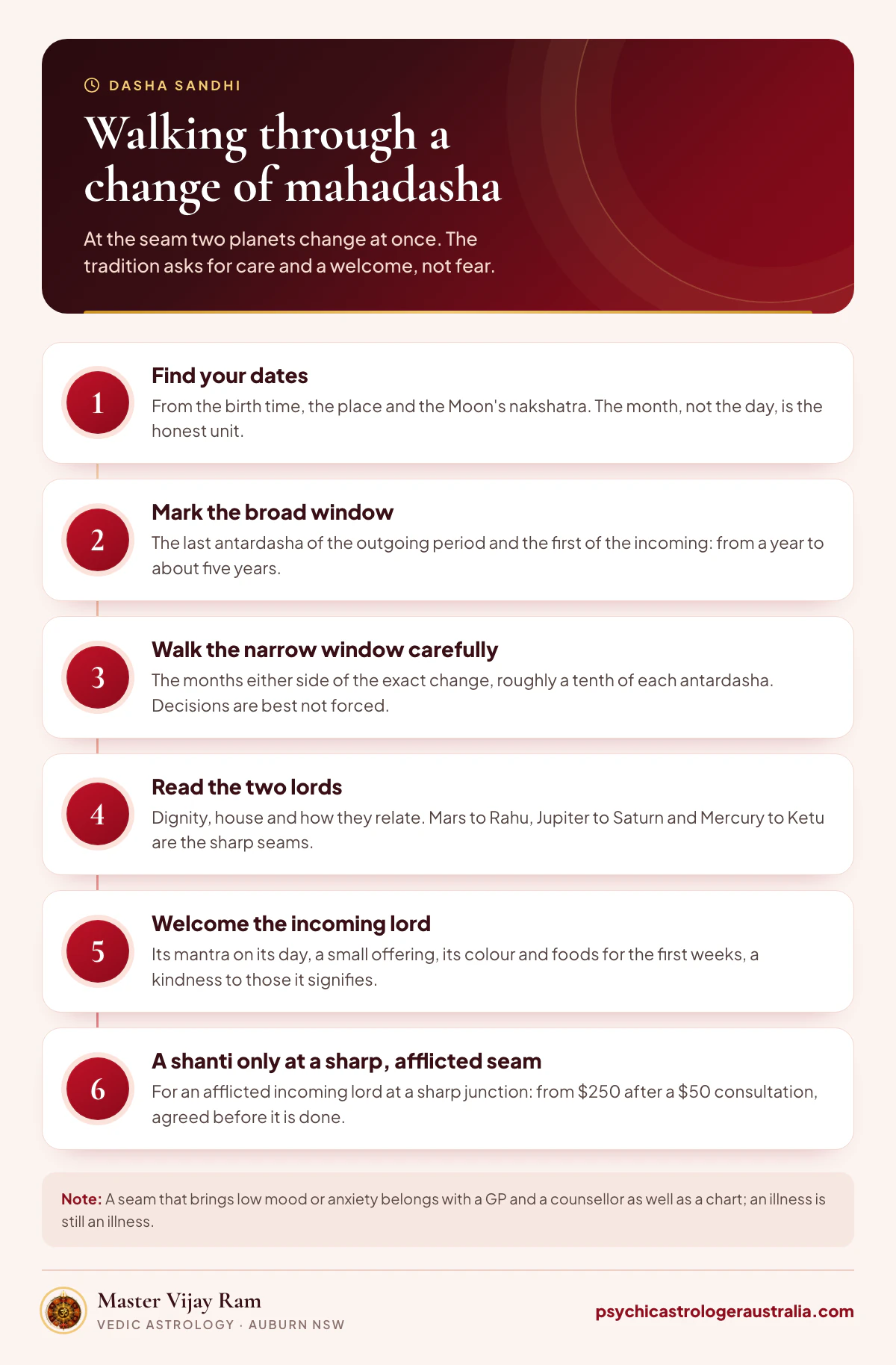
The broad reading takes the last antardasha of the outgoing period and the first of the incoming as the sandhi, which can span from a year to five years depending on the lords. The sharp reading, which he uses for timing, takes the months either side of the exact date of change, roughly a tenth of each antardasha, and treats the exact month as the seam itself. Some texts call that narrow window dasha chhidra, the gap, and it is the window in which decisions are best not forced.
Both readings are used together: the broad window explains why the years before a change felt like winding down, and the narrow one says which months to walk carefully. The exact date depends on the birth time and on the ayanamsa used, which is why two apps can place the same change months apart.
The nine changeovers: what shifts at each
| Changeover | Last antardasha of the outgoing period | What shifts | Traditionally read as |
|---|---|---|---|
| Ketu to Venus | Mercury in Ketu, about a year | detachment to desire | a relief that disorients; new comforts, new wants |
| Venus to Sun | Ketu in Venus, about fourteen months | comfort to authority | sobering; luxury ends, responsibility and visibility begin |
| Sun to Moon | Venus in Sun, a year | self to feeling | gentle; home, mother and mood come forward |
| Moon to Mars | Sun in Moon, six months | feeling to action | brisk; a short seam, often a move or a fight |
| Mars to Rahu | Moon in Mars, seven months | direct force to oblique ambition | sharp; the best-known difficult junction |
| Rahu to Jupiter | Mars in Rahu, about a year | restlessness to meaning | a relief; teachers, faith and children arrive |
| Jupiter to Saturn | Rahu in Jupiter, about two and a half years | expansion to contraction | sharp; the long seam most people feel |
| Saturn to Mercury | Jupiter in Saturn, about two and a half years | endurance to agility | a lightening; trade, study and speech open |
| Mercury to Ketu | Saturn in Mercury, about two and three-quarter years | busyness to withdrawal | sharp; plans dissolve, the inner life begins |
The lengths are fixed by the arithmetic of the system, so a person who knows their current mahadasha can see at once how long their next seam will be. A Jupiter period ends with a Rahu antardasha of almost two and a half years, which is why the end of Jupiter so often feels like the start of Saturn long before Saturn begins.
Mahadasha change or antardasha change?
The seams between antardashas are smaller versions of the same thing and come far more often, every few months to every few years, and an antardasha change is the usual explanation for a season that turned without warning: a quiet Jupiter antardasha giving way to a Saturn one inside the same Venus mahadasha, say. They are read with the same logic, the two lords and their relationship, and the mahadasha lord sets the limits of what either can do.
Below the antardasha sits the pratyantar, the third level, which changes every few weeks and which he reads only for a specific question such as a wedding date or a surgery. Marriage timing by dasha shows how the levels are used together for one question.
What do people actually notice at a seam?
Endings and beginnings at the same time: a job finishing as another is offered, a move, a relationship that had been fading finally going, a parent's health changing, a long project completing. Many people also notice their own temperament shifting, the person who was easy-going for sixteen years becoming careful and tired as Saturn approaches, and they come to a reading asking what is wrong with them. Nothing is; the weather changed.
It is honest to add that some people notice nothing at a mahadasha change, because the two lords are both well placed and friendly in their chart, and that the dasha change effects described in the old texts are the extremes, not the average. A seam in a strong chart is a good year with some packing.
The sharp junctions: Mars to Rahu, Jupiter to Saturn, Mercury to Ketu
Mars to Rahu is the junction the tradition names first. Seven years of direct, physical energy end and eighteen years of Rahu begin with a Rahu antardasha, and the person is often thrown from a life they could push through into a life they must manoeuvre through; the first year of Rahu is where sudden relocations, foreign tangles and obsessions start. The Rahu mahadasha is read on its own page, and its first antardasha is the seam described here.
Jupiter to Saturn is the long seam, because Jupiter ends with Rahu's antardasha of nearly two and a half years, so the person passes from Rahu's restlessness straight into Saturn's weight. Mercury to Ketu is the quiet one: seventeen years of plans, trade and talk end in Saturn's antardasha, and Ketu then dissolves whatever was built for show. In each case the difficulty is the contrast rather than the new lord's malice.
The gentle junctions, and the false alarms
Rahu to Jupiter is the junction people are most grateful for, and Saturn to Mercury the one they feel as a lightening of the shoulders. Ketu to Venus is a relief that takes a year to trust. Sun to Moon and Moon to Mars are short and brisk, and most people pass them with a change of house or a change of mood.
The false alarms come from apps and from frightened reading. A person told that their 'Saturn dasha is starting' with no account of their Saturn's dignity, house and relationship to the outgoing lord has been given a word, not a reading. Saturn well placed, in its own sign or exalted, as the yogakaraka for a Taurus or Libra lagna, begins a period of the best work of a life, and the seam into it is work beginning rather than loss.
How do you find your own sandhi dates?
From the birth time and place and the Moon's nakshatra, which sets the first mahadasha and its balance. The calculation is then arithmetic, and the dates depend on the ayanamsa and on whether the astrologer uses the 365.25-day year or the 360-day year of the old texts; the two conventions drift apart by months over a lifetime. Any date given to the day is a convention; the month is the honest unit.
If your birth time is uncertain the Moon's nakshatra may still be certain, in which case the mahadasha sequence is known and only its exact dates are approximate; if the Moon changed nakshatra on your birthday the whole sequence depends on the hour, and he will say so.
Dasha sandhi remedies: welcoming the incoming lord
The tradition's dasha sandhi remedies are modest. As the new period approaches, the incoming lord is welcomed: its mantra taken up on its day, a small offering in its name, its colour and its foods respected for the first weeks, a kindness done to the people it signifies. Many families call this a dasha pravesh practice, and he gives it to every client whose chart shows a seam within the year, whatever the lords.
A shanti for the incoming lord is added only when that planet is afflicted in the chart and the seam is one of the sharp ones; then it is performed personally by Master Vijay Ram at his own place of practice in Auburn, on the planet's day, with the client joining by video if they wish, and graha shanti puja explains how the planet is judged. A consultation is $50; spell or prayer work starts from $250 and is agreed before it is performed; online puja and havan sets out what a rite includes. The welcome practice is the whole prescription for most seams.
What a sandhi cannot explain
It cannot explain a diagnosis, and a seam that coincides with an illness is still an illness for a doctor. It cannot be blamed for a decision a person made freely in the seam, and it is not a reason to postpone every choice for two years; the narrow window is the one to walk carefully, and the broad one is simply life changing gear. This is faith-based guidance within the Vedic tradition, not medical, legal or financial advice, and a hard seam that brings low mood or anxiety belongs with a GP and a counsellor as well as with a chart.
How does Master Vijay Ram read a changeover?
He needs your date, time and place of birth. He calculates the mahadasha and antardasha dates, marks the next seam and its width, reads the two lords for dignity, house and their relationship to each other, and then tells you what the last years have been doing and what the next lord is likely to ask for, in plain terms, with the months to walk carefully named. A nurse in Townsville at the end of a Jupiter period, exhausted by a Rahu antardasha she had no name for, heard the word sandhi and said it was the first thing that had made the last two years make sense; Townsville clients are read on Queensland time.
Consultations run by phone, video or WhatsApp anywhere in Australia, in English, Hindi or Punjabi, or in person at Auburn by appointment. Dasha transition astrology is, at bottom, the reading of a seam, and a seam is where two pieces of a life are joined rather than where one is cut. Sade Sati in 2027 is the transit most often running through a Saturn seam, and it is read beside the dasha rather than instead of it.
What does a dasha changeover look like for families in Sydney?
In Western Sydney a seam rarely arrives as one dramatic event. It tends to show up as a stack of ordinary changes landing in the same season: a lease in Harris Park ending as a house in Rouse Hill settles, a move from night rosters at Westmead to day work, a permanent residency letter, a parent arriving from Punjab on a visitor visa.
The chart describes the season; it does not sign the papers. What a dasha changeover asks is that the big signatures of those months, a contract in a new estate, a resignation, a loan, are read twice, and that the narrow window around the exact date is walked carefully rather than avoided.
The welcome for the incoming lord is kept on that planet's weekday, and the Vedic day begins at local sunrise. A family in Blacktown welcoming Saturn therefore begins its Saturday from Sydney's sunrise while grandparents in Ludhiana begin theirs from India's, and many take the offering to a temple they already use, such as Sydney Murugan Temple at Mays Hill or the BAPS Shri Swaminarayan Mandir at Rosehill.
The dates themselves come from the birth: someone born in Jalandhar who has lived in Parramatta for twenty years still has a dasha calendar set by Jalandhar's clock. Most families talk it through on a WhatsApp or video call, though astrology readings across Sydney can also be had face to face at Auburn by appointment, a short train ride from Parramatta. A parent in Punjab can follow every word through consultations in Hindi and Punjabi, and if the seam falls inside the coming twelve months, a yearly forecast reading sets it beside the year's transits.
Read next
- Saturn Mahadasha, Rahu Antardasha: The Sub-Period People FearSaturn mahadasha, Rahu antardasha: why it lasts 2 years 10 months 6 days, what it tends to bring, why it is not a doo…
- Guru Mahadasha: The Jupiter Years ExplainedGuru mahadasha explained: what the sixteen-year Jupiter period brings for study, children, marriage and money, its an…
- Kundli Reading Explained: What Your Birth Chart RevealsWhat a Kundli reading reveals about your life, personality, career and destiny. Master Vijay Ram explains Vedic astro…
Frequently asked questions
What happens during dasha sandhi?
One planetary period ends and the next begins, and because neighbouring lords in the Vimshottari sequence are of unlike nature, a life that ran on one planet's terms is asked to run on the opposite terms. People notice endings and beginnings at once: a job finishing as another is offered, a move, a fading relationship going, a parent's health changing, and a shift in their own temperament. In a chart where both lords are strong the seam is mild.
How long does dasha sandhi last?
The broad reading takes the last antardasha of the outgoing period and the first of the incoming, which spans from a year to about five years depending on the lords; a Jupiter period ends with a Rahu antardasha of almost two and a half years. The sharp reading takes the months either side of the exact change, roughly a tenth of each antardasha, and that narrow window is the one in which decisions are best not forced.
Which dasha sandhi is the most difficult?
The tradition names Mars to Rahu first, where seven years of direct energy give way to eighteen years that must be manoeuvred through; Jupiter to Saturn, the long seam from expansion to contraction; and Mercury to Ketu, where plans dissolve into withdrawal. The difficulty is the contrast between the lords rather than any malice in the new one, and a well-placed incoming lord softens all three.
Is the Jupiter to Saturn dasha change always hard?
No. It is the longest seam, because Jupiter ends with Rahu's antardasha of nearly two and a half years and Saturn opens with its own, so the contrast is felt over a long time. But Saturn well placed, in its own sign or exalted, or as the yogakaraka for a Taurus or Libra lagna, begins the best working years of a life, and the seam into it is work beginning rather than loss. The chart decides, not the names.
What is the difference between dasha sandhi and dasha chhidra?
Sandhi is the seam, read broadly as the last and first antardashas of two periods. Chhidra, the gap, is the narrow window at the exact point of change, the months either side of the date, which some texts single out as the time to avoid forcing major decisions. Master Vijay Ram uses the broad reading to explain the years and the narrow one to name the months to walk carefully.
Can I find my dasha change dates with an app?
An app will give dates, and they may be months away from another app's dates, because the calculation depends on the ayanamsa used and on whether the year is taken as 365.25 days or the 360 days of the old texts. The dates also depend on an accurate birth time, since the Moon's nakshatra sets the whole sequence. Treat any date given to the day as a convention and the month as the honest unit; a consultation reconciles the conventions.
What remedy is done at a dasha change?
The incoming lord is welcomed: its mantra on its day, a small offering in its name, its colour and foods respected for the first weeks and a kindness to the people it signifies, a practice many families call dasha pravesh. That is the whole prescription for most seams. A shanti for the incoming lord is added only when that planet is afflicted in the chart and the seam is a sharp one, performed at Auburn from $250, agreed before it is performed, after a $50 consultation.
Does antardasha change matter as much as mahadasha change?
It matters more often and less deeply. Antardasha seams come every few months to every few years and explain most seasons that turn without warning, such as a quiet Jupiter antardasha giving way to a Saturn one inside the same Venus period. They are read with the same logic, the two lords and their relationship, and the mahadasha lord sets the limits of what either can do.
Should I avoid big decisions during dasha sandhi?
In the narrow window at the exact change, the months either side of the date, the tradition advises not forcing a major decision, and that is sensible advice in any season of upheaval. It does not mean postponing every choice for the whole broad sandhi of a year or more; life changing gear is still life. A decision that must be made in the seam is made with more care and more advice, and that is all the tradition asks.
People also ask
What is the meaning of sandhi in astrology?
Sandhi means a joint or seam, the same word used for the meeting of two bones or two words, and in astrology it names the junction between two planetary periods. The seam has its own character because neighbouring lords are of unlike nature and because the change happens at two levels, mahadasha and antardasha, at the same time.
How do I know when my mahadasha is changing?
From a calculated chart: the birth time and place and the Moon's nakshatra set the first period and its balance, and the rest is arithmetic. The month is the honest unit, because apps using different ayanamsas and year lengths place the same change months apart. A consultation gives you the date, the width of the seam and what the two lords ask for.
Why is the end of a mahadasha difficult?
Because its last antardasha belongs to the planet before the lord in the sequence, so the period winds down under a different planet from the one it ran on, and the next period then opens with a lord of unlike nature. Jupiter ends under Rahu, Saturn ends under Jupiter, Venus ends under Ketu; the end of a period is already a change before the change.
What is dasha pravesh?
The welcome given to an incoming dasha lord: its mantra taken up on its day, a small offering in its name, its colour and foods respected for the first weeks, a kindness to the people it signifies. Families keep it as a simple practice at home; a shanti is added only where the incoming lord is afflicted and the seam is sharp.
Is dasha sandhi the same as Sade Sati?
No. Sade Sati is a transit, Saturn passing over the natal Moon and the signs either side, which affects everyone with a given Moon sign for the same years. A dasha sandhi is personal timing from the birth chart. The two can coincide, and a Saturn seam running through Sade Sati is read with particular care, but they are different clocks.
References & further reading
Serving clients across Australia
Confidential consultations by phone, video & WhatsApp — including: