
Quick answer
If your family speaks Tamil, Telugu, Gujarati, Malayalam, Bengali, Sinhala or Nepali, a Vedic reading with Master Vijay Ram runs in English, with a parent on the call in your own language where that helps. The chart is identical in every language; only the drawing, the ayanamsa and the matching system differ, and each is named at the start. A consultation is $50.
Who is this for?
A consultation in a language other than Hindi is a Vedic reading explained in English, or through a family member, for households whose first language is Tamil, Telugu, Kannada, Malayalam, Gujarati, Marathi, Bengali, Sinhala or Nepali. Jyotish is one system across the subcontinent; the words wrap it differently in each language, and the chart is drawn differently too. Master Vijay Ram reads in English, Hindi and Punjabi, which means a Tamil or Gujarati family consults him in English, with a parent on the call in their own language wherever that helps.
Nearly half of Indian-born Australians speak a language at home that is not Hindi or Punjabi, and the Sri Lankan Tamil, Nepali and Fijian-Indian communities add to that. The Hindi and Punjabi consultations page explains how a reading runs in those two languages; this article is for everyone else, and for the South Indian astrologer Sydney search that ends with a Vedic astrologer who reads in English.
The chart does not need a language
A birth chart is a set of positions computed from the date, time and place of birth. Whether a family calls it a jathagam, a janmakshar or a kosthi, the Moon is in the same degree of the same sign, and the dasha running this year is the same dasha. Nothing about the sky is Tamil or Gujarati.
What differs is the presentation, and three of those differences matter in a reading: how the chart is drawn, which ayanamsa the family’s own astrologer used, and which matching system the family expects for a marriage. Each is dealt with below, because each causes a real misunderstanding on the call if nobody names it.
The words your family uses
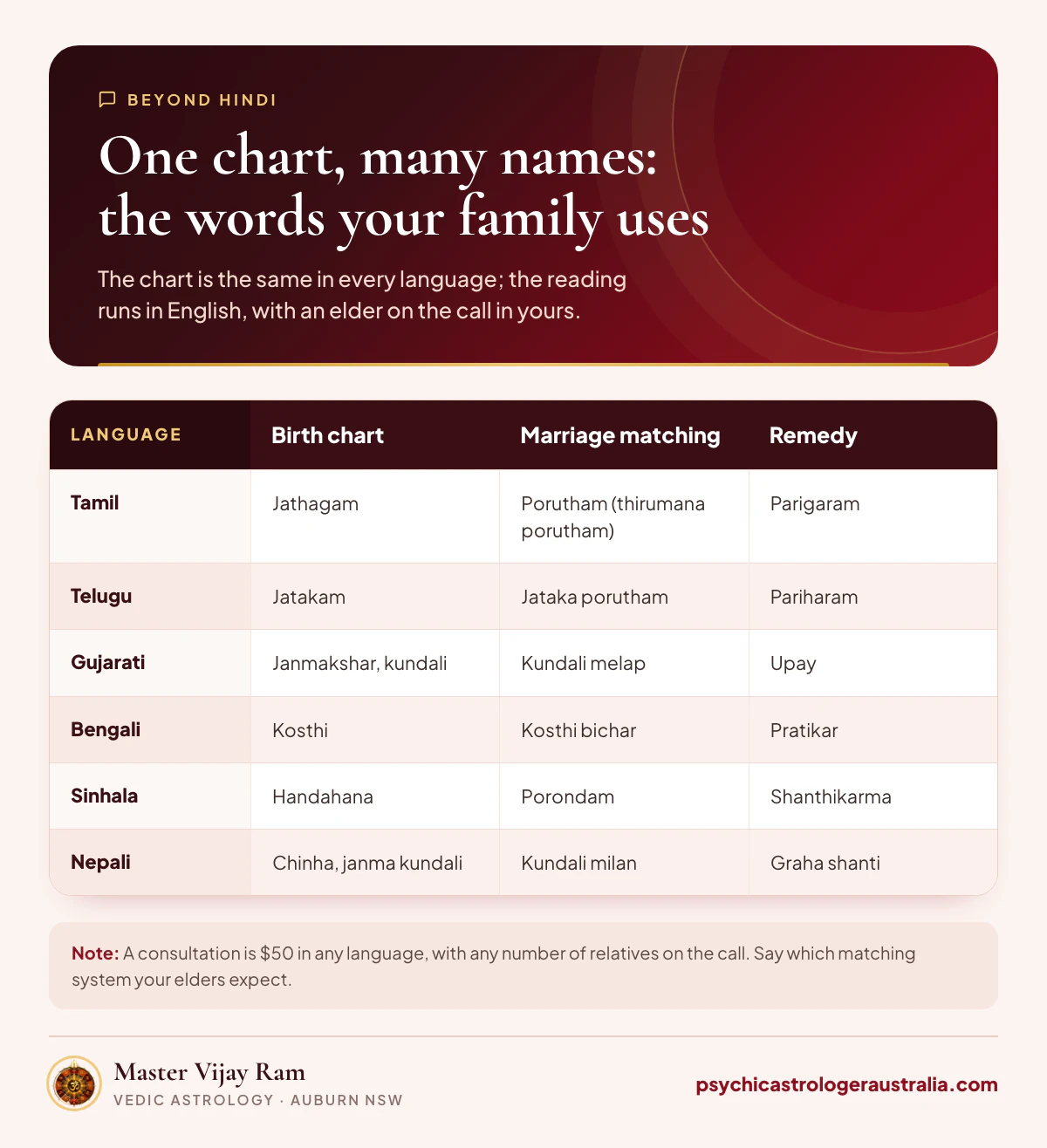
Bring the words you grew up with. He knows most of them and will ask about the rest; the table gives the ones heard most often, with the Sanskrit term they correspond to.
| Language | Birth chart | Marriage matching | Fault in the chart | Remedy |
|---|---|---|---|---|
| Tamil | Jathagam | Porutham (thirumana porutham) | Thosham (sevvai thosham, naga thosham) | Parigaram |
| Telugu | Jatakam | Jataka porutham | Dosham (Kuja dosham) | Pariharam |
| Kannada | Jataka | Jataka hondanike | Dosha | Parihara |
| Malayalam | Jathakam | Porutham | Dosham | Pariharam |
| Gujarati | Janmakshar, kundali | Kundali melap | Dosh (mangal dosh) | Upay |
| Marathi | Patrika, kundali | Gun melan | Dosh | Upay |
| Bengali | Kosthi | Kosthi bichar | Dosh | Pratikar |
| Sinhala | Handahana | Porondam | Apala (a bad period) | Shanthikarma |
| Nepali | Chinha, janma kundali | Kundali milan | Dosh | Graha shanti |
| Sanskrit / Hindi | Janma kundali | Kundli milan, gun milan | Dosha | Upaya |
A Telugu astrologer Australia search and a Gujarati astrologer Australia search usually want the same two things: someone who knows these words and someone who will not laugh at the family’s old chart. Both are reasonable.
Two cautions. A Sinhala handahana is read in the same Vedic frame but Sri Lankan practice leans on nekath, auspicious times, more than many Indian families do, and he will ask which the family wants. And a Fijian-Indian family is at home in Fiji Hindi, so for them the Hindi page applies more than this one.
Three differences that cause real confusion
First, the drawing. North Indian charts are diamonds with the houses fixed and the signs moving; South Indian charts are squares with the signs fixed and the houses moving; Bengali and Odia families use a third, eastern layout. A Tamil caller shown a northern chart often thinks the astrologer has the wrong birth, when only the shape has changed. He will draw it the way you read it.
Second, the ayanamsa, the correction that turns the Western sky into the sidereal one. He uses Lahiri, as most Indian panchangs do, but some southern almanacs and software use Raman or KP values that differ by a degree or so. Near a sign boundary that shifts the Moon or the lagna into the next sign, and families then arrive with two charts that disagree. He will say which he is using and recast from the birth details rather than from either chart.
Third, matching. Northern families expect the thirty-six points of gun milan; Tamil and Telugu families expect the ten poruthams, with rajju and dina weighed heavily; Sinhala families expect porondam. Relationship compatibility is read in the Parashari frame that underlies all of them, and the nakshatra layer of matching is where the southern systems and the northern one meet. Say at the start which system your elders will ask about.
Reading in English, with an elder on the call
Most second-generation callers are fully at home in English and want the reading that way, with a parent or grandparent listening. The pattern that works is a WhatsApp group call: the reading in English, the grandparent asking in Tamil or Telugu, the caller translating the question, and the key terms left untranslated because the elder already knows them. A Tamil astrologer Australia search often ends here, with a Vedic astrologer who reads in English and a family that supplies the Tamil.
India is four and a half hours behind Sydney in winter and five and a half in summer, Sri Lanka and Nepal within fifteen minutes of that, so an Australian evening is an afternoon at home. Online readings by phone, video and WhatsApp describes the formats; nothing about them changes with language.
When a translator genuinely helps
Not every family needs one. A caller in their thirties who grew up in Melbourne and speaks Malayalam at home usually wants the reading in English and will pass the gist to their parents afterwards, and that works well. The cases that need care are the ones where the person whose chart it is sits outside both languages he reads.
If the person whose chart it is speaks little English and no Hindi, a family member should sit with them for the whole call, not only the beginning. The questions an elder asks at minute thirty are usually the real ones. He slows down, repeats the technical terms in Sanskrit, and checks that what came back in Telugu matches what he said in English. Where that is not possible, a written summary after the call, in plain English, lets the family translate at leisure.
What to send before the call
The birth date, time and place, written in English; names and places may be in your own script as well, because a Tamil or Telugu spelling of a village is sometimes the only one anyone remembers. If an old chart exists, photograph the page that shows the planets, not only the cover. If the family almanac is a particular panchangam, say which, so that any difference in ayanamsa can be explained before it becomes a disagreement on the call.
Say which matching system the elders will ask about, and whether a nekath or a muhurat is wanted for a wedding or a housewarming. None of this is required; all of it shortens the call and makes the reading land in the words your family uses.
Where these families live, and where they pray
Sydney’s Tamil families cluster around Strathfield and Homebush and the Sri Lankan Tamil community in the inner west; Malayali nurses fill the Westmead health precinct; Telugu and Gujarati families are strong in the Hills and around Parramatta and Harris Park. The Sri Venkateswara Temple at Helensburgh south of the city, and the Sri Mandir in Auburn, the oldest Hindu temple in the country, draw all of them. Melbourne’s Tamil and Sri Lankan families gather around Dandenong, Glen Waverley and Clayton, with the Shri Shiva Vishnu Temple at Carrum Downs; Brisbane’s South Indian community around Sunnybank has its Tamil temple at South Maclean.
The Brisbane page and the Melbourne page describe the communities and the time zones in those cities. None of this requires a visit: his only place of practice is Auburn, and every other city is served by phone and video.
Festival dates in your own calendar
Southern and eastern calendars run on the same sky with different names. Pongal falls on the Makar Sankranti day, Puthandu and Vishu on the Mesha Sankranti, 14 April in 2027; Ugadi and Gudi Padwa on the Chaitra new moon’s first day; Durga Puja on the last days of Sharad Navratri. Australian dates can differ from Indian ones by a day because the tithi is the same moment on a different clock. Makar Sankranti in Australia works through the first of these; ask on the call for the others and he will give your city’s date.
What a reading in English cannot do
It cannot make a vague question precise, and it cannot replace the family astrologer in Chennai or Colombo whom the elders trust; he is happy to be a second reading alongside that one. It cannot read the rules of a visa, diagnose an illness or settle a dispute, and he will say so when a question belongs to a migration agent, a doctor or a lawyer. This is faith-based guidance in the Vedic tradition, not medical, legal or financial advice.
What it costs
A consultation is $50 in any language and with any number of relatives on the call. Where the chart warrants a remedy, spell or prayer work starts from $250 and is agreed with you before anything is performed; if nothing is warranted, nothing further is charged. A parigaram or shanthikarma that a southern family would expect is performed personally in Auburn on an auspicious muhurat, and online puja and havan sets out what it includes and how the sankalp is taken in your name and gotra, whichever language the gotra comes in.
How to begin
Send a WhatsApp message in English with your city, your language and the matter in one line; Tamil, Telugu or Gujarati script is fine for the names and places. Say who will join the call and which matching system or almanac your family uses. Punjabi families have their own article; the kundli reading itself is the same for everyone.
Read next
- Astrology and Mental Health: When to See a Doctor FirstAstrology and mental health: the signs that need a GP or Lifeline before any reading, what a chart can add once care …
- North Indian and South Indian Chart Styles, ExplainedNorth Indian, South Indian and East Indian kundli charts explained: what stays fixed in each, how to find the lagna, …
- Kala Jadu Removal for Indians & Punjabis in AustraliaKala jadu removal explained for Indian and Punjabi families in Australia: the stage-by-stage process, what you are as…
Frequently asked questions
Does Master Vijay Ram speak Tamil, Telugu or Gujarati?
No. He reads and explains a chart in English, Hindi and Punjabi. Families whose language is Tamil, Telugu, Kannada, Malayalam, Gujarati, Marathi, Bengali, Sinhala or Nepali consult him in English, usually with a parent or grandparent on a WhatsApp group call who asks in their own language while the caller translates. The technical terms are shared Sanskrit, so elders follow them without translation.
Will a reading in English be less accurate than one from our family astrologer in Chennai?
The chart is computed the same way whatever language the reading is in, so the language changes nothing about the positions or the dasha. What can differ is interpretation, as it would between any two astrologers. He is glad to be a second reading alongside the family astrologer, and will tell you where he agrees and where he reads a placement differently, and why.
Our old jathagam shows a different Moon sign from the app. Which is right?
Usually neither is wrong; they were made with different ayanamsa values, the correction that turns the tropical sky into the sidereal one. Lahiri, which he uses, and Raman or KP values differ by around a degree, which moves a Moon or lagna near a sign boundary into the next sign. He recasts from the birth details and tells you which value he used.
My parents want the ten poruthams, not gun milan. Can he do that?
Say so at the start. He reads compatibility in the Parashari frame that underlies both systems and gives particular weight to the nakshatra layer, rajju and dina, which is where the ten poruthams and the thirty-six points meet. He will explain the result in the terms your parents expect and will say plainly where the systems would disagree, rather than quoting a score from one and calling it the other.
Can a Sri Lankan Tamil or Sinhala family consult him?
Yes. A Sri Lankan handahana or jathagam is read in the same Vedic frame. Sinhala practice leans more on nekath, auspicious times, and he will ask whether the family wants those as well as the chart reading. Colombo is within fifteen minutes of India’s time difference from Australia, so an evening call here is afternoon there, and relatives can join.
How do we handle a grandparent who speaks no English and no Hindi?
Have a family member sit with them for the whole call, not just the opening, because the real questions usually come late. He slows down, says the technical terms in Sanskrit, and checks that what came back in Tamil or Telugu matches what he said. If that is not possible on the day, a plain-English written summary after the call lets the family translate at their own pace.
What does a consultation cost for a non-Hindi family?
A consultation is $50 in any language and however many relatives join the call. If the chart warrants a remedy, spell or prayer work, the parigaram or shanti a southern family would expect, it starts from $250 and the figure is agreed with you before anything is performed. If nothing is warranted, nothing further is charged. Nothing is free.
Is there a South Indian astrologer in Sydney I can visit?
His only place of practice is Auburn in Sydney, where a visit can be arranged by appointment; the Sri Mandir is in the same suburb. Everyone else, including families around Strathfield, Westmead, the Hills, Dandenong or Sunnybank, consults by phone, video or WhatsApp. He does not visit homes or hold sessions in other cities, and no page on this site claims otherwise.
People also ask
Is there a Tamil astrologer in Australia?
Tamil-speaking astrologers exist in the larger cities, but a Vedic reading does not depend on the language of the astrologer. Master Vijay Ram reads in English, Hindi and Punjabi from Auburn in Sydney, and Tamil families consult him in English with a parent on the call in Tamil. The chart, the dasha and the nakshatra matching are the same in every language.
Is Telugu astrology different from Vedic astrology?
No. Telugu, Tamil, Kannada and Malayalam astrology are regional traditions within Vedic astrology, using the same planets, signs, nakshatras and dashas. The differences are in the words, in the square chart layout, sometimes in the ayanamsa value used, and in the matching system, where southern families use the ten poruthams rather than the northern thirty-six points.
Can a Gujarati janmakshar be read by a North Indian astrologer?
Yes. A janmakshar is a kundali; the Gujarati layout is the northern diamond, and the words, rashi, dosh and upay, are the same as in Hindi. A Gujarati family in Australia usually consults in English or Hindi, with grandparents in Ahmedabad or Surat joining the call, and the matching is read as kundali melap or gun milan, which are the same thing.
What is a handahana?
Handahana is the Sinhala word for a birth chart, read in Sri Lanka in the same Vedic system used across India. A Sinhala family will also ask about porondam, the matching of two charts for marriage, apala, a difficult planetary period, and nekath, the auspicious times for beginning something, which Sri Lankan practice uses more than many Indian families do.
Does an Indian astrologer need to speak my language?
No. The chart is arithmetic and the terms are Sanskrit, shared across every Indian language. What matters is that the person whose chart it is, or an elder beside them, understands the explanation, which a reading in English with a family member translating achieves. A written summary afterwards helps families who want to discuss the reading in their own language.
References & further reading
Serving clients across Australia
Confidential consultations by phone, video & WhatsApp — including: