

Quick answer
Negative energy from a neighbour is nearly always one of three things: an ordinary dispute over noise, fences or parking; envy that has been given a spiritual name; or, rarely, something left at your door that frightened you. The Vedic response is protection on your own side of the fence, never retaliation, and a reading only when the pattern outlasts the ordinary explanations.
What does negative energy from a neighbour usually mean?
Negative energy from a neighbour is the name a household gives to one of three things: an ordinary dispute that has worn everyone down, envy that has been given a spiritual name, or, rarely, something found at the door that frightened the household. Each needs a different response, and only the third has anything to do with what Master Vijay Ram does. Most families who ring him about a neighbour are helped most by being told which of the three they have.
The tradition’s own answer is unglamorous. Protect your threshold, keep your lamp, mind your own conduct, and never send anything back across the fence. Negative energy removal as he performs it is work on your own house, and it begins only where the ordinary explanations have been tried.
Why do neighbours get blamed?
Because they are close enough to see. The person who watched the new car arrive, heard the wedding music and knows the renovation went over budget is the person a family thinks of when things turn. In the growth estates of Tarneit or Marsden Park the fences are a metre apart and the houses went up in the same year, so comparison is constant, and in the apartment blocks of Harris Park and Parramatta a shared wall carries every argument.
A jealous neighbour is also a real thing, and envy does sour a street. What the tradition says is that envy is the neighbour’s burden, and that a household’s protection does not depend on the neighbour’s heart changing.
What should be ruled out first?
A dispute is a dispute. Noise, fences, overhanging trees, parking, dogs and rubbish have councils, strata committees and community mediation services for a reason, and a problem that can be solved by a letter should not be solved by a lemon. Every state runs a community justice or dispute settlement service that mediates between neighbours without a court, and Legal Aid can say which one applies to you.
Then the household’s own state. A couple fighting after a long commute, a child not sleeping, a business in a bad year, all feel like something pressing in from outside, and the neighbour is the nearest outside there is. He asks about these before anything else, and most calls end here.
What is being noticed, and what does it usually mean?
The table takes the things families describe and sets the ordinary explanation beside the first step. The last column is the narrow case where a reading is worth having.
| What you notice | The ordinary explanation | First step | When a reading helps |
|---|---|---|---|
| Everything went wrong after they moved in | Coincidence; a new noise or light changing your sleep | Keep a two-week log of sleep, noise and incidents | The log shows a pattern that began on one nameable date |
| They stare, comment on your things, ask what you paid | Envy, or just a talkative neighbour | Share less; keep your threshold clean and your lamp lit | The signs of nazar follow their praise within a day |
| Arguments start when they are home | Noise through a shared wall; your own stress | Strata or council; a quiet word if it is safe | Never, for this on its own |
| Chillies, lemons, ash or a doll at your door | Their discarded bundle; children; an attempt to frighten you | Photograph, bin with gloves, wash the step with salt water | The household feels wrong for weeks afterwards |
| A plant dies, a pet sickens, a car fails | Season, age, maintenance | Vet, mechanic, nursery | Several unrelated failures on one date |
The signs of negative energy in a home covers the household side of this in detail, and it does not change because the suspected source lives next door.
Is it the evil eye?
Sometimes, and the sign is timing. Nazar, in the tradition, lands when a thing is admired, and a neighbour who praised the new kitchen, the baby or the car the day before the trouble began is the classic case. Even then the response is not aimed at the neighbour; it is nazar utarna for your own household, done once, and the threshold practices that keep the house steady.
Evil eye and nazar removal describes what he reads and what a shanti involves when the timing does carry something. It never involves naming who looked.
What if something was left at your door?
Most of what families find is innocent: a bundle that fell from a neighbour’s own door on bin night, children, a lemon from a tree. Occasionally it is an attempt to frighten, which is a nasty thing to do and still only an attempt. Photograph it, put it in the outside bin with gloves, wash the step with salt water, and let it go.
If it came with a threat, a note or damage, that is a police matter and not a spiritual one. Jadu tona explained sets out what such objects mean in the tradition and why the right response is always protection of your own house rather than a reply.
Protection that stays on your side of the fence
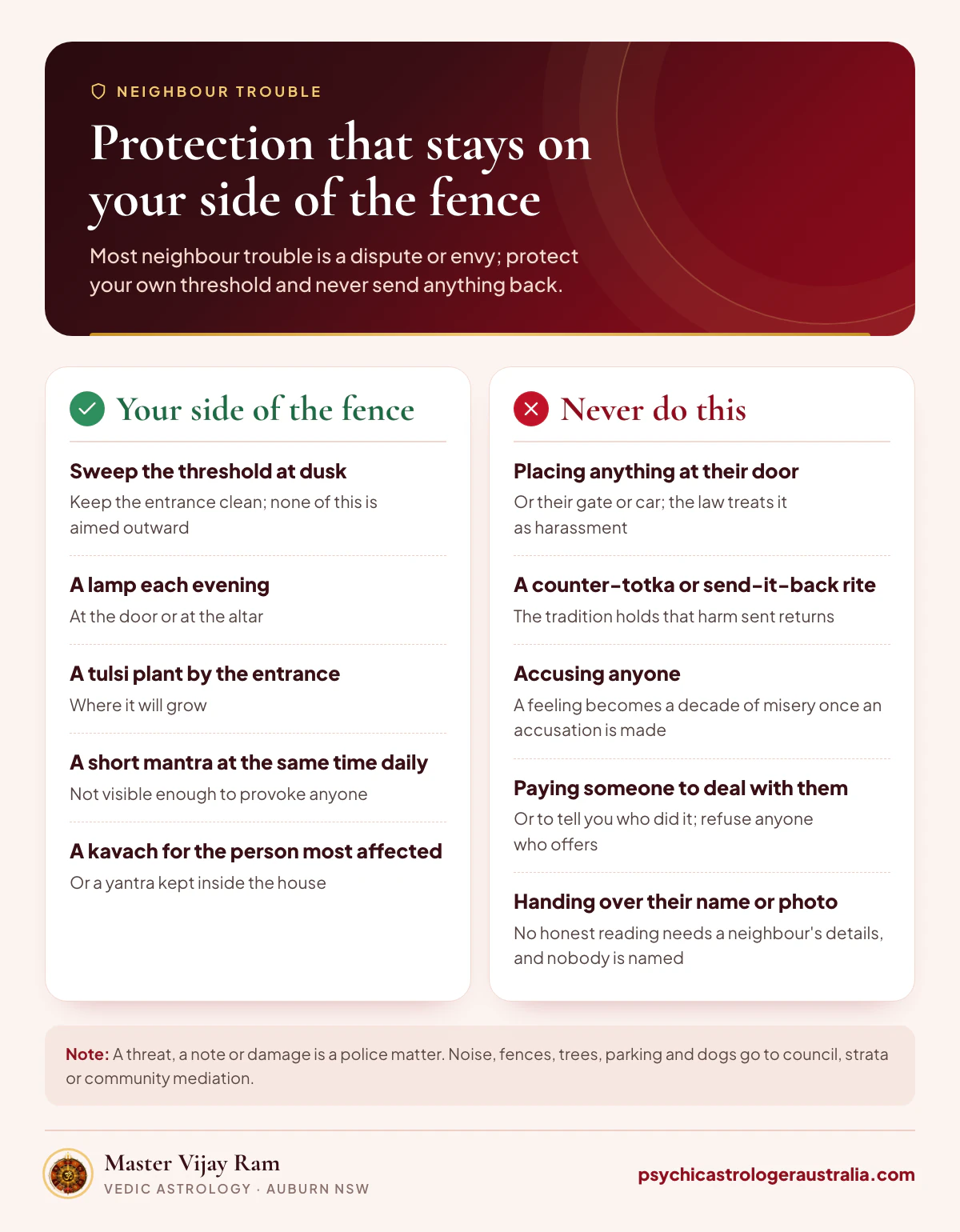
Protection from neighbours, in the Vedic sense, is protection of your own threshold. The entrance is kept clean and swept at dusk, a lamp is lit at the door or the altar each evening, a tulsi plant sits by the entrance where it will grow, and a short mantra is said at the same time each day. None of it is aimed outward, and none of it is visible enough to provoke anyone.
A kavach worn by the person who feels most affected, or a yantra kept inside the house, are the traditional additions. Taweez and kavach protection explains what is honest to expect from one and what is not.
What should you never do?
Never place anything at the neighbour’s door, gate or car. Never attempt a counter-totka, a “send it back” rite, or anything sold to you as turning their energy around on them; the tradition is clear that harm sent returns, and the law is clearer still about harassment. Never accuse. A neighbour dispute that began as a feeling becomes a decade of misery once an accusation is made, and no reading is worth that.
He refuses to perform anything aimed at another person, and he says so at the first mention of it.
What does Master Vijay Ram check?
The birth details of the head of the household and of the person most affected, the date the trouble began, and the dates of the move, the dispute or the praise. He reads the chart against those dates and says plainly whether the timing carries anything or whether the household has a hard season with a convenient face next door.
He does not ask for the neighbour’s name, photograph or birth details, and he would not use them if offered. A reading of a stranger’s chart to find a culprit is not something the tradition permits, and nobody is ever named.
When is a house cleansing warranted?
When the household, not the neighbour, shows the pattern: heaviness that began on a nameable date, lifts away from the house, and has outlasted the ordinary fixes and the log. Then a shanti is performed by him personally at his place of practice in Auburn, on a chosen muhurat, with the family joining by video if they wish, followed by a short practice at the threshold for a set number of evenings.
The cleansing is of your house. Nothing is done to the house next door, and the neighbour need never know anything happened.
Apartments and shared walls: Harris Park, Parramatta, Tarneit
The calls that mention a neighbour come most from places where people live closest: the apartment blocks of Harris Park and Parramatta, the new estates of Tarneit and Point Cook, the townhouses of Dandenong and Blacktown. Negative energy removal in Parramatta and the Tarneit page describe how the work runs for a flat with a shared wall or a house a metre from the next.
A caller in Melbourne, on the Gold Coast or in Newcastle is read the same way by phone, video or WhatsApp, and the only in-person option is Auburn by appointment.
What does it cost?
The consultation is $50 and is the whole of the first charge; most calls about a neighbour end there, with the family sent to council, mediation, a GP or a fortnight’s log. Where a cleansing of your own house is warranted, it starts from $250, agreed with you before anything is performed, and the figure does not rise because a neighbour is involved. Online puja and havan explains what a performed remedy includes.
Anyone who offers to deal with the neighbour for a fee, or to tell you who did it, should be refused.
What a reading cannot do
It cannot move a neighbour, change their heart, prove they did anything, or win a dispute that belongs with council or a mediator. It cannot be guaranteed, and it is offered as faith-based guidance, not as medical, legal or financial advice; a threat is for the police and a fence is for the surveyor.
What it can do is tell a frightened household which of the three things it is facing, protect its own threshold properly, and, in the minority of cases where the house itself carries a pattern, clear it once. That is a smaller promise than the one families hope for, and it is the one that holds.
Neighbour trouble across Australian suburbs: who handles what
Who handles a neighbour problem depends on the kind of home. In a unit block the strata committee or body corporate deals with noise, smells and shared walls; on a suburban street in Liverpool or Campbelltown the council looks after trees, dogs and rubbish; and on a new estate in Perth's south-east, where houses in Harrisdale and Canning Vale went up side by side, a dividing fence is a matter for the two owners first. A renter goes to the property manager in writing, and where talking fails, the community mediation service in each state is the next step, never a reply over the fence.
Festival weeks are when friction peaks. Diwali lights, wedding music and a street lined with cars for a Saturday puja are joy on one side of the fence and a long night on the other, and a friendly note in the letterbox a week ahead does more for a street than any protective rite. A family in Salisbury or Mawson Lakes, or in Logan south of Brisbane, may find the quarrel began with a parking spot and the fear of nazar arrived later.
The reading itself does not change from city to city: it happens by phone, video or WhatsApp, a Perth household simply books in its own evening, two or three hours behind Auburn, and in-person appointments are kept only in Auburn. Each local page, whether Liverpool negative energy removal, Campbelltown negative energy removal, negative energy removal for Salisbury or Logan negative energy removal, describes protection for your own threshold, never anything aimed next door.
Read next
- Jealous Relatives and Negative Energy: Protection Without a Family RiftJealous relatives and negative energy: the ordinary causes first, nazar from praise, boundaries that keep the peace, …
- Visiting India: Nazar, Gifts and Protection When You Travel HomeVisiting India and nazar: small protections before you fly, taking praise without fear, gifts and biosecurity, jet la…
- House Cleansing for Negative Energy: A Room-by-Room Vedic GuideA room-by-room Vedic guide to house cleansing for negative energy: what to rule out first, what is safe to do yoursel…
Frequently asked questions
How do I protect my home from a negative neighbour?
By protecting your own threshold rather than aiming anything at theirs. Keep the entrance clean and swept at dusk, light a lamp at the door or the altar each evening, keep a tulsi plant by the entrance, say a short mantra at the same time daily, and share less about your purchases. None of it is visible enough to provoke anyone, and none of it depends on the neighbour changing.
Can a jealous neighbour give my family the evil eye?
In the tradition, nazar lands when a thing is admired, so a neighbour who praised the baby, the car or the kitchen the day before trouble began is the classic case. The response is still nazar utarna for your own household, done once, and the threshold practices. Nobody is named, nothing is sent back, and a child who is unwell sees a GP before anything else.
Someone left chillies, a lemon or ash at my door. What should I do?
Photograph it, put it in the outside bin wearing gloves, wash the step with salt water and let it go. Most such finds are a neighbour’s own discarded bundle, children or a prank; occasionally an attempt to frighten, which is still only an attempt. A threat, a note or damage is a police matter. If the house feels wrong for weeks afterwards, have the pattern read rather than the object.
Should I do a counter-totka or send the energy back?
No. The tradition holds that harm sent returns, Master Vijay Ram refuses any work aimed at another person, and the law treats objects placed at a neighbour’s door as harassment. A counter-rite also keeps your attention on the neighbour, which is the opposite of protection. Clean your own threshold, keep your own lamp, and let the fence be a fence.
Will he tell me whether the neighbour did something?
No, and he will not read the neighbour’s chart or look at their photograph to find out. He reads your household’s chart against the dates the trouble began and says whether the timing carries anything. If it does, the remedy is a cleansing of your own house; who looked, said or did anything is left unanswered, because naming a neighbour causes harm no energy ever did.
When is a neighbour problem a council or mediation matter instead?
Whenever it can be described in a letter: noise, fences, trees, parking, dogs, rubbish, building work. Councils and strata committees handle most of it, every state runs a community justice or dispute settlement service that mediates between neighbours without a court, and Legal Aid can say which one applies. A reading does not win a fence dispute, and he will say so.
What does it cost to have the house cleansed because of a neighbour?
The consultation is $50 and is the whole of the first charge; most neighbour calls end there with a referral to council, mediation, a GP or a two-week log. Where the house itself shows a pattern, a cleansing performed personally at Auburn starts from $250, agreed before anything is done, and the figure does not rise because a neighbour is involved.
Does living in an apartment make negative energy from a neighbour more likely?
It makes the ordinary causes more likely: noise through a shared wall, cooking smells, a corridor light, a neighbour’s argument at midnight all change sleep and temper and feel like something pressing in. Most apartment calls from Harris Park or Parramatta end with strata, earplugs and a log. The pattern that warrants a reading is the same as in a house: a nameable date and signs that outlast the ordinary fixes.
People also ask
How do you get rid of negative energy from neighbours?
Separate the dispute from the feeling. Noise, fences and parking go to council, strata or community mediation; envy is answered by sharing less and keeping your own threshold clean, your lamp lit and a mantra said daily. Nothing is placed at the neighbour’s door and nobody is accused. Where your own house then shows a pattern on a nameable date, a reading says whether a cleansing is warranted.
What are the signs of a jealous neighbour?
Constant questions about what you paid, comments on the car or the renovation, watching from the window, coolness after your good news. In the tradition the only sign that matters is timing: trouble that began within a day of their praise. Even then the response is protection of your own household, not confrontation, and a child who is unwell sees a doctor first.
Can a neighbour put a curse on your house?
Families fear it, and the tradition takes the fear seriously, but most households that feel cursed have a dispute, a hard season or a frightening find at the door, not a curse. A reading of the household’s chart against the dates tells which. Where the house carries a pattern, it is cleansed once; the neighbour is never named, read or targeted.
What should you never do in a neighbour dispute?
Never place objects at their door, never attempt a counter-rite or anything sold as sending energy back, never accuse them of nazar or black magic, and never let a feeling become a feud. Harm sent returns in the tradition and harassment is an offence in law. Keep the dispute with council or a mediator and the protection on your own side of the fence.
Does Master Vijay Ram deal with the neighbour for you?
No. He refuses any work aimed at another person, does not read or name a suspected neighbour, and will say so at the first mention. What he offers is a $50 reading of your own household’s chart against the dates the trouble began, honest advice on which of the three ordinary explanations fits, and a cleansing of your own house from $250 only where the pattern is really there.
References & further reading
Serving clients across Australia
Confidential consultations by phone, video & WhatsApp — including: