

Quick answer
Jinn removal in Melbourne and Sydney, as Master Vijay Ram practises it, is a series of ruqyah sessions held by video or phone from the family's own home, after a $50 consultation that puts medical care and ordinary causes first. The recitation is the work, not the room; sessions start from $250, agreed before the first is held, and nobody is named or blamed.
What is jinn removal, and why is it done remotely?
Jinn removal is the lifting of a disturbance that a family attributes to a jinn, through ruqyah: recitation of the Quran over the person or the house, with a daily practice set for the household afterwards. Jinn removal in Melbourne and in Sydney is done by Master Vijay Ram the same way it is done for a family in Townsville, by video or phone from the family's own home, because the recitation is the work and the room is not. Nothing about a session requires him to be in Dandenong or Granville, and nothing about it is weaker for his being in Auburn.
This page explains how a remote ruqyah session is set up and run, what is asked beforehand, what medical care comes first, what a family should and should not expect to see, and what it costs. Jinn and jinnat removal is the service page behind it, and ruqyah and spiritual healing describes the practice more broadly.
Who calls from Melbourne and Sydney?
From Melbourne, families in the south-east around Dandenong, Springvale, Noble Park and Keysborough, and from the northern growth corridor, where Craigieburn's Turkish and Iraqi communities and the Indian families around them share a vocabulary for this. From Sydney, families in Auburn itself, Granville, Merrylands, Harris Park and Parramatta, and out through Bankstown and Liverpool. Many are Muslim; a good number are Hindu or Sikh households who use the word jinn because their Muslim neighbours do.
The Dandenong and Parramatta suburb pages describe those areas in their own terms, and both say what this page says: there is no office, room or visiting day in either suburb, and the work does not need one.
Why does a remote session work as well as one in the room?
Because ruqyah is recitation, and recitation carries over a call as it carries across a room. Reciting over a person by phone or video is widely practised by raqis in Australia and overseas, and the parts of the practice that need a physical presence, the water, the oil, the hand on the head, are done by a family member on instruction while he recites. The person is in their own home rather than a stranger's, which for a frightened child or an elderly parent is a mercy rather than a compromise.
What a remote session cannot do is make a disturbance real that is not there, and a practitioner who can only find a jinn when he is paid to visit is telling you something. Melbourne families in particular ask whether he travels; he does not, and the reasons are in the next section.
Before the first session: what is asked, and what is not
A short account by WhatsApp of what has been happening, with dates: what is seen or heard, who it affects, when it began, what has changed in the house, what has already been tried and who has already been consulted. The names of the people in the home. For a family that wants the Vedic reading alongside the ruqyah, the birth details of the person affected. A photograph of the room, if the disturbance is in the house.
Not asked for: a photograph or the name of anyone the family suspects, any object to be posted, gold or jewellery, or any payment beyond the $50 consultation until a series of sessions has been agreed. A practitioner who asks for any of these before the first session is to be avoided, and the signs of a jinn disturbance at home explains what a careful assessment looks like instead.
Medical care and ordinary causes come first
Hearing voices, seeing what others cannot, seizures, long periods of lost time, a person who has stopped eating or sleeping: each of these is a medical matter before it is anything else, and the consultation says so and stops. A GP, a psychologist or a psychiatrist comes before any recitation, and a family that has not yet seen one is asked to, kindly and without exception. Faith-based guidance is not medical, legal or financial advice, and ruqyah is offered alongside care, never in place of it; when to see a doctor first sets out the line.
The ordinary causes of a disturbed house are gone through at the same time: plumbing, vermin, a gas or electrical fault, a neighbour, a grief that has not been spoken, a child who has learnt that a story gets attention. Most enquiries end here, with an explanation and a practical step, and no sessions are offered.
How does a remote ruqyah session run?
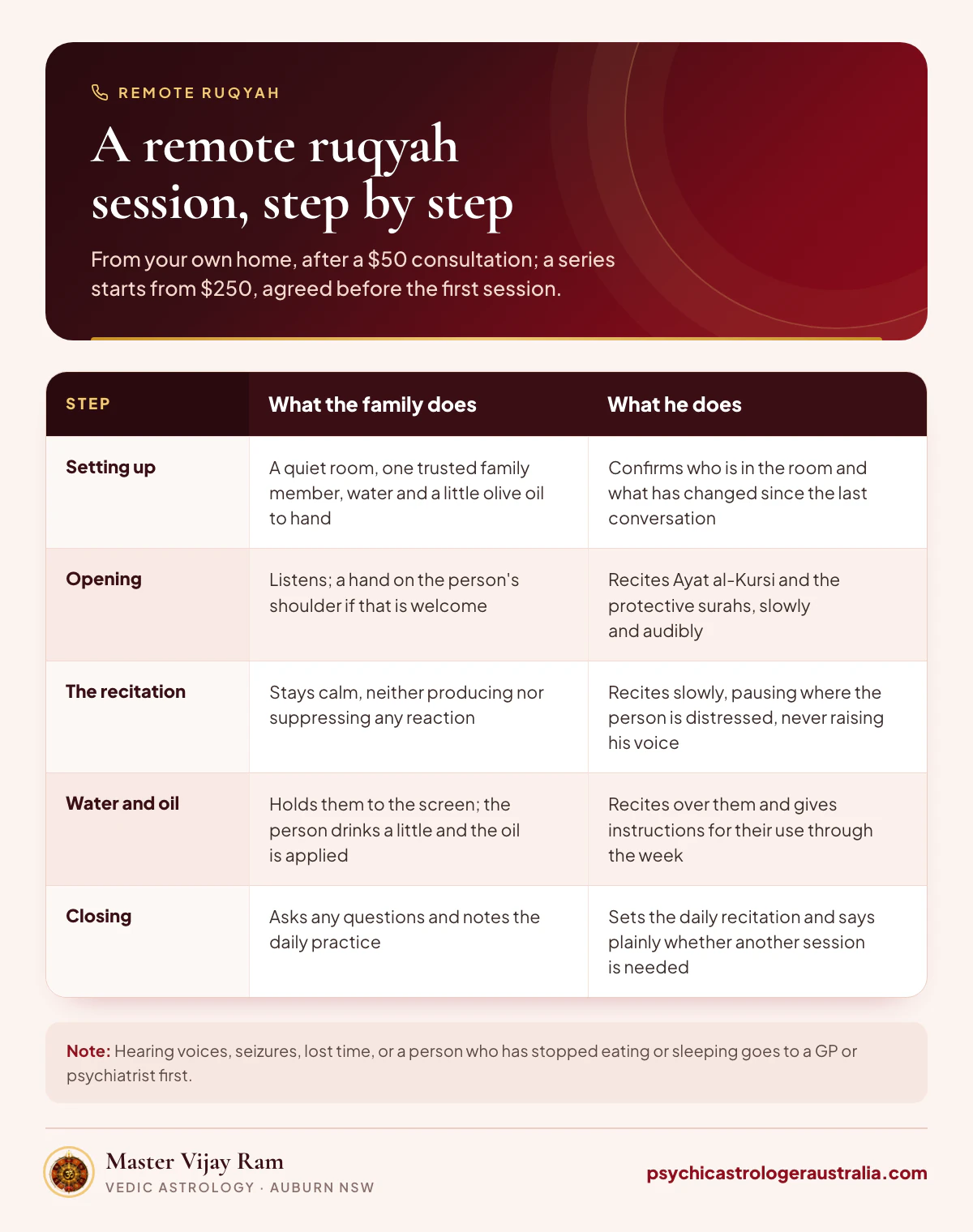
The table sets out a session step by step, with what the family does and what he does. It is deliberately undramatic.
| Step | What the family does | What he does |
|---|---|---|
| Setting up | A quiet room, the person seated comfortably, one trusted family member present, a glass of water and a small bottle of olive oil to hand; for Muslim clients, wudu | Confirms who is in the room, how the person is today, and what has changed since the last conversation |
| Opening | Listens; the family member keeps a hand on the person's shoulder if that is welcome | Recites the opening verses, Ayat al-Kursi and the protective surahs over the person, slowly and audibly |
| The recitation | Stays still and calm; does not try to produce or suppress any reaction | Continues the recitation, pausing where the person is distressed, never raising his voice or touching through the screen |
| Water and oil | Holds the water and oil to the screen; the person drinks a little and the family member applies the oil as instructed | Recites over the water and oil and gives the instructions for their use through the week |
| Closing | Asks anything they need to; notes the daily practice given | Sets the household's daily recitation, says plainly what he observed, and names the next session or says that none is needed |
A person or a house: two different sessions
A session for a person is the one in the table. A session for a house is a walk through it on video, room by room, with the family carrying the phone, while he recites in each and gives the household its own practice for the threshold, the bedrooms and the room where the disturbance sits. Sometimes the two are needed together, and sometimes the house session shows that what was being described is a damp wall, a loose gutter or a neighbour's extractor fan, and he says so.
What should you expect to see, and what should you not?
Not much, and that is the point. Some people yawn, weep, feel heat or cold, or become drowsy during recitation; some feel nothing at all; neither is proof of anything, and he does not treat a reaction as a diagnosis. There is no shouting, no commanding, no theatrics and no moment at which a jinn is said to speak. A practitioner who produces drama on a call is producing it for the family, and a family that has been told to expect convulsions has been told something by someone who wanted the next booking.
Between sessions: what the household keeps
A short daily practice, given at the first session and kept through the series: the morning and evening recitations that Muslim families already know, the water used as instructed, the room aired and the household's own routines, sleep, meals, prayer, kept to. Where a child is involved, the practice is small enough for the child to keep too. Recurring nightmares and sleep paralysis covers the night-time side, which is where most families notice change first.
How many sessions, and when is it over?
A short series over some weeks, with the number agreed at the start rather than discovered as it goes, and fewer rather than more where the household settles early. It is over when the nights are ordinary, the person is themselves and the house is a house, and he says so rather than finding a reason for one more. A jinn removal specialist who cannot say when the work is finished is not practising a tradition.
For Hindu and Sikh families: the same story, a different remedy
A family who arrives with the word jinn but keeps a Hindu or Sikh home is read and treated within its own tradition: the same consultation, the same ordinary causes first, and where a disturbance is genuinely indicated a havan with mantra sadhana performed by him personally at Auburn, the family joining by video, with a lamp, a mantra and a threshold practice kept afterwards. Online puja and havan explains how that is performed and witnessed from a distance.
What does it cost?
The consultation is $50, by phone, video or WhatsApp, and it is where the assessment happens: the medical questions, the ordinary causes, and the account of the disturbance with its dates. Most enquiries end there and no further fee applies. Where a series of sessions is warranted, it starts from $250 and the figure is agreed in full, as one number for the series, before the first session is held. It does not rise, there is no stronger round, and no gold, jewellery or valuables are asked for at any stage.
Privacy, recording and who is in the room
Nothing is recorded unless the family asks for it, and nothing is shared with anyone, including relatives who made the referral and want to know how it went. One trusted family member in the room is best; a crowd is not, and relatives who have been promoting the idea of a jinn are gently asked to sit elsewhere. For a woman who would prefer it, a female relative holds the phone and he recites without the camera on her; for a child, a parent is always present.
Jinn removal in Sydney: what to check before you book anyone
Whether the first conversation puts the doctor before the recitation, whether a culprit is named or a relative blamed, whether the fee is stated once and in full, whether you are told to expect drama, and whether the work has an end. Jinn removal in Sydney and ruqyah in Melbourne are advertised by many hands, and the honest version is recognisable by how little it promises and how plainly it says when nothing is there. An online ruqyah session with him begins with a message and a time, in your own home, and the first question asked is whether anyone in the house has seen a doctor.
Read next
- Black Magic Removal Online: How Remote Vedic Removal WorksHow remote black magic removal works: what to send, the $50 consultation by phone or WhatsApp, the havan at Auburn fo…
- Voodoo Removal in Sydney and Melbourne: How Remote Reversal WorksVoodoo removal in Sydney and Melbourne: what people mean by the word, the signs they describe, ordinary causes first,…
- Sihr Removal in Australia: Signs of Sihr and How Ruqyah HelpsSihr removal in Australia explained: the signs worth taking seriously, what to rule out first, how ruqyah actually wo…
Frequently asked questions
Can jinn removal really be done over a video call?
Yes. Ruqyah is recitation, and reciting over a person by phone or video is widely practised by raqis in Australia and overseas. The parts that need a physical presence, the water, the oil, a hand on the shoulder, are done by a family member on instruction while Master Vijay Ram recites. The person stays in their own home, which for a frightened child or an elderly parent is easier than a stranger's room. Nothing is weaker for the distance.
Does he visit homes in Melbourne or Sydney for jinn removal?
No. There is no office, consulting room or visiting day anywhere except his own place of practice in Auburn, where in-person appointments can be made, and anyone offering a jinn removal house call in Dandenong, Parramatta or anywhere else in his name is not him. Sessions for a person and for a house are both held by video, and a house session is a walk through the rooms with the family carrying the phone.
What should we see a doctor about before booking?
Hearing voices, seeing what others cannot, seizures or fits, long periods of lost time, and a person who has stopped eating or sleeping. Each is a medical matter first, and the consultation will ask whether a GP, psychologist or psychiatrist has been seen and will stop until one has. Ruqyah is offered alongside medical care and never instead of it, and faith-based guidance is not medical advice.
What happens during a remote ruqyah session?
The person sits in a quiet room with one trusted family member, a glass of water and a little olive oil to hand. He recites the opening verses, Ayat al-Kursi and the protective surahs over them, slowly and audibly, pausing where the person is distressed, then recites over the water and oil and gives instructions for the week. The session ends with a daily practice for the household and a plain account of what he observed.
What reactions are normal during ruqyah?
Some people yawn, weep, feel heat or cold or become drowsy; some feel nothing at all. Neither is proof of anything and he does not treat a reaction as a diagnosis. There is no shouting, no commanding and no moment at which a jinn is said to speak. A family told to expect convulsions or drama has been told it by someone who wanted the next booking, and the honest version of this work is quiet.
How many sessions does jinn removal take?
A short series over some weeks, with the number agreed at the start rather than discovered as it goes, and fewer where the household settles early. It is over when the nights are ordinary, the person is themselves and the house is a house, and he says so rather than finding a reason for one more. The daily practice given at the first session continues afterwards as the household's own routine.
What does jinn removal cost in Melbourne or Sydney?
The consultation is $50 and covers the whole assessment, by phone, video or WhatsApp; most enquiries end there with an ordinary cause found and no further fee. Where a series of sessions is warranted, it starts from $250 and is agreed in full as one figure before the first session is held. It does not rise, there is no stronger round, and no gold, jewellery or valuables are asked for at any stage.
We are Hindu but our neighbours say it is a jinn. Who do we call?
The same consultation. A family that keeps a Hindu or Sikh home is read and treated within its own tradition: ordinary causes first, and where a disturbance is genuinely indicated a havan with mantra sadhana performed by Master Vijay Ram personally at Auburn, with the family joining by video and a lamp, a mantra and a threshold practice kept afterwards. The word the neighbours used does not change what is done.
Is anything recorded or shared?
Nothing is recorded unless the family asks for it, and nothing is shared with anyone, including the relative who made the referral. One trusted family member in the room is best; relatives who have been promoting the idea of a jinn are gently asked to sit elsewhere. A woman who prefers it has a female relative hold the phone and he recites without the camera on her, and a parent is always present for a child.
People also ask
How do you get rid of a jinn in the house?
First by ruling out what a house does on its own, plumbing, vermin, a fault, a neighbour, and by seeing a doctor about anything that affects a person's mind or sleep. Where a disturbance is genuinely indicated, by ruqyah: a walk through the rooms on video while Master Vijay Ram recites in each, with a daily practice set for the household afterwards. No culprit is named and no drama is produced.
Is online ruqyah effective?
Ruqyah is recitation, and recitation carries over a call as it carries across a room; reciting by phone or video is widely practised by raqis in Australia and overseas, with a family member handling the water and oil on instruction. What no session can do, remote or in the room, is make a disturbance real that is not there, and a practitioner who finds a jinn only when paid to visit is telling you something about himself.
Who is a jinn removal specialist in Sydney?
Master Vijay Ram takes jinn removal enquiries from Sydney and Melbourne by phone, video or WhatsApp, working with Muslim clients within the Islamic framework and with Hindu and Sikh families within theirs, and practising in person only at Auburn. The consultation is $50 and a series of sessions, where warranted, starts from $250, agreed first. The honest version of this work puts the doctor first and promises little.
What are the signs of a jinn in a person?
Families describe changed behaviour, aversion to prayer or recitation, nightmares, fear at night and a person who does not seem themselves. Every one of these has ordinary and medical explanations that are checked first, and anything involving voices, seizures or lost time goes to a doctor before any recitation. A reaction during ruqyah is not proof, and a careful practitioner does not treat it as one.
How much does ruqyah cost in Australia?
With Master Vijay Ram the consultation is $50 and a series of ruqyah sessions, where a disturbance is genuinely indicated, starts from $250, agreed in full as one figure before the first session and never rising afterwards. Many enquiries end at the consultation with an ordinary cause found. Advertised prices elsewhere vary widely; a fee that grows session by session is the pattern to walk away from.
References & further reading
Serving clients across Australia
Confidential consultations by phone, video & WhatsApp — including: