

Quick answer
Ruqyah for anxiety, fear and waswas is recitation offered as faith-based comfort alongside medical care, never in place of it. Master Vijay Ram asks first whether a GP or psychologist has been seen and sends anyone in crisis to Lifeline; where a person wants recitation beside that care, gentle sessions are held by phone or video. The consultation is $50; sessions start from $250.
What is ruqyah for anxiety?
Ruqyah for anxiety is recitation of the Quran over a person who is frightened, restless or besieged by doubt, offered as faith-based comfort that sits beside medical care and never in its place. Anxiety is a medical condition that a GP and a psychologist treat well, and nothing on this page suggests otherwise. What ruqyah offers is the thing many Muslim clients ask for alongside that treatment: the recitations the tradition gives for fear, a steady voice, and a daily practice that makes the nights shorter.
This page sets out the gentle approach Master Vijay Ram takes: who comes first, what waswas is and is not, what a session looks like, what it costs, and the signs that mean the phone should be put down and Lifeline rung instead. Ruqyah and spiritual healing is the service page behind it; this page is narrower, and quieter.
Who comes first: your GP, a psychologist, and Lifeline
Before any recitation, a doctor. Anxiety that has lasted weeks, panic that arrives without warning, sleep that has broken down, a low mood that will not lift, thoughts of not wanting to be here: each of these is a medical matter, and the first thing he asks on a call is whether a GP has been seen and whether a psychologist is involved. If the answer is no, that is the first step, and the consultation says so kindly and does not go further until it is taken. Anyone in crisis is sent to Lifeline or to emergency services before anything else is discussed.
Faith-based guidance is not medical, legal or financial advice. The tradition itself says to seek treatment, and a recitation offered to someone who has been talked out of their medication is harm dressed as help. When to see a doctor first draws the same line for every service on this site.
What is waswas?
Waswas is the tradition's word for the whispering: intrusive thoughts and doubts that arrive unbidden, often about faith itself, prayer done wrongly, wudu not valid, a thought so unwelcome that having it feels like a sin. The tradition's advice is older than any clinic and remarkably close to modern practice: seek refuge, do not engage the thought, do not repeat the prayer a fourth time, and carry on. The thought is not the person, and the distress at having it is the sign of a sincere heart rather than a corrupted one.
Waswas as people describe it is very often what a psychologist would recognise as obsessive thinking, including the religious form sometimes called scrupulosity, and that is treatable. He says so, and he sends people to that treatment. Recitation is offered beside it, as the tradition's own comfort for the whispering, not as a cure for a condition.
What do people describe, and what helps first?
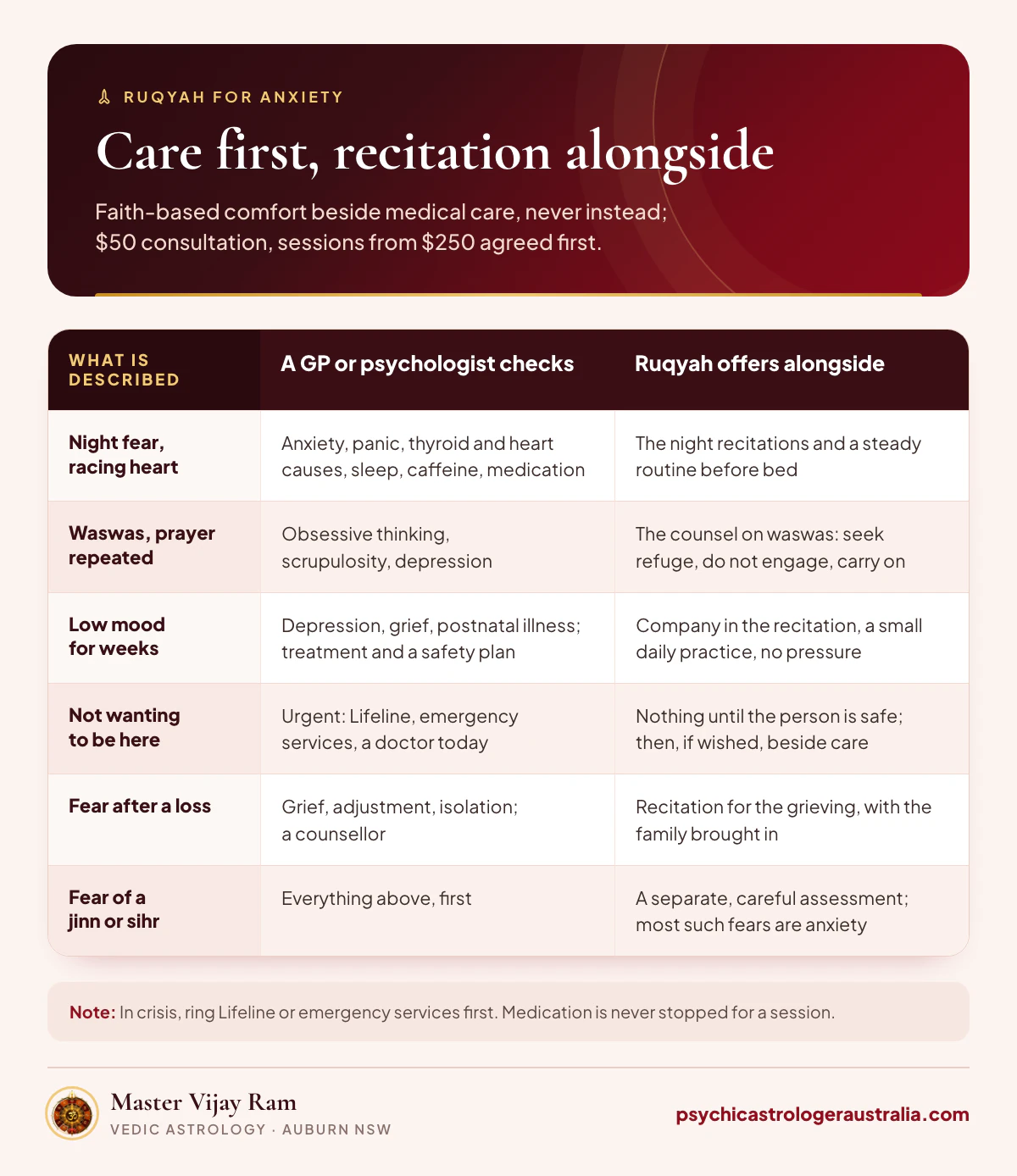
The table sets what people bring to a ruqyah for fear call beside what a doctor would want to check and what recitation can offer alongside. The middle column is always first.
| What the person describes | What a GP or psychologist checks first | What ruqyah offers alongside |
|---|---|---|
| Fear at night, a racing heart, cannot settle | Anxiety, panic, thyroid and heart causes, sleep, caffeine, medication effects | The night recitations, a steady routine before bed, a calm voice at the worst hour |
| Thoughts about faith that will not stop; prayer repeated | Obsessive thinking, scrupulosity, depression; a psychologist with experience of it | The tradition's own counsel on waswas: seek refuge, do not engage, carry on |
| A low mood for weeks, nothing enjoyable | Depression, grief, postnatal illness, a medical cause; treatment and a safety plan | Company in the recitation, a small daily practice, no pressure to feel better on a schedule |
| Thoughts of not wanting to be here | Urgent: Lifeline, emergency services, a doctor today | Nothing until the person is safe; then, if they wish, recitation beside care |
| Fear after a death, a loss, a migration | Grief, adjustment, isolation; a counsellor | Recitation for the grieving, the family brought into the practice |
| Fear that a jinn or sihr is the cause | Everything above first | A separate, careful assessment; most such fears are anxiety wearing older clothes |
What does the gentle approach mean?
No shouting, no commanding, no theatrics and no diagnosis of a jinn in a frightened person. Recitation is slow and audible, paused wherever the person is distressed, and never used to produce a reaction. Nobody is told that their anxiety is a punishment, a possession or the work of a relative. Sessions are short rather than long, and the person decides what they can manage on the day. A practitioner who meets anxiety with drama has added to it, and the gentle approach exists because the opposite one does harm.
What does a session look like?
By phone or video from the person's own home, at a time they choose, with a family member present if they want one and absent if they do not. He asks how the week has been, what the doctor has said, and what the person wants from the session. Then the recitations the tradition gives for fear and for the whispering, over the person and over a glass of water they keep for the week, and a small daily practice set at the end: the morning and evening remembrances most Muslim families already know, kept at the same hour each day.
What happens in a ruqyah session describes the practice in full; the anxiety session is a quieter version of it, with more listening and less recitation than a session for a disturbance.
Is ruqyah for depression the same thing?
Ruqyah for depression follows the same rules, with the medical side weighted even more heavily. Depression is treated by doctors and psychologists, often with medication that the tradition does not forbid and that he will never advise against; recitation is company in the illness, not treatment of it. Where a person is low enough that safety is in question, the session does not happen until a doctor is involved and a plan is in place. Beyond Blue is given on every such call, and the family is brought in with the person's consent.
Anxiety, waswas and the fear of a jinn
Many people who ask for spiritual anxiety relief are afraid the anxiety is itself the sign of something: a jinn, sihr, a relative's ill-will. The fear is understandable and almost always wrong, and he says so. Anxiety wearing older clothes is still anxiety, and it is treated as such; where a family nonetheless wants a careful assessment of a disturbance, that is a separate conversation with its own rules, and the spiritual view of nightmares and sleep paralysis covers the night-time fears that most often prompt it.
Who asks for this?
Students far from home in their first exam season, new mothers in the months after a birth, wives on a mine roster alone for a fortnight at a time, men who have never said the word anxious aloud, grandparents who lost a spouse. From Brisbane and the Gold Coast, from Newcastle and the Central Coast, from Melbourne. What they share is a wish for the recitation they grew up with to be part of getting better, and that wish is honoured alongside the doctor, not in competition with them.
Ruqyah or a Vedic remedy?
A Hindu or Sikh client with the same fear is offered the equivalent within their own tradition: a mantra practice, a lamp at dusk, the Moon and the mind read in the chart, with the same medical line drawn first. Health and wellbeing remedies describes that side, and ruqyah or Vedic healing helps a mixed household choose. Where a remedy is performed, it is performed personally at Auburn and witnessed by video; for anxiety it is rarely warranted and never the first step.
Decisions made in fear
Anxiety pushes people towards decisions, a marriage ended, a job left, a move made, in the hope that the decision will stop the fear, and it usually does not. Where a person wants guidance on a decision rather than comfort in a feeling, istikhara is the practice the tradition gives for that, and it is a different conversation; a decision made at the worst hour of the night is the one most often regretted, and he will say so before offering either.
What does it cost?
The consultation is $50, by phone, video or WhatsApp, and it is where the medical questions are asked, the story is heard and the person decides whether recitation is something they want beside their care. Where sessions are wanted, they start from $250 for a short series, agreed in full as one figure before the first session; the figure does not rise, there is no stronger round, and no gold, jewellery or valuables are asked for. A person who cannot afford sessions is not pressed, and is given the daily practice regardless.
When ruqyah is not enough, and what to do that night
If the fear is of harming yourself, or of not wanting to be here, the recitation waits and the phone call that matters is to Lifeline, or to emergency services if you are in danger now. If the anxiety has lasted weeks and no doctor has been seen, the first appointment is with a GP, and ruqyah healing in Australia, with him or anyone else, is something to add afterwards rather than instead. If the thoughts are about faith and will not stop, a psychologist who understands scrupulosity is worth asking for by name. None of this is a failure of faith; the tradition that gave the recitations also said to seek the cure.
Read next
- Ruqyah or Vedic Healing: Which Is Right for You?Ruqyah or Vedic healing? Choose by your own tradition, what is being described and who is trained for the work. Costs…
- Jinn Removal in Melbourne and Sydney: How Remote Ruqyah Sessions WorkJinn removal for Melbourne and Sydney families: how a remote ruqyah session is set up and run by video, what medical …
- Sihr Removal in Australia: Signs of Sihr and How Ruqyah HelpsSihr removal in Australia explained: the signs worth taking seriously, what to rule out first, how ruqyah actually wo…
Frequently asked questions
Can ruqyah cure anxiety?
No, and nothing on this page claims it. Anxiety is a medical condition treated by GPs and psychologists, and ruqyah is offered as the tradition's comfort alongside that treatment: the recitations for fear, a steady voice at the worst hour, a daily practice that shortens the nights. Master Vijay Ram asks first whether a doctor has been seen and does not go further until one has. Faith-based guidance is not medical advice.
What is waswas and is it the same as OCD?
Waswas is the tradition's word for the whispering: intrusive thoughts and doubts, often about faith, prayer or purity, that arrive unbidden and distress the person who has them. As people describe it, it is very often what a psychologist would recognise as obsessive thinking, including the religious form called scrupulosity, which is treatable. The tradition's counsel, seek refuge, do not engage, do not repeat the prayer again, sits well beside that treatment.
Should I stop my medication to have ruqyah?
No. The tradition does not forbid medication, says to seek the cure, and he will never advise against treatment a doctor has given. A recitation offered to someone who has been talked out of their medication is harm dressed as help. Ruqyah sits beside treatment as comfort and company; where a person is low enough that safety is in question, no session happens until a doctor is involved and a plan is in place.
What happens in a ruqyah session for anxiety?
By phone or video from your own home, at a time you choose, with a family member present only if you want one. He asks how the week has been and what the doctor has said, then recites the passages the tradition gives for fear and for the whispering, slowly, pausing wherever you are distressed, over you and over a glass of water you keep for the week. A small daily practice is set at the end. Sessions are short.
Is my anxiety a sign of a jinn or sihr?
Almost always not, and he says so. Anxiety wearing older clothes is still anxiety and is treated as anxiety, with the doctor first. A frightened person is never told on a call that they are possessed, punished or the target of a relative, because that adds to the fear and is not true. Where a family still wants a careful assessment of a disturbance, that is a separate conversation with its own rules and the same medical line drawn first.
What does ruqyah for anxiety cost?
The consultation is $50, by phone, video or WhatsApp, and covers the medical questions, the story and the decision about whether recitation is wanted beside care. Where sessions are wanted, a short series starts from $250, agreed in full as one figure before the first session; it does not rise and no valuables are asked for. A person who cannot afford sessions is not pressed and is given the daily practice to keep regardless.
I have thoughts of not wanting to be here. Can you help tonight?
Not with recitation, not tonight. Please ring Lifeline, or emergency services if you are in danger now, and if you can, tell someone in your home. That is the call that matters, and he will say the same on the phone and stay with you while you make it. Recitation, if you want it, is something to add afterwards, beside a doctor and a plan, when you are safe. Nothing about asking for help is a failure of faith.
Does he treat non-Muslim clients for anxiety?
He offers a Hindu or Sikh client the equivalent within their own tradition, a mantra practice, a lamp at dusk, the Moon and the mind read in the chart, with the same medical line drawn first: a GP and a psychologist before anything, and Lifeline or Beyond Blue for anyone in crisis. A remedy performed at Auburn is rarely warranted for anxiety and is never the first step, whichever tradition the person keeps.
How is this different from a ruqyah session for a jinn disturbance?
Quieter, shorter and with more listening. A session for a disturbance follows a careful assessment of a house or a person and has its own rules; a session for anxiety assumes nothing of the kind, treats the fear as fear, and offers the tradition's recitations for it beside the care a doctor is giving. Nobody is told during an anxiety session that a jinn has been found, because that is not what the session is for.
People also ask
Is there ruqyah for anxiety and fear?
The tradition gives recitations for fear and for the whispering, and Master Vijay Ram offers them by phone or video as comfort beside medical care, never instead of it. The first question on any call is whether a GP or psychologist has been seen, anyone in crisis is sent to Lifeline first, and sessions are short, gentle and free of theatrics. The consultation is $50 and a series of sessions starts from $250, agreed first.
What is the treatment for waswas?
Medically, treatment for obsessive thinking, which waswas very often is, including the religious form called scrupulosity; a psychologist with experience of it is worth asking for by name. From the tradition, the counsel to seek refuge, not engage the thought, not repeat the prayer again, and carry on. Recitation is offered beside that treatment as the tradition's own comfort, not as a cure for the condition.
Can ruqyah help with depression?
As company in the illness, beside treatment, and not as treatment itself. Depression is treated by doctors and psychologists, often with medication the tradition does not forbid and that he never advises against. Where safety is in question no session happens until a doctor is involved and a plan is in place, Beyond Blue is given on every such call, and the family is brought in with the person's consent.
Does anxiety mean a jinn is affecting me?
Almost always not. Anxiety is a medical condition with ordinary causes and good treatment, and a frightened person is never told on a call that they are possessed or the target of a relative, because it is not true and it adds to the fear. Where a family still wants a careful assessment of a disturbance, that is a separate conversation with its own rules, and the doctor comes first in that one too.
Where can I get ruqyah healing in Australia?
Master Vijay Ram offers ruqyah by phone or video from anywhere in Australia, working with Muslim clients within the Islamic framework and alongside their own imam, and practising in person only at Auburn in Sydney. For anxiety the approach is gentle and the doctor comes first. The consultation is $50 and a short series of sessions starts from $250, agreed in full before the first; nobody is pressed to pay for sessions they cannot afford.
References & further reading
Serving clients across Australia
Confidential consultations by phone, video & WhatsApp — including: