
Quick answer
A roka is the small family ceremony that formally settles a match; a sagai is the engagement itself, usually with rings and a larger gathering. Each is held on a muhurat chosen from the panchang for the place where it happens, avoiding Rahu kaal and inauspicious spans. Families split between Australia and India can join by video and plan around the time difference.
What are roka and sagai, and how do they differ?
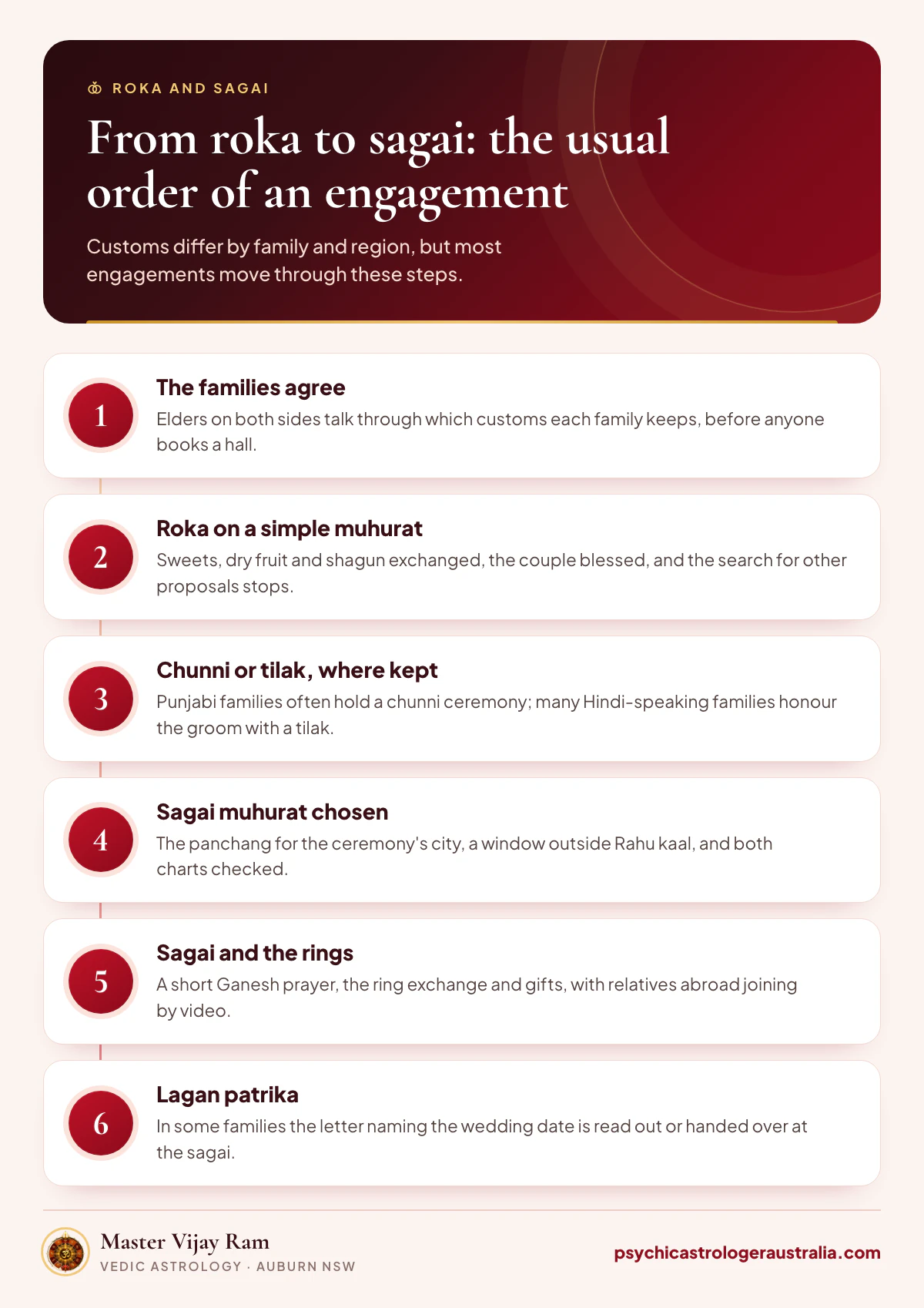
A roka ceremony is a small, mostly private gathering that marks the moment two families agree to a match, and the word itself is usually explained as “stopping”: the search for a partner stops here. A sagai ceremony is the engagement proper, often with an exchange of rings, a larger guest list and, in many families, the first public announcement. Some families hold both months apart; others fold them into a single afternoon.
The names and the details change from region to region. Punjabi families often keep a roka and then a chunni ceremony for the bride; Hindi-speaking families may say mangni for the sagai and hold a tilak for the groom; south Indian families speak of nischayathartham, and Gujarati families of gol dhana. The underlying idea is shared: the families commit publicly before the wedding is planned.
What happens at a roka?
In most families a roka is short. The two families meet at one of their homes or at a temple, exchange sweets, dry fruit and shagun (a gift of money, clothes or jewellery), and the couple receive blessings from the elders. Sometimes a red thread is tied or a tilak applied, and a simple Ganesh prayer begins it.
Its purpose is social rather than ritual. After the roka, both families stop entertaining other proposals, and relatives are quietly told.
Choosing its day is usually where a muhurat and auspicious date reading first comes in. That is why many couples feel it is the real point of commitment, more than the larger party that follows.
What happens at a sagai?
A sagai is usually larger and more formal. Rings are exchanged, the families present gifts to each other, and in many north Indian homes a family priest performs a short puja before the exchange. In some families the lagan patrika, the letter naming the wedding date, is read aloud or handed over at the sagai.
The scale varies enormously. A sagai in Geelong may be thirty people in a community hall; one in Amritsar may be three hundred. Neither is more correct, and the ritual core, the blessing and the exchange, can be kept intact in either.
| Ceremony | Usually held | What it marks | Muhurat usually needed? |
|---|---|---|---|
| Roka | Soon after the families agree | The match is settled; the search stops | A good day and hour; many families keep it simple |
| Chunni ceremony | With or after the roka (Punjabi families) | The groom’s family welcomes the bride with a chunni | Often taken with the roka or sagai muhurat |
| Tilak | Before the sagai (many Hindi-speaking families) | The bride’s family honours the groom | Yes, in families who keep it |
| Sagai or mangni | Weeks to months before the wedding | The engagement; rings exchanged | Yes, chosen from the panchang |
| Lagan patrika | At or after the sagai | The wedding date written and shared | Follows the vivah muhurat |
Does a roka need a muhurat?
Many families say yes, but a light one. The usual practice is to choose a day with a supportive tithi and nakshatra, avoid Rahu kaal, and begin within a good choghadiya. A family priest or an astrologer looks at the panchang for the city where the roka will be held, because the times are local.
Some families do not worry about a muhurat for the roka at all and keep their care for the sagai and the wedding. That is a matter of family custom, not a rule that brings bad luck if ignored. If one side cares and the other does not, agreeing to a muhurat is an easy courtesy and usually settles the matter.
How is an engagement muhurat chosen?
An engagement muhurat is chosen the same way as other auspicious times: the panchang for the place of the ceremony is read for tithi, weekday, nakshatra and yoga, and then the daytime is narrowed to a window free of Rahu kaal and inside a favourable choghadiya. The couple’s own charts are checked so that the day does not sit on a difficult transit for either of them. A muhurat consultation does this for the actual city and date range the families are considering.
The method behind it is set out in how a vivah muhurat is chosen; a sagai uses the same building blocks with fewer restrictions. Rahu kaal, for example, is one eighth of the daylight, its position fixed by the weekday, so it moves with the local sunrise and sunset. No date or hour is typed here, because every one depends on the city and the couple.
Which periods do families avoid for an engagement?
Traditions differ, but three spans come up most often. Kharmas, when the Sun is in Dhanu from 16 Dec to the Makara Sankranti on 15 Jan, is avoided for weddings and by many families for engagements too. Chaturmas, the four months that end at Dev Uthani Ekadashi, is avoided for weddings by many, though some families allow a roka or sagai inside it.
Dev Uthani Ekadashi falls on Wed 10 Nov 2027 in every Australian city, and it is traditionally when the wedding season reopens; Dev Uthani Ekadashi and the wedding season explains why. Some families also avoid a period of mourning or the year after a death in the immediate family. Ask the elders on both sides which of these they keep before anyone books a hall.
How do families split between Australia and India hold a roka?
This is now common. The groom’s parents may be in Ludhiana while he lives in Townsville; the bride’s family may be on the Sunshine Coast and her grandparents in Jaipur. Many couples hold the roka in whichever country both families can physically gather, and have the absent side join by video for the blessing.
When the ritual is in one country and the family watching is in another, the muhurat is calculated for the place where the ritual is actually performed. Time zones matter for the people joining. India is several hours behind the east coast, and the gap changes when daylight saving starts or ends in the southern states.
| Where you are | Standard time | Daylight saving | Compared with Sydney |
|---|---|---|---|
| NSW (incl. Central Coast), Victoria (incl. Geelong), ACT, Tasmania | AEST, UTC+10 | AEDT, UTC+11 | Same as Sydney all year |
| Queensland (Brisbane, Gold Coast, Sunshine Coast, Townsville, Cairns) | AEST, UTC+10 | None | Same April–October; 1 hour behind October–April |
| South Australia (Adelaide) | ACST, UTC+9:30 | ACDT, UTC+10:30 | 30 minutes behind all year |
| Northern Territory (Darwin) | ACST, UTC+9:30 | None | 30 minutes behind April–October; 1½ hours behind October–April |
| Western Australia (Perth) | AWST, UTC+8 | None | 2 hours behind April–October; 3 hours behind October–April |
In 2027 daylight saving ends on Sunday 4 April and begins on Sunday 3 October.
Northern families have their own arithmetic: Darwin keeps one clock all year, so the gap to Sydney changes twice a year while the gap to India stays fixed. Darwin families planning with relatives in the south can see how readings are arranged from there on the astrologer in Darwin page. For a family reading with elders in India on the call, family in India joining a reading covers the practical side.
Can one family do the roka here and the other in India?
Some families do exactly that: the bride’s side blesses her in Cairns on the same day the groom’s side holds a small prayer in Delhi, each at its own local muhurat, with a video call linking them. It is a practical compromise rather than a classical form, and most priests accept it where travel is impossible. The rings or the chunni can be exchanged in person later, at the sagai or before the wedding.
What does not work well is choosing one muhurat and asking the other country to wake at 3 am for it. A good muhurat reading looks for a window that is sensible in both places, or advises two local windows.
What about gifts and sweets carried from India?
Engagements involve a great deal of mithai, dry fruit and gifts crossing borders. Arriving travellers must declare food, plant material and animal products on the Incoming Passenger Card. The Department of Agriculture’s festival guidance names sweets such as burfi, ras malai, rasgulla and pedas, along with dairy, dried fruit, spices and raw nuts, as possible risks, while artificial flowers, fabric and gold or silver beads are not.
Declare everything and let the officers decide; items that pose no risk are handed back. It is far easier to buy fresh sweets from an Indian shop near the venue than to argue at the airport.
Is a puja needed before the sagai?
Many families begin a sagai with a short Ganesh puja led by their own priest or an elder, and that is entirely sufficient. Where a chart shows a strained period for one of the couple and the family wants a prayer for a smooth engagement, a puja can be performed by Master Vijay Ram personally at his place of practice in Auburn, with the family joining by video if they wish. Puja and havan performed on request start from $250, and the amount is agreed before anything is done.
That is optional. No sagai is incomplete without a paid puja, and he will say so if asked.
What if the families disagree about the customs?
Disagreements usually come from two regional customs meeting for the first time: one side expects a chunni ceremony, the other has never heard of it; one side gives heavy shagun, the other keeps it symbolic. These are questions for the elders to talk through early, ideally before the roka, so nobody feels slighted on the day.
A useful rule many families follow is that the side hosting a ceremony sets its customs, and the other side is welcomed into them. The couple can quietly agree which customs matter to them and ask their parents to protect those.
What can a muhurat reading not do?
A muhurat chooses a supportive time; it does not make an engagement successful, and it cannot settle family disagreements over gifts, guest lists or the wedding itself. It is faith-based guidance, not legal or financial advice. An engagement has no legal effect in Australia, and anything about property or visas belongs with a lawyer or Home Affairs.
If the couple are still unsure about the match itself, an engagement is not the place to resolve it. Questions about the relationship belong with a love and marriage reading or a counsellor, before the rings.
How does a muhurat consultation work, and what does it cost?
A consultation with Master Vijay Ram is $50 by phone, video or WhatsApp, in English, Hindi or Punjabi. You give the city of the ceremony, the date range the families are considering and both partners’ birth details; he reads the panchang and the charts and gives one or more windows with the reasoning. Families from the Central Coast sometimes visit Auburn in person instead.
Once the sagai is behind you, the wedding rituals that follow are set out in Hindu wedding rituals from haldi to vidaai.
Read next
- Wedding Date Astrology: How a Vivah Muhurat Is ChosenWedding date astrology for Australian families: how a vivah muhurat is chosen from the panchang, the lagna, both char…
- Planning a Wedding in India From Australia: Dates and MuhuratPlanning a wedding in India from Australia: why the muhurat is set for the Indian venue, how leave and travel fit, an…
- Kala Jadu Removal for Indians & Punjabis in AustraliaKala jadu removal explained for Indian and Punjabi families in Australia: the stage-by-stage process, what you are as…
Frequently asked questions
What is the difference between roka and sagai?
A roka is a small family gathering that marks the moment two families agree to a match, after which both stop considering other proposals. A sagai is the engagement itself, usually with a ring exchange, gifts between families and a larger guest list. Some families hold them months apart; others combine them. Regional names and customs differ.
Do we need a muhurat for a roka?
Many families choose one, but it is usually simple: a supportive tithi and nakshatra, a window outside Rahu kaal and inside a good choghadiya, read for the city where the roka will be held. Some families keep their care for the sagai and the wedding instead. It is a family custom rather than a rule, and ignoring it does not bring bad luck.
Whose city is used for the engagement muhurat?
The place where the ritual is actually performed. If the sagai is in Townsville and relatives in India join by video, the muhurat is calculated for Townsville, because sunrise, sunset and Rahu kaal are local. If each family holds its own prayer on the same day, each can use its own local window, and a reading can look for times that suit both.
Can a roka be done over video?
The ritual part, the blessing and the exchange of sweets and shagun, is normally held in person with at least some of the family present, and the other side often joins by video. Where travel is impossible, some families hold a small prayer in each country at its local muhurat, linked by a call. Rings or a chunni can be exchanged in person later.
Which months are avoided for an engagement?
Traditions differ. Many families avoid Kharmas, when the Sun is in Dhanu from 16 Dec until Makara Sankranti on 15 Jan. Chaturmas, which ends at Dev Uthani Ekadashi, is avoided for weddings by many families, though some allow a roka or sagai inside it. Some also avoid the months after a death in the close family.
Can we bring sweets from India for the sagai?
You must declare food, plant material and animal products on the Incoming Passenger Card. Official festival guidance names sweets such as burfi, ras malai, rasgulla and pedas, as well as dairy, dried fruit and spices, as possible risks. Declare everything and officers decide; items with no risk are handed back. Buying fresh sweets locally is usually simpler.
Is a puja necessary before the engagement?
Most families begin a sagai with a short Ganesh prayer led by their own priest or an elder, and that is sufficient. A separate puja is only worth considering if a chart shows a strained period and the family wants a prayer. Master Vijay Ram performs one personally in Auburn from $250, agreed before it is done, and it is never required.
How much does a sagai muhurat consultation cost?
A consultation with Master Vijay Ram is $50, by phone, video or WhatsApp, in English, Hindi or Punjabi. You give the ceremony city, the date range being considered and both partners’ birth details, and he gives one or more suitable windows with the reasons. Any optional puja is separate, starting from $250 and agreed before it is performed.
People also ask
What is a roka ceremony?
A roka is a small north Indian ceremony, common in Punjabi and Hindi-speaking families, that marks the formal agreement of two families to a match. The families meet, exchange sweets, dry fruit and shagun, and bless the couple. Afterwards both sides stop considering other proposals. It is usually short and private, and often comes weeks or months before the sagai.
What happens at an Indian engagement ceremony?
Customs vary, but a sagai usually opens with a short prayer, often to Ganesha, then the couple exchange rings and the families exchange gifts. In some families the wedding date is read out or handed over in a letter called the lagan patrika. Guest lists range from a few relatives at home to a large hall gathering.
How is a good date for an engagement chosen?
A priest or astrologer reads the panchang for the ceremony’s city, looking at tithi, weekday, nakshatra and yoga, then narrows the day to a window outside Rahu kaal and inside a favourable choghadiya. The couple’s charts are checked so the day does not fall on a difficult transit for either. Exact times depend on local sunrise and sunset.
Is roka the same as engagement?
Not quite. A roka is the earlier, smaller step where the families agree and the search stops; a sagai is the engagement with rings and a wider announcement. Some families treat the roka as the true commitment and the sagai as a celebration, while others combine both into a single event. Regional names for each step differ.
References & further reading
Serving clients across Australia
Confidential consultations by phone, video & WhatsApp — including: