

Quick answer
A blended family settles slowly, over years rather than months, and it settles best when the children’s needs come before the adults’ hopes. A Vedic reading can show the seasons each person is in and how the new partner’s children are read in the chart, but counselling, patience and clear parenting roles do the real work. Relationships Australia comes first.
What is a blended family, and why is it hard?
A blended family is a household that joins a couple with children from one or both partners’ earlier relationships, and it is hard because everyone arrives with a history. The children did not choose the new arrangement, the ex-partner still exists, and each adult brings habits from a household that ended. In Indian families there is often a fourth layer: grandparents and relatives who are still deciding how they feel about the remarriage itself.
Master Vijay Ram hears from step-mothers in Adelaide, fathers rebuilding after divorce on the Gold Coast and widows in Hobart starting again. He treats these questions as part of guidance for family problems, and the first thing he says is that the children’s needs come first, ahead of anyone’s wish for a quick happy ending.
How long does it take for a blended family to settle?
Longer than anyone hopes. Counsellors who work with stepfamilies commonly speak in years, not months, and the age of the children matters a great deal: young children may adapt faster, teenagers often resist hardest, and adult children can surprise everyone with their feelings about a parent’s new partner.
Patience is not passivity. It means letting relationships grow at the children’s pace, accepting that a step-child may be polite long before they are warm, and not measuring success by whether everyone sits happily at Diwali dinner in the first year.
What do children need first?
Safety, routine and permission to love both homes. A child who is made to choose between a parent and a step-parent, or who hears adults criticise the other household, carries that strain into school and sleep. A child who is allowed to miss the old arrangement, and is not punished for it, usually settles faster.
Their own time with their own parent matters too. A father who still takes his son to cricket alone on Saturdays, even after remarrying, tells the boy that he has not been replaced. Kids Helpline and headspace are there for children and young people who need someone outside the family to talk to.
What should a step-parent do, and not do?
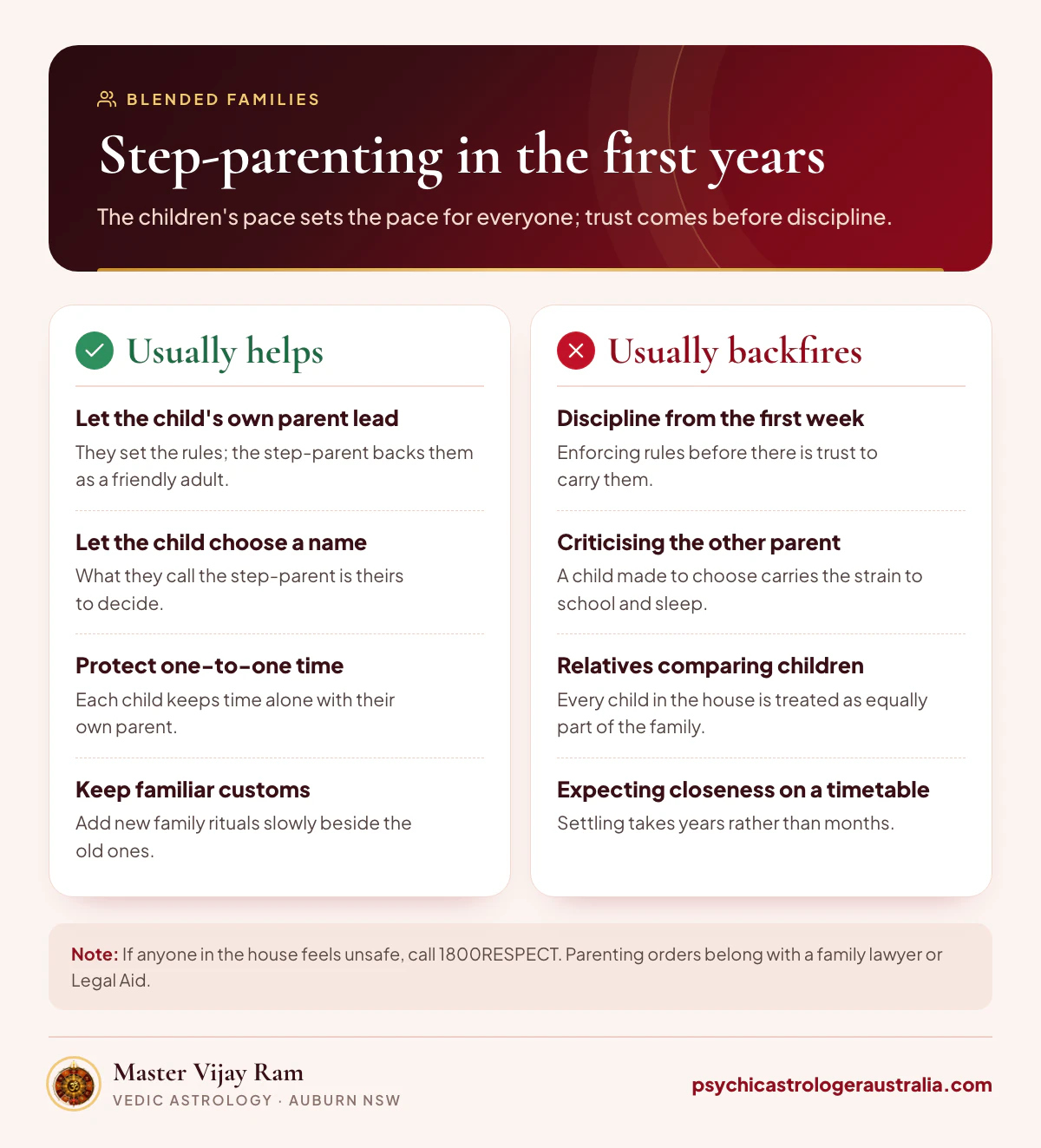
In the early years, a step-parent does best as a friendly adult rather than a second disciplinarian. The biological parent sets and enforces the rules, the step-parent supports them, and discipline from the step-parent comes later, once there is trust to carry it.
| Area | Usually helps | Usually backfires |
|---|---|---|
| Discipline | The child’s own parent sets the rules; the step-parent backs them | The step-parent enforcing rules from the first week |
| Names and titles | Letting the child choose what to call the step-parent | Insisting on Mum, Dad, Mummy-ji or Papa |
| The other parent | Speaking of them neutrally or not at all | Criticism in the child’s hearing |
| Grandparents | Inviting them gradually, with clear expectations | Relatives comparing step-children with grandchildren |
| Rituals and festivals | Keeping each child’s familiar customs and adding new ones slowly | Replacing the old family’s traditions all at once |
What does the chart say about a second marriage?
The seventh house is read for the spouse, and traditions differ on how a later marriage is read. Some astrologers look to the ninth house, counted as the third from the seventh, and some to the eleventh or to the dasha running at the time of the remarriage. It is one input among many, and nothing in it says a second marriage is doomed or blessed.
What matters more is the season. A couple who marry during a Jupiter or Venus period often find goodwill easier to come by; a couple who marry in a Saturn stretch may find the first years heavier and the bond more durable for it. Remarriage after losing a spouse looks at the family feelings that follow a widow or widower who marries again.
How are a partner’s children read in your chart?
Vedic astrology reads your own children from the fifth house, and a partner’s children can be read through bhavat bhavam, counting houses from another house. The fifth counted from the seventh is the eleventh house, so one derived-house method reads a spouse’s children from your eleventh. The fifth house and children explains the base house this rests on.
The eleventh is also the house of friendships and networks, which many step-parents find fitting: the relationship that works best is often closer to a trusted friend than to a replacement parent. Traditions differ on how far to take derived houses, and the method describes texture, never a verdict on a child.
Can two families’ charts be compared?
Some couples ask for a compatibility reading before remarrying, and a few ask about the step-children too. A couple’s charts can be read for the strains and supports they bring to each other, and relationship compatibility readings covers that. Reading a child’s chart to decide whether to marry their parent is something he will not do: a child is not a factor to be scored.
Where a child is struggling, their own chart can be read gently for the season they are in, with the parent’s consent and the child’s privacy respected. Reading a child’s kundli with care sets out what is sensible to look at.
What about step-siblings who do not get on?
Children who suddenly share a house, a bathroom and their parents’ attention will compete, and some rivalry is normal. Separate spaces where possible, one-to-one time with each parent, and rules that apply equally to every child in the house reduce it. Sibling rivalry and family peace looks at the chart side of brothers and sisters.
When rivalry turns into bullying, threats or harm, the adults step in firmly and early, and the school or a counsellor is involved.
How do Indian relatives react to a blended family?
Often with more opinions than help. A divorced daughter who remarries, or a widower who brings a wife with her own children into the family home, can meet silence from aunts, comparisons between grandchildren, or gifts at Raksha Bandhan that quietly leave someone out. Relatives may mean no harm and still wound a child.
The parent who belongs to that family is the one to speak up. A short, firm line, that every child in this house is our child, said once and repeated as needed, protects the step-children more than any ritual. Families who fear jealousy or nazar from relatives can keep the usual household protections, but the main protection is a parent who will not let a child be treated as second-class.
When should a blended family get counselling?
Earlier than most do. Relationships Australia and other family services offer counselling for stepfamilies and couples, and family dispute resolution where parenting arrangements with an ex-partner are contested. Parenting orders, child support and anything that touches the law belong with a family lawyer or Legal Aid.
If anyone in the house is afraid, of a partner, an ex-partner or a step-parent, 1800RESPECT is the number to call, and the safety of the children comes before any other consideration in this post.
Is there a ritual for a new blended household?
Many families find a small shared ceremony helps everyone feel the house is now theirs together: a griha shanti, a havan, a Satyanarayan katha, or simply lighting a lamp together on the first evening in a new home. The point is inclusion, so each child can be given a role, pouring the ghee, ringing the bell or carrying the prasad.
If the family wants Master Vijay Ram to perform a puja for the household, he does it personally at his place of practice in Auburn on a chosen muhurat, and the family joins by video if they wish. Puja and havan for a household explains how it is arranged. A puja starts from $250, agreed before it is performed.
What can a reading not do for a blended family?
It cannot make a step-child love you, settle a custody arrangement, or decide who is right in an argument with an ex-partner. It will not name anyone as the cause of the household’s troubles. Step parent problems are mostly solved with time, clear roles and outside help, and the chart only describes the seasons in which those are tested.
What it can do is ease blame. A step-mother who learns that her husband is in a heavy dasha, and that her step-daughter is in a restless one, often stops taking every slammed door personally. A consultation is $50, by phone or video in English, Hindi or Punjabi; readings for Canberra families explains how sessions work for clients outside Sydney. In person, he sees people only in Auburn, by appointment.
What helps in the hardest months?
Small, repeated things. A weekly family meal with phones away, one outing a month the children choose, a couple’s evening that is protected from the household’s noise, and a habit of thanking each child for something specific. Blended family harmony is built from many ordinary days rather than one breakthrough.
The adults also need somewhere to put their own frustration that is not the children. A friend, a counsellor, a temple community or a daily prayer each serve, and a step-parent who looks after themselves has more patience left for the house.
Read next
- Debt and Loans: The Sixth House and Practical StepsDebt and loans in the chart: the sixth house, Saturn and Rahu, rin mukti traditions, and the practical steps first, s…
- Parents Visiting From India: Long Stays and Family HarmonyParents visiting from India for months: health insurance, routines, kitchen and grandchild questions, in-law tension,…
- Vashikaran for Marriage Approval: Softening Family ResistanceHow family resistance to a marriage really softens: what vashikaran addresses, a stage-by-stage timeline, the honest …
Frequently asked questions
Can astrology tell if my step-children will accept me?
No. A chart can describe the seasons you and the children are in and the general texture of the relationship, but acceptance grows from time, routine and respect. Counsellors who work with stepfamilies commonly speak in years rather than months. Letting the child set the pace and leaving discipline to their own parent at first helps more than any prediction.
Which house shows step-children in Vedic astrology?
Your own children are read from the fifth house. Using bhavat bhavam, the fifth counted from the seventh, which is the eleventh house, is one traditional way of reading a spouse’s children. Traditions differ on how far to rely on derived houses, and the method describes the character of the bond, never a judgement on a child.
Is a second marriage shown in the birth chart?
Traditions differ. Some astrologers read a later marriage from the ninth house, counted as the third from the seventh, others from the eleventh, and many look mainly at the dasha running at the time. None of these says a second marriage will fail or succeed. They describe tendencies and the season in which the marriage begins.
Should a step-parent discipline the children?
In the first years most counsellors suggest the child’s own parent sets and enforces the rules, while the step-parent supports them and builds a friendly relationship. Discipline from the step-parent tends to work later, once trust exists. Agreeing the rules privately as a couple and presenting them together prevents most early clashes.
My relatives treat my step-children differently. What can I do?
The parent who belongs to that family should speak up, calmly and early, with a simple message that every child in the house is equally part of the family. Repeat it as often as needed. Keep festivals and gift-giving inclusive, and step in when a child is left out. A reading can ease tension but it cannot replace a parent who protects the children.
Where can blended families get counselling in Australia?
Relationships Australia and other family services offer counselling for couples and stepfamilies and family dispute resolution where arrangements with an ex-partner are contested. Kids Helpline and headspace support children and young people. A family lawyer or Legal Aid advises on parenting orders and child support, and 1800RESPECT helps anyone who feels unsafe.
Is there a puja for a new blended family?
Many families hold a griha shanti, a havan or a Satyanarayan katha when a new household forms, giving each child a role in it. Master Vijay Ram performs such a puja personally at his place of practice in Auburn on a chosen muhurat, with the family joining by video if they wish. It starts from $250 and the figure is agreed before it is performed.
Can Master Vijay Ram compare my chart with my partner’s before we remarry?
Yes. A compatibility reading looks at the supports and strains two charts bring to each other and the season in which the marriage would begin. He will not read a child’s chart to decide whether you should marry their parent. A consultation is $50, by phone or video, in English, Hindi or Punjabi.
People also ask
How long does it take a blended family to bond?
Counsellors who work with stepfamilies commonly speak in years rather than months, and teenagers often take longest. Letting relationships develop at the children’s pace, protecting each child’s time with their own parent, and avoiding pressure for instant closeness all help the family settle more steadily.
What is the hardest age for a child in a blended family?
Many families find early adolescence the hardest, because a teenager is already pulling away from parents and a new adult in the house adds to the strain. Younger children often adapt more readily, and adult children can still have strong feelings. Each child needs their own pace and their own time with their parent.
Does Vedic astrology have anything to say about step-parents?
Vedic astrology reads relationships through houses counted from other houses. A spouse’s children can be read from the eleventh house, the fifth from the seventh. The running dashas of everyone in the house usually say more about a difficult season than any single placement does.
Where do blended families get help with parenting arrangements?
Family dispute resolution services, including those run by Relationships Australia, help separated parents agree arrangements without court. A family lawyer or Legal Aid advises on parenting orders and child support. Anyone who feels unsafe can call 1800RESPECT.
References & further reading
Serving clients across Australia
Confidential consultations by phone, video & WhatsApp — including: