
Quick answer
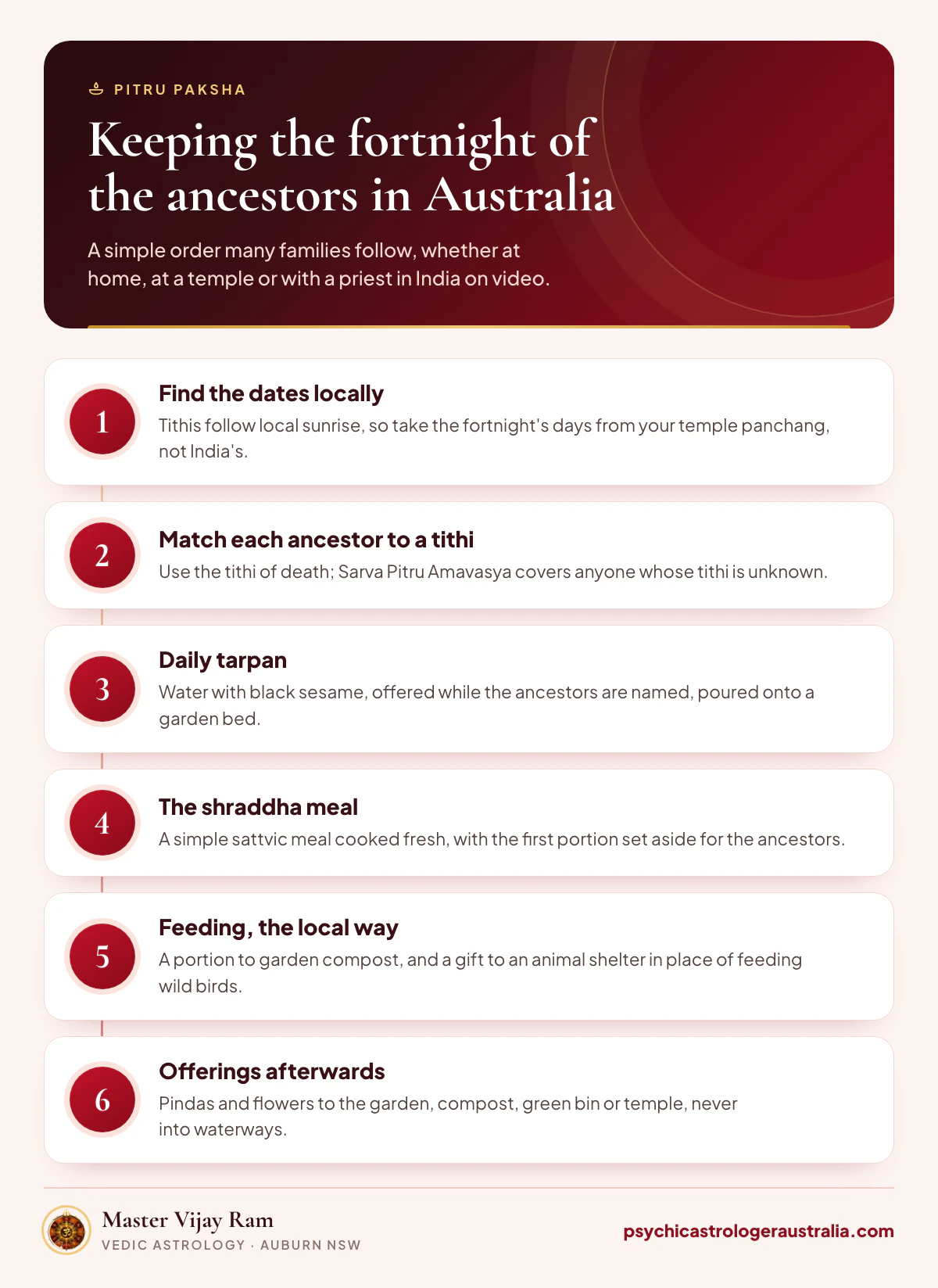
Pitru Paksha is the dark fortnight before Navratri when Hindu families honour their ancestors with shraddha, tarpan and food offerings. Australian families keep it at home, at a temple or with a priest in India on video. Each ancestor is honoured on the tithi of their death, read from the local panchang, and offerings go to compost or a shelter, never into waterways.
What is Pitru Paksha?
Pitru Paksha is a lunar fortnight that Hindu families set aside each year for their ancestors, the pitrs, offering them water, food and remembrance through rites called shraddha and tarpan. It is also called Shraddha Paksha or Mahalaya Paksha, and in many households simply "shraadh". For families in Australia it is often the one time in the year when the whole family tree is spoken aloud.
The idea underneath is gratitude and continuity. The living feed the dead, symbolically, and in return the family line is read as blessed and steady. Whatever a family believes about the afterlife, the fortnight is a structured time to remember grandparents and great-grandparents by name, and that alone makes it worth keeping. Where a family also worries about ancestral karma in a chart, a Kaal Sarp and Pitra Dosh reading looks at that separately.
When does Pitru Paksha fall, and why is no date given here?
It is the Krishna paksha, the waning fortnight, that follows the full moon of Bhadrapada. Calendars that start the month at the new moon call it Bhadrapada Krishna; those that start at the full moon call it Ashwin Krishna, but it is the same fortnight. It ends with Sarva Pitru Amavasya, often called Mahalaya Amavasya, and Sharad Navratri begins straight after.
The exact day each tithi falls on depends on where you are, because a tithi is counted from local sunrise. A shraddha tithi in Sydney can fall a day apart from the same tithi in India, and Perth can differ from both. This page does not type dates for that reason: your temple's panchang, or the family priest, gives them for your city. The full moon dates by Australian city show when each Purnima falls, which tells you roughly when the fortnight opens.
Shraddha, tarpan and pinda daan: what is the difference?
The three words are often used loosely, and families differ in how much of each they do. The table sets out the usual meanings.
| Rite | What it is | How Australian families often keep it |
|---|---|---|
| Tarpan | Water with black sesame offered from the hand while ancestors are named | Daily during the fortnight, at home in the morning, poured onto a garden bed or a plant |
| Pinda daan | Balls of cooked rice, sesame and ghee offered to the ancestors | Usually through a priest, at a temple or in India on the family's behalf |
| Shraddha | The full rite for one ancestor on their death tithi, with prayers, offerings and a meal | At home with a simple meal, at a temple, or by a priest with the family on video |
How tarpan itself is done at home, with the direction, the hand and the naming, is covered step by step in the signs of pitra dosh. This page concentrates on the fortnight as a whole and on the practical questions families raise here.
Which day belongs to which ancestor?
In a shraddha ceremony each ancestor is honoured on the tithi, the lunar day, on which they died, not on the calendar date. A grandfather who died on a Saptami is remembered on the Saptami of Pitru Paksha, whatever month he actually died in. That is why families need the death tithi, and why many keep it written in a diary or the family's old janam patri.
Where the tithi is not known, the last day of the fortnight, Sarva Pitru Amavasya, is kept for every ancestor at once. Many families also keep the Navami for mothers and other women of the family who died while married, and in many traditions the Chaturdashi is reserved for those who died suddenly or violently. Customs differ by region and community, and the family's own practice comes first.
If no one knows the tithi, the date of death can be converted: a panchang for that year and that place shows which tithi was running. A consultation can do this from a death certificate or a remembered date.
How do families in Australia actually observe the fortnight?
Most families here keep the pitru paksha rituals in one of three patterns. Some keep everything at home: daily tarpan in the morning, a simple meal cooked on the ancestor's tithi, and a lamp at the altar in the evening. Others ask a temple priest to perform the shraddha, which many Australian temples arrange during the fortnight. A third group asks the family priest in India to perform the rite, sometimes at a pilgrimage place, while the family joins by video at a time that suits both clocks.
None of these is more correct than the others. A family in Wollongong with a grandmother who always did it at home may prefer to keep that, while a young couple in Cairns with no temple nearby and no elder to guide them may be glad of a priest in India who knows the family's gotra. What matters in every tradition is that the names are said and the offering is made with care.
What is cooked for a shraddha meal?
The meal is usually simple and sattvic: rice, dal, a vegetable, kheer and puris or rotis are common, and many families cook the dishes the ancestor liked. Many households leave out onion and garlic for the day. The food is cooked fresh, not tasted while cooking, and a first portion is set aside for the ancestors before anyone eats.
Traditionally the meal is offered to a Brahmin or a guest before the family. In Australia that may be a priest, an elder of the community, or simply a friend who is invited to eat first. The point is hospitality given in the ancestor's name.
Crows, cows and dogs: what is the Australian version of feeding?
In India portions are traditionally set out for crows, cows and dogs, with the crow read as a messenger of the ancestors. In Australia feeding wild birds is discouraged by councils because bread and cooked food harm the birds, so most families here adapt the custom rather than copy it. Placing a small portion of the offering in your own garden compost keeps the gesture without harming wildlife.
The cow's and dog's portions can become a donation to an animal shelter or a gaushala run by a temple, made in the ancestor's name during the fortnight. Feeding animals as a remedy looks at the whole custom and its safer local forms. Feeding a pet dog a little of the plain meal is fine, but leave out onion, garlic and anything heavily sweetened.
Where do the pindas and offerings go afterwards?
Never into rivers, the sea, creeks or bushland. In Australia that can count as littering or illegal dumping, and rice and ghee in a waterway harm fish and birds. Pindas, flowers and leftover offerings go to your own garden, a compost bin, the council green bin or a temple's collection.
Water from tarpan in Australia can be poured onto a garden bed or a potted plant, which many families already do. In India, offerings are often taken to a river; the custom here simply finds a respectful equivalent.
What do families avoid during Pitru Paksha?
Many families avoid starting new things during the fortnight: weddings, engagements, griha pravesh, large purchases and, in some households, haircuts and new clothes. The reasoning is that the fortnight belongs to the ancestors, and celebrations wait until Navratri. These are customs, and families keep them to different degrees.
No one is punished for buying a car during Pitru Paksha. If a purchase or a move cannot wait, many families simply say a prayer for the ancestors first. A muhurat consultation can find a good window after the fortnight where there is a choice.
How does Pitru Paksha connect with pitra dosh?
Pitra dosh is a pattern in a birth chart that the tradition reads as unfinished duty to the ancestors, shown mainly through the Sun and the ninth house. Pitru Paksha is the time of year when that duty is most naturally attended to. A chart reading looks at whether it shows at all; most charts flagged online carry a cancellation.
Where a family story involves a quarrel, a disinheritance or a death without rites, the work goes further than one fortnight. Repair with the ancestors covers that heavier case. For most families, keeping the fortnight faithfully each year is the whole of it.
Can a shraddha be performed on your behalf?
Yes. When there is no elder to lead it, no temple nearby or the family is unsure of the steps, Master Vijay Ram performs shraddha and tarpan in the family's name, personally, at his place of practice in Auburn. He needs the names of the ancestors, the gotra where it is known and the tithi, and the family can join by video if they wish.
A puja or rite of this kind starts from $250, and the figure is agreed before anything is performed; how a puja is performed on your behalf explains the process. A consultation to work out tithis, gotra and what the family actually needs is $50, in English, Hindi or Punjabi. Families from Newcastle and the Hunter to Townsville book by phone or WhatsApp.
What can Pitru Paksha not do?
It cannot settle a family dispute, divide an estate or replace grieving. If a death is recent and grief is heavy, Griefline and a GP are good places to start, and the rites can sit alongside that support. This is faith-based practice, not counselling, legal or medical advice.
What it can do is give a family a fortnight each year to say its names aloud, cook for the people who came before, and teach the children where they come from. For families a long way from their ancestors' villages, that is no small thing.
Read next
- Pitra Dosh: Signs Ancestral Karma Is Affecting YouPitra Dosh explained: the chart placements that show it, the signs families report, Pitru Paksha 2027 dates for Austr…
- Full Moon and New Moon Dates 2027 in Australia (Purnima and Amavasya)Every full moon (Purnima) and new moon (Amavasya) of 2027 in Australian time, with Perth and India dates, Hindu month…
- Black Magic Signs in the Family Home: A Household ChecklistA calm household checklist for black magic signs in the family home: what to rule out first, the shared-roof test, an…
Frequently asked questions
When is Pitru Paksha in Australia?
It is the waning fortnight that follows the full moon of Bhadrapada, ending with Sarva Pitru Amavasya just before Sharad Navratri. The exact day each tithi falls on depends on local sunrise, so Sydney, Perth and India can differ by a day. Your temple's panchang or the family priest gives the dates for your city.
How do I know which day to do shraddha for my grandfather?
Shraddha is done on the tithi of death, not the calendar date. If he died on a Saptami, his shraddha falls on the Saptami of Pitru Paksha. If the family only has the date of death, a panchang for that year and place shows which tithi was running. If nothing is known, Sarva Pitru Amavasya covers every ancestor.
Can shraddha be done at home in Australia?
Yes. Many families keep daily tarpan in the morning, cook a simple meal on the ancestor's tithi, set aside a first portion and light a lamp at the altar. Others prefer a temple priest or the family priest in India on a video call. The tradition values the naming of the ancestors and the care of the offering above the setting.
Can women or daughters perform shraddha?
Traditionally the eldest son leads the rite, but traditions differ and many families today include daughters, wives and other relatives, especially where there is no son or he lives far away. Many priests now accept this. What matters in every tradition is a sincere offering made in the ancestor's name.
Should we feed crows during Pitru Paksha in Australia?
In India a portion is traditionally set out for crows, but councils here discourage feeding wild birds because cooked food and bread harm them. Most families place a small portion in their garden compost instead, and give the portions traditionally meant for cows and dogs to an animal shelter or a temple gaushala in the ancestor's name.
What do we do with the pindas after the rite?
Put them in your own garden, a compost bin, the council green bin or a temple's collection. Never place pindas, flowers or other offerings in rivers, the sea, creeks or bushland, which can be littering or illegal dumping in Australia and harms wildlife. Tarpan water can go onto a garden bed or a potted plant.
Is it bad to buy a house or car during Pitru Paksha?
Many families avoid starting new things during the fortnight, including purchases, weddings and house moves, because the time is set aside for the ancestors. It is a custom, not a rule with a penalty. If something cannot wait, many families say a prayer for the ancestors first, or a muhurat reading finds a good window after the fortnight.
Can Master Vijay Ram perform shraddha for my family?
Yes. He performs shraddha and tarpan in the family's name personally at his place of practice in Auburn, with the ancestors' names, gotra where known and the tithi, and the family can join by video. A rite starts from $250, agreed before it is performed. A $50 consultation can first work out the tithis and what the family needs.
People also ask
What is the difference between shraddha and tarpan?
Tarpan is the offering of water with black sesame, poured from the hand while the ancestors are named, often done daily through the fortnight. Shraddha is the fuller rite for one ancestor on their death tithi, with prayers, offerings, pinda daan in many families and a meal given first to a guest or priest in the ancestor's name.
What food is made for shraddha?
Usually a simple sattvic meal of rice, dal, a vegetable, kheer and puris or rotis, often including dishes the ancestor liked. Many families leave out onion and garlic for the day, cook fresh, do not taste while cooking and set aside the first portion for the ancestors before anyone eats.
What is Sarva Pitru Amavasya?
It is the new-moon day that ends Pitru Paksha, also called Mahalaya Amavasya. Rites on this day are offered for every ancestor together, including those whose death tithi is not known or who were missed earlier in the fortnight. Sharad Navratri begins immediately after it.
Why is Pitru Paksha date different in India and Australia?
Tithis are counted from local sunrise, and Australia's sunrise comes hours before India's. A lunar day that begins in the middle of the night in Sydney may cover a different sunrise than it does in Delhi, so a shraddha tithi can fall a day apart. Families follow the panchang for the city where they live.
References & further reading
Serving clients across Australia
Confidential consultations by phone, video & WhatsApp — including: