

Quick answer
Psychic attack is a term from Western occult writing of the last century for harm thought to come from another person's hostile mind. People use it for sudden exhaustion, nightmares or feeling targeted after a conflict. The Vedic tradition speaks instead of nazar, shrap and abhichara, and much of what is felt overlaps with anxiety. Sleep, distance and protection help first.
What does psychic attack mean?
Psychic attack is a term from Western occult writing of the last century for the idea that another person's hostile thoughts, envy or will can harm you at a distance, without any physical act or ritual. People reach for it after a falling-out, a hostile meeting or a bitter breakup, when they feel drained, frightened or unwell and the other person's face keeps coming to mind.
It is not a Vedic term, and no Sanskrit word maps onto it exactly. This page explains what the term means, what people describe when they use it, the Vedic words for related ideas, and how much of the experience overlaps with ordinary anxiety. Negative energy removal is the service for the narrower cases where something more than anxiety is at work, and it always begins with the ordinary explanations.
Where does the term come from?
It grew up in Western esoteric circles in the twentieth century, where writers on the occult described hostile minds working on vulnerable ones and set out methods of self-defence. From there it passed into New Age books, energy healing and, more recently, social media, where it is used for almost any encounter that leaves someone feeling worse.
A related idea travelled the same road. The psychic vampire, in folklore and occult writing, is someone who drains other people's life force; today the phrase is used loosely for anyone exhausting to be around. Both words describe a real experience, feeling depleted by another person, and both add a theory about how it happens that the Vedic tradition frames differently.
What do people mean when they say they are under psychic attack?
The descriptions are consistent. Sudden exhaustion after contact with one person; nightmares in which that person appears; headaches, a tight chest or a racing heart; a feeling of being watched or thought about; small accidents and breakages clustering in one week; and above all a sense of being targeted that began after a conflict.
Every one of these psychic attack symptoms also has an ordinary cause that is far more common. Conflict switches on the body's threat response, which produces exactly that racing heart and broken sleep, and a mind that expects harm notices every mishap that seems to confirm it. The experience is real; the question is what is causing it.
What words does the Vedic tradition use for related ideas?
The tradition does not have one word for psychic attack, but it has several for the experiences people bundle under it, and it treats them differently. Nazar, the everyday Hindi and Urdu word, called drishti, the Sanskrit for sight, in many South Indian homes, is the harm attributed to an admiring or envious look, usually unintended and usually passing. Shrap is an ill wish spoken aloud by someone who was wronged, and shrap, spoken curses and bad wishes explains why the tradition answers it with repair before ritual.
Abhichara is the older word for hostile ritual, deliberate work aimed at a person, and kritya the name for such a working in the Atharvaveda, whose healing and protective hymns include charms against it. And then there is the chart: a hard planetary period or transit, which the tradition reads as weather rather than as anyone's doing.
Those distinctions matter because each calls for a different response. Treating an envious glance as a ritual attack frightens a family for nothing; treating a planetary period as someone's malice turns a hard year into a feud.
Psychic attack vs black magic: is there a difference?
In Western usage, yes: a psychic attack needs no ritual, only hostile intent, while black magic means a deliberate rite. In Vedic terms the nearest thing to the first is nazar or the weight of a bad wish, and the nearest thing to the second is abhichara. People who search psychic attack vs black magic are usually asking whether what they feel is passing or serious, and the tradition's answer is that most of it is passing.
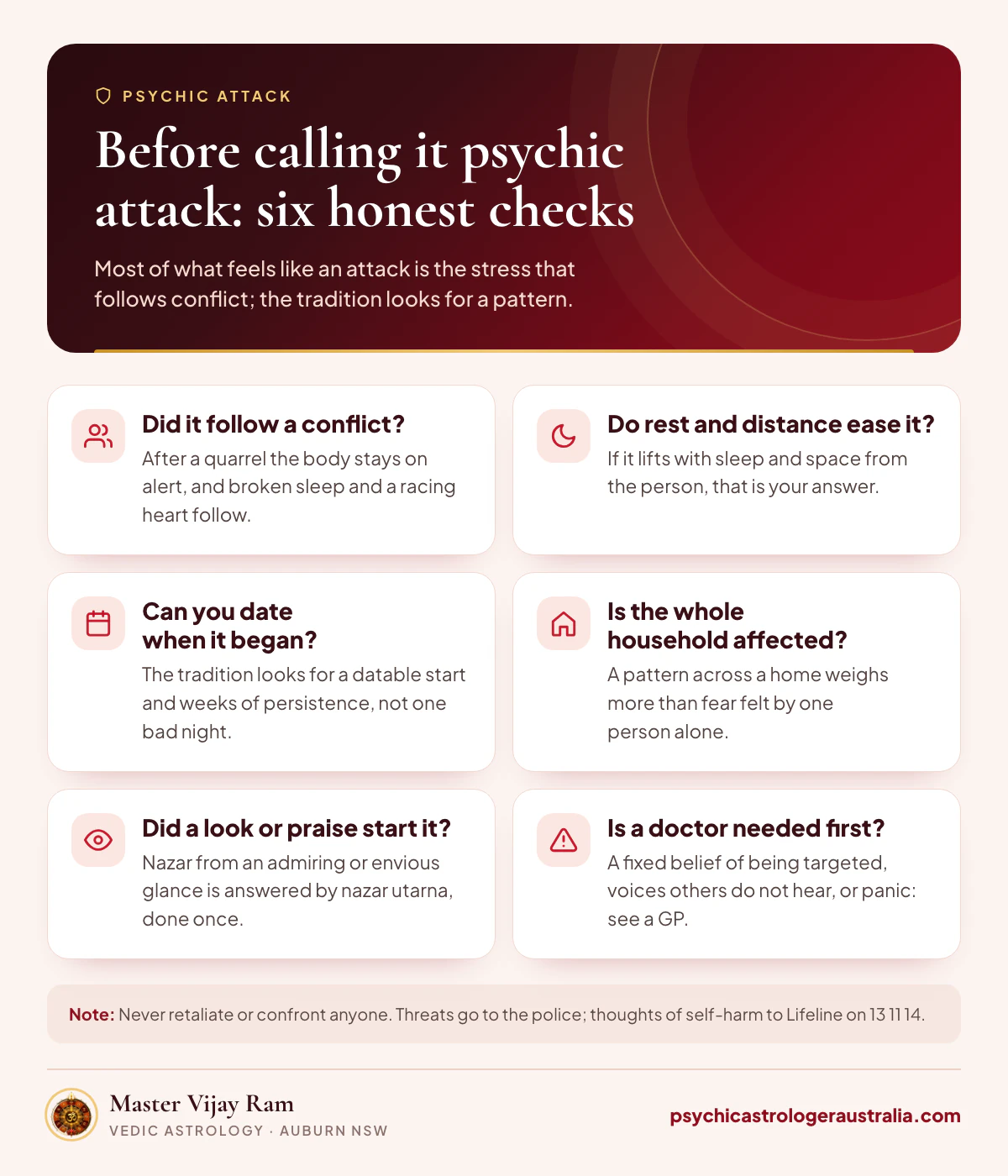
The deliberate kind is rare, and it is recognised by pattern rather than by feeling: a sudden change across a household that can be dated, that outlasts ordinary fixes and a doctor's check, and that the chart's timing does not explain. Even then, nobody is named and nothing is sent back.
Which word fits what you are feeling?
The table sets the common terms beside what each describes, its nearest Vedic idea and what helps first. The last row is the one most people are actually in.
| The term | What it describes | Nearest Vedic idea | What helps first |
|---|---|---|---|
| Psychic attack | Another person's hostility felt as harm at a distance | Nazar, or the weight left by a quarrel | Distance, sleep, a lamp and a mantra |
| Psychic vampire | Someone whose company leaves you drained | No single word; the tradition speaks of giving with discernment | Boundaries and time limits |
| Evil eye | Harm attributed to an admiring or envious look | Nazar, drishti | Nazar utarna once, then let it go |
| Curse | An ill wish spoken by someone who was wronged | Shrap | Repair, an apology, an elder's blessing |
| Black magic | A deliberate rite aimed at a person | Abhichara, kritya | A reading first; removal only if warranted |
| Anxiety after conflict | Dread, a racing heart, broken sleep, replaying the argument | Not a spiritual matter | A GP, counselling, rest |
How much of it is anxiety?
A good deal, and saying so is not dismissive. After a conflict the body stays on alert, the mind replays the encounter, sleep breaks, and the stress response produces the headaches, stomach upsets and tight chest that people list as signs of attack. Expecting to be harmed can itself produce symptoms, which researchers call the nocebo effect.
None of that means the other person was kind, or that the hurt was imagined. It means the feeling of being under attack is often the lingering shape of a real conflict, and that it responds to the same care any stress does: rest, distance, someone to talk to, and a GP when it will not settle.
There is a harder edge too. A fixed belief that someone is targeting you, which the people around you cannot share, or voices that others do not hear, are reasons to see a doctor promptly; they respond to care, and a reading waits until they have been looked at.
Can another person's anger or envy really harm you?
The tradition gives weight to intention and speech, which is why it has words like nazar and shrap at all. It also teaches, consistently, that a person's own conduct, prayer and protection count for more than another's ill will, and that a household kept steady is not at the mercy of a neighbour's mood or a former friend's resentment.
Many teachers in the tradition go further and say that fear does more damage than the wish behind it, because fear is the part that moves into your house. The practical meaning is simple: tend your own side, and do not hand the other person the power of living in your thoughts.
What helps when you feel under attack?
Practical steps first. Put distance between yourself and the conflict where you can, sleep at regular hours, write down what actually happened beside what you fear, and tell one trusted person; if the conflict is at work, the workplace's own processes or a mediator are the place for it, and threats belong with the police.
A calm first-week plan if you feel targeted lays out those days one by one, and most people find the feeling has eased by the end of it. What does not help is replaying the other person's words, searching lists of spiritual attack signs late at night, or confronting anyone.
What does Vedic protection look like in practice?
It faces inward, towards your own home and mind. An evening diya, the Hanuman Chalisa or a short mantra said at the same hour each day, a bath after a hard encounter with the intention of leaving it behind, and conduct kept calm and clean: that is the core of psychic attack protection in the Vedic sense, and none of it needs anything bought.
Where a glance or praise seems to have started the trouble, nazar utarna done once is the traditional answer, and evil eye and nazar removal explains when more is warranted. A kavach for protection is prepared only where a consultation finds it will help, for the person who will wear it.
What protection never includes is a counter-attack. The urge to strike back is understandable, and why harm is never sent back explains why the tradition refuses it.
What about people who leave you drained?
Some people leave everyone tired: constant complaint, crises that need rescuing, guilt applied like pressure. The tradition's answer is not to label them evil but to give with discernment, and energy vampires and the Vedic view of giving looks at how seva and daan can continue without leaving the giver empty.
Boundaries are protection too: shorter visits, fewer late-night calls, a polite no. Many people find that once the boundary is in place, the sense of being attacked fades with it.
When is a reading worth having?
When the feeling has a date, has lasted weeks, has outlasted sleep, distance and a GP's check, and shows up as a pattern across a household rather than only as fear. Master Vijay Ram reads your chart against that timeline, including any hard period or transit you are running, and says plainly whether it points to nazar, to a season of the chart, or to something that warrants more.
You can have the $50 consultation over WhatsApp, by video or on an ordinary call, in English, Hindi or Punjabi. Where a remedy is warranted, he performs the puja or havan himself in Auburn, his only place of practice, at a muhurat chosen for your chart; the work begins at $250, a figure agreed before it is performed, and the page on a puja or havan performed for you shows how a client joins by video. Callers on the Central Coast are close enough to come to Auburn by appointment, as readings for Central Coast clients explains.
When should you see a doctor instead?
When dread or panic will not settle, when sleep or appetite has gone for more than a few days, when the belief that someone is targeting you has become fixed and the people close to you cannot share it, or when you hear voices others do not. The healthdirect line, 1800 022 222, is there to help weigh the urgency.
Anyone thinking about self-harm should ring Lifeline on 13 11 14 at once, or 000 in an emergency. A consultation can run alongside medical care but never replaces it.
What are the limits of a reading here?
It cannot read another person's intentions, stop them disliking you, or confirm that anyone is attacking you, and no reading comes with a promised result. It is faith-based guidance from the Vedic tradition, not a medical, psychological or legal opinion.
It can tell a frightened person which of the tradition's ideas, if any, fits what they are feeling, and give them a protective practice that steadies the mind. For most people that, and the passing of time after a conflict, is enough.
Read next
- Spiritual Possession Symptoms: Jinn, Spirit or Black Magic?Possession, jinn or black magic? A calm Australian guide to what these symptoms mean, what to rule out medically firs…
- Energy Vampires: Draining People and the Vedic View of GivingEnergy vampires: where the term comes from, the draining patterns behind it, the Vedic view of giving with discernmen…
- How to Protect Yourself from Black Magic: Daily RemediesPractical daily protection from black magic: the three-doorway habit, what is safe to do at home, what needs guidance…
Frequently asked questions
What are the symptoms of a psychic attack?
People describe sudden exhaustion after contact with one person, nightmares featuring them, headaches, a tight chest or racing heart, a feeling of being watched, and small mishaps clustering after a conflict. Every one of these also has a common ordinary cause, above all the stress response that follows a quarrel, so rest, distance and a GP's check come before any spiritual explanation is considered.
Am I under psychic attack, and how would I know?
Most people who ask are living with the after-effects of a real conflict: broken sleep, replaying, a body on alert. The tradition would look further only if the trouble has a date, has lasted weeks, has outlasted rest, distance and a medical check, and shows up across a household rather than only as fear. At that point it makes sense to have your chart read against the dates.
Is psychic attack the same as black magic?
Not in the way the terms are used. Psychic attack, in Western writing, needs only hostile intent, while black magic means a deliberate rite; in Vedic terms the first is closest to nazar or the weight of a bad wish, the second to abhichara. Most of what people feel is the first kind, and it passes with protection, rest and time.
Is there a Vedic word for psychic attack?
No single word. The tradition names the experiences separately: nazar or drishti for harm from an envious or admiring look, shrap for an ill wish spoken by someone wronged, abhichara for hostile ritual, and planetary periods for hard seasons that are nobody's doing. Separating them matters because each calls for a different and usually much gentler response than people fear.
How can I protect myself from psychic attack?
Start with distance from the conflict, regular sleep and one trusted person to talk to. Then the inward-facing practices: a lamp at dusk, the Hanuman Chalisa or a short mantra at the same hour each day, a bath after a hard encounter, and calm conduct. Where praise or a glance started it, nazar utarna done once is the traditional answer.
Can someone's jealousy really harm me?
The tradition takes envy seriously enough to have a word for its effects, nazar, but it also teaches that your own conduct, prayer and protection count for more than another person's ill will. Many teachers say the fear does more damage than the envy. Keep your own household steady, share a little less of your good news, and do not let their feelings occupy yours.
Should I send the attack back to the person doing it?
No. Sending harm back is refused in the Vedic tradition Master Vijay Ram practises, because it adds harm to the world, makes the act your own and is easily aimed at someone innocent. Protection faces inward. Real threats or harassment go to the police, and boundaries and distance do the rest.
What does a consultation about psychic attack involve, and what does it cost?
The fee is $50, and it can be done on a call, a video link or WhatsApp. You send your birth details with a dated account of events; Master Vijay Ram reads your chart against it and says plainly whether it points to nazar, a hard period or something more. If the reading calls for a puja or havan, the starting figure is $250, agreed with you before he performs it in Auburn.
When is it anxiety rather than an attack?
When it follows a conflict and eases with rest and distance, when the symptoms are the classic stress ones of broken sleep, a racing heart and replaying, and when nothing else in the household has changed. That is most cases. If dread, panic or a fixed sense of being targeted will not settle, or you hear voices, see a GP promptly.
People also ask
What is a psychic attack?
A term from Western occult writing of the last century for the idea that another person's hostile thoughts or envy can harm you at a distance without any ritual. People use it for exhaustion, nightmares or feeling targeted after a conflict. It has no exact Vedic equivalent; the tradition speaks instead of nazar, shrap and abhichara, and reads hard planetary periods as weather.
What are signs of a spiritual attack?
The lists online include exhaustion, nightmares, dread, a feeling of being watched and things going wrong after a quarrel. All of these are also signs of stress after conflict, which is far more common. The tradition looks for a pattern instead: a datable start, weeks of persistence, a whole household affected, and the ordinary causes and a medical check already ruled out.
How do you stop a psychic attack?
Step back from the conflict, sleep at regular hours, write down the facts beside the fears and talk to someone you trust. Keep a lamp and a short daily mantra, and keep your own conduct calm. Do not retaliate or confront anyone. If the feeling persists for weeks with a clear pattern, a consultation can look at your chart against the timeline.
What is the difference between psychic attack and the evil eye?
The evil eye, nazar or drishti, is harm the tradition attributes to an admiring or envious look, often unintended and usually passing, and it is answered by nazar utarna done once. Psychic attack is a broader Western term for deliberate hostility felt at a distance. In practice the two describe similar feelings, and both respond first to rest, distance and simple protection.
References & further reading
Serving clients across Australia
Confidential consultations by phone, video & WhatsApp — including: