

Quick answer
A return-to-sender spell is a working that claims to throw black magic back at whoever sent it. Master Vijay Ram refuses it: the tradition answers harm with protection and peace, and suspicion so often lands on the wrong person. A removal lifts the influence from you and aims at no one. A consultation is $50; a puja starts from $250.
What is a return-to-sender spell?
A return to sender spell is a working sold on the promise that black magic, a curse or a binding can be thrown back at whoever cast it, so that the sender suffers what they meant for you. It is advertised under many names, and the people who ask for it are usually frightened, angry and exhausted all at once.
Master Vijay Ram does not perform it, and this page explains why without pretending that the anger behind the request is wrong. Curse and hex removal as he practises it lifts what is weighing on a person and aims at no one; the sections below set out the difference, and what to do if you have already been sold the other thing.
What do the advertisements actually promise?
Western spell sites sell the idea in a dozen costumes: the return-to-sender jar, the reflection candle, the karma return spell that promises the guilty person will reap what they sowed within a set number of days. The pitch is protection, but the product is an outcome for somebody else, and the outcome is suffering.
Indian advertisements are blunter. Ulta vaar and palat vaar mean the counter-blow, jaise ko taisa is tit for tat, and shatru nash promises the destruction of enemies, often with a line about the caster being ruined or brought begging. Both versions share one feature that should stop anyone reading them: they cannot work without a named target, so the first thing they sell you is an enemy.
Why does sending it back feel like justice?
Because something real has usually happened. A marriage collapsed, money went missing, a child fell ill, and a relative's cold words at a wedding have become, in memory, the moment it all began; when a person has been hurt and cannot prove anything, a spell that settles the account in secret looks like the only justice on offer.
There is fear in it as well. Many callers believe that unless the sender is stopped they will simply cast again, so revenge is sold to them as the only lasting protection. Vijay Ram ji hears this with sympathy, and he also hears, in the same breath, how much of the caller's life the suspected sender already occupies.
Why will a Vedic healer not send harm back?
The first reason is ahimsa, non-harm, which the tradition places at the root of right conduct. A healer's work is to reduce suffering, and a rite designed to make a person ill, poor or heartbroken increases it, whoever the person is and whatever they did. There is no version of the vow with an exception for people we believe deserve it.
The second is karma, understood plainly. An act carries its consequence for the one who does it, so a healer who throws harm becomes a doer of harm, and a client who pays to send black magic back has commissioned an act in their own name; neither is made safer by it. The tradition leaves the working out of another person's karma to forces that need no help from us.
The third is shanti. The protective remedies of the Vedic tradition are pacifying by nature, and a shanti puja or havan settles what is disturbed rather than redirecting it. The six tantric acts and the protective answer explains how the old lists of harmful rites were met with protection, never by joining in.
How does the tradition answer harm, if not with harm?
With protection, devotion and patience, which sounds weak until you look at the stories families actually tell. Prahlada, threatened again and again by his own father, answers with devotion, and the protection comes from Narasimha rather than from any curse of Prahlada's. The devotee's part is to keep faith and keep clean conduct; the rest is not his to arrange.
The same pattern runs through the household practices: a lamp lit at dusk, the Hanuman Chalisa, a kavach, a mantra said at the threshold. Every one of them faces inward, towards the family being protected, and none of them is aimed over the fence.
What does a removal do instead?
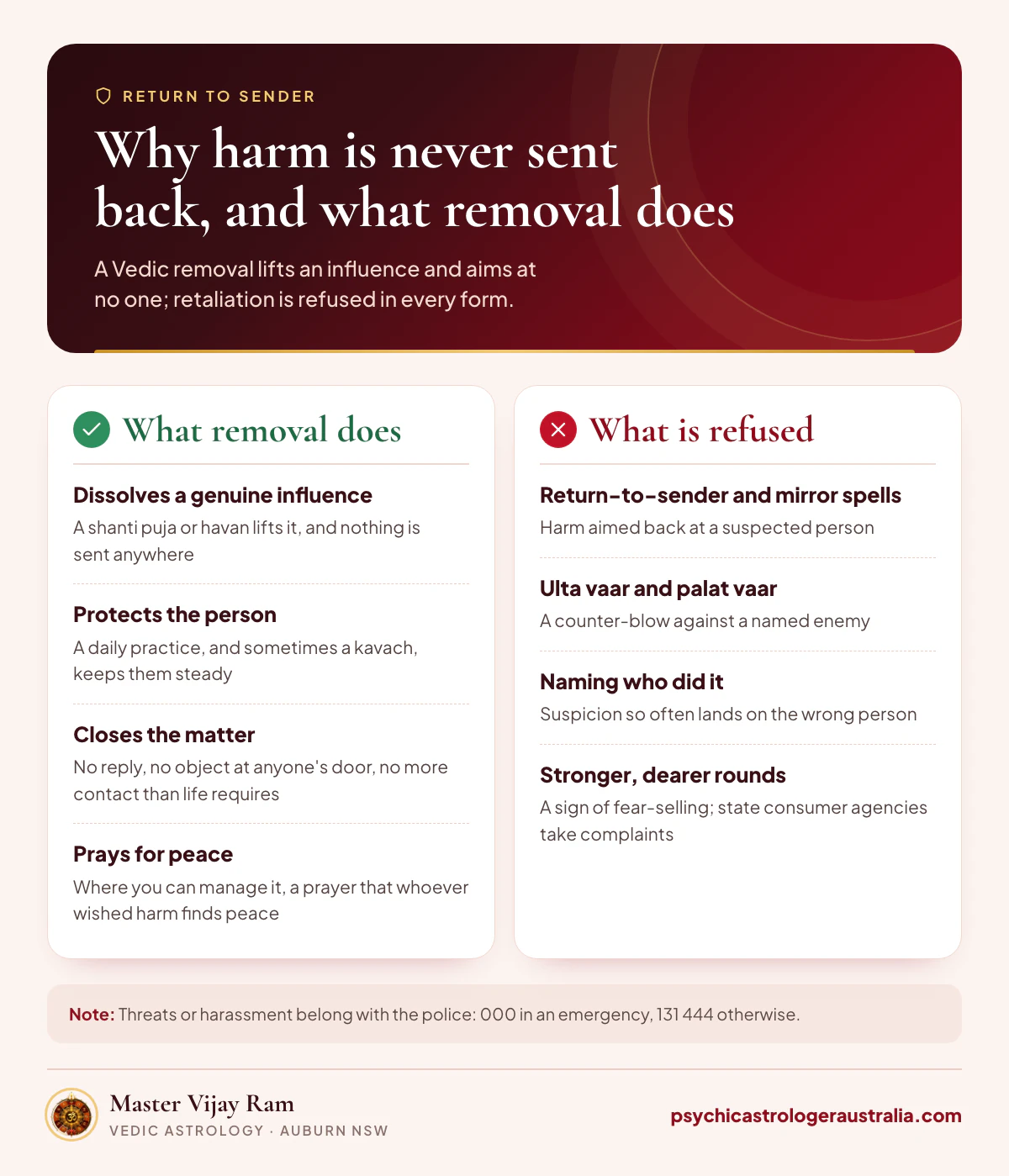
Three things, in order. First it dissolves: where a reading finds a genuine influence, a shanti puja or havan lifts it from the person and nothing is sent anywhere. Then it protects, with a daily practice and sometimes a kavach prepared for protection, which keeps the person steady while life settles.
Last, it closes. Closing means no reply, no object left at anyone's door, no more contact than daily life requires and, where the person can manage it, a prayer that whoever wished harm finds peace. Black magic removal follows the same three stages in the heavier cases.
Return to sender or removal: where is the difference?
The table puts the advertising language beside what each offer involves and what a removal does instead.
| What the advertisement offers | What it involves | What a removal does instead |
|---|---|---|
| Return to sender | Aiming the original harm back at a suspected person | Lifts the influence from you, aimed at no one |
| Mirror or reflection spell | Turning protection into something that bounces harm at a neighbour or relative | Protection that stills: a kavach, a mantra, a lamp at dusk |
| Karma return spell | Paying someone to hurry another person's karma | Leaves karma to work on its own and keeps your own conduct clean |
| Ulta vaar or palat vaar | A counter-blow against a named enemy | A shanti puja or havan with only your household in the sankalp |
| Revenge spell | Suffering ordered for an ex, a rival or an in-law | Nothing: refused outright, and the anger heard instead |
Is a protective mirror the same as sending harm back?
The household version of the mirror spell is a mirror turned to face a neighbour's door or gate, borrowed from feng shui and said to bounce bad luck back where it came from. Facing nothing in particular it is harmless; turned on one house it becomes a message, and it starts more neighbour disputes than it settles.
Vedic protection reflects nothing at anyone. Kavach means armour, and the lamp, the threshold mantra and the protective thread are meant to keep a household steady, so that whatever strikes them stops there.
Can you pray for the person you believe harmed you?
You can, and it is not the same as excusing them. The old peace prayer, sarve bhavantu sukhinah, asks that all beings be happy and lists no exceptions; saying it with one particular face in mind is among the hardest practices the tradition offers, and one of the most freeing.
Nobody is asked to forgive on a schedule, and nobody is asked to stay close to someone who hurts them, because distance and silence are protection too. The prayer simply stops the other person from occupying your thoughts, which is the one thing a revenge spell can never achieve.
Why is an offer of revenge a red flag?
Because it tells you how the rest of the dealing will go. A practitioner who will harm someone for you has already shown that harm is for sale, and the usual sequence follows: the enemy is fighting back, a stronger round is needed, the fee rises.
- It needs a named enemy, so the practitioner either confirms your suspicion or supplies one.
- It promises an outcome you can never check, because you will not be in touch with the person it was aimed at.
- It keeps you frightened, since a sender who can be hurt can presumably hurt back.
- It comes with a price list arranged by severity, as though suffering were sold by weight.
A practitioner who tells you that you are cursed and must pay to have it lifted may be engaging in misleading or unconscionable conduct under Australian Consumer Law. NSW Fair Trading, Consumer Affairs Victoria, Queensland's Office of Fair Trading and WA Consumer Protection take complaints.
What if you are sure you know who did it?
Then the certainty is worth slowing down. Suspicion in families and neighbourhoods lands on the wrong person often enough that any reading which named someone would be dangerous, and in India witch accusations still kill people: more than 2,500 between 2000 and 2016 by NCRB figures, overwhelmingly women. Why removal never starts with a name sets out what to do with a suspicion instead.
If someone has threatened, followed or harassed you, that is a police matter: 000 in an emergency, and the police non-emergency line, 131 444, otherwise. A report puts the matter on record, which no ritual aimed at anyone can do.
What if you have already paid for ulta vaar?
Stop paying, and do not buy a stronger round, or a removal, from the same seller. Write down what you were told and what you paid, ask for your money back in writing, and if they refuse or threaten you, take it to the consumer agency in your state.
Many people in this position worry less about the money than about what they set in motion. The tradition's answer is kshama prarthana, a prayer asking forgiveness, said sincerely at your own altar, and it is entirely possible the seller performed nothing at all. From there, the steps for breaking a witchcraft spell safely apply just as they would to anyone else.
What happens when you ring wanting revenge?
You are listened to first, anger included, and nobody is lectured for being furious about being hurt. Then the reading starts where every reading starts, with your own birth details and a timeline of what happened, and it says plainly whether the trouble fits an ordinary pattern or whether a removal is warranted.
The consultation costs $50 and runs by phone, video or WhatsApp, in English, Hindi or Punjabi. If a removal is called for, Master Vijay Ram carries out the shanti puja or havan himself in Auburn, on a muhurat he chooses, with only your household named in the sankalp; it starts from $250, agreed before it is performed, and how a puja or havan is performed explains how you can join by video. A caller in Geelong, Hobart or Wollongong is heard exactly as one in Sydney, and readings for Geelong clients covers the practical details.
Where the person affected is a spouse or a child rather than you, consent shapes what can be done, and spell removal for someone else explains how.
What can a removal not do?
It cannot stop another person wishing you harm, punish anyone, prove who did what, or recover money paid to someone else. No outcome is promised, because none honestly can be, and what is offered is faith-based guidance rather than legal, medical or psychological advice; threats belong with the police and losses with a lawyer or a consumer agency.
What it can do is lift what is weighing on you without adding harm anywhere else, so that when the matter is over, it is actually over. That is a quieter promise than the advertisements make, and it is one a household can live with afterwards.
Read next
- Black Magic Removal in Australia: Cost, Process & ResultsBlack magic removal in Australia explained honestly: how fees are built, what should never be charged, how the work i…
- How a Black Magic Specialist Diagnoses and Breaks a SpellHow a black magic specialist works out whether a spell is real: the intake questions, what a chart can show, the thre…
- What Black Magic Removal Costs With Master Vijay Ram: $50 Consultation, Remedies From $250Black magic removal cost with Master Vijay Ram: a $50 consultation, remedy work from $250 agreed beforehand, what eac…
Frequently asked questions
Can black magic be sent back to the person who did it?
Sellers offer it, and Master Vijay Ram refuses it. The tradition he practises answers harm with protection and peace, never with retaliation, and a reading cannot reliably say who did anything, so a return-to-sender working risks aiming harm at an innocent person. A removal lifts the influence from you and aims at nobody, which is all a genuine practitioner needs to do.
Is a reversal the same as a return to sender?
Not here. Many Western sites use the word reversal to mean sending a spell back to its caster. In this practice a reversal means lifting an influence from the person it was placed on, so that they return to their own weight, and nothing is pointed anywhere. If an advertisement says reversal, ask plainly where the harm is supposed to go.
Won't karma punish the person who cast it anyway?
The tradition holds that every act carries its consequence for the one who does it, and that this works without anyone's help. That is exactly why a healer does not hurry it along: the moment you pay to speed up another person's karma, you have made an act of your own. Keep your own conduct clean and leave theirs where it belongs.
Will a removal stop them from trying again?
No removal can control what another person wishes or does. What it can do is lift what is weighing on you, and the protection that follows, a daily mantra, a lamp and sometimes a kavach, keeps a household steady. If someone is actually threatening or harassing you, that is for the police: 000 in an emergency, 131 444 otherwise.
I paid someone online for ulta vaar. What should I do now?
Stop paying, and do not buy a stronger round or a removal from the same seller. Write down what you were told and what you paid, ask for a refund in writing, and contact your state's consumer agency if they refuse or threaten you. Then say a prayer asking forgiveness at your own altar; nothing is undone by a second rite against anyone.
Is a mirror facing the neighbour's door a form of return to sender?
In effect, yes, even when it is sold as protection. A mirror turned on one particular house is a message, and it starts more disputes than it settles. Vedic protection faces inward: a lamp at dusk, a mantra at the threshold, a kavach for the person most affected. If a mirror is already up, turning it to face nothing in particular is a kindness to everyone.
What if I know exactly who did it?
Certainty is the moment to slow down. Suspicion lands on the wrong person often enough that no reading names anyone, and accusations of witchcraft still cost lives in parts of India. The removal does not need a name to work. If the person has threatened or followed you, report it to the police, which puts it on record in a way no ritual can.
How much does a removal cost, compared with a return-to-sender offer?
The consultation is $50 and can be held by phone, video or WhatsApp. If a removal is warranted, the shanti puja or havan starts from $250, agreed before it is performed, and Master Vijay Ram does the work himself at Auburn with only your household named. There is no tier for harming anyone, because that is not on offer at any price, and the agreed figure does not rise.
Is it wrong to want revenge?
Wanting it is human, especially after real harm that nobody will acknowledge. The tradition's concern is what you do with the wanting. Anger can go into a police report, a lawyer's letter, a boundary, a counsellor's room or a daily prayer, and each of those protects you; paid into a revenge spell, it only ties you more tightly to the person who hurt you.
People also ask
What is a return to sender spell?
A working sold on the promise that black magic, a curse or a binding can be sent back to whoever cast it, so that they suffer what they intended. It appears in Western advertising as mirror, reflection or karma return spells, and in Indian advertising as ulta vaar or palat vaar. A Vedic healer refuses it and lifts the influence instead.
Can a spell be sent back to the caster?
Advertisers claim so; no honest practitioner can show it, and none needs to. The person who cast anything cannot be identified from a chart, so sending harm back means aiming it at a suspect who may be innocent. Removal lifts the influence from the person affected, and protection keeps them steady afterwards, without anyone else being harmed.
Is it bad karma to send black magic back?
In the tradition, yes: an act carries its consequence for the one who does it, and paying for harm makes it your act whatever the provocation. That is why Master Vijay Ram refuses return-to-sender work and performs only shanti, a pacifying puja or havan that settles what is disturbed rather than redirecting it at someone else.
What does ulta vaar mean?
Ulta vaar is Hindi for a counter-blow, and in spell advertising it means a rite to strike back at someone believed to have done black magic. Palat vaar is used in the same way. Both need a named enemy and both promise harm to a person, which is why a genuine Vedic healer turns them down and offers removal and protection instead.
References & further reading
Serving clients across Australia
Confidential consultations by phone, video & WhatsApp — including: