
Quick answer
An energy vampire is a modern name, taken from the occult idea of the psychic vampire, for someone whose company leaves you drained. The Vedic tradition describes the exchange rather than condemning the person: giving is a duty, but daan asks for discernment and seva was never meant to empty the giver. Clear limits, a mantra before hard meetings and a bath afterwards protect you.
What is an energy vampire?
An energy vampire is a popular name for a person whose company leaves you tired, flat or guilty, so reliably that you dread their number on the screen. The phrase is borrowed from an older occult idea and has become everyday slang for exhausting people. It describes something real, and it is also an unkind word for a human being.
Master Vijay Ram hears it from nurses, teachers, carers and eldest daughters, usually people who give a great deal and have started to feel hollow. His work on aura cleansing and personal protection begins with the question the tradition would ask: not who is the vampire, but what kind of giving has gone wrong.
Where does the idea of a psychic vampire come from?
The psychic vampire is a figure of folklore and occult writing: someone said to feed on another person’s life force the way the vampire of legend feeds on blood. Modern self-help took the image and loosened it, until it covered the friend who only rings with bad news and the colleague who leaves every meeting a little worse. The vividness is why it spread.
The Vedic tradition has no exact twin for it. It speaks of nazar, of bitter words and of the drain that comes from bad company, and a sibling post on psychic attack and the Vedic view sets out how those older ideas compare with the Western ones. This page stays with the commonest case, which is not an attack at all but an exchange that has become one-sided.
What does draining actually look like?
It usually takes one of three shapes. Constant complaint, the same grievance told for the hundredth time to someone who is expected to listen and never to suggest anything. Guilt used as a lever, often with a reminder of old favours, so that every request arrives already decided.
The third is the manufactured crisis: the call at eleven at night that is urgent only because it was left until eleven, the problem that must be solved today, every week. Around these sit smaller habits, such as conversations that never turn to you, loans that are never mentioned again, and criticism dressed as concern. Recognising the shape matters more than naming the person, because each shape has its own boundary.
Why are some people so draining?
Mostly because they are struggling. Loneliness, anxiety, depression, chronic pain, money trouble and grief all make people repeat themselves, lean too hard and reach for whoever answers the phone. Some have learned, often in childhood, that a crisis is the only reliable way to be looked after; a few are knowingly manipulative, and they are fewer than the word vampire suggests.
The other half of the exchange is you. A person who is already short of sleep, carrying a role as the reliable one in the family, or caring for an ageing parent alongside a job, has less to give, and the same phone call that was manageable last year now flattens them. The drain is often in the timing as much as in the caller.
What does the Vedic tradition say about giving?
Giving is a duty in the tradition, not an optional kindness, and daan is praised in almost every text a family keeps. But the teaching on daan that many families know from the Bhagavad Gita weighs a gift by three things: the place, the time and the person receiving it, desh, kaal and patra. A gift given freely, at the right moment, to someone it will genuinely help, ranks highest.
The same teaching ranks lower the gift given grudgingly or in hope of a return, and lowest the gift given at the wrong time, to the wrong person, without care. Read plainly, it is a teaching about discernment, viveka: money handed over to end an argument, or hours given to feed a crisis that will be back next week, is not what the tradition means by daan.
Can seva be done without being emptied?
Seva is service offered without expecting a return, and Punjabi families know it from the gurdwara kitchen as well as from the temple. It is never measured by how exhausted the server becomes. The tradition counts five daily offerings for a householder, the pancha mahayajna, to the gods, to the teachers, to the ancestors, to other people and to all beings, and pouring everything into one demanding relationship leaves the other four unattended.
That includes your own household, your prayer and your health, which keep you able to give at all. A person who sleeps, eats and prays properly is not being selfish in this view; they are keeping the lamp filled so it can go on burning.
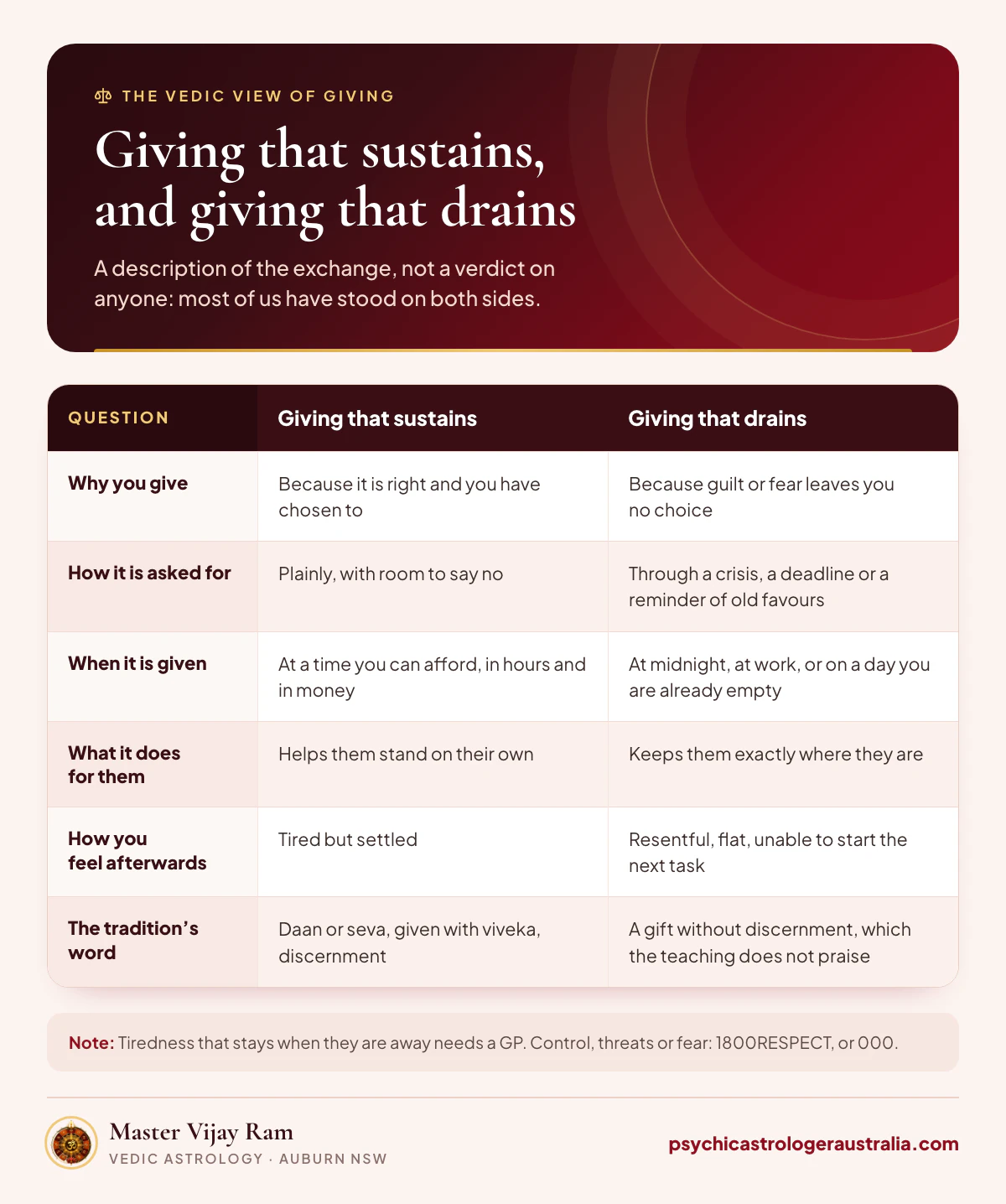
Giving that sustains, giving that drains: how can you tell?
The table sets the two kinds of giving side by side. It is a description of the exchange, not a verdict on anyone, and most people will recognise themselves on both sides at different times in their lives.
| Question | Giving that sustains | Giving that drains |
|---|---|---|
| Why you give | Because it is right and you have chosen to | Because guilt or fear leaves you no choice |
| How it is asked for | Plainly, with room to say no | Through a crisis, a deadline or a reminder of old favours |
| When it is given | At a time you can afford, in hours and in money | At midnight, at work, or on a day you are already empty |
| What it does for them | Helps them stand on their own | Keeps them exactly where they are |
| How you feel afterwards | Tired but settled | Resentful, flat, unable to start the next task |
| The tradition’s word | Daan or seva, given with viveka | A gift without discernment, which the teaching does not praise |
How do you set a boundary without being cruel?
A boundary describes what you will do, not what the other person must do. “I can talk until eight” is a boundary; “stop ringing me with your problems” is a demand, and demands start fights. Say it once, kindly, and then keep it without explaining it again.
Give help in a shape that has edges: a set time for the weekly call, a lift to one appointment rather than open-ended rescue, a specific sum rather than a standing tab. Meeting at a café instead of at home makes leaving easier. Pointing a person in despair towards a GP, a counsellor or Lifeline on 13 11 14 is not a brush-off; it is giving them something more useful than a fortieth hour of your listening.
Which protective habits does the tradition offer?
Before a hard meeting, a short mantra said three times in the car or the corridor, so that you arrive with your own intention set rather than theirs. Many people use the Gayatri mantra or a few lines of the Hanuman Chalisa; the words matter less than the habit. Decide before you go in how long you will stay.
Afterwards, wash. Hands, face and feet on coming home is an old household custom, and a bath or shower with a pinch of rock salt, followed by clean clothes, closes the day; the Hindu ritual bath explains what is traditionally added and what to leave out. Light the evening lamp, and write down anything you agreed to, so it does not circle in your head all night.
The wider routine of sleep, food, speech and company is set out in removing negative energy from yourself, and it is worth reading alongside this page. The habits here are only the edges of a hard encounter.
What if the drain is at work?
A colleague who offloads every morning, a manager who runs the team on emergencies, a client who rings after hours: workplace drain is real, and the first remedies are workplace ones. Talk to your manager, or to HR if the manager is the problem, and keep brief notes of what is asked and when. Many employers fund a confidential counselling service, often called an employee assistance program, and it is there for exactly this.
Bullying is a work health and safety matter, not a spiritual one. Where the trouble is about timing, such as a stuck career or a run of bad years at work, career and workplace readings look at the chart’s periods, and a mantra before the Monday meeting does no harm alongside.
Why should you never call someone evil?
Because the label does the damage the person never could. Calling a sister, a mother or a colleague a vampire, even privately, turns a pattern into a monster, and once someone is a monster in your mind, every call proves it. The tradition sees people acting from their nature, their circumstances and their karma, and the person draining you may be living through the worst year of their life.
There is a humbler point too. Almost everyone has been the needy one at some stage, after a death, a divorce or a lost job, and leaned too hard on someone who stayed kind. You can step back, keep your limits, and still wish the person well in your evening prayer; that is protection the tradition recognises, and it leaves the door open for the day they are steadier.
When is it more than a draining person?
When the tiredness stays even on the days the person is nowhere near you, see a GP before reading anything spiritual into it. When the relationship involves control, threats or fear, it is not a matter of energy at all: 1800RESPECT is the national service for family and domestic violence, and 000 is for danger now. If you are a full-time carer, Carers Australia has support for people looking after a family member.
The narrow case for a reading is a heaviness with a clear starting point that has outlasted the ordinary changes. Families from jealous relatives to difficult in-laws raise the same question, and the answer is read from your chart against those dates, never from the other person’s.
What does Master Vijay Ram offer, and what does it cost?
The first conversation costs $50 and can be held in English, Hindi or Punjabi, over the phone, on video or through WhatsApp; most calls about draining people end with practical advice and a short daily practice. Where the chart shows a period that calls for it, an aura cleansing or a shanti puja costs from $250; the amount is settled with you first, and Vijay Ram ji does the work himself in Auburn while you watch by video if you choose. What a performed puja includes is set out separately.
Nothing he does is aimed at the other person, and nothing is offered to cut, bind or turn anyone. Learning to protect your energy from people who lean too hard is your own work, and the remedy is for you alone.
Giving across distance: family, money and the calls from home
For many families in Perth, Adelaide or Brisbane the most draining calls come from far away: the relative whose every conversation ends with a request, the cousin with a new emergency each month. Discernment applies to money as much as to time. Give what you can sustain, give towards a need you can see, such as school fees or a hospital bill paid directly, and decline the crisis that repeats on schedule.
None of that makes you a bad son or daughter. Vedic readings for Perth families are booked on Perth time, callers from the Gold Coast or Sydney ring the same way, and anyone who wants to sit across the table comes to Auburn by appointment.
Where a reading stops
It cannot change another person, make a demanding relative grateful, or replace a counsellor for a relationship that keeps hurting you. It cannot be guaranteed, and it is faith-based guidance, not medical, psychological or legal advice. Dealing well with draining people is mostly ordinary work: clear limits, rest, and help from the right professional.
What it can do is show whether a hard season in your own chart is making ordinary demands feel unbearable, give you a daily practice that steadies you, and remind you that giving with discernment is the tradition’s idea, not a betrayal of it.
Read next
- Cleansing, Clearing, Protection and Healing: Four Words People Mix UpCleansing, clearing, protection and healing defined plainly: what each word means in Vedic practice, the order they c…
- Psychic Attack: What the Term Means, and the Vedic ViewPsychic attack: where the term comes from, what people mean by it, the Vedic words for related ideas, the overlap wit…
- Aura Cleansing in Australia: How It Works & When You Need ItHow aura cleansing actually works in Australia: the five-doorway read, each stage of a remote remedy, what you provid…
Frequently asked questions
What is an energy vampire?
It is a popular name for someone whose company leaves you tired, flat or guilty every time, borrowed from the older occult idea of the psychic vampire, a person said to feed on another’s life force. The term describes a real experience but is unkind to the person. The Vedic tradition would describe the pattern instead: an exchange that has become one-sided, usually through complaint, guilt or repeated crises.
Are energy vampires real in the Vedic tradition?
The tradition has no exact equivalent of the Western psychic vampire. It speaks of nazar, of bitter words, and of the drain that comes from bad company, and it treats giving as a duty that still requires discernment. Most of what people call energy vampires it would read as a one-sided exchange with a struggling person, answered with boundaries and prayer rather than fear or labels.
How do I protect my energy from draining people?
Decide the length of a visit or call before it starts, say a short mantra before you go in, and give help in shapes with edges, such as a set weekly call or one lift to one appointment. Afterwards wash hands, face and feet, or take a bath with a pinch of rock salt and change clothes. Point someone in despair towards a GP, a counsellor or Lifeline on 13 11 14.
Is it selfish to limit time with someone who drains me?
Not in the tradition’s terms. Seva and daan are duties, but they are meant to be given with discernment, and a householder has five daily offerings to keep, including family, prayer and health, not one demanding relationship. Looking after your sleep and strength keeps you able to give at all. A boundary that is kind and kept is a form of care for both people.
A relative keeps asking for money. What does the tradition say?
The teaching on daan weighs a gift by place, time and recipient, and praises the gift that genuinely helps. Money handed over to end an argument, or sent to meet the same crisis every month, is not what it means by giving. Give what you can sustain, prefer needs you can see, such as school fees or a hospital bill paid directly, and decline the emergency that repeats on schedule.
Can a draining person affect my aura?
In the tradition, the company you keep affects the subtle body, and a person who leaves you flat after every visit is felt there. Most of that heaviness lifts with rest, limits and your own daily practice. Where it has stayed for weeks, began at a point you can identify and does not change when the person is absent, a reading of your own chart shows whether an aura cleansing is warranted.
What should I do after a draining meeting or phone call?
Close the encounter on purpose. Wash your hands, face and feet, or shower with a pinch of rock salt and put on clean clothes; light the evening lamp; write down anything you agreed to, so it does not circle in your mind all night. A short walk helps more than replaying the conversation, and an early night does more than any ritual.
What if the draining person is my manager or a colleague?
Start with workplace remedies: talk to your manager, or HR if the manager is the problem, and keep brief notes of what is asked and when. Many employers fund a confidential counselling service, often called an employee assistance program. Bullying is a work health and safety matter rather than a spiritual one. A mantra before the meeting and a clear finishing time still help alongside.
Can Master Vijay Ram cut my connection to someone?
He does not perform anything aimed at another person, whether it is described as cutting, binding or turning them. What he offers is a $50 reading of your own chart against the dates your heaviness began and, where the chart calls for it, an aura cleansing or shanti for you, priced from $250 and settled before he begins, carried out by him in Auburn. Your boundaries remain your own work.
People also ask
How do you know if someone is an energy vampire?
Look at the shape of the exchange rather than the person: conversations that never turn to you, the same complaint told again and again, guilt used to settle every request, and crises that arrive at night with a deadline. If you dread their calls and feel flat for hours afterwards, the exchange has become one-sided. That calls for boundaries, not a label, and certainly not an accusation.
How do you protect yourself from energy vampires spiritually?
Say a short mantra before you meet them, so you arrive with your own intention; decide in advance how long you will stay; and close the encounter afterwards with washing, clean clothes and the evening lamp. Keep them in your prayers rather than your resentment. Where heaviness persists after limits and rest, a reading of your own chart shows whether an aura cleansing is warranted.
What is the Hindu view of giving?
Giving, daan, is a duty, but the teaching many families know from the Bhagavad Gita weighs a gift by the place, the time and the person receiving it. A gift given freely to someone it truly helps ranks highest; a gift given grudgingly or for a return ranks lower; and one given carelessly, to the wrong person at the wrong time, lowest. Discernment is part of generosity.
Why do I feel drained after talking to certain people?
Usually because the exchange is one-sided: you listen, absorb and reassure while they repeat, complain or demand, often while you are already short of sleep or carrying a lot. Sometimes the person is in real distress and needs more than you can give. Limits, rest and pointing them towards proper help usually ease it; if the heaviness stays when they are absent, see a GP.
What is seva in Hinduism?
Seva is service offered without expecting anything in return, at a temple, a gurdwara kitchen, in the family or in the community. The tradition never measures it by how exhausted the giver becomes. It sits among the householder’s five daily offerings, to the gods, teachers, ancestors, other people and all beings, so service to one person is not meant to crowd out the rest.
References & further reading
Serving clients across Australia
Confidential consultations by phone, video & WhatsApp — including: