
Quick answer
A prashna kundli is a chart cast for the moment a sincere question is asked, so it needs no birth time. The lagna is read for the person asking, the house of the matter for the question, and the Moon for its flow. It answers one urgent question at a time, as a tendency, never a certainty.
What is a prashna kundli?
A prashna kundli is a chart cast for the moment a sincere question is asked, rather than for the moment of a birth. Prashna means question, and the tradition holds that the moment a real question arises carries the shape of its own answer. Western astrology has a cousin of the method in horary astrology, but the Vedic version has its own rules, its own zodiac and a long literature, of which the Kerala tradition is the best known.
It is most useful to people who do not know when they were born, and to anyone with one pressing question. An online astrology reading can be built around a single prashna, by phone, video or WhatsApp.
When does a question chart help?
In two situations above all. The first is a missing birth time: older relatives whose births were never timed, records lost in a move between countries, adoption, or papers that note only the date. Without a reliable time the lagna and the houses of a birth chart cannot be trusted, but a question chart does not need them.
The second is a single urgent, sincere question, even for someone who knows their birth time: a job offer with a deadline, a planned move, a decision about a relationship, a matter already in progress. Broad questions about a whole life suit the birth chart better, and anything medical, legal, financial or about a visa goes to the right professional first.
How is a prashna chart cast?
The astrologer notes the moment the question is put and understood, and casts a chart for that moment exactly as a birth chart is cast: lagna, Moon, planets and houses in the sidereal zodiac. The tithi, weekday and nakshatra of the moment, the same elements a panchang lists for every day, are noted as well. Traditions differ on the details, including whether the clock moment or a number chosen by the person asking sets the chart.
They also differ on the place: some astrologers cast for where they receive the question, others for where the person asking is. The Kerala tradition, set out in the Prashna Marga, goes further and weighs the circumstances of the asking itself. Choosing a muhurat works the other way round, picking a moment for an action, while prashna reads the moment a question arrives.
How is it read?
Traditionally the lagna and its lord stand for the person asking, and the house of the matter and its lord stand for the thing asked about. A link between those two lords, by conjunction, aspect or exchange of signs, is read as the matter tending to come together; no link, or a link spoiled by a malefic, as delay or obstruction.
The Moon carries the flow of the question, so its sign, strength and company matter in every prashna jyotish reading. Benefics in the kendras support the matter, malefics in its house complicate it, and any sense of timing is approximate, drawn from how close the significators are to joining.
Which house answers which question?
The houses keep their usual meanings in a prashna, and the question decides which one is read. The table pairs the common questions with the house traditionally used, and with the people who actually decide each matter, because the chart describes a tendency while they make the decision.
| Question | House traditionally read | Who decides in real life |
|---|---|---|
| A job offer or a career move | 10th, career and status | The employer, the contract and you |
| A relationship or a marriage | 7th, spouse and partnership | The two people, and their families |
| A home, a property or a lease | 4th, home and property | The lender, the conveyancer and the contract |
| Study, or a question about children | 5th, children and study | Teachers, and a GP for any health question |
| A debt, a dispute or an illness | 6th, debts, disputes and illness | A financial counsellor, a lawyer or a GP |
| Moving or settling abroad | 12th and 9th, foreign lands and long journeys | Home Affairs and a registered migration agent for any visa |
| Money owed or an expected gain | 11th, gains and income | The paperwork, and an accountant where needed |
A visa question shows the limit plainly: a chart can describe how a planned move sits with you, but Home Affairs decides on the law and the evidence. The twelfth house of foreign lands explains what a chart can and cannot say about settling abroad.
A worked example: one question, one moment
Here is an illustration, not a real client. A paramedic in Townsville might ask, sincerely and once, whether to accept a transfer to Cairns, and suppose the question is put at a moment when Leo is rising. The Sun, lord of Leo and so of the person asking, sits exalted in Aries in the ninth house of long journeys and fortune, with Venus, lord of the tenth house of work, in the same sign and well clear of the Sun.
The Moon is in Taurus, exalted, in the tenth itself. Traditionally that reads as a favourable indication: the asker's lord and the work lord joined in a good house, and the Moon, the flow of the question, strong in the house of the matter.
It is still an indication, not a verdict, and the practical facts outrank it. The roster, the pay, the housing and the family's needs are checked with the employer and at home before anything is decided.
What can a prashna not do?
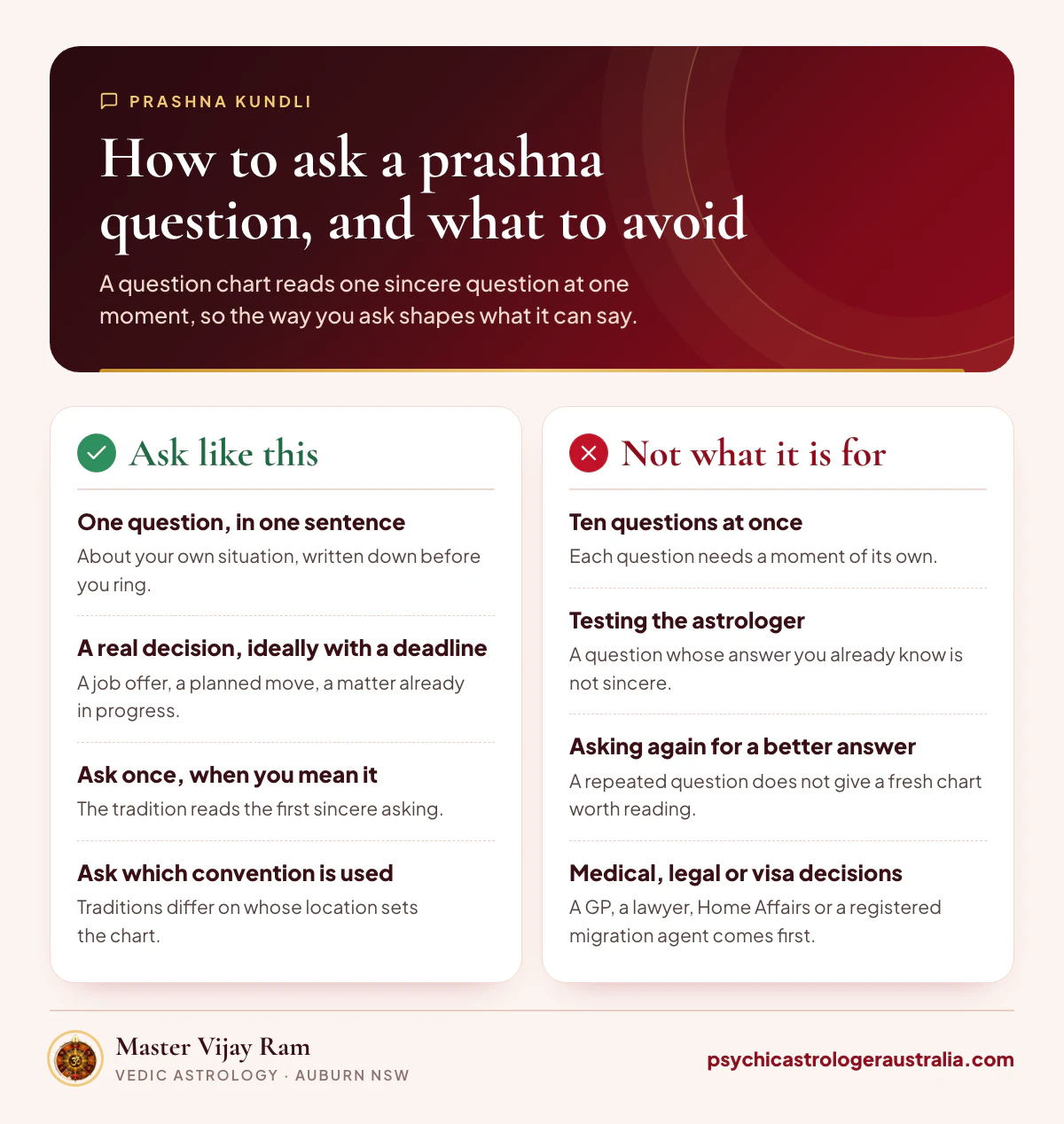
It answers one question at a time; a list of ten questions put at once is ten questions without a moment of their own. It is not a test: a question asked to catch an astrologer out, or one whose answer is already known, is not sincere, and the tradition does not read it.
It is not for repeated asking either. Putting the same question again because the first answer was unwelcome does not produce a fresh chart worth reading; if circumstances genuinely change, a new question about the new situation is fair. And it cannot decide a medical, legal, financial or visa matter, which belongs with the professional responsible for it.
Is prashna the same as Western horary astrology?
They share the idea that the moment of a real question carries its answer. Vedic prashna uses the sidereal zodiac, the nakshatras and Parashari house rules, and the Kerala school adds the circumstances and omens around the asking. Western horary astrology uses the tropical zodiac and its own conventions, so the two methods can describe the same question in different terms.
Does the time zone change a prashna?
The moment of a question is one instant everywhere; only the clocks disagree. Darwin runs an hour and a half behind Sydney in summer and half an hour in winter, Cairns and Townsville keep Queensland time all year, and none of that changes the instant at which the question was asked.
The place is a different matter, because the lagna depends on where a chart is cast as well as when. Darwin lies about twenty degrees of longitude west of Auburn, enough to move the rising sign, which is one reason traditions differ on whose location to use. Readings for Darwin clients run on Darwin's own clock, which stays the same all year.
No birth time at all: what are the options?
A prashna is one of three approaches, and each answers a different kind of question. The table sets them side by side.
| Approach | What it needs | What it can answer | Its limits |
|---|---|---|---|
| Prashna, the question chart | The moment and place of a sincere question | One specific question | One question at a time; not for repeated asking |
| Birth-time rectification | A birth date and several dated life events | A likely birth time, then a full chart | An estimate that depends on reliable dates |
| A date-only chart | The birth date alone | The Moon sign in most cases, and broad transits | No lagna, no houses and no exact dasha dates |
Where a reliable birth time does exist, a full kundli reading is the better tool for questions about a whole life, and a prashna can sit alongside it for one pressing matter.
How should you prepare a prashna question?
Write the question down before you ring, in one sentence, and make it about your own situation: whether to accept this offer, whether this move is well timed, how this matter is likely to go. Note any deadline and the decision that hangs on the answer, because the reading is more useful when it knows what you will do with it.
Then ask it once, from a quiet place, when you genuinely want to know. A question put in a rush between errands, or asked of three astrologers in one afternoon, loses the sincerity the whole method depends on.
How does a $50 consultation handle a prashna?
You put one question clearly, in your own words, and it helps to think it through beforehand; how to phrase a question for an astrologer shows how. Master Vijay Ram notes the moment, casts the chart and reads it with you over the phone, on video or by WhatsApp, in Hindi, Punjabi or English.
You come away with the indication, how firm it looks, any rough sense of timing the chart shows, and a plain statement of what it cannot answer. The consultation is $50; a prashna reading rarely leads to a remedy, and where one is ever relevant it starts from $250 and is agreed before it is performed, as online puja and havan explains. Treat the answer as faith-based guidance; medical, legal, financial and migration decisions rest with the professionals.
Read next
- How to Read Your Birth Chart: A Beginner’s Guide to the Vedic MethodHow to read your birth chart the Vedic way: find the lagna and Moon sign, learn the 12 houses and nine grahas, check …
- Grahan Dosha: Sun or Moon with Rahu or Ketu in the Birth ChartGrahan dosha, the Sun or Moon with Rahu or Ketu, explained calmly: the four forms, what each colours, what changes it…
- Kundli Reading Explained: What Your Birth Chart RevealsWhat a Kundli reading reveals about your life, personality, career and destiny. Master Vijay Ram explains Vedic astro…
Frequently asked questions
What is the difference between a prashna kundli and a birth chart?
A birth chart is cast for the moment of birth and describes a whole life and its periods; a prashna kundli is cast for the moment a sincere question is asked and answers that one question. The birth chart needs an accurate birth time, while the prashna needs only the moment of asking and a place, which is why it helps people who do not know when they were born.
Can astrology work without a birth time?
Partly. Without a time the Moon's sign usually survives, and a date-only chart can show broad transits, but the lagna, the houses and exact dasha dates cannot be trusted. A prashna answers a specific question without any birth data, and birth-time rectification can sometimes rebuild a likely time from dated life events. Each method has limits, and the reading should say which you are getting.
What kind of question suits a prashna?
One sincere, specific question that matters to you now, such as whether to accept a particular job offer, whether a planned move is well timed, or how a pending matter is likely to turn. Broad questions about a whole life suit a birth chart better. Questions that belong with a doctor, a lawyer or Home Affairs go to them first, whatever the chart might show.
Can I ask the same prashna again?
The tradition reads the first sincere asking, and asking again because the answer was unwelcome is not a new question, so the second chart is not given the same weight. If circumstances genuinely change, a new question about the new situation is a fair one. It is better to ask once, carefully, than to keep asking until an answer feels comfortable.
Can I ask a prashna about someone else?
You can ask about a matter that genuinely involves you, such as your own relationship or a family decision, but not to pry into another person's private life. The chart describes the matter from the asker's side. Questions about someone else's health or legal situation belong with that person and their own advisers, not with a question chart.
Whose location is used for a prashna cast over the phone?
Traditions differ. Some astrologers cast the chart for the place where they receive the question, others for the place of the person asking. Because the lagna depends on the place as well as the moment, the choice can change the rising sign, so a careful reader tells you which convention they follow before reading the chart.
How accurate is prashna astrology?
No method of astrology can promise accuracy, and prashna is no exception. It is a traditional way of reading the tendency of one matter at one moment, and its usefulness depends on the sincerity of the question and the care of the reading. It cannot replace evidence, professional advice or your own judgement, and it should never be the only basis for a major decision.
Is prashna the same as horary astrology?
They rest on the same idea, that the moment a real question arises carries its own answer. Vedic prashna uses the sidereal zodiac, the nakshatras and its own house rules, and the Kerala tradition also weighs the circumstances around the asking. Western horary astrology uses the tropical zodiac and its own conventions, so the two can describe the same question differently.
Can a prashna tell me whether my visa will be granted?
No. Visa decisions are made by the Department of Home Affairs on the law and the evidence, and a registered migration agent is the right adviser. A prashna about moving abroad can describe how a planned move sits with you at the moment of asking, which is a different and much smaller thing than a visa decision.
People also ask
What is prashna kundli in astrology?
It is a chart cast for the moment a sincere question is asked, rather than for a birth. Vedic astrologers use it when a birth time is unknown or when one specific question needs an answer, reading the lagna for the person asking, the house of the matter for the question, and the Moon for its flow.
How does prashna astrology work?
The astrologer notes the moment the question is put, casts a chart for that moment and an agreed place, and reads the lagna as the asker and the relevant house as the matter. A link between their lords, the Moon's condition and the planets in key houses are traditionally read for the likely direction of the matter.
What is prashna jyotish used for?
For specific questions when no reliable birth time exists, and for urgent single questions even when one does: a job offer, a move, a relationship decision, a matter already in progress. It is not used for whole-life readings, for testing an astrologer, or in place of a doctor, a lawyer or a migration agent.
Do I need my birth details for a prashna?
No. A prashna is cast for the moment of the question, so it needs no birth date or time. If you do have birth details, even approximate ones, the astrologer may read them alongside, especially for broader questions in which the periods of the birth chart matter.
References & further reading
Serving clients across Australia
Confidential consultations by phone, video & WhatsApp — including: