

Quick answer
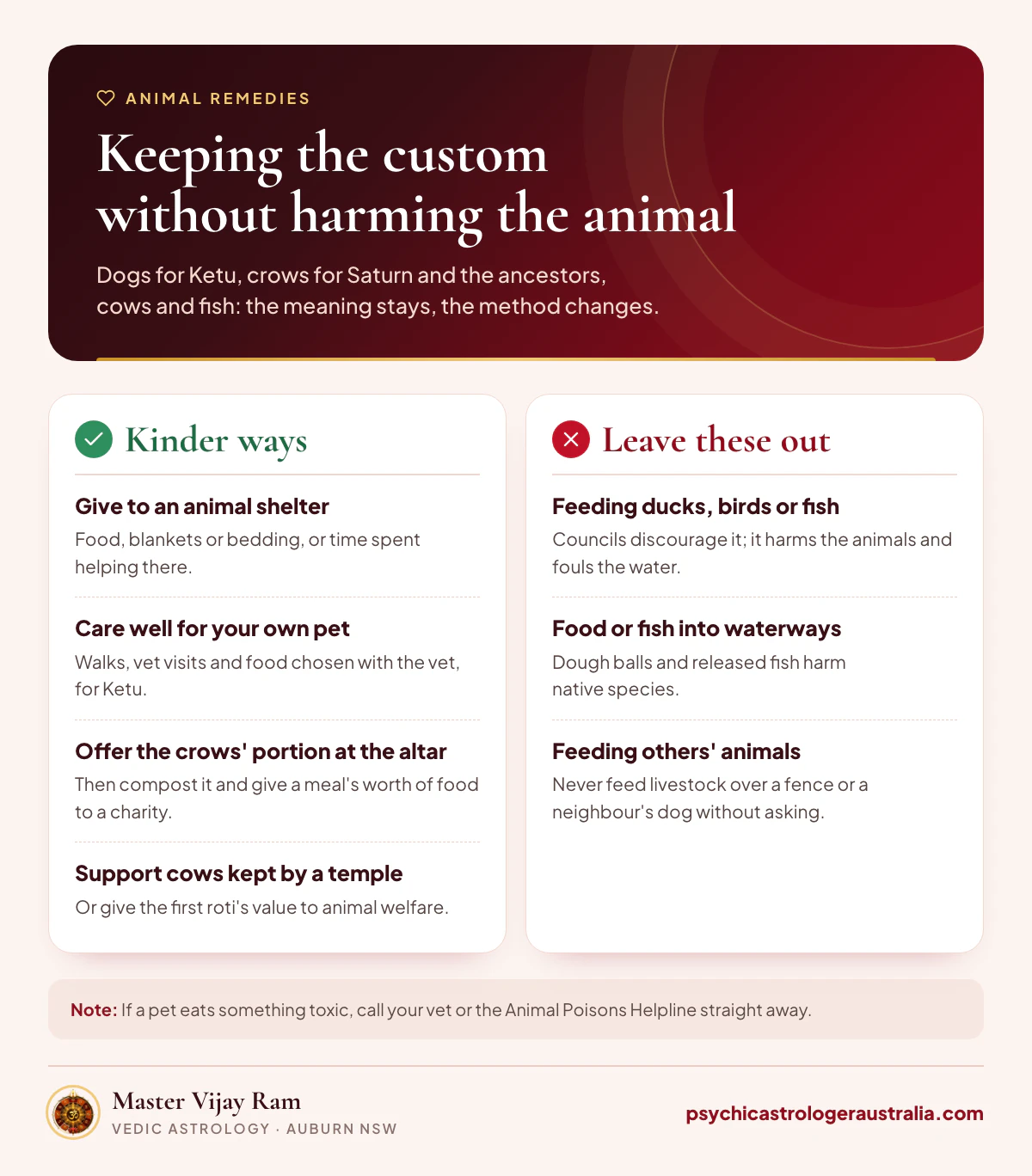
Indian custom feeds cows, dogs, crows and fish as remedies, linking dogs with Ketu and crows with Saturn and the ancestors, though traditions differ. In Australia, councils discourage feeding ducks, birds and fish because it harms them, so the custom is kept through animal shelters, your own pets’ care under a vet’s advice, temple cow care and an offering at the altar.
Why is feeding animals a remedy at all?
A feeding animals remedy is a traditional act of care toward particular creatures, chosen because each is linked in custom with a planet, a deity or the ancestors, and offered so that kindness flows where a chart shows strain. The cow is honoured as a mother, the dog is Bhairava’s companion, the crow carries offerings to the ancestors, and fish are fed in memory of Vishnu’s first avatar. Behind every version is one idea: care given to a living being that cannot repay it.
That idea travels to Australia well. The particular methods often do not, because feeding wild animals here can sicken them and breaks council rules. This page keeps the meaning and changes the method. A graha shanti puja is the formal remedy for a planet under strain; animal care is the everyday one that sits beside it.
Which animal is linked to which planet?
Families and texts differ, sometimes widely, and the folk handbooks that popularised many of these remedies do not always agree with older practice. The table gives the associations most families mention, with the Australian way to keep each one.
| Animal | Commonly linked with | The custom in India | A kinder Australian way |
|---|---|---|---|
| Cow | Jupiter, Venus, the mother, general merit | Feeding the first roti, greens or jaggery to a cow | Support a temple or community that keeps cows; never feed someone’s livestock |
| Dog | Ketu; Bhairava’s vahana | Feeding roti to street dogs | Care for your own dog with a vet’s advice; give food or bedding to an animal shelter |
| Crow | Saturn; the ancestors at shraddha | Placing a portion of food out for crows | Offer the portion at the altar, then give food to a charity or compost it |
| Fish | Remedies for Rahu or Jupiter in some books; Vishnu’s matsya avatar | Dough balls thrown into a river or tank | Care for an aquarium you own; never throw food or release fish into waterways |
| Ants and small birds | Rahu and Saturn in some books | Sugar or flour at an anthill; grain for sparrows | Leave it: it attracts pests; give grain-based food to a food bank instead |
Daan of goods for each planet is a closely related practice, and daan by planet sets out the traditional gifts and days.
Why is feeding wildlife a problem in Australia?
Councils across Australia discourage feeding ducks, birds and fish, and many parks display signs saying so. Bread, rice and roti give wild birds little of what they need, uneaten food rots in ponds and lakes, and regular feeding draws animals into crowds and teaches them to depend on people. The result is the opposite of the kindness the remedy intends.
Some councils go further and fine people for feeding wildlife in particular places, so check local rules. The tradition never asked for harm to the creature being honoured; when a custom hurts the animal, changing the method is the faithful choice, not the lax one.
What about crows and the offering for the ancestors?
In India a portion of the shraddha meal is set out for crows, which are said to carry it to the ancestors, and some families feed crows on Saturdays for Saturn. Australian ravens and crows are native birds, and food left out also brings rats, foxes and the neighbours’ complaints.
Many families now offer the crows’ portion at the altar with a prayer, then compost it or bury it in their own garden, and give a meal’s worth of food to a charity in the ancestors’ name. That keeps the meaning without feeding wildlife. Pitru Paksha and shraddha in Australia describes the wider observance.
How can you keep the dog remedy for Ketu?
Ketu’s traditional remedy is care for dogs, and the classic image is a roti given to a stray. Australian cities have few strays, and a neighbour’s dog should never be fed without asking, because many human foods are dangerous to dogs and some are deadly.
The better way to feed a dog as a remedy for Ketu is to look after one properly: your own dog’s walks, vet visits and good food, chosen with the vet. Families without a dog can give food, blankets or bedding to an animal shelter, or volunteer to walk dogs there. If a pet eats something it should not, the Animal Poisons Helpline and your vet are the first calls. The Ketu mahadasha and its remedies explains why care for animals suits that period.
And the cow, for families without one nearby?
Feeding a cow as a remedy is the most loved of these customs and the hardest to keep in an Australian suburb. Cattle on farms belong to someone, their diets are managed, and farmers have strict biosecurity rules about what animals may eat; feeding livestock over a fence is not kindness and can be against the law.
Some temple communities and devotional farms in Australia keep cows and accept help with their care. Families also set aside the first roti of the day at the altar, as many households in India do, and give its value to animal welfare. The gesture of putting another being first is what the custom honours.
What about feeding fish?
Throwing dough balls into a river, lake or the sea is a common remedy in India, and in Australia it fouls the water and harms native fish. Puja items and food never go into waterways here, and releasing bought or aquarium fish into a creek or dam harms native species and is prohibited in many places.
Families who keep an aquarium can treat its care as the practice, feeding properly and keeping the water clean. Others choose a different form of the remedy altogether, such as a donation to a wildlife rescue group or an animal shelter on the relevant day.
Which animal remedies suit which periods?
Families most often ask about crows for Saturn and dogs for Ketu. People in Sade Sati or a Saturn period, or anyone with Saturn under strain, are traditionally told to serve the overlooked, and that includes animals no one cares for; Sade Sati and Shani remedies covers the fuller set of Saturn practices.
A Ketu period is traditionally a time of detachment and confusion, and regular, practical care for an animal gives that restlessness somewhere useful to go. A Rahu period is sometimes linked with feeding fish or birds in folk handbooks; in Australia a donation to wildlife rescue keeps that gesture without the harm.
Is a donation to an animal shelter really the same remedy?
In spirit, yes. The remedy is care for creatures that cannot repay it, given regularly and without show. A monthly gift of food to the RSPCA or a local shelter, or a Saturday spent helping at one, is care that actually reaches animals in need.
Many families like to mark it at home too: a short prayer at the altar on the planet’s day, and the donation made that day or the next. That keeps the link to the planet clear in the giver’s mind, which is where the tradition says the remedy does its work.
Can children take part?
They often make the remedy work. Grandparents who fed street dogs in Jalandhar or cows in Jaipur want to pass the habit on, and Australian children usually love animals; a family visit to help at a shelter, or a child choosing the food to donate, turns an old custom into something the next generation understands.
It also teaches the safety rules gently: we do not feed the ducks, we ask before patting a dog, we never give a pet chocolate or onion. Of all the animal remedies astrology describes, the ones a family does together are the ones that last beyond a single difficult period.
What can an animal remedy not do?
It cannot cure an illness, fix a debt, win a court case or change another person’s choices, and no one can promise what it will change in a chart. It is faith-based practice, not medical, legal or financial advice, and it never replaces the doctor, the vet, the lawyer or the financial counsellor.
What it reliably does is good for animals and a steadier habit for the giver. That is reason enough, and it asks nothing of anyone else.
How does Master Vijay Ram suggest an animal remedy?
He reads the birth chart and the running period first. Where Saturn or Ketu is under strain, he may suggest a regular act of care for animals, adapted to your city and home, alongside a mantra; families in Tasmania can book through an astrologer for Hobart clients on the same terms. He never asks anyone to feed wildlife, break a council rule or give food that could harm an animal.
A consultation is $50, by phone, video or WhatsApp, in English, Hindi or Punjabi. If a planet calls for a puja or havan, it is performed personally at his place of practice in Auburn, from $250 and agreed before it is performed, as the online puja and havan page explains.
Read next
- Karka Rashi 2027: Ketu on the Moon and Jupiter’s Brief ReturnKarka rashi 2027 for the Cancer Moon: Ketu on the Moon and Rahu in the 7th all year, Jupiter back in Cancer from 25 J…
- Gochar: Reading Transits From the MoonHow gochar works in Vedic astrology: counting transits from the Moon sign, the favourable houses for each planet, ved…
- 11 Signs of Negative Energy in Your Life (and How to Clear It)Eleven signs of negative energy, the ordinary causes to rule out first, and the three-doors test that tells you wheth…
Frequently asked questions
Which planet is feeding dogs good for?
Feeding or caring for dogs is traditionally linked with Ketu, and the dog is the vahana of Bhairava. In Australia, look after your own dog well with a vet’s guidance, or give food, blankets or bedding to an animal shelter. Never feed a neighbour’s dog without asking, because many human foods are dangerous to dogs.
Is feeding crows good for Saturn?
Many families feed crows on Saturdays for Saturn, and crows receive a portion of the shraddha meal for the ancestors. In Australia, crows and ravens are native birds and food left out attracts pests, so families often offer the portion at the altar, compost it, and give food to a charity instead.
Can I feed ducks or fish at the park as a remedy?
Councils discourage it, and some fine people for feeding wildlife in certain places. Bread and rice give birds little nourishment, leftover food fouls the water, and crowding harms the animals. Keep the remedy through a donation to an animal shelter or wildlife rescue group, or care for an aquarium you own.
How do I do gau seva in Australia?
Some temple communities and devotional farms keep cows and welcome help with their care. Many families also set aside the first roti of the day at the altar and give its value to animal welfare. Never feed cattle on a farm over a fence: farmers manage diets and biosecurity, and it can be against the law.
Is putting dough balls in a river a good remedy?
Not in Australia. Food and puja items never go into rivers, lakes, creeks or the sea, because they foul the water and harm native fish, and releasing bought fish into waterways is prohibited in many places. Choose another form of the remedy, such as a donation to wildlife rescue on the relevant day.
What should I do if my dog eats food meant for an offering?
Call your vet or the Animal Poisons Helpline straight away if the food contained anything that may be toxic, such as onion, grapes, chocolate or a lot of salt. Keep offerings out of pets’ reach in future. The tradition never asks for an animal to be harmed, so safety comes first.
Does a donation to the RSPCA count as an animal remedy?
In spirit, yes. The remedy is care for creatures that cannot repay it, given regularly and without show. A regular gift of food, bedding or money to the RSPCA or a local shelter reaches animals in need. Many families say a short prayer at the altar on the planet’s day when they give.
How much does a remedy consultation cost?
A consultation with Master Vijay Ram is $50, by phone, video or WhatsApp, in English, Hindi or Punjabi. He reads the chart and period and suggests practical remedies, which might include care for animals adapted to your city. If a puja or havan is warranted, it starts from $250 and is agreed before it is performed.
People also ask
Which animal should I feed for Rahu?
Folk handbooks sometimes suggest feeding fish or birds for Rahu, and traditions differ a great deal. In Australia, feeding wildlife harms it, so families keep the gesture through a donation to a wildlife rescue group or animal shelter, alongside the mantra or other remedy a chart reading suggests.
Why do Hindus feed cows the first roti?
The cow is honoured as a mother figure who nourishes the household, so many families set aside the first roti for a cow as an act of gratitude and merit. In Australian suburbs, families often offer it at the altar and give its value to animal welfare or a temple that keeps cows.
Is feeding stray animals a good remedy?
Care for animals that no one looks after is a traditional remedy, especially for Saturn and Ketu. In Australia, strays are usually best helped through shelters and rescue groups rather than by feeding them in the street, which can draw complaints and spread disease among animals.
Is feeding birds bread harmful?
Yes, councils across Australia discourage it. Bread fills birds without giving them what they need, uneaten bread fouls ponds and lakes, and regular feeding crowds birds together and makes them dependent on people. Kinder alternatives include supporting wildlife rescue groups.
References & further reading
Serving clients across Australia
Confidential consultations by phone, video & WhatsApp — including: