
Quick answer
Breaking a family curse in the Vedic tradition means repair rather than reversal: the pattern is read in the family's charts as pitra dosh, an unpaid duty to the ancestors, and answered with shraddha, tarpan, restitution to anyone wronged and, where the chart calls for it, a shanti havan performed personally by Master Vijay Ram at Auburn. No relative is named.
What does breaking a family curse mean?
A family curse is a pattern of trouble that repeats down a family line, and breaking a family curse, in the Vedic tradition, is repair rather than reversal. The pattern a family describes, sons who do not prosper, daughters whose marriages fail at the same age, a line that loses its land or its health in each generation, is read in the charts as pitra dosh: a duty owed to the ancestors that was never paid, and that keeps presenting itself until it is. Nothing is broken by force; a debt is acknowledged and settled, and the household is released from the shape it has been living in.
This page explains how Master Vijay Ram reads a family curse, how pitra dosh shows in a chart, what repair to the ancestors actually involves, who takes part, and what it costs. It sits beside the generational cycle guide, which covers the diagnosis in detail; here the emphasis is on the repair. Curse, hex and tona-totka removal is the service page behind both.
The story a family tells, and the pattern underneath it
The story usually has a wrong in it. A grandfather who took a brother's share of the land, a widow turned out of a house, an adopted child denied, a marriage broken by the elders, and words spoken by the person wronged that the family still repeats. Then the pattern: the same difficulty arriving in each generation, often at the same age, often to the same kind of person in the family.
He takes the story seriously and the pattern more seriously, because the pattern is what the charts can test. A family that believes itself cursed has usually been carrying the belief for longer than the trouble, and the belief itself shapes choices. The first task is to separate the three things, the wrong, the words and the pattern, and to see which of them the charts actually support.
What is pitra dosh?
Pitra dosh, or pitru dosha, is the Vedic name for an affliction that comes down a line rather than arising in one life: a duty to the ancestors left unperformed, a death without the rites, a wrong done by an elder that the descendants inherit the weight of. In a chart it is read mainly in the ninth house, the house of the father and the lineage, and in the Sun and Moon when Rahu, Ketu or Saturn sit with or aspect them; the fifth house, the house of children, is read beside it because the dosha tends to reach forward as well as back.
It is not a sentence and it is not rare. Many charts carry some indication of it, and most of those families live ordinary lives. What makes it a working diagnosis is the same indication appearing across the charts of several family members, with the family's history fitting the pattern the charts describe. The signs of pitra dosh walks through the chart side in detail.
Is a family curse the same thing as pitra dosh?
They overlap, and the table shows where. A spoken curse from a wronged person is a shrap and is answered first by putting the wrong right; pitra dosh is a debt to the ancestors and is answered by the rites owed to them; a family curse, as families use the phrase, is usually both at once, which is why the repair has two parts.
| What the family calls it | What is usually behind it | What the charts show | What repair addresses |
|---|---|---|---|
| A shrap, a spoken curse | A wrong done within living memory and the words that followed it | A moment in the timeline that fits the trouble; often little in the chart itself | Restitution and reconciliation first; a shanti havan only if still warranted |
| Pitra dosh, ancestral karma | Rites left undone, a death without its due, an elder's wrong inherited | Ninth house afflicted; Sun or Moon with Rahu, Ketu or Saturn; the same marks across several family charts | Shraddha, tarpan and pind daan; the Pitru Paksha fortnight; a havan where the charts call for it |
| A family or generational curse | Both of the above, remembered as one story | A dated wrong in the history plus the lineage marks in the charts | Both parts of the repair, agreed as one piece of work with the family's role set out |
| A pattern that is actually learned | Money habits, a marriage pattern taught by example, migration, drink | Nothing consistent across the charts | No remedy; a plain explanation and, often, a counsellor |
The three questions he asks a family first
Who was wronged, and is anyone from that side still alive? When did the pattern begin, and does it have a start or has it always been told as always? What exactly repeats, in whom, and at what age? The answers do more than any single chart, because they let the charts be read together: the grandfather's if the date is known, the parents', the children's, with the same houses compared across them.
Ordinary causes are gone through at the same time, and they explain most of what families bring. A pattern of failed businesses is usually a pattern of the same decisions, taught by example; a line of broken marriages is often a line of marriages arranged the same way for the same reasons; drink and debt run in families without any help from the ancestors. Where the explanation is ordinary, he says so, and the repair offered is practical rather than ritual.
What does repair to the ancestors involve?
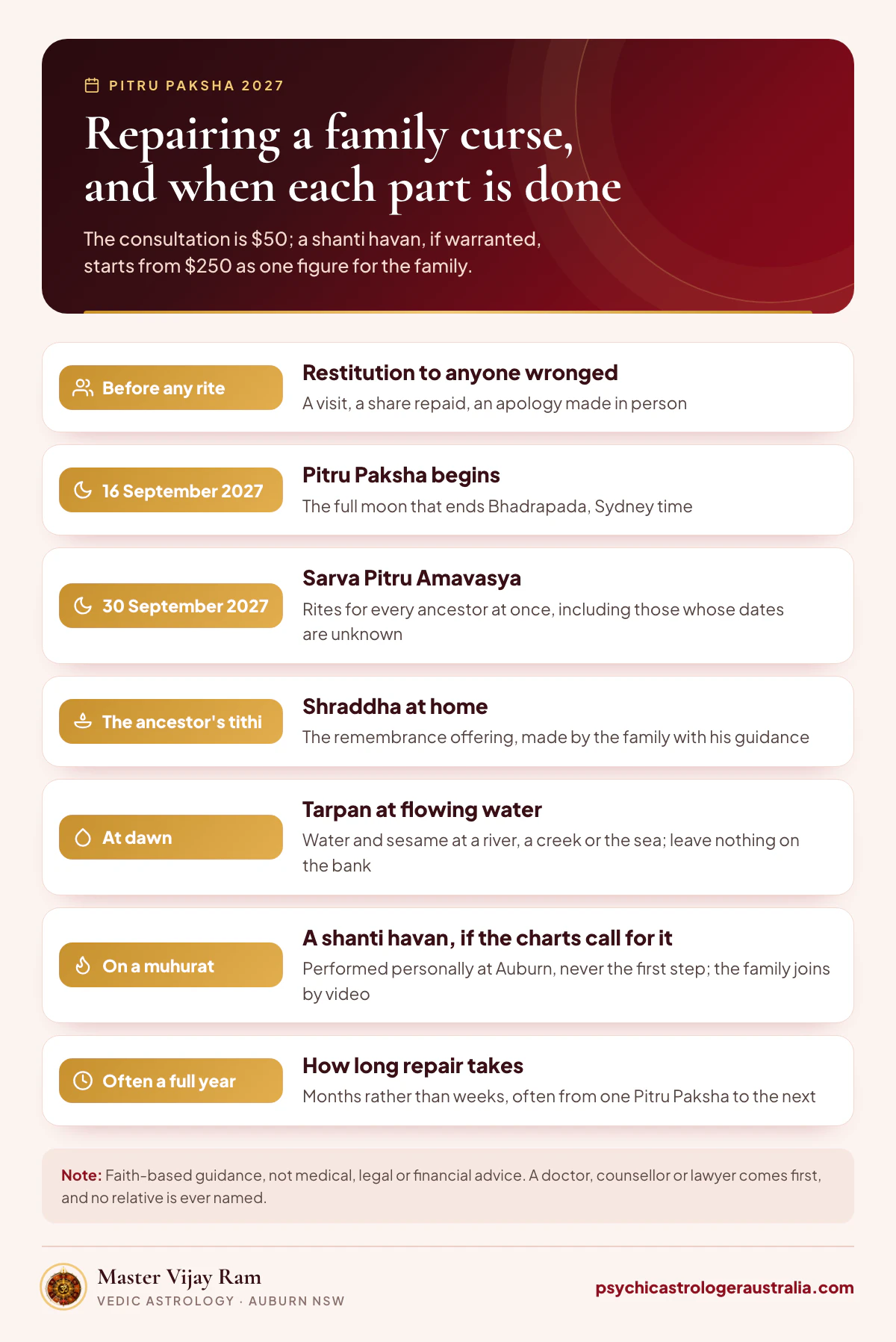
The core of an ancestral curse remedy is the set of rites the tradition says the living owe the dead: shraddha, the remembrance offering on the ancestor's tithi; tarpan, the offering of water with sesame; pind daan, the rice offerings made for those who died without their rites or whose line has forgotten them. These are duties, not spells, and they are performed by the family, with his guidance on the day, the manner and the words, rather than by him on their behalf.
From Australia this is simpler than families expect. Tarpan is offered at any flowing water, and families in Sydney, Melbourne and the regional cities do it at a river or the sea at dawn with a priest's guidance; shraddha is made at home. Where a family can travel, the traditional places in India remain open to them, and he will say when that is worth the journey and when it is not.
Pitru Paksha 2027: the fortnight for this work
The fortnight set aside for the ancestors falls between the full moon that ends the month of Bhadrapada and the new moon that opens Ashwin, and the last day, Sarva Pitru Amavasya, is the one on which rites may be offered for every ancestor at once, including those whose dates are unknown. In 2027 that fortnight runs from the full moon on 16 September 2027 to the new moon on 30 September 2027, Sydney time, with Navratri beginning the day after. A family that has begun its repair aims the main offerings at this fortnight; one that has not can begin on any ancestor's tithi and complete the work the following year.
When is a havan warranted, and what does it address?
Not always. Where the charts show pitra dosh across the family and the history fits, and the rites have been begun, he may perform a shanti havan with mantra sadhana on a chosen muhurat at his own place of practice in Auburn, the family joining by video. The sadhana addresses release: the debt acknowledged, the ancestors honoured, forgiveness asked for the wrong that began the pattern, and the line released from the shape the story gave it. Online puja and havan explains how the work is performed and witnessed from a distance.
A havan is never the first step and never the whole repair. A family that wants the fire without the rites, or the fire without the restitution, is asking for the part of the work that costs money in place of the part that costs effort, and he will say that plainly.
Who in the family takes part?
The tradition gives the eldest son the duty and the modern family distributes it. Daughters offer tarpan where there is no son or where the son will not, and the rites are accepted; a family spread across Australia, India and Canada joins the same dawn by video, each at their own water. What matters is that the people who carry the pattern take part in the repair, which usually means the generation in the middle, the ones with living parents and growing children, who are also the ones who ring.
The relative who was wronged
Where the story has a wrong in it and someone from the wronged side is alive, repair begins there, before any rite and long before any fire. A visit, a share repaid, an apology made in person, a widow's name restored to the family's telling of its history. The tradition holds that a debt answered in life loosens faster than one answered only in ritual, and the families who see the pattern change are nearly always the ones who did this part. What the tradition says about spoken curses sets out why the words carry weight and why reconciliation is the first remedy.
What repair does not do
It does not name anyone. The relative suspected of having cursed the family is not confirmed from a chart or from anything else, and nothing is ever sent back at a person; repair is aimed at a debt, not a culprit. It does not replace a doctor for an illness that runs in a family, a counsellor for a marriage, an addiction service for drink, or a lawyer for the land, and he will send a family to any of those before he reads a chart for them. Faith-based guidance is not medical, legal or financial advice, and this page should be read in that light.
How long does breaking a family curse take?
Months rather than weeks, and often a full year from one Pitru Paksha to the next. The rites have their own calendar, restitution takes the time the people involved need, and a pattern that took three generations to form does not change its shape in a fortnight. What tends to settle first is the family itself: the story told less often, the fear less present at every setback, decisions made on their own merits. When a dosha is cancelled explains why many charts that frighten a family on first reading turn out to carry their own remedy.
What does it cost?
The consultation is $50, by phone, video or WhatsApp, and for a family it is usually a longer conversation with more than one chart in it; most families learn in it whether the charts support the story at all. Where repair is warranted, the rites are the family's own and cost them the materials and the morning. A shanti havan, where the charts call for one, starts from $250 and is agreed in full before the muhurat is chosen, as one figure for the whole family's work rather than a fee per sitting; it does not rise, and no gold, jewellery or valuables are asked for. Kaal sarp and pitra dosh describes the chart-side remedy on its own page.
Generational curse or learned pattern: when is this not the answer?
Often. A generational curse that turns out to be a learned pattern is still a real pattern, and naming it correctly is the most useful thing a reading can do, because learned patterns can be unlearned and cursed ones cannot. Families in that position are pointed to a counsellor, a financial counsellor or a family mediator, and the family problem page describes what a reading can offer alongside them. Pitru dosh family problems and ordinary family problems look alike from inside the family; the charts, read together, are how the two are told apart.
Can families in Perth or Adelaide repair pitra dosh without going to India?
Families outside Sydney and Melbourne often assume the rites must wait for a trip to India, and they need not. Pitra dosh repair from Australia follows the lunar calendar where you live, and because a tithi is worked out for the place where the rite is kept, a son in Canning Vale, a daughter in Salisbury and an uncle in Ludhiana can find the same ancestor's shraddha falling on different days.
Vijay Ram ji sets each household's day separately rather than handing one date to the whole family. Pitru Paksha arrives in the Australian spring, and anyone who wants a priest beside them for the shraddha can ask at their own temple, whether that is the Perth Hindu Temple at Canning Vale or the Shri Ganesha Temple at Oaklands Park in Adelaide.
Tarpan needs only flowing water at dawn: a river, a creek or the sea. Take water and sesame, say the names you know, and leave nothing behind on the bank or the sand.
The clock is the harder part. Dawn in Harrisdale or Parafield Gardens is still the middle of the night in Punjab, so relatives in India can make their offering at their own sunrise and join the family's video call afterwards, remembering that Perth sits two hours behind Sydney through winter and three through summer, while Adelaide stays half an hour behind all year.
The consultation that reads the family's charts side by side happens over the phone, on video or through WhatsApp, with consultations in Hindi and Punjabi for elders who prefer them, and it often finds an ordinary family pattern rather than a dosha. Families in Western Australia can begin with Vedic readings for Perth clients, and those in South Australia with astrology readings in Adelaide. If the charts do call for a shanti havan, he performs it himself in Auburn, where he practises, and the family watches by video from whichever city it calls home.
Read next
- Family Curse Removal in Australia: Breaking the Generational CycleA grounded guide to family curse removal in Australia: what a generational curse means, the myths worth dropping, and…
- Curse Removal in Australia: How a Curse Is Diagnosed and LiftedCurse removal in Australia: the four kinds of curse people describe, how a genuine practitioner diagnoses one, what l…
- Shrap: Spoken Curses and Bad Wishes in the Vedic TraditionShrap, the spoken curse of the Hindu tradition: what the epics say, what a parent’s curse means today, why reconcilia…
Frequently asked questions
How do you break a family curse?
By repairing what the pattern points to rather than attacking it. The family's charts are read together for pitra dosh, the history is tested against them, and where they agree the family performs the rites owed to the ancestors, shraddha, tarpan and pind daan, makes restitution to anyone the original wrong touched, and, only where the charts call for it, Master Vijay Ram performs a shanti havan at Auburn. Nothing is sent back at anyone.
What is pitra dosh and how is it seen in a chart?
Pitra dosh is an affliction inherited down a line, read as a duty to the ancestors left unperformed or an elder's wrong carried by the descendants. In a chart it shows mainly in the ninth house and in the Sun or Moon joined or aspected by Rahu, Ketu or Saturn, with the fifth house read beside them. Many charts carry some indication of it; it becomes a diagnosis only when the same marks repeat across several family members' charts.
Is a family curse the same as pitra dosh?
They overlap. A shrap is a spoken curse from a wronged person and is answered first by putting the wrong right; pitra dosh is a debt to the ancestors answered by the rites owed to them; what families call a family curse is usually both remembered as one story, which is why the repair has two parts. A fourth possibility, a learned pattern with nothing consistent in the charts, is the most common finding of all.
What rites are involved in repairing pitra dosh from Australia?
Shraddha, the remembrance offering on the ancestor's tithi, made at home; tarpan, water offered with sesame at any flowing water, which families do at a river or the sea at dawn with a priest's guidance; and pind daan, rice offerings for those who died without their rites or whose names are lost. The Pitru Paksha fortnight is the time for the main offerings, and Sarva Pitru Amavasya covers every ancestor at once.
Who in the family has to take part?
The tradition names the eldest son and the modern family shares the duty. Daughters offer tarpan where there is no son or where he will not, and it is accepted; relatives in different countries join the same dawn by video at their own water. The people who carry the pattern are the ones who need to take part, which usually means the middle generation, with living parents and growing children, who are also the ones who make the call.
Will he tell us which relative cursed the family?
No. A name is not confirmed from a chart or from anything else, because repair is aimed at a debt rather than a culprit and because a name confirmed inside a family does more lasting harm than the pattern it was meant to explain. He will hear the family's suspicion once, set it aside, and read the charts without it. Where the story has a wrong in it, the work is to put the wrong right, not to find someone to blame.
How long does it take and what does it cost?
Months, and often a year from one Pitru Paksha to the next, because the rites have their own calendar and restitution takes the time the people involved need. The consultation is $50 and usually covers more than one chart. The rites cost the family their materials and their mornings. A shanti havan, where the charts call for one, starts from $250 and is agreed in full as one figure for the family before the muhurat is chosen; it does not rise.
What if the pattern turns out to be ordinary?
Then that is the finding, and it is a useful one, because a learned pattern can be unlearned where a cursed one cannot. A line of failed businesses is usually the same decisions taught by example; a line of broken marriages is often marriages arranged the same way; drink and debt run in families on their own. Families in that position are pointed to a counsellor, a financial counsellor or a mediator, and no remedy is offered.
Can a havan alone break the curse without the rites?
No, and he will say so. The havan is the last part of the repair and never the first: it addresses release once the debt has been acknowledged and the rites begun. A family asking for the fire without the shraddha, or without restitution to the person wronged, is asking for the part that costs money in place of the part that costs effort, and the tradition is clear that the debt answered in life loosens faster than one answered only in ritual.
People also ask
What are the signs of a family curse?
The same difficulty arriving in each generation, often at the same age and to the same kind of person: sons who do not prosper, marriages that fail at one point, a line that loses its land or its health. A wrong in the family's history with words attached to it. Read on their own these are also the signs of a learned pattern, which is why the charts of several family members are read together before anything is said.
What are the remedies for pitra dosh?
Shraddha on the ancestor's tithi, tarpan with water and sesame at flowing water, pind daan for those who died without their rites, the main offerings in the Pitru Paksha fortnight, restitution to anyone the original wrong touched, and, where the charts call for it, a shanti havan with mantra sadhana performed on a chosen muhurat. The rites are the family's own; the havan is Master Vijay Ram's part.
When is Pitru Paksha in 2027?
The ancestors' fortnight runs from the full moon that ends Bhadrapada to the new moon that opens Ashwin: in 2027 from the full moon on 16 September to the new moon on 30 September, Sydney time, with Navratri beginning the day after. The last day, Sarva Pitru Amavasya, is the one on which rites may be offered for every ancestor at once, including those whose dates are not known.
Can a generational curse be broken from Australia?
Yes, because the repair is made by the family wherever they are: shraddha at home, tarpan at a river or the sea at dawn, restitution to the person wronged by phone or in person, and a havan performed by Master Vijay Ram at Auburn that the family joins by video. The consultation is $50 by phone, video or WhatsApp, and nothing in the work depends on travelling to India, though he will say when a journey is worth making.
Does pitra dosh affect children and marriage?
The tradition reads it forward as well as back, which is why the fifth house, the house of children, is read beside the ninth, and why delayed marriage and difficulty conceiving appear in the family stories. Those two things also have ordinary causes that are checked first, a doctor for conception and the ordinary astrology of marriage timing for the delay, before any ancestral reading is offered as the explanation.
References & further reading
Serving clients across Australia
Confidential consultations by phone, video & WhatsApp — including: