

Quick answer
Parivartana yoga is a sign exchange: two planets each sit in the sign the other rules, so their houses are tied together. The texts sort the 66 possible exchanges into maha (good houses), khala (involving the 3rd) and dainya (involving the 6th, 8th or 12th). It links two areas of life; dignity and dashas decide how it shows.
What is parivartana yoga?
Parivartana yoga is a combination that forms when two planets occupy each other's signs: Mercury in Taurus while Venus is in Gemini, or the Sun in Cancer while the Moon is in Leo. Each planet is a guest in the other's house, and the tradition reads the pair as strongly bound, as if each were also sitting in its own sign. The word means exchange, and Western astrologers call the same pattern mutual reception.
The exchange ties together the two houses involved, so their matters affect each other for life. A kundli reading with Master Vijay Ram starts by naming which two houses are joined, because that decides almost everything about the yoga.
How does a sign exchange work in practice?
Think of two neighbours who have swapped houses for a year. Each lives in the other's home, uses the other's kitchen and answers the other's door, and the two households become entangled. In a chart, the planet ruling the 4th sitting in the 10th, while the 10th lord sits in the 4th, makes home and career inseparable: work from home, a family business, a career that moves the household.
Because each planet is in the other's sign, many astrologers treat both as having near own-sign strength. Traditions differ on how far that goes, and a debilitated planet in an exchange is still debilitated by sign, which is why dignity is checked separately.
Maha, khala and dainya: the three types
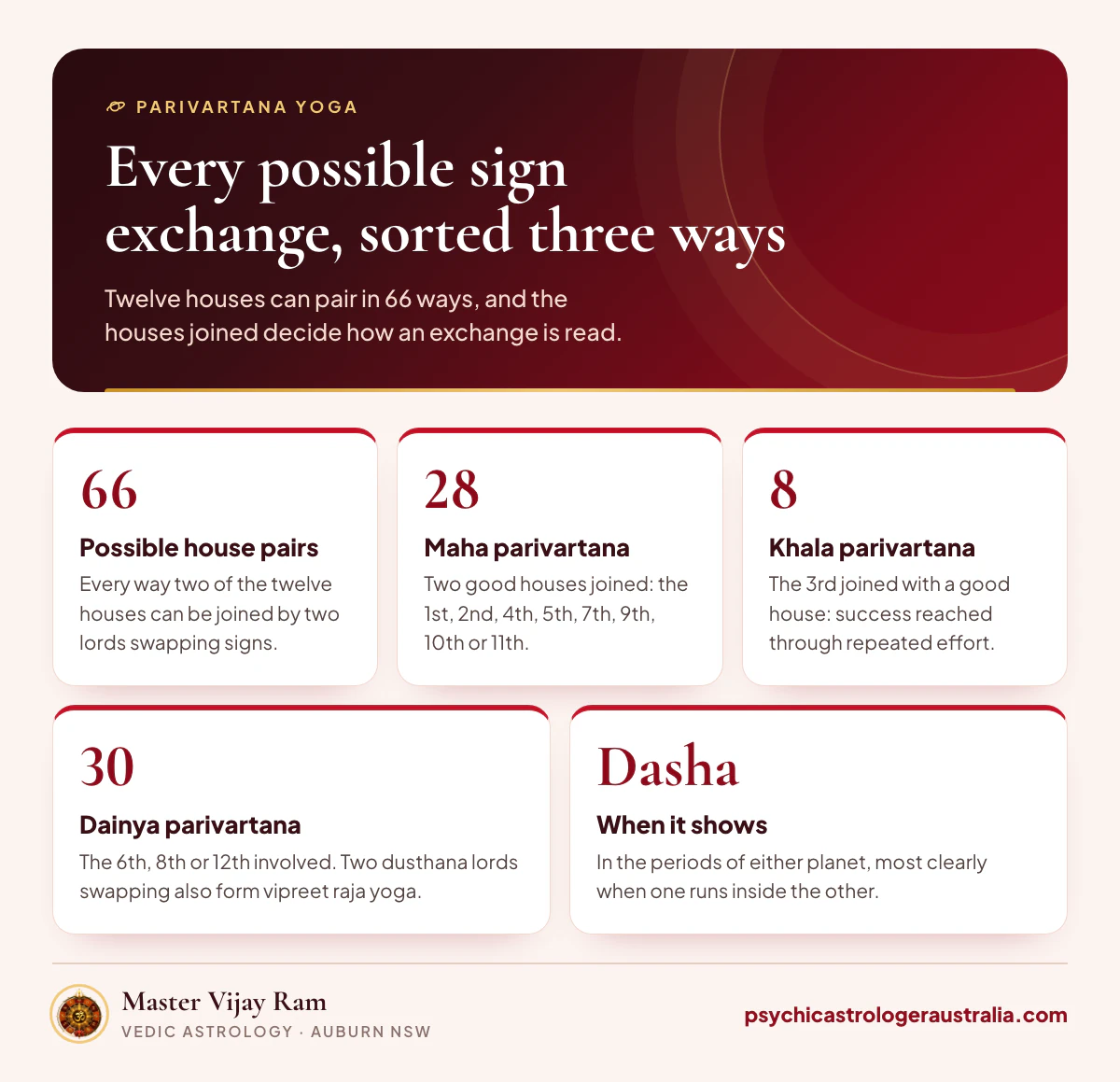
Parashara's scheme sorts every exchange by the houses it joins. Twelve houses give 66 possible pairs, and they fall into three groups.
| Type | Houses involved | Number of pairs | Traditional reading |
|---|---|---|---|
| Maha parivartana | Any two of the 1st, 2nd, 4th, 5th, 7th, 9th, 10th and 11th | 28 | The great exchange: prosperity, standing, support between two good areas of life |
| Khala parivartana | The 3rd with any of those eight good houses | 8 | Mixed: effort, courage and some fickleness; fortunes that rise and dip |
| Dainya parivartana | The 6th, 8th or 12th with any other house | 30 | Difficult on paper: debt, illness, loss or upheaval linking into another area |
So 28, 8 and 30 add up to all 66. The labels describe tendencies; they are not grades of a person.
What does a maha parivartana yoga look like?
A maha parivartana yoga joins two good houses and is read as each strengthening the other. The 9th and 10th lords exchanging is the most praised case, a link between fortune and career that the texts also count as a raj yoga. The 1st and 5th lords exchanging is read as intelligence put to personal use; the 2nd and 11th, as earnings that feed savings.
An illustrative chart, not a client: Leo rising, the Sun in Aries in the 9th and Mars in Leo in the 1st. The lagna lord and the 9th lord have swapped, and the Sun is exalted as well. The tradition reads a person whose own initiative and good fortune keep reinforcing each other, often through teachers or a father's influence.
What is khala parivartana, and why is it mixed?
The 3rd house is effort, courage, siblings, short travel and communication. It is an upachaya, a house that improves with time, but it is not a house of fortune, and the texts read an exchange involving it as success reached through repeated effort, with some impatience along the way. A 3rd–10th exchange is often seen in people who build careers through their own media, writing or sales.
Khala means something like rough or wicked in Sanskrit, which sounds worse than the tradition's actual reading. The third house of courage and effort explains why effort is the key to this exchange.
Is dainya parivartana always bad?
No. Dainya parivartana joins one of the dusthanas, the 6th, 8th or 12th, with another house, and the textbook reading is that the hard house's themes leak into the other. A 6th–10th exchange can show as a career in health, law or service that involves conflict; an 8th–4th exchange as a home affected by sudden change or inheritance.
Two dusthana lords exchanging with each other, the 6th with the 8th, or the 8th with the 12th, is a special case: it also forms a vipreet raja yoga, where difficulty cancels difficulty. Vipreet raja yoga explained covers how that reversal is read.
Why are some exchanges impossible for some lagnas?
An exchange needs two different planets. Mars rules both Aries and Scorpio, so for an Aries lagna the 1st and 8th can never exchange; Venus rules Taurus and Libra, Mercury Gemini and Virgo, Jupiter Sagittarius and Pisces, Saturn Capricorn and Aquarius, and each of those pairs is closed in the same way. The Sun and Moon rule one sign each, so a Sun–Moon exchange is always Leo for Cancer.
The same fact means a planet ruling two houses brings both into the exchange. For Gemini rising, Saturn rules the 8th and 9th; Saturn in Gemini with Mercury in Aquarius joins the lagna to the 9th by sign, but Saturn carries its 8th-house rulership into the lagna as well, and the reading has to hold both.
A worked dainya example
Another illustration: Capricorn rising, Saturn in Leo in the 8th and the Sun in Capricorn in the 1st. The lagna lord and the 8th lord have swapped, a dainya exchange. The textbook reads periods of upheaval tied to the self: health scares, sudden changes of direction, interest in research or the hidden.
In a real chart the picture is more nuanced. Saturn and the Sun are natural enemies, and the planetary friendships and enmities between them colour the exchange; yet the same pair often gives an investigator, an insurance assessor or someone who rebuilds after setbacks. The point of the reading is to name the theme, not to frighten.
How is the strength of an exchange judged?
Several checks matter. The dignity of each planet in its borrowed sign, which can range from exalted to debilitated; combustion; aspects from other planets; whether either planet is retrograde; and how the pair sit in the navamsa. An exchange in which both planets are strong delivers its houses' themes clearly; one in which both are weak delivers them faintly.
Some astrologers also read the exchange as if each planet were back in its own sign, a technique sometimes called swapping the planets home, to see what the chart would look like without the exchange. Traditions differ on how far to take this; it is a useful second view rather than a rule.
What about three planets in a chain?
Sometimes Mars sits in Jupiter's sign, Jupiter in Saturn's and Saturn in Mars's: a ring of three rather than a pair. This is not parivartana in the classical sense, which is strictly a two-planet sign exchange astrology pattern, but many astrologers read a closed chain of dispositors as a weaker cousin, with the three houses influencing one another in turn.
Traditions differ on how much to make of chains, and most readings mention them only in passing. A two-planet exchange remains the clear, named yoga, and its dignity is checked in the usual way; exalted and debilitated planets explains that part of the check.
When does a parivartana yoga give results?
An exchange shows most in the mahadasha or antardasha of either planet, and most strongly when one runs inside the other, such as Venus–Mercury or Mercury–Venus where those two have swapped. Transits of Jupiter or Saturn over either sign can bring the theme forward for a season.
Because the two planets are bound, their periods often feel like one long chapter, which is something clients notice once it is pointed out.
What does the exchange mean in an Australian working life?
In practice, exchanges are among the most recognisable patterns in a chart. A nurse in Newcastle with a 6th–10th exchange works in a field of illness and service; an engineer with a 4th–10th exchange ends up running projects from a home office; a migrant with a 9th–12th exchange finds that study, faith and life abroad keep turning up together.
None of these is a forecast; each is a theme that helps a person see their own choices more clearly. Readings for Newcastle clients run by phone or video in Sydney time.
Are there remedies for a difficult exchange?
For a dainya exchange the tradition suggests prayer and service aimed at the dusthana lord: Saturday seva for Saturn, Tuesday Hanuman prayers for Mars, and patience with the matters involved. Where a consultation finds real affliction, a graha shanti puja may be suggested, performed personally by Master Vijay Ram at his place of practice in Auburn, from $250, agreed before it is performed; how a puja on request is arranged. A consultation is $50, in English, Hindi or Punjabi.
No remedy dissolves an exchange; the two houses stay linked for life. The aim is to live the link well.
What a parivartana reading cannot tell you
It cannot predict a specific event, a promotion or an illness, and it is not medical, legal or financial advice. A 6th–8th exchange is not a diagnosis, and a 2nd–11th exchange is not a savings plan. It names two areas of life that move together and the seasons in which they are likely to move.
Read next
- Sunapha, Anapha and Durudhara Yoga: Planets Beside the MoonSunapha, Anapha and Durudhara yoga: planets in the 2nd, 12th or both from the Moon, what each planet adds, and why th…
- Exalted and Debilitated Planets: What They Really MeanUchcha and neecha graha: each planet's exaltation, debilitation, own sign and moolatrikona, the dignity ladder, and w…
- Sihr Removal in Australia: Signs of Sihr and How Ruqyah HelpsSihr removal in Australia explained: the signs worth taking seriously, what to rule out first, how ruqyah actually wo…
Frequently asked questions
How do I find a parivartana yoga in my chart?
For each planet, note the sign it occupies and which planet rules that sign. If planet A sits in a sign ruled by planet B, and planet B sits in a sign ruled by planet A, they have exchanged. Then count the houses those signs occupy from your lagna to name the type: maha, khala or dainya.
Is parivartana the same as mutual reception?
Yes, in its basic geometry. Western astrology calls two planets in each other's signs mutual reception. Vedic astrology adds the classification by houses into maha, khala and dainya, and reads the exchange through the dashas, which gives it a more specific timing and meaning.
Is maha parivartana yoga a raj yoga?
Some maha exchanges also count as raj yogas, especially an exchange between a kendra lord and a trikona lord, such as the 9th and 10th lords. Others, such as a 2nd–11th exchange, are classed as wealth combinations. Every maha exchange is read as supportive, but its exact flavour depends on the houses involved.
Can Rahu or Ketu form a parivartana yoga?
In the classical scheme, no, because Rahu and Ketu do not rule signs in the Parashari system. Some modern astrologers assign them co-rulership of Aquarius and Scorpio and speak of node exchanges, but this is not traditional and should be treated as a separate, optional technique.
Does a debilitated planet become strong in an exchange?
It becomes better supported, because its dispositor is bound to it, and some astrologers count the exchange as a step towards cancelling the debilitation. It does not stop being debilitated by sign. A careful reading checks the cancellation rules separately before calling such a planet strong.
What is the most difficult parivartana yoga?
The textbook answer is an exchange between the lagna lord and the 8th lord, or the 12th lord, because it ties the self to upheaval or loss. In real charts these often show as resilience, research or a life lived across countries. Strength, aspects and dashas change the reading a great deal.
When will my exchange give its results?
Mainly in the mahadasha or antardasha of either planet, and most clearly when one planet's antardasha runs inside the other's mahadasha. Jupiter's and Saturn's transits over either sign can bring the theme forward for a season. Outside those periods the exchange is usually in the background.
How much does a reading on exchanges cost?
A consultation with Master Vijay Ram is $50, by phone, video or WhatsApp, and covers every exchange in the chart along with its timing. If a graha shanti is recommended for an afflicted planet, it starts from $250, is agreed before it is performed, and is done personally at his place of practice in Auburn.
People also ask
What are the three types of parivartana yoga?
Maha parivartana joins two good houses, any two of the 1st, 2nd, 4th, 5th, 7th, 9th, 10th and 11th. Khala parivartana joins the 3rd with one of those. Dainya parivartana involves the 6th, 8th or 12th. Together they cover all 66 possible house pairs.
Is parivartana yoga good?
It depends on the houses and the strength of the planets. A maha exchange is read as supportive, khala as mixed and effortful, and dainya as difficult on paper, though an exchange between two dusthana lords also forms a vipreet raja yoga. Every exchange ties two areas of life together.
Which exchange is the best in Vedic astrology?
The exchange between the 9th and 10th lords is the most praised, because it links fortune with career and also counts as a raj yoga. Exchanges between the lagna lord and the 5th or 9th lord are close behind. Strength and timing still decide how much they show.
How common is parivartana yoga?
Exchanges are common enough that many charts contain one, especially between slow planets that stay in signs for long periods or between Mercury and Venus, which travel close together. A chart with two or more exchanges is less common and is usually read as strongly linked themes.
References & further reading
Serving clients across Australia
Confidential consultations by phone, video & WhatsApp — including: